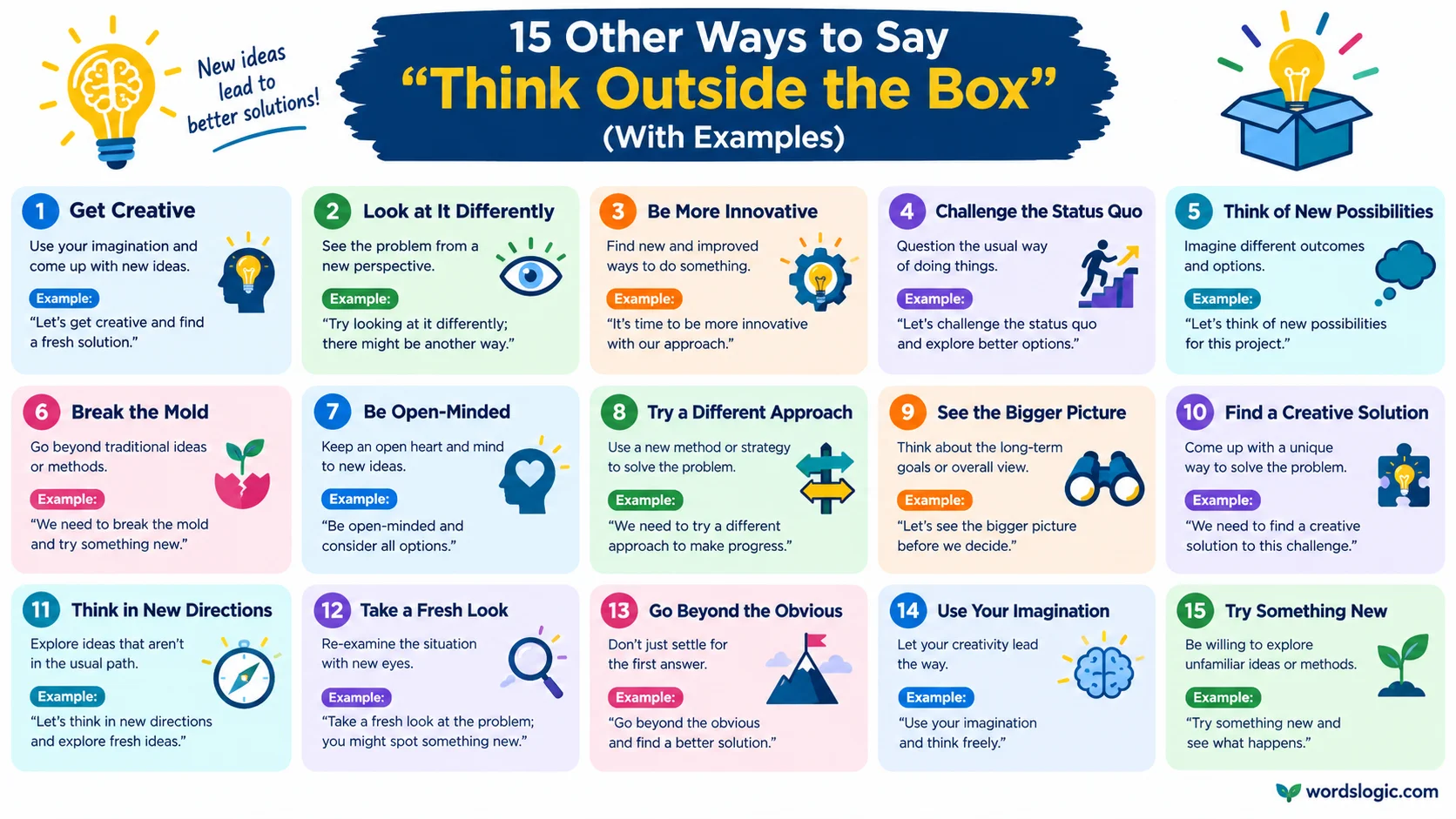
Other Ways to Say “Think Outside the Box” help you express creative thinking, share fresh ideas, and find better solutions in professional and everyday situations.
Creative thinking helps you challenge assumptions, explore alternatives, and discover practical solutions instead of repeating familiar patterns. Whether you work in an office, study in a classroom, or handle everyday challenges, using a flexible mindset helps you see problems from different perspectives. Learning alternative expressions also makes your communication clearer and more engaging.
In professional settings, choosing the right words can strengthen credibility, encourage collaboration, and make your message more effective. During a brainstorming session, business meeting, or casual conversation, expressions such as “explore new possibilities” and “find creative solutions” communicate your ideas with confidence. These alternatives support innovation, inspire others, and help turn challenges into opportunities for growth.
What Does “Think Outside the Box” Mean?
“Think outside the box” means to approach a problem creatively rather than relying on traditional ideas, familiar routines, or established solutions. It encourages people to question assumptions, consider unusual possibilities, and explore approaches they might not normally consider. For example, a business team might use this expression when searching for a new way to attract customers without increasing its advertising budget. The phrase communicates creativity, open-mindedness, and innovation. Although it is common in workplaces, it also fits classrooms, personal projects, brainstorming sessions, and everyday conversations. Depending on the situation, it can be an encouraging invitation to experiment or a direct request to find a more original solution.
Common Situations Where “Think Outside the Box” Is Used
People commonly use this phrase when they want others to consider fresh ideas or challenge familiar ways of doing things. In the workplace, managers might encourage employees to improve a process, develop a product, or solve a difficult problem. Teachers may use it to inspire students to approach assignments creatively, while friends might say it when planning an unusual activity or finding a solution to an everyday challenge.
The expression also appears in presentations, team meetings, text messages, and social media discussions about creativity. However, someone may prefer a more specific alternative when asking for practical innovation, unconventional thinking, or a completely new approach. Choosing the right wording helps explain whether you want more imaginative ideas, a different strategy, or a solution that challenges conventional thinking.
Is It Professional or Polite to Say “Think Outside the Box”?
Yes, “think outside the box” is generally professional, polite, and encouraging. It works well in brainstorming meetings, presentations, emails, and conversations about innovation. A manager might say, “Let’s think outside the box and find a better way to serve our customers.” The phrase sounds collaborative because it invites people to consider possibilities instead of demanding a particular answer.
However, it is also a familiar expression that can feel vague when used without further explanation. In formal business communication, phrases such as “explore alternative approaches” or “challenge conventional assumptions” may sound more precise. If you want to encourage experimentation, “try a different approach” can feel practical and approachable. The best choice depends on your audience, the problem, and whether you want to emphasize creativity, strategy, or innovation.
Advantages and Disadvantages of Saying “Think Outside the Box”
Advantages
- Encourages creativity: It invites people to move beyond familiar solutions.
- Promotes open-mindedness: The phrase suggests that different perspectives are welcome.
- Works in many settings: You can use it in workplaces, schools, brainstorming sessions, and casual conversations.
- Creates an encouraging atmosphere: It can help people feel comfortable sharing unconventional ideas.
Disadvantages
- Can sound overused: Frequent repetition may make the phrase feel predictable.
- May be vague: It does not explain what kind of creative thinking or result is needed.
- Can overlook practical limits: A request for unusual ideas may not address budgets, deadlines, or available resources.
- May need a more precise alternative: Professional discussions sometimes benefit from language that identifies the specific action required.
The phrase remains useful, but choosing a more targeted expression can make your message clearer and more effective.
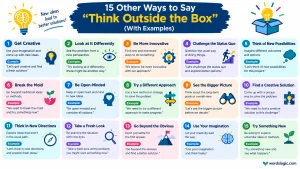
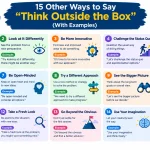
15 Alternatives to “Think Outside the Box”
- Think creatively
- Take a fresh approach
- Challenge conventional thinking
- Explore new possibilities
- Break the mold
- Push the boundaries
- Think beyond the obvious
- Come up with innovative ideas
- Look at it from a different perspective
- Rethink the problem
- Be imaginative
- Question the status quo
- Try a different approach
- Embrace unconventional ideas
- Find a new angle
1. Think Creatively
Meaning
“Think creatively” means using imagination and original ideas to solve problems or develop something new. It closely matches “think outside the box” while placing greater emphasis on the creative process itself.
Definition
To think creatively is to generate original ideas or find imaginative ways to approach a task.
Detailed Explanation
This expression works when you want someone to use imagination instead of following familiar patterns. It is straightforward, positive, and easy to understand. Unlike the original phrase, it directly names the desired skill rather than using a figurative expression. It is especially useful when discussing assignments, product development, design, or problem-solving activities.
Scenario Examples
- Scenario: A teacher encourages students to develop original project ideas.
Example: “Think creatively when designing your science project; your solution doesn’t have to look like everyone else’s.” - Scenario: A small business needs to promote a new product with limited resources.
Example: “We’ll need to think creatively to reach more customers without increasing our budget.”
Best Use
Use this expression in education, professional communication, brainstorming, and everyday problem-solving. It is particularly helpful when you want to emphasize imagination as a skill.
Tone
Tone: Encouraging, clear, and positive.
The wording motivates people without sounding overly formal or demanding.
2. Take a Fresh Approach
Meaning
“Take a fresh approach” means trying a new way of handling a task, situation, or problem. It suggests moving away from an existing method that may no longer be effective.
Definition
To take a fresh approach is to use a different method or strategy instead of continuing with the usual one.
Detailed Explanation
This phrase focuses on changing the method rather than simply generating unusual ideas. It is useful when an existing strategy has stopped producing good results. Compared with “think outside the box,” it sounds more practical and action-oriented. It also works well in professional settings because it encourages improvement without criticizing previous efforts.
Scenario Examples
- Scenario: A project team has missed several deadlines using its current workflow.
Example: “Let’s take a fresh approach to scheduling so everyone has a clearer view of their responsibilities.” - Scenario: A friend is struggling to organize a busy week.
Example: “Maybe you should take a fresh approach and plan your most important tasks first.”
Best Use
Choose this phrase for workplace discussions, project planning, personal organization, and process improvement. It is especially effective when a different method is needed.
Tone
Tone: Professional, constructive, and practical.
It communicates change without suggesting that the previous approach was entirely wrong.
3. Challenge Conventional Thinking
Meaning
“Challenge conventional thinking” means questioning widely accepted ideas, assumptions, or established practices. It encourages people to examine whether the usual way of thinking is still appropriate.
Definition
To challenge conventional thinking is to question traditional beliefs or methods and consider whether better alternatives exist.
Detailed Explanation
This expression is more analytical than “think outside the box.” It encourages people to examine the reasons behind established practices rather than accepting them automatically. It is particularly useful when a team needs to reconsider an assumption that limits progress. However, challenging conventional thinking does not mean rejecting every traditional idea; it means evaluating familiar beliefs critically.
Scenario Examples
- Scenario: A company assumes that customers prefer long product demonstrations.
Example: “We should challenge conventional thinking and test whether shorter demonstrations lead to better engagement.” - Scenario: Students are discussing how communities can reduce waste.
Example: “Our assignment asks us to challenge conventional thinking about packaging and consumption.”
Best Use
Use this expression in strategy meetings, academic discussions, research, policy debates, and innovation projects.
Tone
Tone: Analytical, confident, and thought-provoking.
It encourages critical examination rather than creativity alone.
4. Explore New Possibilities
Meaning
“Explore new possibilities” means considering options that have not yet been examined. It encourages people to remain open to different opportunities, solutions, or directions.
Definition
To explore new possibilities is to investigate potential choices or opportunities beyond those already considered.
Detailed Explanation
This expression emphasizes discovery rather than immediately producing a final solution. It is helpful when a problem has several possible answers and the best one is not yet clear. Compared with the original phrase, it sounds more open-ended and collaborative. It also avoids suggesting that traditional approaches must be abandoned completely.
Scenario Examples
- Scenario: A startup is deciding how to expand its services.
Example: “Before choosing a direction, let’s explore new possibilities in the local market.” - Scenario: A student is unsure which subject to study at university.
Example: “Talk to people in different fields and explore new possibilities before making your decision.”
Best Use
This phrase fits planning sessions, career conversations, business development, education, and personal decision-making.
Tone
Tone: Open-minded, curious, and encouraging.
It creates room for discussion without pressuring people to reach an immediate conclusion.
5. Break the Mold
Meaning
“Break the mold” means doing something differently from the established pattern or expectations. It often suggests originality that stands apart from what people normally see.
Definition
To break the mold is to reject a familiar pattern and create something noticeably different.
Detailed Explanation
This expression is more expressive than “think outside the box.” It often describes a bold idea, distinctive design, unusual strategy, or person who does not follow conventional expectations. Rather than focusing only on solving a problem, it can suggest creating something that stands out. Use it when the goal involves originality or a departure from established norms, not merely a small improvement.
Scenario Examples
- Scenario: A clothing designer wants to create a distinctive collection.
Example: “We want to break the mold with designs that combine traditional materials and modern shapes.” - Scenario: A company is introducing a different kind of employee development program.
Example: “Instead of another standard training course, let’s break the mold and make learning more interactive.”
Best Use
Choose this expression for creative projects, branding, product design, leadership, and discussions about originality.
Tone
Tone: Bold, expressive, and confident.
It suggests a meaningful departure from familiar patterns.
6. Push the Boundaries
Meaning
“Push the boundaries” means exploring the limits of what is currently possible, accepted, or expected. It often involves experimentation and ambitious thinking.
Definition
To push the boundaries is to extend existing limits or test how far an idea, method, or ability can go.
Detailed Explanation
This phrase is stronger than “think outside the box” because it suggests going beyond current limits, not simply considering a different idea. It works well when a project requires experimentation, technical progress, or ambitious creative work. However, pushing boundaries should still involve sound judgment and appropriate safeguards. It is not always suitable when the situation calls for a small, low-risk improvement.
Scenario Examples
- Scenario: A design team is developing a more accessible digital product.
Example: “Let’s push the boundaries of accessible design while keeping the experience simple for every user.” - Scenario: A musician wants to experiment with an unfamiliar sound.
Example: “Her latest album pushes the boundaries by blending styles that are rarely combined.”
Best Use
Use this phrase in design, technology, the arts, product development, and ambitious projects where experimentation matters.
Tone
Tone: Ambitious, energetic, and adventurous.
It communicates a willingness to explore limits rather than stay within established expectations.
7. Think Beyond the Obvious
Meaning
“Think beyond the obvious” means looking past the easiest or most noticeable answer to consider less apparent options. It encourages deeper thought before making a decision.
Definition
To think beyond the obvious is to consider possibilities that may not be immediately apparent.
Detailed Explanation
This expression is useful when the first answer seems too simple or fails to address the whole problem. It encourages people to look for hidden factors, alternative explanations, or overlooked opportunities. Compared with “think outside the box,” it is more specific about moving beyond the most apparent answer. It can also suggest careful analysis rather than pure imagination.
Scenario Examples
- Scenario: A marketing team wants to understand why customers are leaving.
Example: “Let’s think beyond the obvious and examine whether the checkout process is causing frustration.” - Scenario: A student is solving a challenging puzzle.
Example: “If the answer seems too simple, think beyond the obvious and check the other clues.”
Best Use
This phrase works well in troubleshooting, research, analytical discussions, puzzles, and strategic planning.
Tone
Tone: Thoughtful, analytical, and mildly challenging.
It encourages people to examine details they might otherwise overlook.
8. Come Up With Innovative Ideas
Meaning
“Come up with innovative ideas” means developing original ideas that offer a new or improved way to do something. It emphasizes producing suggestions that may lead to meaningful change.
Definition
To come up with innovative ideas is to generate new concepts or improvements that offer practical or creative value.
Detailed Explanation
This phrase is more outcome-focused than “think outside the box.” It asks people to produce ideas rather than simply adopt a creative mindset. In professional settings, innovation may involve improving an existing product, designing a service, or finding a more efficient process. The word innovative suggests novelty, but a useful innovation should also address a real need.
Scenario Examples
- Scenario: A company wants to improve its customer support service.
Example: “We need to come up with innovative ideas that make it easier for customers to find answers.” - Scenario: Students are preparing a project about reducing food waste.
Example: “Our group is trying to come up with innovative ideas for sharing surplus food in the community.”
Best Use
Choose this expression for business proposals, team brainstorming, product development, school projects, and innovation planning.
Tone
Tone: Professional, purposeful, and forward-looking.
It emphasizes generating useful ideas rather than creativity for its own sake.
9. Look at It From a Different Perspective
Meaning
“Look at it from a different perspective” means considering a situation from another person’s viewpoint or examining it through a different lens.
Definition
To look at something from a different perspective is to reconsider it using another point of view or set of assumptions.
Detailed Explanation
This expression emphasizes changing how you interpret a situation rather than necessarily inventing a new solution. It is especially valuable when people disagree or when a problem seems difficult to resolve. Unlike “think outside the box,” it can focus on empathy and understanding as much as creativity. Considering another perspective may reveal information that was missed or help people reach a fairer decision.
Scenario Examples
- Scenario: Two coworkers disagree about how to divide responsibilities.
Example: “Before we decide, let’s look at it from a different perspective and consider each person’s workload.” - Scenario: A friend is disappointed by a rejected application.
Example: “Try looking at it from a different perspective; the feedback might help you strengthen your next application.”
Best Use
Use this phrase in conflict resolution, teamwork, relationships, education, and personal reflection.
Tone
Tone: Empathetic, reflective, and collaborative.
It invites understanding instead of insisting that someone must immediately change their opinion.
10. Rethink the Problem
Meaning
“Rethink the problem” means reconsidering how an issue has been defined or understood before deciding what to do about it.
Definition
To rethink a problem is to examine it again, possibly changing the assumptions or questions used to approach it.
Detailed Explanation
This phrase is especially useful when repeated attempts have failed to produce a satisfactory result. Sometimes, the difficulty lies not in the available solutions but in how the problem was originally framed. Rethinking the problem encourages people to identify the real obstacle before choosing another strategy. It sounds more analytical and focused than “think outside the box,” making it suitable for complicated tasks.
Scenario Examples
- Scenario: A software team keeps fixing the same issue without lasting success.
Example: “We’re treating the symptoms rather than the cause, so let’s rethink the problem before writing more code.” - Scenario: A community group is struggling to increase event attendance.
Example: “Perhaps we should rethink the problem and ask whether the event timing works for local families.”
Best Use
This expression works best in troubleshooting, technical work, strategic planning, research, and complex decision-making.
Tone
Tone: Analytical, direct, and solution-oriented.
It signals that the current understanding may need revision.
11. Be Imaginative
Meaning
“Be imaginative” means using creativity and imagination to develop original thoughts, designs, or possibilities. It encourages people to go beyond familiar ideas.
Definition
To be imaginative is to use your imagination to create or consider ideas that are not limited to what already exists.
Detailed Explanation
This expression places the emphasis on imagination rather than a specific problem-solving technique. It works particularly well when the task allows room for artistic freedom, storytelling, or personal expression. Compared with “think outside the box,” it sounds softer and more personal. It may be less suitable when a task requires detailed strategic analysis or a clearly measurable solution.
Scenario Examples
- Scenario: A parent helps a child prepare a costume from household materials.
Example: “Be imaginative with the cardboard and fabric we already have.” - Scenario: A writer is developing a short story.
Example: “Be imaginative when creating the setting; it doesn’t have to resemble a real place.”
Best Use
Use this phrase in art, writing, design, children’s activities, creative assignments, and personal projects.
Tone
Tone: Warm, playful, and encouraging.
It gives people permission to explore ideas freely without demanding a specific outcome.
12. Question the Status Quo
Meaning
“Question the status quo” means examining whether current practices, rules, or accepted ways of doing things should remain unchanged.
Definition
To question the status quo is to challenge existing arrangements or assumptions and consider whether they need improvement.
Detailed Explanation
This expression focuses on established systems rather than individual ideas. It is useful when people want to examine workplace policies, traditional processes, social expectations, or long-standing business practices. It carries a stronger critical tone than “think outside the box” because it may imply that existing arrangements are inadequate. Questioning the status quo does not automatically mean rejecting it; the aim is to evaluate whether it still serves its purpose.
Scenario Examples
- Scenario: An employee notices that a reporting process creates unnecessary work.
Example: “We should question the status quo and find out whether every report is still necessary.” - Scenario: A student is preparing a discussion about school policies.
Example: “Our presentation will question the status quo by examining whether the current rules support different learning needs.”
Best Use
Choose this expression for organizational change, policy discussions, leadership, research, and critical debates.
Tone
Tone: Critical, assertive, and reform-minded.
It encourages people to examine established practices instead of accepting them automatically.
13. Try a Different Approach
Meaning
“Try a different approach” means using another method when the current one is ineffective or unsuitable. It encourages experimentation through practical action.
Definition
To try a different approach is to attempt another way of handling a task or solving a problem.
Detailed Explanation
This phrase is one of the most practical alternatives because it connects fresh thinking with a clear next step. It does not necessarily require a highly original idea; even a small adjustment can count as a different approach. Compared with “think outside the box,” it is more direct and less figurative. It is especially useful when a team needs to stop repeating an unsuccessful method and test a realistic alternative.
Scenario Examples
- Scenario: A student has studied for a test but struggles to remember key information.
Example: “If rereading your notes isn’t helping, try a different approach, such as using practice questions.” - Scenario: A customer service representative is having trouble resolving a complaint.
Example: “Let’s try a different approach and see whether a replacement would solve the issue.”
Best Use
Use this expression in everyday conversation, workplace problem-solving, customer support, learning, and practical decision-making.
Tone
Tone: Practical, friendly, and solution-focused.
It encourages action without implying that the person needs to produce a groundbreaking idea.
14. Embrace Unconventional Ideas
Meaning
“Embrace unconventional ideas” means being willing to consider and support ideas that differ from established expectations or common practices.
Definition
To embrace unconventional ideas is to welcome approaches that are unusual or outside traditional patterns.
Detailed Explanation
This phrase emphasizes openness and acceptance rather than the act of generating ideas. It is useful when people already have unusual suggestions but hesitate to share or develop them. Compared with “think outside the box,” it places greater emphasis on creating an environment where different ideas can be considered seriously. However, embracing an idea does not mean accepting it without evaluating its risks, evidence, or practical value.
Scenario Examples
- Scenario: A creative team is reviewing proposals for a new campaign.
Example: “Let’s embrace unconventional ideas during brainstorming and evaluate their feasibility afterward.” - Scenario: A school is encouraging students to develop original solutions to a local issue.
Example: “The project gives students room to embrace unconventional ideas about improving their neighborhood.”
Best Use
This expression fits creative teams, leadership discussions, innovation programs, education, and brainstorming sessions where openness matters.
Tone
Tone: Open-minded, supportive, and progressive.
It communicates a willingness to give unfamiliar ideas a fair hearing.
15. Find a New Angle
Meaning
“Find a new angle” means discovering a different way to examine, present, or approach a subject. It often involves identifying an overlooked aspect of a familiar issue.
Definition
To find a new angle is to approach a topic or problem from a fresh viewpoint that may reveal an opportunity or insight.
Detailed Explanation
This expression is particularly useful when an idea feels familiar or a project lacks originality. It encourages people to identify a perspective that has not yet received attention. Unlike “think outside the box,” it often applies to presentation, storytelling, marketing, and communication rather than broad problem-solving alone. A new angle does not need to change the entire strategy; it may simply highlight a more relevant feature or audience need.
Scenario Examples
- Scenario: A journalist is preparing an article about a familiar local event.
Example: “We’ve covered the event before, so let’s find a new angle by speaking with the volunteers behind it.” - Scenario: A business wants to promote a product that has several similar competitors.
Example: “Instead of repeating the usual product claims, let’s find a new angle that explains how customers actually use it.”
Best Use
Choose this phrase for writing, journalism, advertising, presentations, content planning, and creative problem-solving.
Tone
Tone: Curious, creative, and strategic.
It encourages people to uncover a distinctive viewpoint without requiring a completely new idea.
FAQs
What does “think outside the box” mean?
“Think outside the box” means using creative thinking to find new ideas and solutions instead of following familiar methods. It encourages you to challenge assumptions, explore different perspectives, and discover better ways to solve problems.
What are some professional alternatives to “think outside the box”?
Some professional alternatives include explore new possibilities, approach the problem creatively, consider alternative solutions, challenge conventional thinking, and look at it from a different perspective. These expressions work well in emails, meetings, presentations, and workplace discussions.
Why is thinking outside the box important in the workplace?
Thinking outside the box encourages innovation, collaboration, and effective problem-solving. It helps teams discover overlooked opportunities, improve existing processes, and develop practical solutions to difficult challenges.
How can I encourage creative thinking in a team?
You can encourage creative thinking by welcoming different viewpoints, asking open-ended questions, and creating a supportive environment where people feel comfortable sharing ideas. Brainstorming sessions, constructive feedback, and open discussions can also help teams explore new possibilities.
Is “think outside the box” suitable for formal writing?
Yes, “think outside the box” is widely understood and can work in professional writing. However, for a more polished professional tone, consider alternatives such as develop innovative solutions, explore alternative approaches, or consider fresh perspectives, depending on your audience and purpose.
Conclusion
Learning other ways to say “think outside the box” helps you communicate ideas more clearly and adapt your language to different situations. Expressions such as explore new possibilities, challenge conventional thinking, and find creative solutions can make your communication more engaging in professional environments, classrooms, and everyday conversations. Choosing the right phrase also strengthens your vocabulary, improves your communication skills, and helps you express your ideas with greater confidence.
The real value of creative thinking comes from being willing to question familiar methods and consider different approaches. Whether you are participating in a meeting, writing an email, or solving a complex problem, a flexible mindset can help you discover practical opportunities for improvement. By encouraging collaboration, respecting diverse perspectives, and welcoming innovative ideas, you can build stronger relationships and contribute to a culture of continuous growth and meaningful progress.