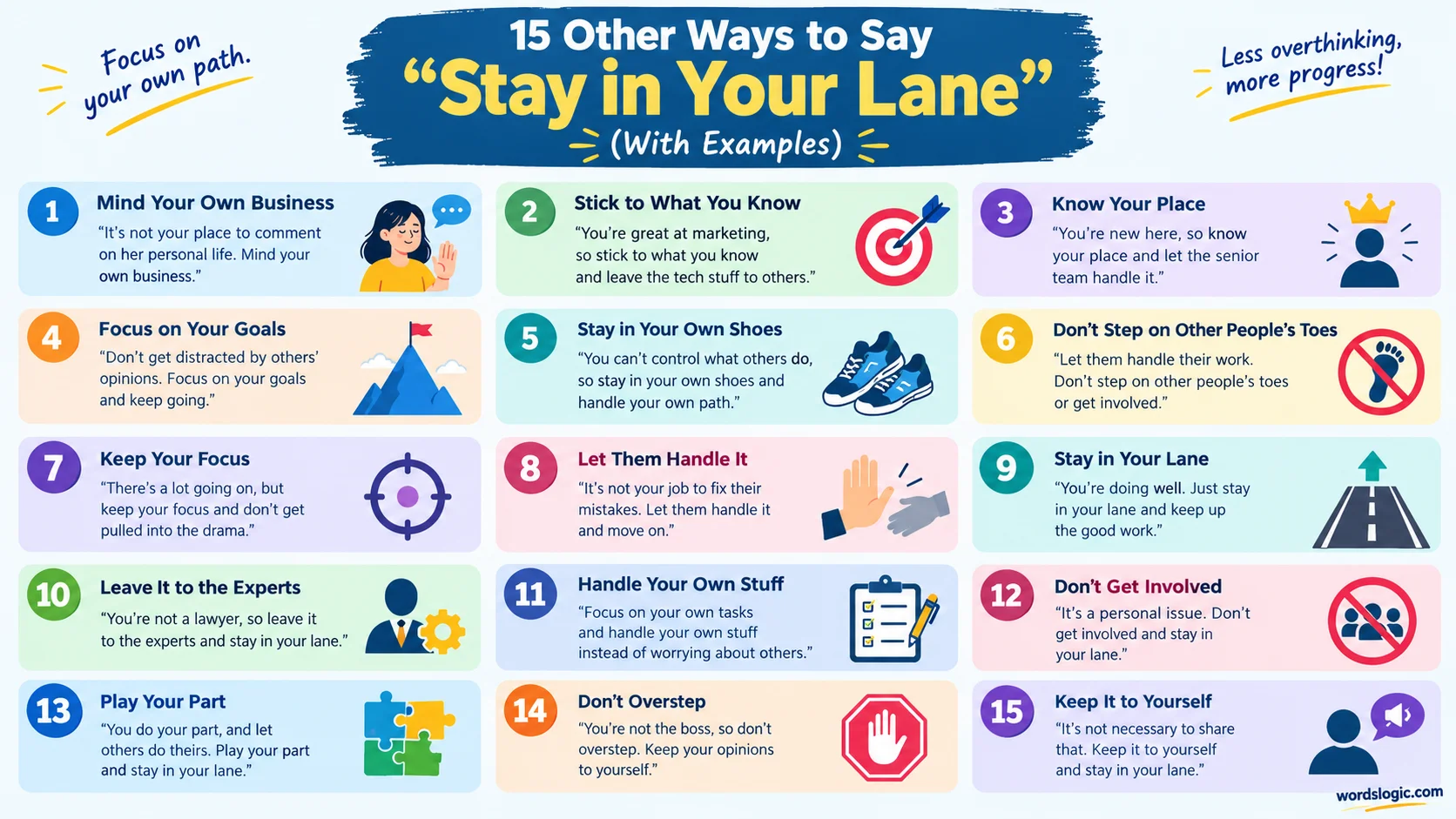
Other Ways to Say “Stay in Your Lane” can help you set boundaries, communicate clearly, and maintain a respectful tone at work.
The phrase “Stay in your lane” tells someone to focus on their responsibilities, opinions, or area of expertise. However, in a work setting, it can sound blunt, territorial, or rude. Choosing better wording helps you make your point without adding unnecessary tension. For example, you might type a sentence in an email and delete it before hitting send because the tone feels too harsh. Careful email writing, word choice, and sentence structure can help you communicate the same message more professionally.
When exploring other ways to say “Stay in Your Lane,” consider your audience, the situation, and your intended meaning. Formal alternatives, direct alternatives, and softer expressions each serve a different purpose. Phrases such as “Please focus on your responsibilities,” “Let’s stick to our respective roles,” and “I’ll handle this within my area” help you express boundaries without sounding unnecessarily dismissive. The right expression supports professional communication, respectful communication, and healthier workplace relationships while allowing you to remain clear, confident, and respectful.
What Does “Stay in Your Lane” Mean?
“Stay in your lane” means to focus on your own responsibilities, respect other people’s boundaries, and avoid interfering in matters outside your role or area of knowledge. The expression comes from the idea of staying within a designated lane rather than moving into someone else’s space. In everyday English, it can be used when someone gives unwanted advice, interferes in a personal matter, or tries to control a decision that does not belong to them. Depending on the speaker’s tone, it may sound like practical advice, a firm boundary, or an insult. In professional settings, it can also refer to respecting job responsibilities and allowing others to manage their own work.
Common Situations Where “Stay in Your Lane” Is Used
People commonly use “stay in your lane” during disagreements, casual conversations, online discussions, and situations where someone crosses a personal boundary. For example, a person might use it when a friend comments on a private relationship or when someone online criticizes a decision that does not affect them. At work, the phrase may describe a need to respect responsibilities, although more diplomatic wording is usually better. Students may use it when classmates interfere with group assignments or offer unwanted opinions. In each situation, an alternative can help communicate the same boundary without creating unnecessary tension.
Is It Professional or Polite to Say “Stay in Your Lane”?
The phrase is informal, direct, and potentially confrontational. Among close friends, it may sound playful or humorous when both people understand the intention. During an argument, however, it can feel dismissive and suggest that the other person has no right to speak. In professional communication, phrases such as “Please respect my responsibilities” or “Let’s focus on our respective roles” are usually more constructive. The original expression may be appropriate when a strong boundary needs to be established, but the best wording depends on the relationship, the seriousness of the situation, and the tone you want to convey.
Advantages and Disadvantages of Saying “Stay in Your Lane”
Advantages
The phrase communicates a boundary quickly and clearly. It can discourage unwanted interference, remind someone to respect their responsibilities, and express frustration without requiring a long explanation. In casual conversations, its familiar wording can also make a message sound confident and decisive. When used among people who understand each other’s humor, it may even be playful.
Disadvantages
The expression can sound rude, dismissive, or aggressive, particularly when someone is genuinely trying to help. It may discourage useful feedback or turn a minor disagreement into a larger conflict. The phrase also lacks the diplomatic tone often needed in professional emails, customer communication, or sensitive personal discussions. A more specific alternative can explain the boundary clearly while preserving mutual respect.
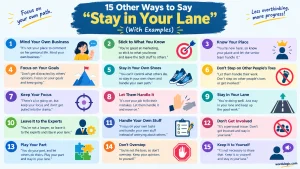
15 Alternatives to “Stay in Your Lane”
- Mind your own business.
- Focus on your own responsibilities.
- Respect my boundaries.
- Stick to what you know.
- Let me handle this.
- Please don’t interfere.
- Keep to your area of expertise.
- Let’s stay in our respective roles.
- Worry about your own affairs.
- Give me some space.
- Leave this to me.
- Please respect my decisions.
- Don’t overstep your boundaries.
- Concentrate on what concerns you.
- Let’s focus on our own paths.
1. Mind Your Own Business
Meaning
“Mind your own business” tells someone to stop involving themselves in a matter that does not concern them. It shares the boundary-setting meaning of “stay in your lane,” but it often sounds sharper and more personal.
Definition
A direct expression asking someone to avoid interfering in another person’s private affairs.
Detailed Explanation
This phrase is useful when someone asks intrusive questions or comments on a private matter without being invited. Compared with “stay in your lane,” it places more emphasis on privacy than on responsibilities or roles. It can sound defensive or irritated, so it may not be the best choice when preserving a relationship is important. A softer delivery can reduce its harshness, but the wording remains quite direct.
Scenario Examples
- Scenario: A friend keeps asking about your private relationship.
Example: “I appreciate your concern, but please mind your own business when it comes to my relationship.” - Scenario: Someone questions how you spend your personal money.
Example: “I’ve got my finances under control. You should mind your own business.”
Best Use
Use this expression in casual conversations when someone repeatedly crosses a personal boundary. Choose a gentler alternative for workplace discussions or sensitive relationships.
Tone
Tone: Direct, defensive, sometimes confrontational.
Its strength makes the boundary clear, but it can also make the other person feel rejected.
2. Focus on Your Own Responsibilities
Meaning
This expression encourages someone to concentrate on their duties instead of interfering with someone else’s work. It is particularly useful when “stay in your lane” refers to professional roles.
Definition
A request for someone to prioritize their own tasks and obligations.
Detailed Explanation
Unlike the original phrase, this alternative emphasizes productivity and accountability rather than personal boundaries. It works well when coworkers become distracted by other people’s assignments or try to manage tasks outside their role. The wording sounds more constructive because it identifies what the person should do instead. However, it can still seem critical if delivered without explanation.
Scenario Examples
- Scenario: A colleague keeps commenting on your workload instead of completing their own tasks.
Example: “Let’s both focus on our own responsibilities so we can meet the deadline.” - Scenario: A team member tries to take control of a project assigned to someone else.
Example: “Please focus on your own responsibilities while I manage this part of the project.”
Best Use
This phrase fits workplace conversations, team projects, academic assignments, and situations involving assigned duties.
Tone
Tone: Professional, firm, task-focused.
It redirects attention toward responsibilities rather than attacking someone’s personality.
3. Respect My Boundaries
Meaning
“Respect my boundaries” asks someone to recognize and honor the limits you have established. It focuses on personal space, privacy, choices, and emotional comfort.
Definition
A clear request for another person to acknowledge and follow your personal limits.
Detailed Explanation
This expression is more emotionally aware than “stay in your lane” because it explains the underlying issue: a boundary has been crossed. It is especially useful when someone repeatedly gives unwanted advice, asks personal questions, or tries to influence your decisions. The wording is direct without automatically insulting the other person. It is important to communicate the specific boundary when possible, since people may not always understand which behavior needs to change.
Scenario Examples
- Scenario: A relative keeps questioning a personal decision.
Example: “I’ve made my decision, and I need you to respect my boundaries.” - Scenario: A friend continues calling after you have asked for time alone.
Example: “I care about our friendship, but please respect my boundaries and give me some time.”
Best Use
Use it in personal relationships, family discussions, friendships, and conversations about privacy or emotional space.
Tone
Tone: Assertive, personal, respectful.
It communicates that your limits matter without requiring you to insult the other person.
4. Stick to What You Know
Meaning
This phrase tells someone to focus on subjects they understand rather than making claims about unfamiliar topics. It overlaps with “stay in your lane” when the issue involves knowledge or expertise.
Definition
A suggestion to speak about subjects within one’s knowledge or experience.
Detailed Explanation
“Stick to what you know” is more specific than the original phrase because it challenges someone’s knowledge or expertise, not necessarily their right to participate. It may be appropriate when someone makes confident but poorly informed claims. However, it can sound condescending if used to dismiss a reasonable question or a different opinion. In collaborative environments, a more constructive approach is to explain which information is missing and invite evidence-based discussion.
Scenario Examples
- Scenario: Someone gives technical advice without understanding the subject.
Example: “Before recommending a solution, it might help to stick to what you know and check the technical details.” - Scenario: A friend makes confident claims about a topic they have not researched.
Example: “I think you should stick to what you know before making assumptions about the situation.”
Best Use
Use this phrase in debates, technical discussions, and situations involving inaccurate claims. Avoid it when encouraging someone to learn or participate.
Tone
Tone: Blunt, corrective, potentially critical.
It can challenge credibility, so use it carefully when maintaining trust matters.
5. Let Me Handle This
Meaning
“Let me handle this” tells someone that you are taking responsibility for a situation and would prefer to manage it yourself.
Definition
A statement indicating that you will take charge of a task or problem.
Detailed Explanation
This alternative is less confrontational than “stay in your lane” because it focuses on what you intend to do rather than criticizing someone else’s behavior. It can reassure a colleague, prevent duplicated work, or establish responsibility during a difficult situation. Depending on your delivery, it may sound confident and reassuring or somewhat dismissive. If the other person is helping in good faith, adding a brief thank-you can make the request warmer.
Scenario Examples
- Scenario: A coworker begins answering a question assigned to you.
Example: “Thanks for offering to help. Let me handle this part of the presentation.” - Scenario: A friend tries to resolve a disagreement on your behalf.
Example: “I appreciate you looking out for me, but let me handle this conversation.”
Best Use
This expression works well in workplace discussions, personal disagreements, group projects, and situations where you want to retain responsibility.
Tone
Tone: Confident, calm, reassuring.
It sets a limit without directly accusing the other person of interfering.
6. Please Don’t Interfere
Meaning
This expression asks someone to stop getting involved in a situation where their involvement is unwanted or inappropriate.
Definition
A direct request for someone to avoid interrupting or influencing a matter unnecessarily.
Detailed Explanation
“Please don’t interfere” is a strong boundary-setting expression that closely matches one meaning of “stay in your lane.” Adding “please” introduces some politeness, but the message remains firm. It works when someone is actively disrupting a decision, conversation, or task. Because the word interfere can imply inappropriate involvement, it is worth making sure the person’s actions genuinely need to stop before using it.
Scenario Examples
- Scenario: Someone keeps interrupting a private discussion.
Example: “Please don’t interfere while we work through this issue together.” - Scenario: A person tries to change a decision that belongs to you.
Example: “I’ve considered the options, so please don’t interfere with my final decision.”
Best Use
Use it when you need a clear, firm boundary in personal or professional situations. For a more diplomatic workplace message, explain the roles or responsibilities involved.
Tone
Tone: Firm, serious, direct.
The phrase leaves little doubt that the behavior is unwelcome.
7. Keep to Your Area of Expertise
Meaning
This expression encourages someone to contribute within the subjects or responsibilities they understand best.
Definition
A request to focus on matters that fall within one’s professional knowledge or specialized skills.
Detailed Explanation
This phrase is especially relevant when a person comments on technical or professional matters outside their expertise. It sounds more formal than “stay in your lane” and can fit discussions about project responsibilities or specialized advice. However, it should not be used to silence someone simply because they have a different viewpoint. People can offer valuable questions and fresh perspectives without being experts in every subject.
Scenario Examples
- Scenario: A team member makes unsupported recommendations about a specialized technical process.
Example: “Let’s keep to our areas of expertise and consult the specialist before changing the process.” - Scenario: A project discussion becomes confused because participants are making assumptions about unfamiliar tasks.
Example: “It may be best for each of us to keep to our area of expertise while we review the proposal.”
Best Use
Use it in professional meetings, technical projects, consulting, and specialist discussions where accurate knowledge matters.
Tone
Tone: Professional, measured, corrective.
The wording is more formal, although it can sound exclusionary if used to dismiss legitimate input.
8. Let’s Stay in Our Respective Roles
Meaning
This expression suggests that everyone should respect their assigned responsibilities and avoid taking over someone else’s role.
Definition
A collaborative reminder that each person should work within their agreed duties.
Detailed Explanation
This is a diplomatic alternative to “stay in your lane” because it presents the issue as a shared responsibility. The word “our” makes the statement less accusatory and encourages cooperation. It is particularly useful when multiple people are working together and unclear responsibilities are causing tension. If no roles have been agreed upon, the team should clarify expectations rather than assume everyone already understands them.
Scenario Examples
- Scenario: Two coworkers keep making changes to each other’s work.
Example: “Let’s stay in our respective roles and coordinate before making changes to each other’s sections.” - Scenario: A group project has become disorganized because nobody knows who is responsible for each task.
Example: “We can work more smoothly if we stay in our respective roles and communicate when we need help.”
Best Use
This phrase suits team meetings, project planning, management discussions, and collaborative environments.
Tone
Tone: Diplomatic, cooperative, professional.
It emphasizes teamwork and role clarity rather than blaming one person.
9. Worry About Your Own Affairs
Meaning
This expression tells someone to concentrate on their own personal matters rather than becoming involved in yours.
Definition
A direct instruction to pay attention to one’s own concerns instead of another person’s private business.
Detailed Explanation
“Worry about your own affairs” is similar to “mind your own business,” although it can sound more old-fashioned or stern. It is most useful when someone repeatedly comments on personal decisions that do not affect them. The expression places the emphasis on the other person’s concerns rather than on a specific responsibility. Because it may sound dismissive, it is generally less suitable for professional or sensitive conversations.
Scenario Examples
- Scenario: An acquaintance repeatedly criticizes how you organize your personal life.
Example: “I know you have an opinion, but please worry about your own affairs and let me make this choice.” - Scenario: Someone keeps asking intrusive questions about a family disagreement.
Example: “We are dealing with it privately, so I’d appreciate it if you worried about your own affairs.”
Best Use
Use it in informal situations involving unwanted personal interference, particularly when a gentler request has not worked.
Tone
Tone: Blunt, defensive, slightly old-fashioned.
It is clear but can create distance between the people involved.
10. Give Me Some Space
Meaning
“Give me some space” asks another person to step back, either physically or emotionally, and allow you some room to think or act independently.
Definition
A request for distance, privacy, or time without pressure from another person.
Detailed Explanation
This expression differs from “stay in your lane” because it emphasizes the need for space and independence, rather than telling someone to focus on their own responsibilities. It can be helpful during emotional conversations, stressful moments, or periods when you need time alone. It is softer than an outright accusation of interference, although the other person may still feel rejected. If you want to preserve the relationship, explaining when you will be ready to talk can help.
Scenario Examples
- Scenario: A friend keeps asking you to discuss a problem before you are ready.
Example: “I need a little time to process everything. Please give me some space, and we can talk later.” - Scenario: Someone repeatedly interrupts you while you are trying to concentrate.
Example: “I’m trying to finish this assignment, so could you give me some space for a while?”
Best Use
Use it in personal relationships, emotional discussions, study sessions, and situations requiring privacy or concentration.
Tone
Tone: Personal, calm, sometimes emotional.
It expresses a need for distance without necessarily criticizing the other person’s intentions.
11. Leave This to Me
Meaning
This expression tells someone that you are willing and able to take care of a particular task or situation yourself.
Definition
A statement asking another person to let you manage something independently.
Detailed Explanation
“Leave this to me” is a confident alternative when someone is trying to take control of a task that you are already managing. It focuses on the specific matter at hand, making it more practical than the broader phrase “stay in your lane.” In a friendly conversation, it can reassure someone that you have things under control. In a tense situation, however, it may sound dismissive unless you acknowledge the person’s intention to help.
Scenario Examples
- Scenario: A colleague starts completing a task that you have already accepted.
Example: “Thanks for checking in. Leave this section to me, and I’ll send it over before the meeting.” - Scenario: A family member wants to arrange an appointment on your behalf.
Example: “I’ve already made a plan, so leave this to me and I’ll let you know if I need help.”
Best Use
Use it in work assignments, shared responsibilities, personal errands, and situations where you want to take ownership.
Tone
Tone: Confident, decisive, reassuring.
It can establish independence while leaving room for a friendly exchange.
12. Please Respect My Decisions
Meaning
This expression asks someone to accept that you have the right to make your own choices, even when they disagree with them.
Definition
A polite but firm request for another person to acknowledge your decision-making independence.
Detailed Explanation
This alternative focuses on personal autonomy rather than someone’s role or expertise. It is particularly useful when a person keeps challenging a decision after you have considered their advice. The phrase is more respectful than “stay in your lane,” yet it still communicates a clear expectation. It does not mean that others cannot express concerns; rather, it asks them to recognize that the final choice belongs to you when the matter is yours to decide.
Scenario Examples
- Scenario: A friend continues questioning your choice of career.
Example: “I understand why you’re concerned, but please respect my decisions about my future.” - Scenario: A relative keeps pressuring you to change a personal plan.
Example: “I’ve listened to your advice, and now I need you to respect my decision.”
Best Use
This phrase fits family conversations, friendships, relationships, and discussions about major personal choices.
Tone
Tone: Respectful, assertive, sincere.
It makes your expectations clear without suggesting that disagreement itself is unacceptable.
13. Don’t Overstep Your Boundaries
Meaning
This expression warns someone that their behavior has gone beyond what is appropriate or acceptable.
Definition
A direct instruction to stop crossing established personal, professional, or social limits.
Detailed Explanation
“Don’t overstep your boundaries” is one of the stronger alternatives because it directly identifies the behavior as inappropriate. It works when someone takes on authority they do not have, shares private information, or continues interfering after being asked to stop. Compared with “stay in your lane,” it emphasizes a specific limit that has been crossed. It can be useful when a gentle reminder has failed, but explaining the boundary can make the message clearer and fairer.
Scenario Examples
- Scenario: A coworker tries to approve decisions that belong to your manager.
Example: “Please don’t overstep your boundaries by approving changes outside your assigned authority.” - Scenario: A friend shares private details about you without permission.
Example: “I trusted you with that information. Please don’t overstep your boundaries by sharing it with others.”
Best Use
Use it when addressing repeated interference, inappropriate behavior, privacy violations, or unclear authority.
Tone
Tone: Firm, serious, assertive.
It communicates that a limit has been crossed and that the behavior needs to change.
14. Concentrate on What Concerns You
Meaning
This expression encourages someone to pay attention to matters that directly involve them rather than focusing on unrelated issues.
Definition
A request to direct one’s attention toward relevant responsibilities or personal concerns.
Detailed Explanation
This phrase is more measured than “mind your own business,” although it can still sound dismissive. It works when someone is becoming involved in an issue that does not require their input. The wording emphasizes relevance and attention rather than directly accusing the person of interfering. In a workplace setting, a collaborative version such as “Let’s focus on the issues relevant to our roles” is usually more natural and constructive.
Scenario Examples
- Scenario: A group discussion keeps drifting into unrelated personal matters.
Example: “Let’s concentrate on what concerns us and finish reviewing the project requirements.” - Scenario: Someone keeps commenting on a disagreement between two other people.
Example: “I think it would be better to concentrate on what concerns you rather than speculate about their situation.”
Best Use
Use it in group discussions, everyday conversations, and situations where people are getting distracted by unrelated matters.
Tone
Tone: Controlled, direct, somewhat formal.
It redirects attention, but the wording should be softened when the other person has a legitimate reason to participate.
15. Let’s Focus on Our Own Paths
Meaning
This expression encourages people to concentrate on their individual goals and choices rather than interfering in or comparing their lives with each other.
Definition
A gentle reminder to pursue one’s own direction while allowing others to follow theirs.
Detailed Explanation
Unlike “stay in your lane,” this alternative emphasizes independence, personal growth, and mutual respect rather than confrontation. It is especially useful when people compare achievements, criticize different life choices, or become overly involved in one another’s plans. The inclusive word “let’s” makes it sound less like an order and more like a shared principle. It is not an exact substitute for situations involving formal job responsibilities, but it works well for personal boundaries and encouraging healthier relationships.
Scenario Examples
- Scenario: Friends keep comparing their careers and criticizing each other’s progress.
Example: “We’re all moving at different speeds, so let’s focus on our own paths instead of comparing ourselves.” - Scenario: Someone pressures you to follow the same life choices they have made.
Example: “I respect your plans, and I hope you can respect mine. Let’s focus on our own paths.”
Best Use
Use it in personal conversations, motivational messages, social media posts, and discussions about independence or self-development.
Tone
Tone: Warm, reflective, encouraging.
It communicates independence without sounding hostile or shutting down a conversation.
FAQs
What does “stay in your lane” mean?
“Stay in your lane” means focusing on your own responsibilities, opinions, or area of expertise instead of interfering in someone else’s work or personal matters. The phrase can sound blunt or rude, depending on the situation and tone.
What are some polite alternatives to “stay in your lane”?
Polite alternatives include “Please focus on your responsibilities,” “Let’s stick to our respective roles,” “I’ll handle this within my area,” and “Please allow me to manage this.” These expressions help you set professional boundaries while maintaining respectful communication.
How can I say “stay in your lane” professionally?
In a professional setting, use clear and respectful language. You could say, “I appreciate your input, but I’ll take responsibility for this task,” or “Let’s focus on our respective areas of responsibility.” These phrases communicate your intended meaning without creating unnecessary tension.
Is “stay in your lane” rude?
It can be. The phrase may sound territorial, dismissive, or confrontational, especially in workplace emails or formal conversations. Your tone of voice, word choice, and relationship with the other person influence how the message is received.
When should I use alternatives to “stay in your lane”?
Use alternatives when you need to set boundaries, redirect someone, clarify responsibilities, or prevent workplace conflict. Choose polite expressions for sensitive situations, direct language for clear instructions, and casual expressions for friendly conversations where the meaning is already understood.
Conclusion
Learning other ways to say “stay in your lane” helps you communicate with greater clarity, confidence, and respect. Instead of using words that may sound harsh or territorial, choose expressions that match your audience and situation. Phrases such as “Please focus on your responsibilities,” “Let’s stick to our respective roles,” and “I’ll handle this within my area” help you maintain professional boundaries without damaging workplace relationships. The best alternative depends on your intent, the level of firmness you need, and the tone you want to convey.
Whether you are writing professional emails, participating in workplace conversations, or handling personal disagreements, thoughtful word choice can make a meaningful difference. Use polite language when empathy matters, direct communication when clarity is essential, and firm but respectful wording when someone crosses a boundary. With practice, you can improve your communication skills, prevent misunderstandings, and express your point without sounding unnecessarily rude. Ultimately, effective communication means protecting your boundaries while treating others with professionalism and respect.