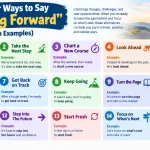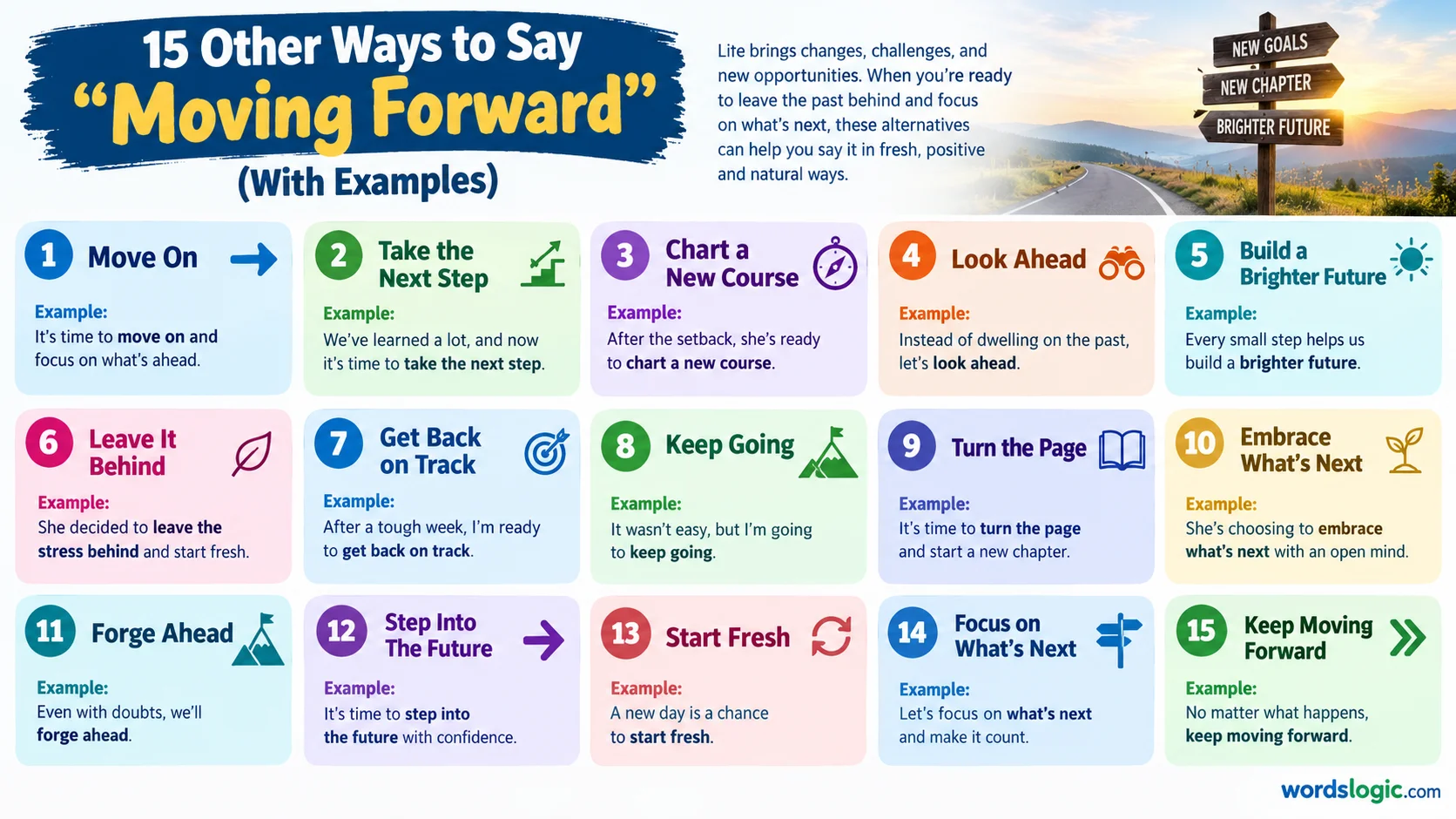
Other Ways to Say “Moving Forward” helps you express progress, improve professional communication, and discuss future plans with clarity and confidence.
In modern communication, the phrase moving forward can become repetitive when used too often. Choosing alternatives like taking the next step, looking ahead, and planning ahead helps you express ideas clearly in emails, meetings, and professional conversations. These phrases improve clarity, create the right tone, and guide discussions toward future actions.
In real life, moving forward means learning from a setback, recovering from challenges, and focusing on improvements. Whether you are handling a tough project at work or facing difficulties in your studies, thoughtful wording can show resilience, empathy, and a positive attitude. In professional and personal settings, the right words encourage flexibility, understanding, and a shared sense of purpose.
During project planning and team meetings, leaders can use proactive phrases to invite participation, spark collaboration, and support thoughtful decision-making. Expressions that encourage strategic planning, constructive discussion, and forward-thinking action help teams understand the next step without dictating direction. By using varied wording, you can reduce repetition, strengthen collaboration, and communicate future goals more effectively.
What Does “Moving Forward” Mean?
“Moving forward” generally means making progress, continuing with a plan, or focusing on what happens next. People use this expression when discussing future actions, setting expectations, or deciding how to handle a situation after a change or setback. For example, a manager might say, “Moving forward, we’ll share weekly updates,” to explain a new procedure. In a personal conversation, someone might say, “I’m ready to move forward,” to express a desire to leave a difficult experience behind and focus on the future. The phrase can describe practical progress, future plans, or emotional growth, depending on the context.
Common Situations Where “Moving Forward” Is Used
People use “moving forward” in several everyday situations. At work, it often introduces new procedures, expectations, deadlines, or plans. In emails, it can clarify what a team should do next. During school projects, students may use it to discuss the next stage of an assignment. In personal conversations, the phrase can express a willingness to forgive, accept change, or pursue new goals.
It also appears in presentations, meetings, social media posts, and discussions about relationships. However, the best alternative depends on the intended message. “Looking ahead” suits future planning, while “from this point on” emphasizes a change in behavior. Choosing a more specific expression can make your meaning clearer and prevent unnecessary repetition.
Is It Professional or Polite to Say “Moving Forward”?
Yes, “moving forward” is generally professional, polite, and widely understood. It works well in business emails, team meetings, project discussions, and formal presentations. For example, “Moving forward, we’ll review the figures every Friday” communicates a clear expectation without sounding overly forceful.
However, context matters. In a sensitive conversation, the phrase can sometimes sound as though you want to leave a problem behind before addressing someone’s concerns. In that situation, “As we work toward a solution” may sound more considerate. Similarly, “henceforth” may suit formal writing but sound stiff in everyday conversation. Choose wording that matches your audience, purpose, and relationship with the reader.
Advantages and Disadvantages of Saying “Moving Forward”
Advantages
The phrase “moving forward” is flexible and easy to understand. It can introduce future plans, encourage progress, or explain a change in expectations. Its professional tone makes it useful in emails, meetings, reports, and presentations. It can also help shift a conversation from past difficulties toward practical next steps. Because it works in many settings, readers usually understand its intended meaning without needing a lengthy explanation.
Disadvantages
Although the phrase is versatile, it can become repetitive when used too often in workplace communication. It may also sound vague if the speaker does not explain what will happen next. In emotional conversations, it can seem dismissive when someone still needs time to discuss a problem. More specific expressions, such as “from this point on” or “as we work toward a solution,” can communicate a clearer intention. The goal is not to avoid the original phrase completely but to use wording that fits the situation.
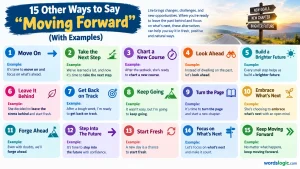
15 Other Ways to Say “Moving Forward”
- Going forward
- From this point on
- Looking ahead
- In the future
- As we proceed
- Moving ahead
- From here on
- Taking the next step
- Continuing with
- As we progress
- In the next phase
- Henceforth
- Going ahead
- Onward
- With that in mind
1. Going Forward
Meaning
“Going forward” means from now on or during the period ahead. It is particularly useful when discussing future plans, workplace expectations, and changes in routine.
Definition
A phrase used to introduce actions, decisions, or arrangements that will apply in the future.
Detailed Explanation
“Going forward” is one of the closest alternatives to “moving forward” in professional communication. Both expressions can introduce a new approach or explain what will happen next. However, “going forward” often emphasizes future expectations rather than progress itself. It works especially well when establishing procedures or clarifying responsibilities. Use it when you want your message to sound clear, practical, and businesslike.
Scenario Examples
- Scenario: A manager explains a new reporting procedure.
Example: “Going forward, please submit your weekly reports by Thursday afternoon.” - Scenario: A project team agrees to improve communication.
Example: “Going forward, we’ll share important updates in the team channel.”
Best Use
Use this expression in professional emails, meetings, project plans, and discussions about future expectations. It is also natural in everyday conversation.
Tone
Tone: Professional, direct, neutral.
It communicates a future intention without adding unnecessary emotion.
2. From This Point On
Meaning
“From this point on” means starting now and continuing into the future. It often highlights a clear change in behavior, rules, or expectations.
Definition
An expression indicating that something begins at the present moment and applies afterward.
Detailed Explanation
This phrase is more specific than “moving forward” because it clearly identifies the starting point of a change. It can sound firm when used to establish a rule or boundary. For example, it may introduce a new routine after a mistake or disagreement. Unlike “looking ahead,” which focuses on possibilities, “from this point on” emphasizes what changes now.
Scenario Examples
- Scenario: A student decides to manage assignments more carefully.
Example: “From this point on, I’ll write every deadline in my planner.” - Scenario: A team establishes a communication rule.
Example: “From this point on, all schedule changes must be shared with the entire team.”
Best Use
Choose this expression when discussing new rules, personal commitments, boundaries, or changes in routine. It is especially effective when the starting point matters.
Tone
Tone: Firm, clear, purposeful.
It signals a definite decision and makes the change sound intentional.
3. Looking Ahead
Meaning
“Looking ahead” means thinking about the future and considering what may happen next. It emphasizes preparation, planning, and future opportunities.
Definition
An expression used when considering future events, goals, challenges, or possibilities.
Detailed Explanation
Unlike “moving forward,” which can describe actual progress, “looking ahead” often refers to planning before taking action. It encourages people to consider upcoming needs and prepare accordingly. The phrase can also create an optimistic tone when discussing opportunities after a difficult period. It is a natural choice when you want to focus attention on what lies ahead rather than what has already happened.
Scenario Examples
- Scenario: A business discusses its next quarter.
Example: “Looking ahead, we need to prepare for the increase in customer demand.” - Scenario: A friend talks about personal goals after a difficult year.
Example: “I’m looking ahead and focusing on the opportunities I have now.”
Best Use
Use it in strategic planning, presentations, personal reflections, goal-setting, and discussions about future opportunities.
Tone
Tone: Optimistic, thoughtful, forward-looking.
It encourages preparation and helps frame the future as something worth considering.
4. In the Future
Meaning
“In the future” refers to a time that has not happened yet. It is useful when discussing future actions, expectations, possibilities, or plans.
Definition
A time expression referring to a later period rather than the present or past.
Detailed Explanation
This expression is straightforward and often more neutral than “moving forward.” It focuses on when something will happen, not necessarily on progress or improvement. For example, “In the future, we may offer additional services” describes a possibility rather than a firm commitment. It can also sound slightly less immediate than “from this point on.” Choose it when you want to discuss later events without suggesting a specific change begins today.
Scenario Examples
- Scenario: A customer suggests an improvement.
Example: “We’ll consider adding that feature in the future.” - Scenario: A student discusses long-term career plans.
Example: “In the future, I hope to work in environmental research.”
Best Use
Use this phrase in everyday conversation, formal writing, customer communication, academic work, and long-term planning.
Tone
Tone: Neutral, simple, informative.
Its plain wording makes it suitable for readers and listeners of different English proficiency levels.
5. As We Proceed
Meaning
“As we proceed” means while we continue with a task, process, or plan. It suggests that the next actions will happen as the work develops.
Definition
A phrase describing what happens while a process or activity continues.
Detailed Explanation
This expression is especially useful when a project is already underway. Unlike “in the future,” it connects future actions to an ongoing process. It can also suggest that decisions will depend on new information or developments. Because it sounds more formal than “as we go,” it often fits meetings, reports, and professional discussions. Use it when you want to communicate continued action with room for adjustment.
Scenario Examples
- Scenario: A team begins implementing a new system.
Example: “As we proceed, we’ll review feedback and address any technical issues.” - Scenario: A teacher explains a complicated assignment.
Example: “As we proceed, we’ll discuss each stage of the research process.”
Best Use
Choose it for project updates, formal discussions, instructions, collaborative work, and explanations of ongoing processes.
Tone
Tone: Professional, measured, cooperative.
It sounds organized and suggests that the work will continue in a deliberate way.
6. Moving Ahead
Meaning
“Moving ahead” means continuing toward a goal, making progress, or taking action after considering a situation.
Definition
An expression describing continued progress toward a desired result or the next stage of an activity.
Detailed Explanation
“Moving ahead” is very close in meaning to “moving forward” and can often replace it naturally. It places slightly more emphasis on action and progress, especially when people are working toward a shared goal. The expression can sound encouraging when a group has faced delays or uncertainty. It is also suitable for everyday conversations, so it does not feel limited to business settings.
Scenario Examples
- Scenario: A team resolves a disagreement and resumes work.
Example: “Now that we’ve agreed on the design, we can start moving ahead.” - Scenario: A friend encourages someone who has faced setbacks.
Example: “You’ve learned a lot from the experience, and you’re ready to keep moving ahead.”
Best Use
Use it in team discussions, motivational conversations, project updates, and personal messages about progress.
Tone
Tone: Encouraging, practical, positive.
It emphasizes continued effort and helps communicate a willingness to take the next step.
7. From Here On
Meaning
“From here on” means starting at the present moment and continuing afterward. It often refers to a change in habits, behavior, or expectations.
Definition
An expression indicating that something will apply from now onward.
Detailed Explanation
“From here on” is a conversational alternative to “from this point on.” It sounds more relaxed and personal while retaining the idea of a definite change. It is useful when someone makes a promise, establishes a boundary, or explains how they intend to behave in the future. The phrase does not necessarily imply progress toward a goal; instead, it highlights what will happen after the present moment.
Scenario Examples
- Scenario: Two friends agree to communicate more openly.
Example: “From here on, let’s tell each other when something is bothering us.” - Scenario: An employee changes their daily routine.
Example: “From here on, I’ll check the schedule before confirming appointments.”
Best Use
Use it in casual conversations, personal commitments, friendly messages, and informal workplace discussions.
Tone
Tone: Conversational, sincere, decisive.
It feels natural when speaking directly to someone about a change in behavior.
8. Taking the Next Step
Meaning
“Taking the next step” means doing the next necessary or useful thing to make progress toward a goal.
Definition
An expression describing a specific action that advances a process, relationship, plan, or objective.
Detailed Explanation
This phrase is more action-oriented than “moving forward.” Rather than referring broadly to the future, it suggests that a particular next action is needed. It can describe professional development, a business decision, a relationship milestone, or a personal goal. Because it emphasizes one stage at a time, it is helpful when a large task feels overwhelming. Use it when you want to turn a general intention into something practical.
Scenario Examples
- Scenario: A job applicant completes an interview and receives positive feedback.
Example: “I’m excited to take the next step in the hiring process.” - Scenario: A couple discusses their future together.
Example: “We’ve talked about our plans, and we’re ready to take the next step.”
Best Use
Choose it for career development, personal goals, relationship decisions, project planning, and decision-making.
Tone
Tone: Motivational, purposeful, constructive.
It suggests readiness to act rather than simply thinking about the future.
9. Continuing With
Meaning
“Continuing with” means carrying on with an activity, plan, method, or subject that has already started.
Definition
A phrase introducing the continuation of an existing task, approach, or discussion.
Detailed Explanation
This expression is useful when you intend to maintain an existing course of action rather than introduce something new. For example, “continuing with the current plan” indicates that the plan remains in place. Unlike “from this point on,” it does not automatically imply a change in rules or behavior. The phrase generally needs an object or context to complete its meaning. It works well when you want to emphasize consistency and continuation.
Scenario Examples
- Scenario: A project team decides to keep its existing approach.
Example: “Continuing with the current schedule, we expect to finish the first phase next month.” - Scenario: A presenter returns to the main subject after answering questions.
Example: “Continuing with our discussion, let’s examine the proposed budget.”
Best Use
Use it in presentations, meetings, project reports, instructions, and discussions about ongoing work.
Tone
Tone: Neutral, organized, professional.
It keeps attention on an existing activity without suggesting that a major change is necessary.
10. As We Progress
Meaning
“As we progress” means while improvement or development takes place. It can refer to the gradual advancement of a project, skill, plan, or process.
Definition
A phrase describing what happens as a task or situation develops over time.
Detailed Explanation
This expression highlights gradual development, rather than simply referring to a future date. It is especially appropriate when a process has several stages or when results will become clearer over time. It can also communicate that adjustments may be made as new information becomes available. Compared with “going forward,” it places more emphasis on development and measurable progress. Use it when the journey toward a goal matters as much as the final result.
Scenario Examples
- Scenario: A team is developing a new application.
Example: “As we progress, we’ll test each feature and make improvements where needed.” - Scenario: A student discusses learning a new language.
Example: “As we progress through the course, the exercises will become more challenging.”
Best Use
Choose it for training, education, long-term projects, progress reports, and processes that develop in stages.
Tone
Tone: Professional, encouraging, developmental.
It suggests steady advancement and an openness to learning along the way.
11. In the Next Phase
Meaning
“In the next phase” refers to the next distinct stage of a project, process, or plan.
Definition
A time-related expression identifying the following stage in a sequence of activities.
Detailed Explanation
This phrase is more specific than “moving forward” because it assumes that a process has recognizable stages. It works particularly well when the next part of a project has its own tasks, responsibilities, or goals. It is less suitable for an ordinary personal conversation unless the situation genuinely involves stages of development. Use it to clarify what comes next in an organized sequence rather than making a general statement about the future.
Scenario Examples
- Scenario: A company finishes its initial product testing.
Example: “In the next phase, we’ll invite a small group of customers to try the product.” - Scenario: A school project moves from research to writing.
Example: “In the next phase, our group will organize the findings into a final report.”
Best Use
Use it in project management, presentations, research, product development, and structured planning.
Tone
Tone: Formal, structured, precise.
It makes the sequence of work clear and helps people understand where the current task fits.
12. Henceforth
Meaning
“Henceforth” means from this time onward. It is a formal expression used to describe a rule, decision, or condition that applies in the future.
Definition
A formal adverb meaning from now on or from this point forward.
Detailed Explanation
“Henceforth” communicates a definite future change, often in official, legal, administrative, or ceremonial writing. It is less common in everyday speech because it can sound stiff or old-fashioned. Unlike “looking ahead,” it does not express planning or optimism; it indicates that a condition or practice will apply from now onward. Use it when a formal register is appropriate, but choose a simpler phrase for a friendly message or ordinary workplace email.
Scenario Examples
- Scenario: An organization announces a formal policy change.
Example: “Henceforth, all official requests must be submitted through the central office.” - Scenario: A formal notice explains a revised procedure.
Example: “Henceforth, correspondence regarding this matter will be handled by the designated department.”
Best Use
Choose it for formal notices, administrative documents, legal-style writing, and official announcements when its level of formality fits the audience.
Tone
Tone: Formal, authoritative, official.
It communicates a clear rule or change but may sound unnecessarily stiff in casual communication.
13. Going Ahead
Meaning
“Going ahead” can mean proceeding with a planned action or continuing toward a future objective. Its precise meaning depends on the sentence.
Definition
An expression referring to the continuation or commencement of an action, plan, or decision.
Detailed Explanation
“Going ahead” is useful when discussing whether an activity should proceed. For example, “We’re going ahead with the launch” means the launch will take place as planned. This differs from “going forward,” which often introduces expectations for future behavior. In some contexts, “going ahead” can also mean doing something before receiving permission, as in “You went ahead without asking.” Pay attention to context so the phrase communicates your intended meaning.
Scenario Examples
- Scenario: A team confirms a planned event after reviewing the arrangements.
Example: “We’re going ahead with the workshop as scheduled.” - Scenario: A colleague asks about an approved project.
Example: “Are we going ahead with the updated proposal next week?”
Best Use
Use it in planning discussions, everyday conversation, workplace decisions, and messages about whether an activity will proceed.
Tone
Tone: Practical, direct, decision-focused.
It often communicates that a decision has been made and action can continue.
14. Onward
Meaning
“Onward” means continuing forward, usually toward a destination, goal, or new stage. It can be literal or figurative.
Definition
An adverb describing movement or continued progress in a forward direction.
Detailed Explanation
“Onward” is shorter and more expressive than “moving forward.” It can describe physical travel, but it also appears in motivational language about perseverance and personal growth. In professional writing, it may sound too poetic if used where a precise instruction is needed. Its strength lies in its ability to communicate momentum and determination in just one word. Choose it when you want a concise, encouraging expression rather than a detailed explanation of future arrangements.
Scenario Examples
- Scenario: A coach encourages a team after a difficult match.
Example: “We’ve learned from today’s game. Onward to the next challenge.” - Scenario: A traveler describes continuing a journey.
Example: “We rested for the night and continued onward early the next morning.”
Best Use
Use it in motivational messages, speeches, creative writing, travel narratives, and brief statements about perseverance.
Tone
Tone: Inspirational, determined, expressive.
It adds a sense of momentum and resilience, particularly when the goal is to encourage someone.
15. With That in Mind
Meaning
“With that in mind” means considering the information, decision, or point that has just been discussed before deciding what to do next.
Definition
An expression that connects previous information to a following idea, decision, or action.
Detailed Explanation
This phrase is not a direct synonym for “moving forward” in every situation. Instead, it helps explain how an earlier point influences the next decision. It is useful when you want to move a conversation toward a practical response while showing that you have considered relevant facts or concerns. It can sound more thoughtful than a simple announcement about the future. Use it when the next action follows logically from what has already been learned or discussed.
Scenario Examples
- Scenario: A manager reviews customer feedback before suggesting a change.
Example: “With that in mind, let’s simplify the instructions before the next release.” - Scenario: A student considers the results of a research project.
Example: “With that in mind, I’ll focus my final presentation on the most important findings.”
Best Use
Choose it for presentations, analytical writing, professional emails, meetings, and conversations where previous information shapes the next step.
Tone
Tone: Thoughtful, logical, professional.
It creates a clear connection between what has been discussed and what should happen next.
FAQs
1. What does “moving forward” mean?
Moving forward means making progress, learning from past experiences, and focusing on future actions. It often refers to taking the next step after a challenge, decision, or change.
2. What are some professional alternatives to “moving forward”?
Some professional alternatives include looking ahead, taking the next step, going forward, proceeding, and planning ahead. These phrases help improve professional communication in emails, meetings, and workplace discussions.
3. How can I use “moving forward” in a work email?
You can use it to introduce a plan, explain a change, or discuss future responsibilities. For example, “Moving forward, we will share weekly project updates to improve team collaboration.”
4. Why should I use alternatives to “moving forward”?
Using alternatives reduces repetition, improves clarity, and makes your messages more engaging. Choosing the right phrase also helps you maintain a suitable tone in professional and personal conversations.
5. Is “moving forward” formal or informal?
Moving forward works in both formal and informal communication. It is common in workplace emails, leadership discussions, and everyday conversations. However, phrases like proceeding or as a next step may sound more precise in certain professional situations.
Conclusion
Choosing the right alternatives for “moving forward” helps you communicate with greater clarity, confidence, and purpose. Expressions such as looking ahead, taking the next step, and planning ahead encourage progress while keeping your message natural and engaging. Whether you are discussing a project, leading a team meeting, or recovering from a setback, thoughtful wording can express resilience, flexibility, and a positive attitude toward future actions.
In professional communication, varied phrases can reduce repetition, support collaboration, and make decision-making easier to understand. Consider your audience, the situation, and the message you want to convey before choosing an alternative. With practice, you can use these expressions in emails, meetings, and personal conversations to maintain a professional tone, encourage meaningful progress, and communicate your future plans more effectively.