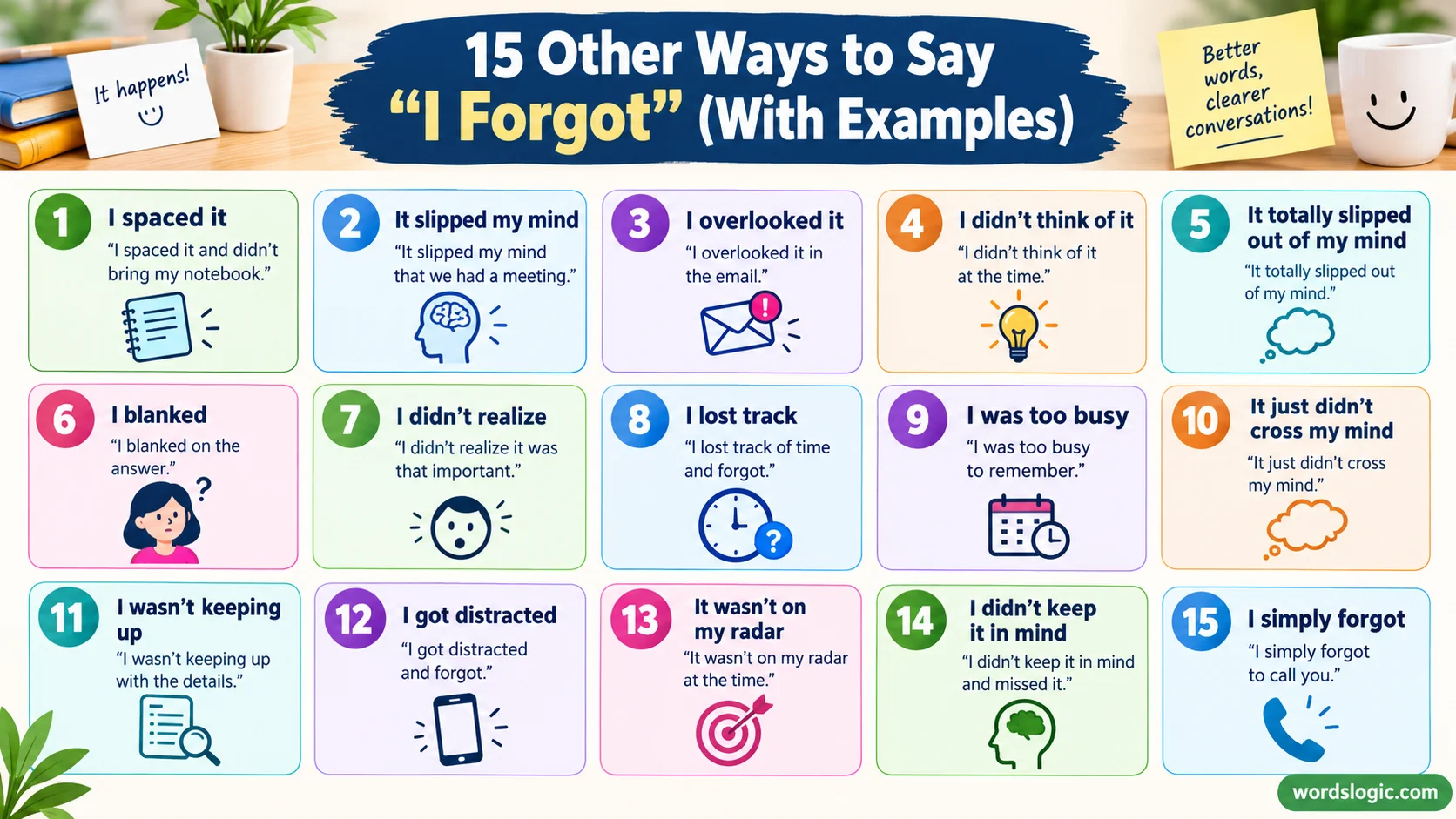
Other Ways to Say “I Forgot” helps you communicate honestly, handle mistakes professionally, and maintain trust when busy schedules cause memory lapses.
Forgetting something at work happens to everyone. Busy schedules, meetings, emails, and daily responsibilities can make you miss important details or commitments. Learning how to acknowledge mistakes, offer a sincere apology, and respond with respectful language helps you maintain a professional tone. Expressions such as “It totally slipped my mind” and “It escaped me” sound natural while showing honesty, humility, and accountability.
When communicating with colleagues, clients, friends, or supervisors, focus on correcting the mistake rather than making excuses. A simple message such as “Sorry, I forgot about the meeting. I’ll join right away” shows responsibility and readiness. If you miss a deadline, explain the oversight and state when you will complete the task. This approach strengthens trust, improves workplace communication, and helps build positive professional relationships.
A memory lapse does not mean you cannot remember something forever. Sometimes, pressure and distractions make information difficult to recall. Practicing alternative expressions, choosing appropriate words, and sending a timely follow-up can improve your communication skills. Whether you are writing an email or speaking with a manager, a clear explanation, a genuine apology, and a solution-focused response help you handle forgetfulness with confidence and professionalism.
What Does “I Forgot” Mean?
“I forgot” means that you failed to remember something you were supposed to remember or had previously known. It can refer to a forgotten appointment, an unfinished task, someone’s name, an important detail, or something you intended to do. In everyday English, the phrase usually communicates that something slipped your mind rather than that you deliberately ignored it. Its tone depends on the context and how you say it. For example, telling a friend “I forgot to call you” sounds casual, while telling a manager “I forgot to submit the report” may sound direct but requires accountability. The expression is common in spoken English, text messages, emails, and personal conversations.
Common Situations Where “I Forgot” Is Used
People use “I forgot” in many everyday situations. You might say it when you miss a meeting, leave something at home, forget a birthday, or fail to complete a task. Friends and family often use the phrase casually because they can explain what happened without much formality.
At work or school, however, forgetting a responsibility may affect other people. In these situations, a more complete explanation can sound more responsible. For example, “I overlooked the deadline” may suit a work email, while “It slipped my mind” sounds natural in a conversation with a friend. When apologizing to someone, acknowledging the mistake and explaining how you will address it can make your response more considerate.
Is It Professional or Polite to Say “I Forgot”?
Yes, “I forgot” can be polite and professional when you use it honestly and take responsibility for the mistake. It is direct, understandable, and suitable for many everyday conversations. However, in formal communication, the phrase may sound too casual if you use it without acknowledging the consequences or explaining your next step.
For example, telling a colleague “I forgot to attach the file” is perfectly understandable. In a message to a client, you might write, “I missed the attachment in my previous email. Please find it attached here.” This wording identifies the problem and immediately addresses it. The best expression depends on the situation: casual language works well with familiar people, while professional wording should be clear, respectful, and focused on resolving the issue.
Advantages and Disadvantages of Saying “I Forgot”
Advantages
The main advantage of “I forgot” is its simplicity. It communicates the mistake directly without forcing you to invent an excuse. The phrase also sounds natural in everyday English and helps you acknowledge what happened. When used sincerely, it can support honest communication and show that you are willing to admit a mistake.
Disadvantages
The phrase can sometimes sound too casual, especially when the forgotten task affects a deadline, customer, or colleague. Repeating it without taking action may make you appear unprepared or unwilling to accept responsibility. It also does not explain whether you overlooked a detail, failed to remember an appointment, or forgot to complete an action. A more specific expression can communicate the situation more accurately and help you maintain a professional and respectful tone.
15 Alternatives to “I Forgot”
- It slipped my mind.
- I completely overlooked it.
- I didn’t remember.
- It escaped my memory.
- I lost track of it.
- I forgot to take care of it.
- I missed that detail.
- I wasn’t able to recall it.
- I had it slip through the cracks.
- I failed to remember.
- I didn’t have it on my radar.
- I got caught up in other things.
- I neglected to do it.
- I overlooked the reminder.
- It completely slipped my attention.
1. It Slipped My Mind
Meaning
“It slipped my mind” means that you unintentionally forgot something you intended to remember or do. It is a natural, conversational alternative to “I forgot.”
Definition
An expression used when something was forgotten unintentionally, often because your attention was elsewhere.
Detailed Explanation
This phrase sounds softer and less blunt than “I forgot.” It suggests that the information or task simply escaped your attention for a while. People commonly use it when talking to friends, family members, or colleagues they know well. Although it sounds casual, it can also work in a professional conversation when the situation is minor and you acknowledge your responsibility.
Scenario Examples
- Scenario: You forget to reply to a friend’s message.
Example: “Sorry, your message slipped my mind yesterday.” - Scenario: You forget to bring something to a family gathering.
Example: “The dessert slipped my mind, but I can pick something up on the way.” - Scenario: You miss a small task at work.
Example: “The follow-up email slipped my mind. I’ll send it now.”
Best Use
Use this expression in casual conversations, friendly messages, and low-pressure workplace discussions. If the mistake has serious consequences, add a clear apology and explain how you will fix it.
Tone
Tone: Casual, gentle, and apologetic.
The wording makes the mistake sound unintentional without denying responsibility.
2. I Completely Overlooked It
Meaning
“I completely overlooked it” means that you failed to notice or consider something that needed your attention. It is especially useful when the information was available but you did not recognize it.
Definition
To overlook something means to miss, fail to notice, or fail to consider it.
Detailed Explanation
Unlike “I forgot,” this expression often suggests that you missed something while reviewing information or handling a task. It sounds more precise and professional because it identifies a failure of attention rather than simply a failure of memory. You can use it when discussing instructions, an email, a document, or a requirement. It works best when the information was present but you did not notice or account for it.
Scenario Examples
- Scenario: You miss an instruction in a project brief.
Example: “I completely overlooked the note about the revised deadline.” - Scenario: You forget to include a required section in a report.
Example: “I overlooked the final section. I’ll add it before submitting the report.” - Scenario: You miss a detail in an email from a client.
Example: “Thank you for pointing that out. I completely overlooked it in your earlier email.”
Best Use
Use this phrase in professional emails, academic work, document reviews, and situations involving missed details. Avoid it when you genuinely remembered the information but simply chose not to act.
Tone
Tone: Professional, accountable, and direct.
It acknowledges a mistake while explaining that the problem involved attention to detail.
3. I Didn’t Remember
Meaning
“I didn’t remember” means that you could not bring a piece of information or an obligation to mind at the relevant time. It is a straightforward alternative to “I forgot.”
Definition
A statement indicating that you did not recall something when it was needed.
Detailed Explanation
This expression is close in meaning to “I forgot,” but it emphasizes the absence of a memory rather than the act of forgetting. It is simple and neutral, making it suitable for ordinary conversation. Depending on the situation, it can sound slightly less conversational than “It slipped my mind.” It does not automatically communicate an apology, so you may want to add one when your forgetfulness inconvenienced someone.
Scenario Examples
- Scenario: A friend asks whether you remembered a restaurant reservation.
Example: “I didn’t remember the reservation until you mentioned it.” - Scenario: Someone asks you to recall a name.
Example: “I didn’t remember his name at first, but I recognized him when he introduced himself.” - Scenario: You forget a detail from a previous discussion.
Example: “I didn’t remember that we had agreed to meet earlier.”
Best Use
Use this phrase in everyday conversations, explanations, and situations where you want to describe a lapse in memory plainly. It is less suitable as a standalone apology for a serious mistake.
Tone
Tone: Neutral, simple, and factual.
Its straightforward wording explains what happened without adding much emotional emphasis.
4. It Escaped My Memory
Meaning
“It escaped my memory” means that you failed to recall something you had previously known. It presents forgetting as an unintended lapse in remembering.
Definition
A somewhat formal or literary expression meaning that something was not recalled when needed.
Detailed Explanation
This phrase communicates a similar idea to “I forgot,” but it sounds less common in everyday conversation. It can feel more reflective or carefully worded, particularly in writing. Most native English speakers would usually choose “It slipped my mind” in a casual situation. Use this expression sparingly, because it may sound overly formal or unnatural in a quick text or workplace chat.
Scenario Examples
- Scenario: You cannot recall a detail during a thoughtful conversation.
Example: “The exact date escaped my memory, although I remember the event clearly.” - Scenario: You write a reflective note about a past event.
Example: “Her address had escaped my memory until I found the old letter.”
Best Use
Use this expression in reflective writing, personal storytelling, or a carefully worded explanation. For ordinary conversation, a more familiar expression will usually sound more natural.
Tone
Tone: Reflective, slightly formal, and literary.
The unusual wording draws attention to the act of remembering, so it is best used where that style feels appropriate.
5. I Lost Track of It
Meaning
“I lost track of it” means that you stopped keeping up with something or lost awareness of its progress, timing, or status. Depending on the context, it can explain why you forgot about a task or event.
Definition
To lose track of something means to stop monitoring, following, or remembering it accurately.
Detailed Explanation
This phrase is not an exact synonym for every use of “I forgot.” It is most appropriate when you were meant to keep track of something over time, such as a deadline, an ongoing task, or a series of messages. It can suggest that you became distracted or that the activity slipped out of your awareness. If you simply cannot remember a person’s name, this expression would not normally fit.
Scenario Examples
- Scenario: You forget to check the progress of an ongoing task.
Example: “I lost track of the application after sending the initial documents.” - Scenario: You forget how long you have been working.
Example: “I lost track of time while preparing the presentation.” - Scenario: You stop following a long email conversation.
Example: “I lost track of the discussion after several new updates came in.”
Best Use
Use it when discussing ongoing projects, schedules, progress, deadlines, or time management. Choose a more direct phrase when you forgot a single fact or specific instruction.
Tone
Tone: Casual, explanatory, and mildly apologetic.
It often suggests distraction or a lapse in monitoring rather than a simple failure to recall information.
6. I Forgot to Take Care of It
Meaning
“I forgot to take care of it” means that you failed to complete a task or responsibility you intended to handle.
Definition
A statement admitting that you did not carry out an action you were supposed to complete.
Detailed Explanation
This expression focuses on an unfinished action, not simply a forgotten fact. It is useful when someone expected you to pay a bill, send a document, make a call, or handle an errand. The wording is clear, but it does not excuse the missed responsibility. In professional settings, it helps to pair the admission with a practical next step.
Scenario Examples
- Scenario: You forget to send an important document.
Example: “I forgot to take care of the paperwork yesterday, but I’ll finish it this morning.” - Scenario: You fail to pay a household bill on time.
Example: “I forgot to take care of the electricity bill. I’ll pay it today.” - Scenario: You miss an errand your partner asked you to handle.
Example: “I’m sorry I forgot to take care of the grocery pickup. Can I get it now?”
Best Use
Use this expression when explaining missed responsibilities, errands, administrative tasks, and personal commitments. In a formal business email, specify the task and how you will resolve it.
Tone
Tone: Direct, responsible, and conversational.
It admits that an expected action was not completed, making it useful when accountability matters.
7. I Missed That Detail
Meaning
“I missed that detail” means that you failed to notice or register a specific piece of information. It is particularly useful when explaining an error caused by overlooking something important.
Definition
A statement acknowledging that a particular detail was not noticed or considered.
Detailed Explanation
This phrase narrows the problem to a specific piece of information instead of suggesting that you forgot everything about the situation. It sounds natural in discussions about instructions, schedules, documents, and plans. It can also help keep a conversation focused on correcting the issue. However, use it only when the mistake really involves a detail you failed to notice.
Scenario Examples
- Scenario: You misunderstand a booking time because you miss a note.
Example: “I missed that detail about the appointment starting at 9:30.” - Scenario: You leave a requirement out of an assignment.
Example: “I missed that detail in the instructions, so I’ll revise my answer.” - Scenario: A colleague points out a small error in a spreadsheet.
Example: “You’re right. I missed that detail in the final column.”
Best Use
Use it in workplace discussions, academic assignments, planning, and document reviews where a specific detail was overlooked.
Tone
Tone: Professional, measured, and accountable.
It acknowledges the oversight without sounding dramatic or making the mistake seem larger than it is.
8. I Wasn’t Able to Recall It
Meaning
“I wasn’t able to recall it” means that you could not remember a particular fact or piece of information when you needed it.
Definition
A formal expression meaning that you could not retrieve information from your memory at a particular time.
Detailed Explanation
This phrase is more formal than “I forgot” and places emphasis on the difficulty of remembering. It works well when describing an inability to recall a name, date, detail, or previously learned fact. Unlike “I overlooked it,” it does not imply that the information was simply missed while reading or reviewing something. In casual conversation, it may sound unnecessarily formal, so choose it when the context calls for more measured wording.
Scenario Examples
- Scenario: You cannot remember a date during a discussion.
Example: “I wasn’t able to recall the exact date during the meeting.” - Scenario: You are answering a question in an academic setting.
Example: “I wasn’t able to recall the formula during the test.”
Best Use
Use this expression in formal explanations, academic contexts, interviews, or discussions where precise wording is helpful. It is less natural for a quick message to a friend.
Tone
Tone: Formal, neutral, and precise.
The wording sounds measured and focuses on the inability to remember rather than on the mistake itself.
9. I Had It Slip Through the Cracks
Meaning
“I had it slip through the cracks” is an attempt to explain that a task or responsibility was missed amid other activities. The more natural standard expression is “It slipped through the cracks.”
Definition
“Slip through the cracks” means to be missed, overlooked, or left unattended within a process or among competing responsibilities.
Detailed Explanation
This expression is particularly useful when a task gets lost among multiple messages, requests, or responsibilities. It often describes a process-related oversight rather than a simple memory lapse. The phrase can sound less personal because it focuses on how something was missed, so be careful not to use it to avoid responsibility. In most situations, “It slipped through the cracks” sounds more natural than “I had it slip through the cracks.”
Scenario Examples
- Scenario: A customer request is missed among several incoming messages.
Example: “Your request slipped through the cracks during the busy week. I’m sorry, and I’ll address it now.” - Scenario: A team forgets to follow up on an assigned task.
Example: “The follow-up slipped through the cracks while we were handling the other deadlines.”
Best Use
Use the standard form in team communication, customer service, project updates, and discussions about missed steps in a process. When you personally caused the problem, acknowledge your role rather than blaming the process.
Tone
Tone: Explanatory, professional, and slightly indirect.
It describes how something was missed, but a direct apology may be needed to show accountability.
10. I Failed to Remember
Meaning
“I failed to remember” means that you did not remember something you were expected to recall. It emphasizes the failure to meet an expectation.
Definition
A direct statement that you did not successfully remember something when necessary.
Detailed Explanation
This expression sounds stronger and more serious than “I forgot.” The word “failed” can suggest that remembering was an important responsibility or that the lapse had consequences. It is grammatically correct, but it may sound stiff or overly dramatic in casual conversation. Use it when you want to emphasize the seriousness of a mistake, although “I forgot” or “I overlooked it” will often sound more natural.
Scenario Examples
- Scenario: You forget a commitment that mattered to a friend.
Example: “I failed to remember our plans, and I’m sorry I left you waiting.” - Scenario: You reflect on an important missed obligation.
Example: “I failed to remember the deadline, so I submitted the application late.”
Best Use
Use it in serious personal explanations, reflective writing, or situations where you need to acknowledge a meaningful lapse. Avoid it for small, everyday forgetfulness because it may sound unnecessarily severe.
Tone
Tone: Serious, direct, and self-critical.
The expression places more weight on the mistake than most casual alternatives do.
11. I Didn’t Have It on My Radar
Meaning
“I didn’t have it on my radar” means that something was not within your awareness or attention at the time. It can explain why you did not consider a task, issue, or upcoming event.
Definition
An informal expression meaning that something was not being monitored, considered, or anticipated.
Detailed Explanation
This phrase is common in conversational workplace English, particularly when people discuss priorities, projects, and upcoming issues. It does not always mean that you forgot something you had previously known; sometimes it means that you were not aware of it or had not considered it. That distinction matters when choosing an accurate expression. If you received a clear instruction and simply forgot to act, saying “I didn’t have it on my radar” may sound evasive.
Scenario Examples
- Scenario: A colleague mentions an upcoming internal event.
Example: “I didn’t have the training session on my radar. Thanks for letting me know.” - Scenario: A team discusses an issue that was not part of its priorities.
Example: “That risk wasn’t on my radar when we finalized the original plan.”
Best Use
Use it in informal workplace conversations, project planning, and discussions about priorities or emerging issues. In formal correspondence, a more specific explanation may be clearer.
Tone
Tone: Conversational, business-casual, and explanatory.
It communicates limited awareness without necessarily suggesting a straightforward memory failure.
12. I Got Caught Up in Other Things
Meaning
“I got caught up in other things” means that other activities or responsibilities occupied your attention, causing you to forget or delay something.
Definition
An expression explaining that competing activities distracted you from a task or commitment.
Detailed Explanation
This phrase emphasizes distraction or competing priorities rather than a direct failure of memory. It can help explain why you missed a message, delayed a response, or forgot to complete an errand. However, it does not automatically excuse the mistake, and it may sound like an excuse if you use it without acknowledging the impact. For important commitments, pair it with an apology and a clear plan to put things right.
Scenario Examples
- Scenario: You forget to answer a friend’s message during a busy day.
Example: “Sorry I didn’t reply sooner. I got caught up in other things yesterday.” - Scenario: You delay sending a work update.
Example: “I got caught up in other things this afternoon and missed the update. I’ll send it before the end of the day.”
Best Use
Use this expression in casual conversations, friendly messages, and informal explanations of delays. For serious mistakes, take responsibility rather than relying on busyness as the main explanation.
Tone
Tone: Casual, explanatory, and mildly apologetic.
It describes distraction and competing demands, but it does not replace a sincere apology when one is needed.
13. I Neglected to Do It
Meaning
“I neglected to do it” means that you failed to carry out an action or responsibility that required your attention.
Definition
To neglect to do something means to fail to do it, often because you did not give it the necessary attention or priority.
Detailed Explanation
This phrase is stronger than “I forgot” because “neglected” can suggest that a responsibility was not given proper attention. It may describe an accidental omission, but it can also imply carelessness depending on the context. The wording is useful when you want to acknowledge that something important was left undone. Because it can sound severe, it is usually better suited to serious explanations than to small everyday mistakes.
Scenario Examples
- Scenario: You forget to complete an important administrative task.
Example: “I neglected to submit the required form, and I’ll complete it today.” - Scenario: You fail to respond to an important request.
Example: “I neglected to follow up on your request. I apologize for the delay.”
Best Use
Use it in formal explanations, serious personal apologies, and situations where you need to acknowledge an unfinished responsibility. Avoid it when you simply cannot recall a name or date.
Tone
Tone: Formal, serious, and accountable.
It communicates more weight than a casual memory lapse and may suggest that the task deserved greater attention.
14. I Overlooked the Reminder
Meaning
“I overlooked the reminder” means that you failed to notice or act on a notification intended to help you remember something.
Definition
A statement explaining that a reminder was present but was not noticed or given the necessary attention.
Detailed Explanation
This expression is more specific than “I forgot” because it identifies the reminder as the thing you missed. It is useful when a calendar alert, email, written note, or message was available but did not catch your attention. The phrase does not imply that the reminder was missing; instead, it acknowledges that you failed to notice it. If the reminder was never delivered, choose wording that accurately explains that different problem.
Scenario Examples
- Scenario: You miss a calendar notification about an appointment.
Example: “I overlooked the reminder about our call. I’m sorry for missing it.” - Scenario: You fail to notice a reminder from a colleague.
Example: “I overlooked your reminder yesterday, but I’ve added the deadline to my calendar now.”
Best Use
Use this phrase in work emails, appointment-related messages, scheduling discussions, and explanations involving notifications or written reminders.
Tone
Tone: Professional, specific, and apologetic.
It identifies exactly what went wrong and can lead naturally into a practical solution.
15. It Completely Slipped My Attention
Meaning
“It completely slipped my attention” is intended to mean that you failed to notice or remember something. However, this wording is less idiomatic than more established expressions.
Definition
A less common phrasing intended to describe something that went unnoticed or escaped your awareness.
Detailed Explanation
Although the meaning is understandable, native speakers would usually say “It slipped my mind” or “It escaped my attention.” The phrase “slipped my attention” combines two familiar expressions, which can make it sound unnatural. If you want to explain that you did not notice an email, instruction, or detail, “It escaped my attention” is a clearer choice. If you want to explain that you forgot a personal commitment, “It slipped my mind” is usually better.
Scenario Examples
- Scenario: You want to explain why you did not notice a message.
Example: “I’m sorry I missed your message; it escaped my attention yesterday.” - Scenario: You forget a small detail during a discussion.
Example: “That detail slipped my mind during our conversation.”
Best Use
For natural English, prefer “It escaped my attention” when you mean that you did not notice something, or “It slipped my mind” when you mean that you forgot it. Avoid “It completely slipped my attention” in polished professional writing.
Tone
Tone: Intended to be explanatory and apologetic, but somewhat awkward as written.
Choosing an established expression makes your meaning clearer and helps your English sound more natural.
FAQs
1. What is a professional way to say “I forgot”?
A professional way to say “I forgot” is “It slipped my mind” or “I overlooked that.” These phrases sound polite and help you acknowledge a mistake without giving unnecessary excuses.
2. How do I apologize for forgetting something at work?
You can say, “I apologize for the oversight. I’ll take care of it right away.” This response shows accountability, respect, and a willingness to correct the mistake.
3. Is “It slipped my mind” appropriate for professional emails?
Yes, “It slipped my mind” is suitable for many professional emails, especially when speaking with familiar colleagues. For formal situations, “I overlooked this” or “I apologize for missing this” may sound more appropriate.
4. How can I explain that I forgot a meeting?
You can write, “I’m sorry I missed the meeting. I should have kept track of the schedule, and I’ll make sure to review the notes and follow up on any pending tasks.” This message shows professionalism, responsibility, and a commitment to taking corrective action.
5. How can I avoid forgetting important tasks at work?
Use a calendar, task list, or reminder app to keep track of deadlines, meetings, and commitments. Reviewing your schedule daily and setting reminders can improve time management, reduce memory lapses, and help you stay organized.
Conclusion
Forgetting something is a normal part of everyday life, but the way you respond can make a real difference. Learning other ways to say “I forgot” helps you communicate with greater confidence in professional emails, workplace conversations, and personal interactions. Expressions such as “It slipped my mind,” “I overlooked that,” and “I apologize for the oversight” allow you to acknowledge mistakes while maintaining a respectful and appropriate tone. Choosing the right words also demonstrates honesty, humility, and professionalism.
The key is to accept responsibility and focus on solutions instead of making excuses. When you forget a meeting, task, or commitment, offer a sincere apology, explain briefly when necessary, and take action to correct the situation. Building habits such as using reminders, organizing tasks, and following up on missed responsibilities can improve your communication skills and accountability. With practice, you can handle forgetfulness gracefully, strengthen workplace relationships, and maintain the trust of colleagues, clients, and supervisors.













