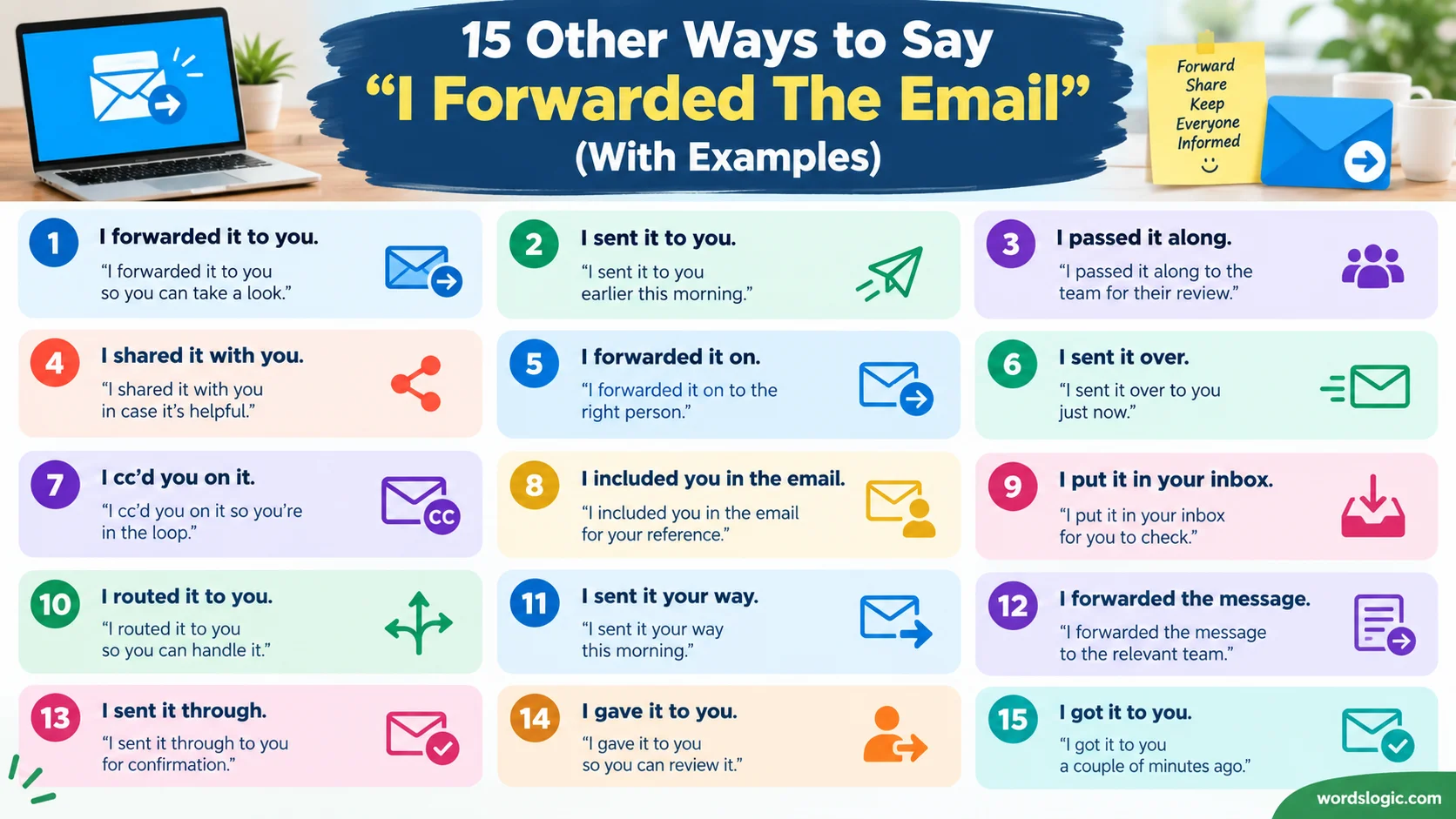
Other Ways to Say “I Forwarded The Email” helps improve clarity, tone, and professionalism in everyday workplace communication.
In a fast-paced professional world, email communication helps teams share information quickly and clearly. Saying “I forwarded the email” is simple and efficient, but using the same phrase repeatedly can make workplace conversations sound flat. A small change in wording can improve clarity, strengthen your professional tone, and help recipients understand your message more easily.
Exploring other ways to say “I forwarded the email” allows you to adjust your wording for formal emails, casual conversations, business communication, and academic writing. For example, “I have forwarded your email” sounds polished and respectful while confirming that the message was sent to another person. These alternatives help professionals, students, and English learners communicate naturally, show attentiveness, and maintain a genuine, thoughtful tone.
Before forwarding emails, check the sender details, subject line, body content, and attachments. Make sure the original message provides enough context for the recipient to understand the information without confusion. Following these best practices supports collaboration, builds trust, reduces ambiguity, and creates a smoother workflow. Using concise wording and varied expressions also helps make your messages more engaging, effective, and suitable for modern professional communication.
What Does “I Forwarded The Email” Mean?
“I forwarded the email” means that you sent an email you received to another person or group. The original message is usually included so the new recipient can read its contents, understand the context, or take the necessary action. People commonly use this phrase when sharing information, passing along instructions, or connecting someone with a relevant conversation. In professional communication, it confirms that information has been transferred without requiring the sender to rewrite the entire message. The phrase usually describes a completed action, so it is useful when giving someone an update. However, it does not necessarily mean the recipient has read the email or acted on its contents.
Common Situations Where “I Forwarded The Email” Is Used
This expression is common in workplace emails, project updates, customer service, school communication, and everyday conversations. For example, an employee might forward a manager’s instructions to a colleague, or a student might send a teacher’s announcement to a classmate. It is also useful when sharing receipts, meeting invitations, important documents, and previous correspondence.
Sometimes, a different expression makes the message more specific. “I’ve passed the email along” sounds conversational, while “I’ve forwarded the correspondence to the appropriate department” provides a more formal tone. Choosing the right alternative helps you explain who received the message, why you shared it, and what should happen next.
Is It Professional or Polite to Say “I Forwarded The Email”?
Yes. “I forwarded the email” is professional, neutral, and direct. It works well in most workplace situations because it clearly describes what you did without sounding overly formal or emotional. You can use it when communicating with managers, coworkers, customers, or business partners.
The wording may feel repetitive if you use it in every update. In those cases, expressions such as “I’ve sent the email along” or “I’ve shared the message with the team” can make your writing sound more natural. For formal correspondence, you might prefer “The email has been forwarded to the relevant department.” Remember that some alternatives have slightly different meanings. For example, “I’ve copied you on the email” usually means the person was included as a recipient, not that you forwarded an earlier message.
Advantages and Disadvantages of Saying “I Forwarded The Email”
Advantages
The phrase is clear, concise, and widely understood. It tells the recipient that you have sent an existing email to someone else. Its neutral tone makes it suitable for workplace communication, customer updates, and routine messages. It also avoids unnecessary explanation when the recipient simply needs confirmation that the task is complete.
Disadvantages
The expression can become repetitive in long email threads. It may also lack useful details, such as who received the message or why you shared it. In some situations, the wording sounds slightly mechanical when a warmer or more specific alternative would be more helpful. Additionally, it does not confirm whether the recipient has read the forwarded email or completed any requested action.
15 Alternatives to “I Forwarded The Email”
- I’ve sent the email along.
- I’ve forwarded the message.
- I’ve passed the email on.
- I’ve sent it to you.
- I’ve shared the email with you.
- I’ve redirected the email.
- I’ve forwarded it to the relevant person.
- I’ve sent the email over.
- I’ve looped you in by email.
- I’ve copied you on the email.
- I’ve sent the email to the team.
- I’ve passed this along to the appropriate person.
- The email has been forwarded.
- I’ve relayed the email.
- I’ve sent the original email your way.
1. I’ve Sent the Email Along
Meaning
“I’ve sent the email along” means you have passed an existing email to another person. It is a natural alternative that sounds slightly more conversational than “I forwarded the email.”
Definition
To send an email along means to share a received message with someone who needs its information.
Detailed Explanation
This expression works well when you want to confirm that information has been passed to another person. It is friendly without sounding unprofessional. The word “along” emphasizes the movement of information from one person to another. Although it is suitable for workplace conversations, it may sound less formal than “forwarded” in official correspondence.
Scenario Examples
- Scenario: A coworker asks whether you shared the meeting details.
Example: I’ve sent the email along to everyone who needs the information. - Scenario: A friend requests a travel confirmation.
Example: I’ve sent the email along so you can check the booking details.
Best Use
Use this expression in everyday workplace communication, friendly emails, and routine updates when you want a natural, uncomplicated tone.
Tone
Tone: Friendly, conversational, professional.
It sounds approachable while still communicating that the task is complete.
2. I’ve Forwarded the Message
Meaning
“I’ve forwarded the message” means you have sent an existing email or its contents to another recipient. It focuses on the message itself rather than the email as a document.
Definition
To forward a message means to transmit an existing communication to someone else.
Detailed Explanation
This phrase is especially useful when the important part is the information being shared. It can refer to an email, although “message” may also describe communication through another platform. The expression is direct and suitable for professional environments. If you specifically mean an email, using “email” instead of “message” can provide greater precision.
Scenario Examples
- Scenario: A manager asks whether the updated instructions were shared.
Example: I’ve forwarded the message to the project coordinator. - Scenario: A colleague needs information from a previous conversation.
Example: I’ve forwarded the message so you can review the original instructions.
Best Use
Choose this wording for workplace updates, team communication, and situations where the message’s contents matter more than the email format.
Tone
Tone: Neutral, direct, professional.
It gives a straightforward update without adding unnecessary details.
3. I’ve Passed the Email On
Meaning
“I’ve passed the email on” means you have transferred an email to another person, often someone better placed to handle the matter.
Definition
To pass an email on means to send it to another recipient for information or further action.
Detailed Explanation
This alternative sounds natural in British and international English. It can suggest that the original recipient is passing responsibility or information to someone else. However, it does not automatically mean that responsibility has formally changed. The phrase is useful when you want to communicate progress without making your message sound overly technical.
Scenario Examples
- Scenario: A customer contacts the wrong department.
Example: I’ve passed the email on to our support team. - Scenario: A colleague sends information that belongs with another manager.
Example: I’ve passed the email on to Priya, who handles those requests.
Best Use
Use it when redirecting inquiries, sharing information between departments, or handing a message to the appropriate colleague.
Tone
Tone: Helpful, conversational, businesslike.
It communicates that the information is moving to someone who can deal with it.
4. I’ve Sent It to You
Meaning
“I’ve sent it to you” means you have sent an item or message directly to the person you’re addressing. In an email conversation, “it” can refer to a forwarded email when the context is clear.
Definition
To send something to someone means to transmit it directly to that person.
Detailed Explanation
This is one of the simplest alternatives because it focuses on the recipient. It works particularly well when the other person has asked you to share a specific message. However, it does not explicitly say that the item was forwarded, so the surrounding conversation should make that clear. If the recipient could confuse it with a new email, specify that you sent the original message.
Scenario Examples
- Scenario: A coworker requests a copy of an approval email.
Example: I’ve sent it to you so you can review the approval. - Scenario: A classmate asks for the teacher’s announcement.
Example: I’ve sent it to you. Check your inbox when you have a moment.
Best Use
Use this phrase in short replies, direct messages, and conversations where both people already know which email you mean.
Tone
Tone: Simple, direct, casual to professional.
Its naturalness comes from being brief and easy to understand.
5. I’ve Shared the Email With You
Meaning
“I’ve shared the email with you” means you have made an email available to another person, usually by forwarding it or sending its contents.
Definition
To share an email means to provide another person with access to its information or contents.
Detailed Explanation
This wording emphasizes access to information rather than the technical act of forwarding. It sounds cooperative and can be useful when the purpose is to keep someone informed. However, “shared” does not always mean “forwarded”; it might also refer to sharing a link or displaying a message through another system. Use it when the exact sending method is less important than the recipient receiving the information.
Scenario Examples
- Scenario: A team member needs the client’s original instructions.
Example: I’ve shared the email with you so we’re working from the same information. - Scenario: A colleague requests details about a company announcement.
Example: I’ve shared the email with you for reference.
Best Use
Choose this alternative for collaborative projects, team updates, and situations where keeping someone informed is the main goal.
Tone
Tone: Cooperative, friendly, professional.
It suggests openness and information-sharing rather than merely completing a task.
6. I’ve Redirected the Email
Meaning
“I’ve redirected the email” means you have sent the message toward a different recipient or destination.
Definition
To redirect an email means to route it to another person or destination, often because that recipient is better suited to handle it.
Detailed Explanation
This expression is useful when an email has reached the wrong person or department. It emphasizes directing the communication to the correct destination rather than simply sharing it. In technical settings, “redirect” can have a more specific meaning depending on the email system, so it should not always be treated as identical to “forward.” For ordinary workplace communication, “I’ve redirected it to the right department” makes the purpose clear.
Scenario Examples
- Scenario: A customer sends a billing question to the sales team.
Example: I’ve redirected the email to our billing department. - Scenario: A colleague receives a request that belongs to another office.
Example: I’ve redirected the email to the regional office for review.
Best Use
Use it when correcting a misdirected inquiry, routing requests, or directing communication to the appropriate department.
Tone
Tone: Professional, procedural, direct.
It sounds focused on routing information correctly.
7. I’ve Forwarded It to the Relevant Person
Meaning
This expression means you have sent the email to the person who is most appropriate to handle or understand its contents.
Definition
To forward something to the relevant person means to send it to someone whose role or responsibilities make the information useful to them.
Detailed Explanation
This alternative provides more context than simply saying that an email was forwarded. It reassures the recipient that the message has reached someone connected to the issue. The wording is particularly useful when the recipient wants to know whether the right person has been informed. However, it does not guarantee that the person will take action or resolve the matter.
Scenario Examples
- Scenario: A customer asks about a technical issue.
Example: I’ve forwarded it to the relevant person on our technical support team. - Scenario: A manager asks you to share a policy question.
Example: I’ve forwarded it to the relevant person for review.
Best Use
Use this phrase in customer service, formal workplace updates, and communication involving specific responsibilities.
Tone
Tone: Professional, reassuring, respectful.
It demonstrates that you considered who should receive the information.
8. I’ve Sent the Email Over
Meaning
“I’ve sent the email over” means you have sent an email or forwarded a message to someone who needs it.
Definition
To send an email over means to deliver an email to another person, usually in a straightforward and informal way.
Detailed Explanation
This expression is common in relaxed workplace conversations, especially when colleagues communicate frequently. It sounds less formal than “I have forwarded the correspondence.” The word “over” adds a conversational feel without changing the basic message. Because the expression does not explicitly identify a forwarded email, use it when the context already makes the action clear.
Scenario Examples
- Scenario: A coworker asks for the latest project email.
Example: I’ve sent the email over so you can look at the revised timeline. - Scenario: A colleague needs the venue’s confirmation.
Example: I’ve sent that email over to you just now.
Best Use
Use it for informal business emails, quick team messages, and conversations with familiar colleagues.
Tone
Tone: Casual, helpful, approachable.
It keeps the update light and natural without being overly familiar.
9. I’ve Looped You In by Email
Meaning
“I’ve looped you in by email” means you have included someone in a communication so they can stay informed or participate in the discussion.
Definition
To loop someone in means to bring them into a conversation or give them relevant information.
Detailed Explanation
This phrase is related to forwarding an email, but it has a broader meaning. You might loop someone in by forwarding an existing message, adding them to an email thread, or sending an update. The main purpose is to involve the person, not merely transfer a message. Avoid using it when you only forwarded an email for private reference and do not intend to involve the recipient in the discussion.
Scenario Examples
- Scenario: A new team member needs context about a project.
Example: I’ve looped you in by email so you can follow the client discussion. - Scenario: A manager should be aware of an ongoing decision.
Example: I’ve looped Daniel in by email to keep him updated on the changes.
Best Use
Use it for team collaboration, project discussions, and situations where someone needs to become part of an ongoing conversation.
Tone
Tone: Collaborative, informal, professional.
It suggests participation and shared awareness rather than a simple transfer of information.
10. I’ve Copied You on the Email
Meaning
“I’ve copied you on the email” means you have included someone as a recipient in the email’s CC field or otherwise copied them into the communication.
Definition
To copy someone on an email means to include that person as a recipient, typically for awareness rather than as the primary addressee.
Detailed Explanation
This expression is useful when you want someone to see a conversation as it happens. However, it is not an exact synonym for forwarding an email that has already been received. Forwarding sends an existing message to a recipient, while copying someone usually includes them in the email being sent. The distinction matters in professional communication because it explains whether the person is receiving a forwarded message or being included in the original distribution.
Scenario Examples
- Scenario: You send a project update and want your manager informed.
Example: I’ve copied you on the email to keep you updated on the client’s request. - Scenario: A colleague should see the discussion about a shared task.
Example: I’ve copied Maya on the email so she has the latest details.
Best Use
Use it when including colleagues, supervisors, or stakeholders in an email conversation. If you forwarded an older email instead, say so directly.
Tone
Tone: Professional, transparent, informative.
It communicates that another person has been included for visibility.
11. I’ve Sent the Email to the Team
Meaning
“I’ve sent the email to the team” means you have shared the message with a group of colleagues or members of a project team.
Definition
To send an email to the team means to distribute the message to the relevant group.
Detailed Explanation
This wording is more specific about the audience than “I forwarded the email.” It tells the recipient that the information has been shared with a group rather than just one person. The expression can describe forwarding an existing email or sending a new email containing the same information. If the distinction matters, mention that you forwarded the original message. This phrase is particularly helpful when confirming that everyone who needs the information has received it.
Scenario Examples
- Scenario: A project lead asks whether the schedule change was shared.
Example: I’ve sent the email to the team so everyone knows about the new deadline. - Scenario: A manager requests that the team review a supplier’s proposal.
Example: I’ve sent the email to the team for feedback.
Best Use
Choose this wording for team coordination, internal announcements, group projects, and workplace updates.
Tone
Tone: Clear, organized, professional.
It highlights group communication and helps establish who has been informed.
12. I’ve Passed This Along to the Appropriate Person
Meaning
“I’ve passed this along to the appropriate person” means you have directed information to someone who is qualified or responsible for handling it.
Definition
To pass something along to the appropriate person means to transfer information to the individual best positioned to address it.
Detailed Explanation
This expression focuses on responsibility and relevance rather than the email itself. It works well when responding to a request or inquiry that another person must handle. The word “this” can refer to an email, a request, or information from a conversation, so it is broader than the original phrase. If the recipient specifically needs confirmation that an email was forwarded, name the email to avoid ambiguity.
Scenario Examples
- Scenario: A customer submits a complaint that requires specialist attention.
Example: I’ve passed this along to the appropriate person for further review. - Scenario: A colleague receives a question about employee benefits.
Example: I’ve passed this along to the appropriate person in HR.
Best Use
Use it in customer support, administrative work, formal updates, and situations where the next step belongs to another person.
Tone
Tone: Respectful, professional, reassuring.
It shows that the matter has been directed to a suitable person without promising a particular outcome.
13. The Email Has Been Forwarded
Meaning
“The email has been forwarded” means the message has been sent to another recipient. It emphasizes the completed action rather than the person who performed it.
Definition
An email has been forwarded when an existing message has been sent onward to another recipient.
Detailed Explanation
This passive construction is useful when the action matters more than the sender. It often appears in formal updates, administrative communication, and process-related messages. Compared with “I forwarded the email,” it sounds more impersonal and does not identify who completed the task. Use it when the sender is already understood or is not important to the update. If accountability matters, the active version is usually clearer.
Scenario Examples
- Scenario: A support team confirms that a request has been routed.
Example: The email has been forwarded to the appropriate department. - Scenario: An administrator provides a brief status update.
Example: The email has been forwarded for review, and the relevant team has been notified.
Best Use
Use this expression in formal business updates, administrative records, and situations where the completed action is the main focus.
Tone
Tone: Formal, neutral, procedural.
The passive structure keeps attention on the action rather than the individual who performed it.
14. I’ve Relayed the Email
Meaning
“I’ve relayed the email” means you have communicated the information contained in an email to another person. Depending on the situation, you may have forwarded the original message or passed along its contents.
Definition
To relay information means to communicate it from one person or source to another.
Detailed Explanation
“Relay” emphasizes the transfer of information rather than the technical act of forwarding an email. It can be appropriate when the message’s contents are more important than the original email itself. However, it does not always mean that the original email was forwarded intact; you might have summarized the information instead. For accuracy, use “I’ve forwarded the original email” if you need to confirm that the actual message was sent.
Scenario Examples
- Scenario: A colleague needs an update from a supplier.
Example: I’ve relayed the supplier’s email to the purchasing manager. - Scenario: A team member asks whether an important instruction was communicated.
Example: I’ve relayed the information from the email to everyone involved.
Best Use
Choose this expression for information sharing, project coordination, and situations where conveying the message’s contents is the main goal.
Tone
Tone: Professional, informative, slightly formal.
It emphasizes accurate communication between people rather than the mechanics of email.
15. I’ve Sent the Original Email Your Way
Meaning
“I’ve sent the original email your way” means you have sent the existing message directly to the person you’re addressing, usually by forwarding it.
Definition
To send an original email someone’s way means to deliver the existing message to them for review or reference.
Detailed Explanation
This expression sounds friendly and conversational. It is useful when the recipient wants to see the original wording, attachments, or context instead of receiving a summary. The phrase “your way” adds a relaxed tone that works well with familiar colleagues or clients with whom you have an established relationship. For highly formal communication, “I’ve forwarded the original email to you” is a safer choice because it is more precise and less colloquial.
Scenario Examples
- Scenario: A colleague asks to see the client’s original request.
Example: I’ve sent the original email your way so you can review the client’s wording. - Scenario: A friend needs the confirmation message for an event.
Example: I’ve sent the original email your way. It includes all the event details.
Best Use
Use it for friendly workplace communication, quick email replies, and situations where the recipient needs the original message for reference.
Tone
Tone: Friendly, relaxed, helpful.
It feels personal and approachable while making clear that the original message has been shared.
FAQs
1. What does “I forwarded the email” mean?
“I forwarded the email” means you sent an email you received to another person. It allows you to share information, documents, or attachments without writing the entire message again.
2. What is a professional way to say “I forwarded the email”?
You can say “I have forwarded your email,” “I’ve shared the email with the team,” or “I’ve sent the message to the relevant person.” These alternatives sound clear and professional in workplace communication.
3. How do I confirm that I forwarded an email?
You can write, “I’ve forwarded the email for your reference,” or “The email has been shared with the relevant team.” These expressions confirm the action and help recipients understand what happened.
4. Can I use “I forwarded the email” in a formal email?
Yes, “I forwarded the email” is grammatically correct and appropriate for professional communication. However, alternatives such as “I have forwarded the requested email” may sound more polished when responding to a formal request.
5. Why should I use alternatives to “I forwarded the email”?
Using different expressions prevents repetitive wording and helps you adjust your tone to suit the situation. It can also improve clarity, maintain professionalism, and make your messages more natural in business, academic, and everyday communication.
Conclusion
Choosing the right alternative to “I forwarded the email” can make your workplace communication clearer, more polished, and more effective. Expressions such as “I have forwarded your email,” “I’ve shared the message with the team,” and “I’ve sent it to the relevant person” help you communicate the same action in different ways. The best choice depends on your audience, purpose, and preferred professional tone.
Before sending a message, consider whether your wording is clear, concise, and respectful. Make sure recipients can identify the forwarded information and understand its context. By using varied phrasing, checking attachments, and keeping your message organized, you can build trust, reduce confusion, and improve everyday email communication.













