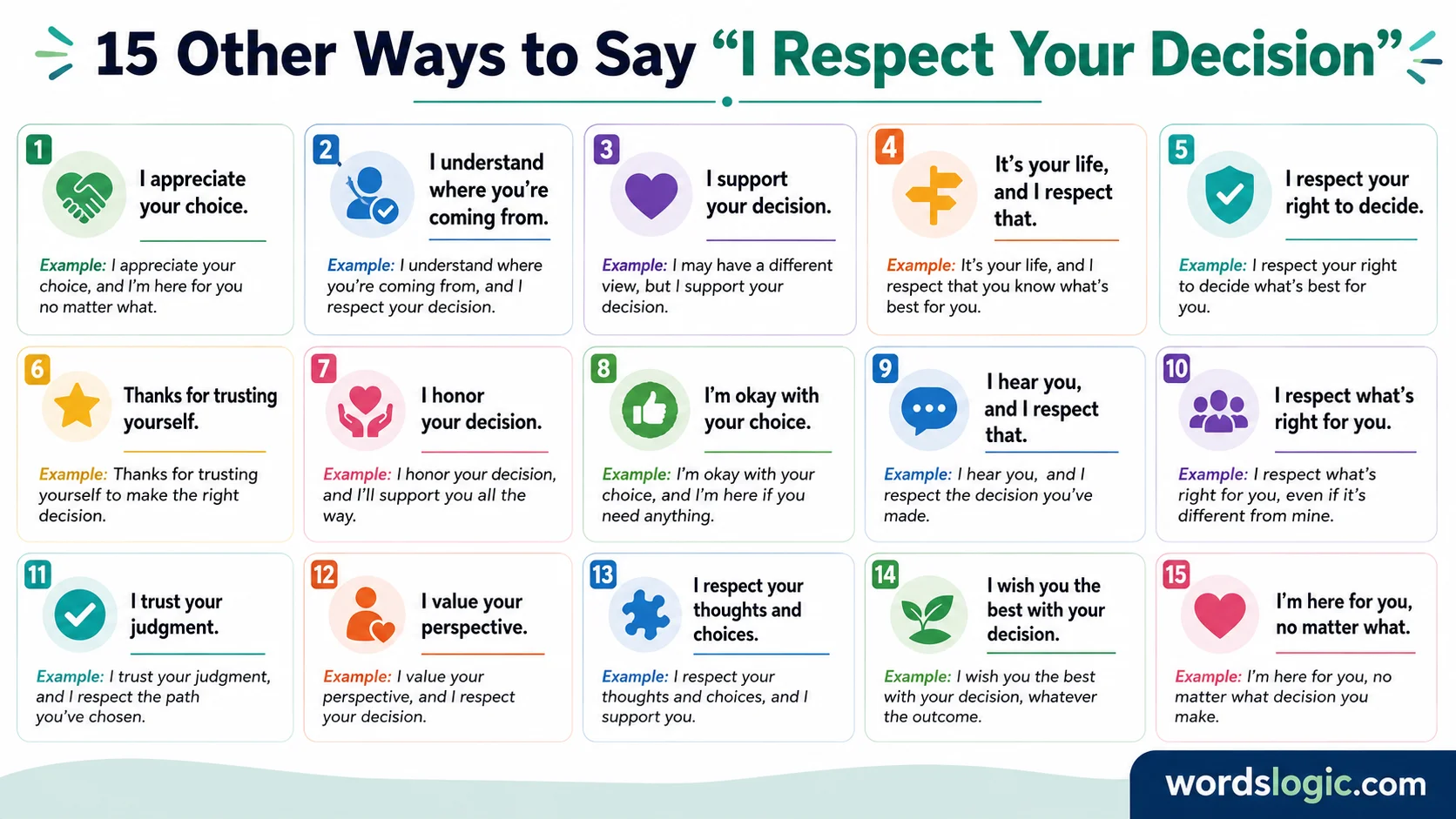
Other Ways to Say “I Respect Your Decision” can help you express empathy, support, and understanding in everyday and professional conversations. The right words build trust and stronger relationships.
Respecting someone’s choice means recognizing their autonomy, even when your opinions differ. Expressions like “I honor your choice,” “I value your judgment,” and “I support your decision” show sincerity, appreciation, and emotional awareness. These thoughtful alternatives help colleagues, friends, family members, and students feel heard and valued without creating conflict or pressure.
In professional settings, maintaining a calm tone, using respectful language, and accepting different perspectives can strengthen teamwork and communication. By choosing words carefully, you can encourage mutual understanding, protect personal boundaries, prevent disagreements from escalating, and build meaningful relationships based on trust, dignity, and genuine respect.
What Does “I Respect Your Decision” Mean?
“I respect your decision” means that you accept another person’s right to make a choice and acknowledge their freedom to decide what is best for them. You do not necessarily have to agree with the decision. Instead, you show that you recognize the other person’s perspective, independence, and personal judgment. For example, if a friend decides to move to another city, you can respect that choice even if you feel sad about being farther apart.
In everyday English, this expression communicates acceptance, maturity, and consideration. It is useful when discussing personal goals, relationships, workplace decisions, education, or other important matters. Depending on your tone, it can sound supportive, neutral, or formal. It also helps prevent disagreements from becoming personal by showing that you can acknowledge someone’s choice without insisting that they follow your advice.
Common Situations Where “I Respect Your Decision” Is Used
People use this phrase when someone makes a personal or professional choice that deserves acknowledgment. In everyday conversations, you might say it when a friend declines an invitation, chooses a different career, or decides to handle a problem independently. In relationships, it can show that you recognize your partner’s boundaries and understand that both people have the right to make individual choices.
The expression is also useful at work. A colleague may choose a different strategy, a manager may select another proposal, or a client may decline your recommendation. In these situations, respectful wording can preserve a positive working relationship without suggesting that you agree with every detail.
Text messages and emails are other common settings. A short response such as “I understand and respect your choice” can help you acknowledge a sensitive decision without writing a lengthy explanation. People may prefer an alternative when they want to sound more empathetic, encouraging, professional, or emotionally supportive.
Is It Professional or Polite to Say “I Respect Your Decision”?
Yes. “I respect your decision” is generally polite and appropriate for both personal and professional communication. It communicates that you recognize another person’s authority over their own choices. In a workplace email, it can acknowledge a colleague’s decision while keeping the conversation courteous and constructive. In personal conversations, it can demonstrate emotional maturity and respect for individual boundaries.
The phrase is also relatively direct. Depending on the situation, it may sound neutral rather than especially warm. If someone has made a difficult personal choice, “I understand where you’re coming from, and I support you” may communicate more empathy. In a formal setting, “I acknowledge your decision and will proceed accordingly” may be more suitable when you need to confirm a practical next step.
Context matters, too. Respecting someone’s decision does not mean you must agree with it, hide legitimate concerns, or accept behavior that violates your own boundaries. You can remain respectful while expressing a different opinion.
Advantages and Disadvantages of Saying “I Respect Your Decision”
Advantages
The main advantage of this phrase is its clarity. It tells the other person that you recognize their right to choose without creating unnecessary conflict. It is versatile enough for personal conversations, workplace discussions, and written communication. The expression also helps establish boundaries by making it clear that you do not intend to pressure someone into changing their mind.
Another benefit is its balanced tone. It can communicate acceptance without making promises you cannot keep. For example, you can respect a colleague’s decision to reject your proposal while continuing to work together professionally.
Disadvantages
Although the phrase is useful, it can sometimes sound formal or emotionally distant, particularly when someone is sharing a difficult or deeply personal decision. A friend who has made a painful choice may need reassurance rather than a neutral acknowledgment.
The wording can also leave your actual feelings unclear. The other person may wonder whether you genuinely support the decision or simply intend to stop discussing it. In situations where empathy matters, a warmer expression can communicate understanding more effectively. Choosing an alternative based on the relationship and circumstances helps prevent your message from sounding dismissive.
15 Alternatives to “I Respect Your Decision”
- I understand your choice.
- I support your decision.
- I respect your choice.
- I understand where you’re coming from.
- I appreciate your perspective.
- I trust your judgment.
- The choice is yours, and I respect that.
- I accept your decision.
- I stand behind your choice.
- I honor your decision.
- I can see why you chose that.
- I respect your right to decide.
- I’ll respect whatever you decide.
- I understand and won’t pressure you.
- I acknowledge your decision and will proceed accordingly.
1. I Understand Your Choice
Meaning
“I understand your choice” communicates that you recognize the reasons behind someone’s decision or accept that they have made a particular choice. It is a gentle alternative when you want to acknowledge someone’s perspective without necessarily agreeing with everything they have said.
Definition
To understand someone’s choice means to recognize or comprehend why they decided to do something.
Detailed Explanation
This expression focuses more on understanding than on explicitly expressing respect. It can reassure someone that you have listened to their explanation and are not dismissing their reasoning. Unlike the original phrase, it does not always clearly state that you accept their right to decide, so context and tone matter. It works particularly well when someone has explained a personal choice and wants to feel heard.
Scenario Examples
- Scenario: A friend explains why they cannot attend your birthday party.
Example: “I understand your choice, and I hope everything works out for you.” - Scenario: A colleague chooses a different project after considering several options.
Example: “I understand your choice. Thanks for explaining your reasons.” - Scenario: Your sibling decides to study in another city.
Example: “I understand your choice, even though I’ll miss having you nearby.”
Best Use
Use this expression in personal conversations, friendly messages, and workplace discussions where acknowledging someone’s reasoning is important.
Tone
Tone: Understanding, calm, considerate.
It sounds approachable because it recognizes the other person’s perspective without creating pressure to defend their decision further.
2. I Support Your Decision
Meaning
“I support your decision” communicates that you stand behind someone’s choice and want them to feel encouraged. It often expresses more active encouragement than simply respecting a decision.
Definition
To support someone’s decision means to approve of or encourage the choice they have made.
Detailed Explanation
This phrase is especially useful when someone needs reassurance about a major life change or an important professional move. It can suggest that you believe the person is making a reasonable choice and that you are willing to stand by them. Unlike neutral acknowledgment, support often communicates a positive attitude toward the decision itself. Use it when you genuinely feel supportive, rather than when you only want to recognize someone’s independence.
Scenario Examples
- Scenario: Your friend decides to return to university.
Example: “I support your decision to go back to school. You’ve thought carefully about this.” - Scenario: A colleague chooses to present a new approach to a client.
Example: “I support your decision to try this strategy. Let’s make sure we prepare well.” - Scenario: Your partner decides to pursue a new career.
Example: “I support your decision, and I’m here to help you through the transition.”
Best Use
Choose this expression for encouraging conversations, close relationships, team discussions, and decisions you genuinely endorse.
Tone
Tone: Warm, encouraging, reassuring.
It communicates active goodwill rather than simple acceptance, so it is best when you want the other person to feel supported.
3. I Respect Your Choice
Meaning
“I respect your choice” means that you recognize someone’s freedom to choose for themselves. It is very close in meaning to the original phrase and works in many of the same situations.
Definition
To respect someone’s choice means to acknowledge their right to make a decision without undue pressure or interference.
Detailed Explanation
This expression is a natural alternative when you want to emphasize personal freedom. The word “choice” can make the statement feel slightly more personal and conversational than “decision,” although both words are appropriate in professional and informal settings. You can use it when someone declines an offer, makes a relationship decision, or chooses a different path. It communicates respect without automatically suggesting agreement or approval.
Scenario Examples
- Scenario: A friend declines to join a weekend trip.
Example: “No worries. I respect your choice, and we can plan something another time.” - Scenario: Someone explains that they do not want to discuss a personal issue.
Example: “I respect your choice not to talk about it right now.” - Scenario: A coworker decides to remain in their current position.
Example: “I respect your choice and appreciate you sharing your plans.”
Best Use
Use it in everyday conversations, respectful disagreements, personal boundaries, and professional exchanges.
Tone
Tone: Respectful, neutral, considerate.
It is direct without being harsh and does not imply that you agree with every aspect of the decision.
4. I Understand Where You’re Coming From
Meaning
This expression means that you understand someone’s perspective, reasoning, or feelings. It helps communicate empathy, particularly when people have different opinions.
Definition
To understand where someone is coming from means to recognize the experiences, concerns, or reasons influencing their viewpoint.
Detailed Explanation
Unlike a direct statement of respect, this phrase focuses on the person’s point of view. It can reduce tension by showing that you have considered their reasons rather than judging the outcome immediately. It is especially useful during disagreements, when a person wants to explain why they made a particular decision. However, understanding someone’s reasoning does not necessarily mean that you approve of their choice.
Scenario Examples
- Scenario: A friend explains why they need more time alone.
Example: “I understand where you’re coming from. Everyone needs space sometimes.” - Scenario: A colleague prefers a different way to complete a task.
Example: “I understand where you’re coming from, although I see a few practical challenges.” - Scenario: Your partner explains why they want to postpone a major commitment.
Example: “I understand where you’re coming from, and I appreciate your honesty.”
Best Use
This expression works best in sensitive conversations, disagreements, relationship discussions, and collaborative workplace communication.
Tone
Tone: Empathetic, thoughtful, conversational.
It emphasizes listening and understanding rather than simply acknowledging the final decision.
5. I Appreciate Your Perspective
Meaning
“I appreciate your perspective” expresses respect for another person’s viewpoint and the reasoning behind it. It is particularly useful when you want to acknowledge an opinion without claiming that you agree.
Definition
To appreciate someone’s perspective means to recognize the value of their viewpoint or the thought behind it.
Detailed Explanation
This phrase is often more appropriate when someone shares their reasoning or explains an alternative approach. It communicates that their thoughts deserve consideration, even if you reach a different conclusion. Compared with the original phrase, it focuses on the person’s perspective rather than their authority to make the final decision. In professional discussions, it can help maintain a collaborative atmosphere while leaving room for further conversation.
Scenario Examples
- Scenario: A teammate recommends a different project timeline.
Example: “I appreciate your perspective. Let’s review how your suggestion would affect the deadline.” - Scenario: A friend explains why they disagree with your advice.
Example: “I appreciate your perspective, and I’m glad we can talk openly about it.” - Scenario: A family member offers a different view about a shared plan.
Example: “I appreciate your perspective, even though I may approach it differently.”
Best Use
Use this phrase in meetings, constructive disagreements, collaborative projects, and conversations where different viewpoints deserve attention.
Tone
Tone: Professional, thoughtful, diplomatic.
It recognizes another person’s contribution without automatically endorsing their decision.
6. I Trust Your Judgment
Meaning
This expression communicates confidence in someone’s ability to make a sensible or appropriate decision. It is stronger than simply acknowledging their right to choose.
Definition
To trust someone’s judgment means to believe they can evaluate a situation and make a sound decision.
Detailed Explanation
This phrase is useful when you want to show confidence in someone’s experience, knowledge, or ability to evaluate their options. It shifts the emphasis from accepting the decision to trusting the person who made it. In the workplace, it can demonstrate confidence in a colleague’s expertise or a team member’s independence. However, it should be used sincerely because it expresses more confidence than a neutral statement of respect.
Scenario Examples
- Scenario: You delegate a project decision to an experienced colleague.
Example: “I trust your judgment on this. Please choose the approach you think will work best.” - Scenario: Your friend is deciding whether to accept a new opportunity.
Example: “You’ve considered the options carefully, and I trust your judgment.” - Scenario: A family member must make a difficult personal choice.
Example: “I trust your judgment, and I know you’ll give this the thought it deserves.”
Best Use
Choose this expression for delegation, leadership, close relationships, and situations where confidence in someone’s decision-making ability matters.
Tone
Tone: Confident, supportive, reassuring.
It communicates faith in the person’s judgment rather than merely accepting the outcome.
7. The Choice Is Yours, and I Respect That
Meaning
This phrase makes it clear that the other person has the freedom to choose and that you accept their independence.
Definition
It means that someone else has the final say and that you acknowledge their right to make the decision.
Detailed Explanation
This expression places strong emphasis on personal autonomy. It is helpful when you have offered advice but do not want the other person to feel pressured to follow it. The wording can sound empowering when delivered warmly, although it may seem distant or dismissive if spoken impatiently. To keep the message respectful, make sure your tone communicates genuine acceptance rather than frustration.
Scenario Examples
- Scenario: A friend is deciding whether to attend a social event.
Example: “The choice is yours, and I respect that. Just let me know what you decide.” - Scenario: Your adult child chooses a different career path from the one you suggested.
Example: “The choice is yours, and I respect that. I want you to find what suits you.” - Scenario: A client decides not to proceed with a proposal.
Example: “The choice is yours, and I respect that. We’re happy to help if your plans change.”
Best Use
Use it when discussing personal independence, boundaries, optional invitations, and decisions that belong to someone else.
Tone
Tone: Direct, accepting, autonomy-focused.
It emphasizes the person’s freedom to choose, so a calm delivery helps it sound respectful rather than detached.
8. I Accept Your Decision
Meaning
“I accept your decision” communicates that you acknowledge the outcome and are willing to move forward without continuing to challenge it.
Definition
To accept someone’s decision means to recognize it as the current outcome and stop resisting it.
Detailed Explanation
This phrase is slightly different from saying you respect a decision. Acceptance emphasizes coming to terms with the result, while respect emphasizes recognizing someone’s right to decide. It is useful when a discussion has reached a conclusion and both parties need to move forward. Depending on the situation, it can sound neutral or somewhat final, especially when the decision disappoints you.
Scenario Examples
- Scenario: A friend decides to cancel a planned trip.
Example: “I accept your decision. We can look at other dates if you’re interested.” - Scenario: A manager selects another employee for a project.
Example: “I accept your decision and will focus on my current responsibilities.” - Scenario: A person decides to end a relationship.
Example: “I accept your decision, even though this is difficult for me.”
Best Use
Choose this expression for final decisions, workplace outcomes, difficult conversations, and situations where acceptance matters more than encouragement.
Tone
Tone: Calm, mature, sometimes final.
It acknowledges the outcome clearly, but it may need a warmer sentence afterward when emotional reassurance is important.
9. I Stand Behind Your Choice
Meaning
This expression means that you are willing to support or defend someone’s choice. It communicates a stronger commitment than simply recognizing their right to decide.
Definition
To stand behind someone’s choice means to support it and remain committed to that support.
Detailed Explanation
This phrase often suggests active backing rather than neutral respect. It can be appropriate when someone makes a difficult decision and needs to know that you will not abandon them because of it. In a professional environment, it may indicate confidence in a team member’s approach. However, standing behind a choice can imply endorsement, so avoid using it when you only want to acknowledge someone’s independence without agreeing with the decision.
Scenario Examples
- Scenario: Your colleague chooses a creative approach for a presentation.
Example: “I stand behind your choice. Let’s make sure we communicate the idea clearly.” - Scenario: A friend decides to set a firm boundary with someone.
Example: “I stand behind your choice to protect your peace.” - Scenario: A project leader chooses a challenging but reasonable strategy.
Example: “I stand behind your choice and will help the team carry it out.”
Best Use
Use it for team support, personal encouragement, leadership discussions, and situations where you genuinely endorse the decision.
Tone
Tone: Strong, loyal, supportive.
It signals commitment, making it more forceful than a simple acknowledgment of respect.
10. I Honor Your Decision
Meaning
“I honor your decision” communicates deep respect for someone’s choice, especially when it involves personal values, boundaries, identity, or an important life decision.
Definition
To honor someone’s decision means to recognize it with sincere respect and treat it as worthy of consideration.
Detailed Explanation
This expression can feel more heartfelt or solemn than the original phrase. It is especially useful when someone has made a deeply personal choice and you want to acknowledge its importance. The word “honor” can carry emotional weight, so it may sound overly formal for an ordinary disagreement about a small matter. In a sensitive conversation, however, it can communicate that you take the person’s choice seriously.
Scenario Examples
- Scenario: A friend chooses to step away from a demanding commitment.
Example: “I honor your decision to make more room for your well-being.” - Scenario: Someone explains a personal boundary.
Example: “I honor your decision and will respect the boundary you’ve set.” - Scenario: A family member chooses a path that reflects their values.
Example: “I honor your decision to follow what feels right for your life.”
Best Use
Choose this phrase for personal boundaries, meaningful life choices, sensitive discussions, and emotionally significant situations.
Tone
Tone: Sincere, thoughtful, heartfelt.
It expresses a deeper level of regard than everyday acknowledgment, so it works best when the situation deserves that emotional weight.
11. I Can See Why You Chose That
Meaning
This phrase communicates that you can recognize the reasoning behind someone’s decision. It shows understanding without necessarily agreeing with the outcome.
Definition
It means that the reasons for someone’s choice make sense or are understandable to you.
Detailed Explanation
This expression is more conversational than the original phrase and often works well when someone explains the factors behind a decision. It acknowledges the person’s reasoning rather than directly commenting on their right to decide. It can make a conversation feel more natural because it responds to the specific reasons someone has shared. If you want to express full acceptance as well, you can follow it with a short statement of respect.
Scenario Examples
- Scenario: A friend chooses a quieter holiday instead of a busy group trip.
Example: “I can see why you chose that. A quiet break sounds refreshing.” - Scenario: A colleague selects a more affordable supplier.
Example: “I can see why you chose that option, given the budget limits.” - Scenario: Your sibling chooses to live closer to work.
Example: “I can see why you chose that. The shorter commute should make life easier.”
Best Use
Use it in casual conversations, discussions about practical decisions, and situations where you want to acknowledge someone’s reasoning.
Tone
Tone: Conversational, understanding, practical.
It sounds natural and approachable, though it emphasizes the logic behind a choice more than respect itself.
12. I Respect Your Right to Decide
Meaning
This phrase explicitly recognizes that another person has the right to make their own decision. It is particularly suitable when discussing independence, boundaries, or differing opinions.
Definition
It means that you acknowledge another person’s freedom and authority to make a choice for themselves.
Detailed Explanation
Unlike the shorter original phrase, this expression places the focus on individual rights and autonomy. It can be helpful when a conversation involves disagreement, pressure, or an attempt to influence someone else’s choice. The wording is clear and firm, which makes it useful when boundaries need to be stated directly. However, it may sound formal or serious in a lighthearted conversation, so use it when personal independence is genuinely relevant.
Scenario Examples
- Scenario: A friend decides not to discuss a private matter.
Example: “I respect your right to decide what you feel comfortable sharing.” - Scenario: A colleague chooses to express a different opinion in a meeting.
Example: “I respect your right to decide how you approach the issue, even though my view differs.” - Scenario: Someone declines an invitation for personal reasons.
Example: “I respect your right to decide, and you don’t need to justify your answer.”
Best Use
This expression works best in boundary-setting conversations, respectful disagreements, personal matters, and discussions about individual freedom.
Tone
Tone: Firm, respectful, principled.
It clearly acknowledges personal autonomy and can help discourage pressure or interference.
13. I’ll Respect Whatever You Decide
Meaning
“I’ll respect whatever you decide” communicates that you will honor someone’s eventual choice, even if they have not made a final decision yet.
Definition
It means that you are willing to accept and respect the outcome of another person’s decision-making process.
Detailed Explanation
This phrase is particularly useful when someone is still weighing their options. Unlike the original phrase, which usually responds to a decision that has already been made, this expression offers reassurance before the outcome is known. It lets the other person know that they do not need to choose an option simply to please you. The wording can be comforting in personal conversations, although it may be unnecessarily lengthy for routine workplace decisions.
Scenario Examples
- Scenario: A friend is unsure whether to join a shared vacation.
Example: “Take your time deciding. I’ll respect whatever you decide.” - Scenario: Your partner is considering a major career change.
Example: “Think through your options carefully. I’ll respect whatever you decide.” - Scenario: A colleague is deciding whether to take on additional responsibilities.
Example: “Consider your workload first. I’ll respect whatever you decide.”
Best Use
Use it when someone needs time, reassurance, freedom from pressure, or room to consider a difficult choice.
Tone
Tone: Reassuring, patient, supportive.
It offers acceptance in advance and helps the other person feel free to make an honest decision.
14. I Understand and Won’t Pressure You
Meaning
This expression communicates understanding while making it clear that you will not try to force someone to change their mind.
Definition
It means that you acknowledge someone’s position and promise not to push them toward a different choice.
Detailed Explanation
This phrase is especially useful when someone has declined an offer, set a boundary, or expressed uncertainty about a decision. It goes beyond simple respect by addressing a common concern: the fear of being pressured after saying no. The wording is direct and reassuring, making it valuable in sensitive personal conversations. In a professional setting, a shorter acknowledgment may be more appropriate unless pressure has been part of the discussion.
Scenario Examples
- Scenario: A friend says they are not ready to discuss a disagreement.
Example: “I understand and won’t pressure you. We can talk when you feel ready.” - Scenario: Someone declines an invitation to a social event.
Example: “I understand and won’t pressure you to come. I hope you have a good evening.” - Scenario: Your partner needs time before making an important decision.
Example: “I understand and won’t pressure you. Take the time you need.”
Best Use
Choose this expression for personal boundaries, sensitive conversations, declined invitations, and situations where someone needs freedom from pressure.
Tone
Tone: Gentle, reassuring, considerate.
It explicitly promises not to push, which can make the message feel more supportive than a general statement of respect.
15. I Acknowledge Your Decision and Will Proceed Accordingly
Meaning
This expression communicates that you have recognized someone’s decision and intend to take the appropriate next steps.
Definition
It means that you formally recognize a decision and will act in a way that reflects the agreed outcome.
Detailed Explanation
This is the most formal alternative on the list. It is especially useful in workplace correspondence when a decision has practical consequences and the conversation needs to move toward action. Unlike the original phrase, it emphasizes acknowledgment and implementation rather than emotional respect. It can sound professional and efficient, but it may feel stiff in a personal conversation. Use it when confirming instructions, project decisions, or business outcomes rather than expressing emotional support.
Scenario Examples
- Scenario: A manager decides to change the project deadline.
Example: “I acknowledge your decision and will proceed accordingly by updating the project schedule.” - Scenario: A client chooses not to continue with a proposed service.
Example: “We acknowledge your decision and will proceed accordingly with the next steps.” - Scenario: A supervisor selects one of two proposed approaches.
Example: “I acknowledge your decision and will proceed accordingly with the implementation plan.”
Best Use
Use this phrase in formal emails, administrative communication, business correspondence, and workplace discussions that require clear follow-through.
Tone
Tone: Formal, professional, direct.
It communicates that the decision has been received and will guide your actions, rather than focusing on personal feelings.
FAQs
1. What does “I respect your decision” mean?
“I respect your decision” means you accept another person’s choice and recognize their right to decide for themselves. You can respect someone’s decision even when you have a different opinion. This phrase shows maturity, understanding, and consideration in personal and professional conversations.
2. What is another way to say “I respect your decision” professionally?
You can say “I value your judgment,” “I understand and respect your choice,” or “I support your decision.” These expressions sound professional while showing respect, empathy, and sincerity. Choose the phrase that best matches your relationship and the situation.
3. How do you respectfully disagree with someone’s decision?
You can acknowledge their perspective without pretending to agree. For example, say, “I understand your reasoning, and I respect your decision, although I see things differently.” This approach encourages respectful disagreement, supports open communication, and helps prevent unnecessary conflict.
4. How can I show respect for a decision at work?
Listen carefully, avoid judgment, and acknowledge your colleague’s point of view. You might say, “I understand your approach and respect your judgment.” Maintaining a professional tone, encouraging team collaboration, and respecting individual boundaries can build trust and improve workplace relationships.
5. Is saying “I respect your decision” better than saying “I support your decision”?
Both phrases express respect, but they have slightly different meanings. “I respect your decision” acknowledges someone’s right to choose, while “I support your decision” suggests that you actively agree with or encourage their choice. If you disagree but want to remain considerate, the first phrase may be more suitable.
Conclusion
Knowing different ways to say “I respect your decision” helps you communicate with greater empathy, confidence, and sincerity. Expressions such as “I honor your choice,” “I value your judgment,” and “I understand your perspective” allow you to recognize another person’s autonomy while maintaining a positive relationship. Whether you are speaking with a colleague, friend, family member, or student, choosing the right words can make your message feel more natural, thoughtful, and respectful.
In professional and personal conversations, focus on active listening, mutual understanding, and respectful communication. You do not have to agree with every decision to treat someone with dignity. By maintaining a calm tone, accepting different perspectives, and avoiding unnecessary judgment, you can strengthen trust, encourage healthy relationships, and create space for honest discussions. Choose the expression that fits your situation and communicates your message with genuine respect.













