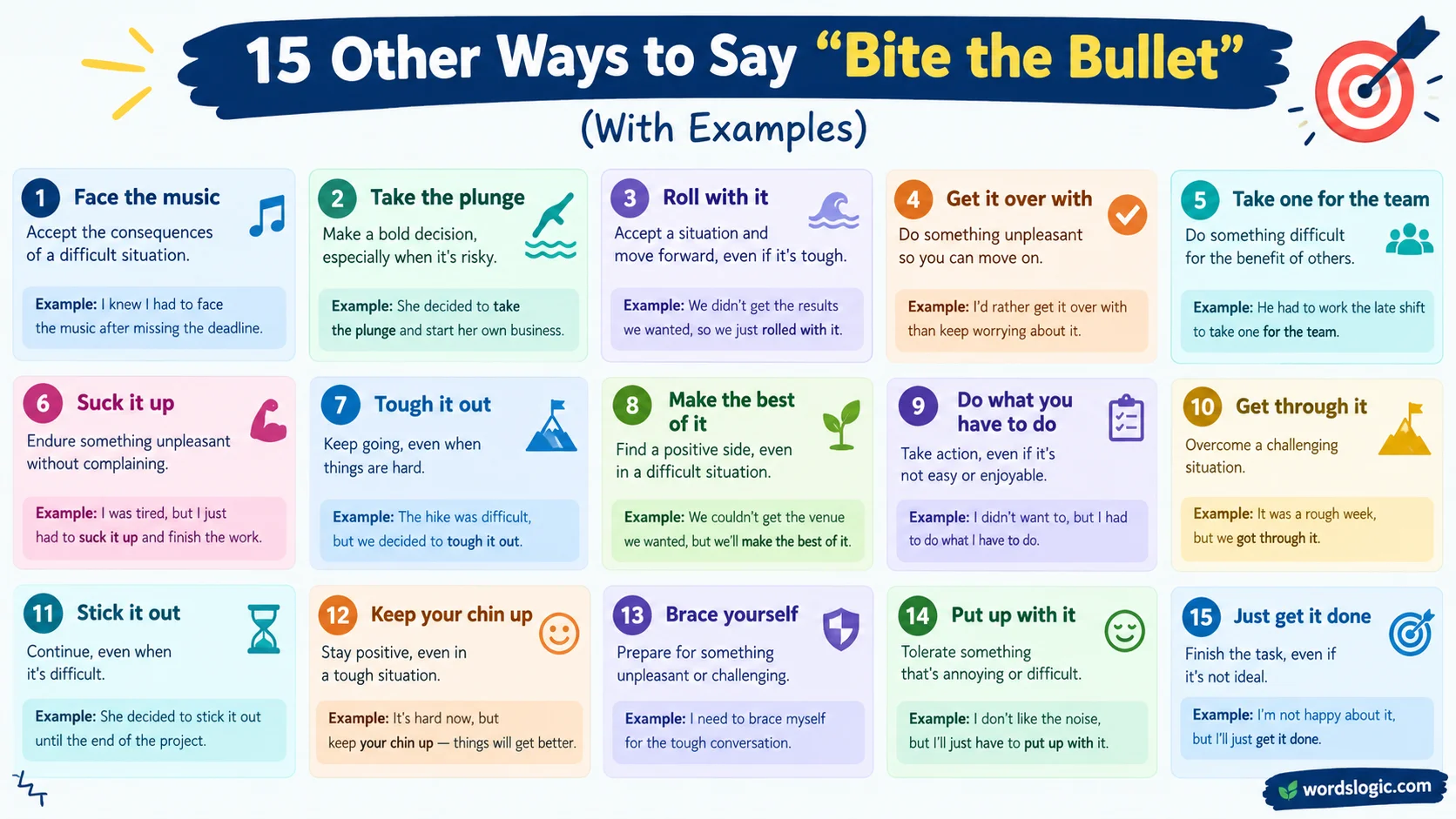
Other Ways to Say “Bite the Bullet” help you describe facing hard situations with courage, determination, and a willingness to act.
The phrase Bite the Bullet is an idiom that means facing something difficult, unpleasant, or painful instead of avoiding it. Its origin relates to historical practices in which soldiers reportedly bit a bullet during surgery to endure pain before anesthesia was available. Today, people use it figuratively when they accept an unavoidable situation and deal with it head-on. The expression encourages you to be brave, face challenges, and accept discomfort rather than keep putting off a necessary decision.
For example, you might hate visiting the dentist, hesitate to spend money on a new car, or struggle to make a decision quickly. If your old car begins to break down, buying another one may be necessary, even when the cost feels uncomfortable. In personal and professional experiences, biting the bullet can mean taking responsibility, choosing the right action, and acting despite fear. From personal experience, facing a problem instead of trying to escape it can help you grow, build confidence, and turn a setback into an opportunity for learning and progress.
Learning to manage time and stress takes self-discipline, accountability, and a positive mindset. Qualities such as fortitude, bravery, persistence, endurance, strength, resolve, commitment, and perseverance help people handle hardship. With determination, focus, and strong decision-making, difficult moments can become opportunities for personal growth. These habits build resilience, emotional strength, and mental toughness, supporting overcoming adversity, confidence building, and better outcomes in life.
What Does “Bite the Bullet” Mean?
“Bite the bullet” means to accept and face a difficult, unpleasant, or unavoidable situation instead of avoiding it. People commonly use this idiom when they must do something they would rather not do, such as having an uncomfortable conversation, paying an expensive bill, visiting the dentist, or completing a challenging task. The phrase suggests that a person is willing to endure temporary discomfort to deal with a problem or move forward. It usually communicates courage, determination, and acceptance, rather than enjoyment. For example, “I finally bit the bullet and told my manager about the mistake” means the speaker faced an uncomfortable situation instead of putting it off.
Common Situations Where “Bite the Bullet” Is Used
People use “bite the bullet” in everyday conversations when they decide to stop delaying something unpleasant. A student might use it when preparing for a difficult exam, while a friend might say it before making an important phone call. In personal relationships, the phrase can describe having an honest conversation even when the subject feels uncomfortable.
It also appears in workplace discussions. Someone might need to address a performance issue, make a difficult business decision, or complete a task they have been avoiding. In these situations, the idiom expresses practical courage and willingness to act. However, it is less suitable for formal documents where direct wording, such as “address the issue” or “make the necessary decision,” may sound clearer.
Is It Professional or Polite to Say “Bite the Bullet”?
“Bite the bullet” is generally acceptable in professional communication, especially in relaxed conversations, team meetings, and informal workplace emails. It sounds conversational and direct rather than strictly formal. For example, a colleague might say, “We need to bite the bullet and update the outdated system.” This communicates that the team should accept the inconvenience and move forward.
However, the phrase may sound too casual in a formal report, a sensitive customer email, or a message involving someone’s personal difficulties. In those situations, expressions such as “address the issue,” “take the necessary steps,” or “move forward with the decision” can sound more measured and respectful. The best wording depends on your audience, the seriousness of the situation, and whether you want to emphasize courage, acceptance, or practical action.
Advantages and Disadvantages of Saying “Bite the Bullet”
Advantages
The phrase “bite the bullet” is short, familiar, and expressive. It communicates the idea of facing discomfort without needing a lengthy explanation. Because it is an established English idiom, it works well in conversations about difficult choices, delayed responsibilities, and unavoidable tasks. It can also make a challenging situation sound manageable by emphasizing the decision to act rather than the discomfort involved.
Disadvantages
The expression is informal and may not suit every professional or sensitive situation. It can also make an unpleasant experience sound like something a person should simply endure, even when they need support or have legitimate concerns. In addition, it does not explain what action someone should take. Depending on the context, a clearer expression such as “deal with the problem,” “face the challenge,” or “make the difficult decision” may communicate the intended meaning more precisely.
15 Alternatives to “Bite the Bullet”
- Face it
- Do what needs to be done
- Grit your teeth
- Get it over with
- Take the plunge
- Brace yourself
- Push through
- Accept the inevitable
- Tackle it head-on
- Endure it
- Summon your courage
- Take the hit
- Do the hard thing
- Steel yourself
- Make the tough call
1. Face It
Meaning
“Face it” means to confront a difficult fact, problem, or situation instead of ignoring it. Like “bite the bullet,” it encourages someone to stop avoiding an uncomfortable reality.
Definition
To face it means to acknowledge a situation and deal with it directly.
Detailed Explanation
This expression is especially useful when the main challenge is accepting reality rather than completing an unpleasant task. It can sound firm and practical, particularly when someone has been denying a problem. Unlike “bite the bullet,” it does not always suggest enduring pain or discomfort. It can also introduce an honest observation about circumstances that cannot easily be changed.
Scenario Examples
- Scenario: A friend keeps avoiding a conversation about a failing relationship.
Example: “I think we need to face it and talk honestly about what’s happening.” - Scenario: A student realizes that an exam is approaching quickly.
Example: “I haven’t studied enough, so I need to face it and start preparing tonight.”
Best Use
Use “face it” when discussing difficult truths, personal problems, or situations that require honest acknowledgment. It works well in everyday conversation, personal messages, and straightforward workplace discussions.
Tone
Tone: Direct, realistic, and sometimes firm.
The phrase emphasizes honesty and acceptance. Depending on your delivery, it can sound supportive or slightly confrontational.
2. Do What Needs to Be Done
Meaning
“Do what needs to be done” means taking the necessary action, even when it is inconvenient or unpleasant. It shares the practical determination behind “bite the bullet.”
Definition
To do what needs to be done means to complete an important or necessary action without letting discomfort prevent you from acting.
Detailed Explanation
This expression focuses on responsibility rather than emotional discomfort. It is useful when a task cannot be ignored and someone must take action. Compared with “bite the bullet,” it sounds more neutral and often more professional. It also avoids suggesting that a person should silently tolerate every difficulty; the emphasis is on handling a genuine responsibility.
Scenario Examples
- Scenario: A team must correct a serious mistake before submitting a project.
Example: “Let’s do what needs to be done and fix the report before the deadline.” - Scenario: Someone needs to apologize after hurting a friend.
Example: “I know the conversation will be uncomfortable, but I need to do what needs to be done.”
Best Use
Use this expression in workplace communication, family responsibilities, personal decisions, and situations that require accountability. It fits both spoken English and professional messages.
Tone
Tone: Responsible, practical, and determined.
It communicates a willingness to act without dramatizing the difficulty.
3. Grit Your Teeth
Meaning
“Grit your teeth” means to prepare yourself to tolerate something painful, frustrating, or unpleasant. It is close to “bite the bullet” because both expressions suggest enduring discomfort.
Definition
To grit your teeth means to endure a difficult experience with determination, even when it tests your patience.
Detailed Explanation
This idiom emphasizes endurance more than decision-making. It is appropriate when someone must tolerate an uncomfortable experience or continue despite frustration. Unlike “bite the bullet,” it often highlights the effort involved in controlling your reaction. It can also suggest that the person dislikes the situation but is determined to get through it.
Scenario Examples
- Scenario: An employee must finish a demanding shift.
Example: “I’ll grit my teeth, finish the last few hours, and rest when I get home.” - Scenario: A runner struggles through the final stretch of a race.
Example: “She gritted her teeth and kept running until she reached the finish line.”
Best Use
Use “grit your teeth” when talking about physical discomfort, frustration, demanding work, or a challenging experience that requires patience. It is more expressive than a neutral phrase such as “continue working.”
Tone
Tone: Determined, tough, and slightly dramatic.
The wording highlights the struggle involved in enduring something difficult.
4. Get It Over With
Meaning
“Get it over with” means completing an unpleasant or uncomfortable task so that you no longer have to worry about it. It reflects the desire to stop delaying something difficult.
Definition
To get it over with means to finish an unwanted task or experience as soon as reasonably possible.
Detailed Explanation
This expression focuses on reaching the end of an unpleasant experience. It is common when someone has delayed a phone call, appointment, difficult conversation, or chore. Compared with “bite the bullet,” it places less emphasis on courage and more emphasis on finishing the task. It can sound impatient, but it is often used casually and naturally.
Scenario Examples
- Scenario: Someone has been putting off a dentist appointment.
Example: “I’ll book the appointment today and get it over with.” - Scenario: A student needs to deliver a presentation despite feeling nervous.
Example: “My presentation is first, so I’ll get it over with and relax afterward.”
Best Use
Use this expression for short-term tasks, appointments, difficult conversations, and responsibilities you want to finish. It works particularly well in casual conversations and text messages.
Tone
Tone: Casual, practical, and slightly impatient.
It suggests relief at the thought of completing something unpleasant.
5. Take the Plunge
Meaning
“Take the plunge” means committing to an important action or decision despite uncertainty or nervousness. It relates to “bite the bullet” when someone must overcome hesitation to move forward.
Definition
To take the plunge means to make a significant decision and finally act on it.
Detailed Explanation
This expression is best suited to decisions involving risk, uncertainty, or a major change. Someone might take the plunge by starting a business, changing careers, or moving to another city. Unlike “bite the bullet,” it often has an optimistic or exciting quality. It suggests stepping into something new rather than simply enduring an unpleasant experience.
Scenario Examples
- Scenario: A designer has been thinking about starting a freelance business.
Example: “After months of planning, she finally took the plunge and opened her own studio.” - Scenario: Someone is nervous about enrolling in a course.
Example: “I’ve been considering the program for a year. I think it’s time to take the plunge.”
Best Use
Use “take the plunge” for major decisions, new opportunities, career changes, and commitments that require confidence. Avoid using it as a direct substitute when the situation involves simply tolerating pain or completing an ordinary chore.
Tone
Tone: Encouraging, adventurous, and optimistic.
It presents a difficult decision as a step toward a new opportunity.
6. Brace Yourself
Meaning
“Brace yourself” means preparing mentally or emotionally for something difficult, surprising, or unpleasant. It shares the preparation aspect of “bite the bullet.”
Definition
To brace yourself means to get ready to face an expected challenge or uncomfortable experience.
Detailed Explanation
This phrase emphasizes preparation rather than action itself. You might brace yourself before hearing disappointing news, receiving difficult feedback, or dealing with a demanding day. Unlike “bite the bullet,” it does not necessarily mean you have accepted a decision or begun solving the problem. It simply communicates that you are preparing to handle what comes next.
Scenario Examples
- Scenario: A manager warns the team that a busy week is ahead.
Example: “Brace yourselves; the next few days will be demanding.” - Scenario: A friend is about to share disappointing news.
Example: “Brace yourself before I tell you what happened with the booking.”
Best Use
Use this expression when someone needs to prepare for a challenge, unexpected news, or an uncomfortable experience. It fits casual speech and friendly messages, although the wording can sound dramatic in sensitive situations.
Tone
Tone: Cautionary, direct, and sometimes playful.
It signals that a challenge may be coming and preparation will help.
7. Push Through
Meaning
“Push through” means continuing with a task or challenge despite difficulty, fatigue, or discouragement. Like “bite the bullet,” it communicates determination in an uncomfortable situation.
Definition
To push through means to keep going despite obstacles or temporary discomfort.
Detailed Explanation
This expression emphasizes persistence rather than acceptance. It works well when someone has already started a task and needs to continue until it is complete. Compared with “bite the bullet,” it sounds more active and focused on progress. However, it should not imply that people must ignore serious health concerns, unsafe conditions, or reasonable limits.
Scenario Examples
- Scenario: A student has several assignments due before the weekend.
Example: “I’ll push through this afternoon and finish the last two assignments.” - Scenario: A team encounters unexpected problems during a project.
Example: “We have a few setbacks, but we can push through and find a workable solution.”
Best Use
Use “push through” when discussing difficult projects, demanding schedules, challenging study sessions, or obstacles that require sustained effort. It is common in everyday and professional conversations.
Tone
Tone: Motivational, energetic, and determined.
It encourages continued effort rather than focusing on the discomfort itself.
8. Accept the Inevitable
Meaning
“Accept the inevitable” means acknowledging that something is going to happen and recognizing that resisting it may not change the outcome. It overlaps with “bite the bullet” when someone must come to terms with an unavoidable situation.
Definition
To accept the inevitable means to acknowledge an outcome that cannot reasonably be avoided.
Detailed Explanation
This expression emphasizes acceptance more than courage or effort. It is useful when circumstances are beyond someone’s control, such as the end of a project, an unavoidable change, or a decision that has already been finalized. Unlike “bite the bullet,” it does not necessarily imply taking action. It may communicate resignation, calm understanding, or reluctant acceptance, depending on the situation.
Scenario Examples
- Scenario: A family must move because their rental property is being sold.
Example: “We can’t change the landlord’s decision, so we’ll need to accept the inevitable and plan our move.” - Scenario: A team learns that a long-running project will be discontinued.
Example: “The funding has been withdrawn, and we have to accept the inevitable.”
Best Use
Use this phrase when discussing unavoidable changes, fixed outcomes, and situations that require acceptance. It suits thoughtful conversations and reflective writing, but it may sound pessimistic when used too early.
Tone
Tone: Realistic, resigned, and reflective.
It acknowledges limits and focuses on accepting circumstances rather than fighting them.
9. Tackle It Head-On
Meaning
“Tackle it head-on” means confronting a problem directly instead of avoiding it or waiting for it to disappear. It expresses the proactive attitude associated with “bite the bullet.”
Definition
To tackle something head-on means to address a challenge directly and deliberately.
Detailed Explanation
This expression emphasizes taking direct action to solve a problem. It works particularly well when the situation requires planning, communication, or active problem-solving. Compared with “bite the bullet,” it sounds more proactive and solution-focused. It is not limited to unpleasant experiences; it can describe confidently addressing any significant challenge.
Scenario Examples
- Scenario: A team has repeated communication problems.
Example: “We should tackle the issue head-on instead of letting misunderstandings continue.” - Scenario: A student struggles with a difficult subject.
Example: “I’m going to tackle algebra head-on by asking my teacher for extra help.”
Best Use
Use “tackle it head-on” in workplace discussions, education, problem-solving, and personal conversations where direct action is necessary. It is especially effective when you want to emphasize responsibility and a willingness to find solutions.
Tone
Tone: Confident, proactive, and solution-oriented.
It suggests facing a challenge directly rather than accepting it passively.
10. Endure It
Meaning
“Endure it” means tolerating a difficult, unpleasant, or painful experience over a period of time. It is related to “bite the bullet” when the focus is on getting through something uncomfortable.
Definition
To endure something means to experience difficulty without giving up or being overcome by it.
Detailed Explanation
This expression emphasizes the ability to withstand a challenging experience. It can describe temporary discomfort, a stressful period, or a demanding responsibility. Unlike “bite the bullet,” it does not necessarily suggest a decision to stop avoiding a task. It focuses on what someone must tolerate, so it may sound more serious or emotionally heavy in some contexts.
Scenario Examples
- Scenario: A student must complete a difficult examination.
Example: “The exam was exhausting, but I endured it and answered every question I could.” - Scenario: An employee works through a temporary period of organizational change.
Example: “The transition will be difficult, but we’ll endure it while the new process settles in.”
Best Use
Use “endure it” when describing a prolonged challenge, hardship, or uncomfortable experience. It fits serious conversations and reflective writing better than lighthearted situations.
Tone
Tone: Serious, patient, and resilient.
It emphasizes the ability to withstand hardship rather than the decision to begin a task.
11. Summon Your Courage
Meaning
“Summon your courage” means gathering the confidence or bravery needed to do something frightening or uncomfortable. It relates closely to “bite the bullet” when fear or nervousness is the main obstacle.
Definition
To summon your courage means to find the bravery needed to take a difficult step.
Detailed Explanation
This expression places emotional courage at the center of the situation. It is especially useful when a person feels afraid of rejection, confrontation, failure, or uncertainty. Compared with “bite the bullet,” it sounds more encouraging and personal. It also suggests that someone may already have the strength they need but must bring it forward to act.
Scenario Examples
- Scenario: An employee needs to raise a concern with a supervisor.
Example: “I finally summoned my courage and asked my manager to discuss the workload.” - Scenario: Someone wants to tell a close friend how they feel.
Example: “She summoned her courage and told him that their friendship meant a lot to her.”
Best Use
Use this expression in personal conversations, motivational writing, and situations involving fear or emotional vulnerability. It is less suitable for routine tasks that require little courage.
Tone
Tone: Encouraging, heartfelt, and courageous.
It highlights the emotional effort required to take a difficult step.
12. Take the Hit
Meaning
“Take the hit” means accepting a loss, setback, cost, or negative consequence instead of trying to avoid it. It relates to “bite the bullet” when a person must accept an unpleasant outcome.
Definition
To take the hit means to accept an adverse consequence or absorb a loss.
Detailed Explanation
This phrase is often used when a person or organization must deal with a financial cost, mistake, criticism, or setback. Unlike “bite the bullet,” it emphasizes the consequence being accepted rather than the courage needed to act. It can sound blunt and practical, especially in business or financial discussions. Use it carefully when someone has suffered a serious personal loss, because the wording may seem dismissive.
Scenario Examples
- Scenario: A business must pay for a mistake made during production.
Example: “We missed the deadline, so we’ll have to take the hit and cover the extra shipping costs.” - Scenario: A traveler discovers that changing a nonrefundable booking will cost extra.
Example: “The new flight is more expensive, but I’ll take the hit and book it anyway.”
Best Use
Use “take the hit” when discussing costs, setbacks, consequences, or short-term losses. It fits informal workplace conversations and practical decision-making, but it may be too blunt for sensitive personal communication.
Tone
Tone: Blunt, practical, and accepting.
It communicates a willingness to absorb a disadvantage rather than avoid the consequences.
13. Do the Hard Thing
Meaning
“Do the hard thing” means choosing to take a difficult but necessary action, even when a more comfortable option is available. It shares the sense of responsibility found in “bite the bullet.”
Definition
To do the hard thing means to take an action that requires effort, honesty, courage, or personal sacrifice.
Detailed Explanation
This expression is useful when a decision involves personal values or responsibility. It might mean apologizing, setting a boundary, telling the truth, or ending an unhealthy arrangement. Compared with “bite the bullet,” it often carries a stronger moral or emotional meaning. It suggests that the difficult choice may be worthwhile because it is responsible or honest, not merely unavoidable.
Scenario Examples
- Scenario: Someone needs to admit a mistake to a colleague.
Example: “I know it’s embarrassing, but I need to do the hard thing and take responsibility.” - Scenario: A person must set a boundary with a friend who repeatedly ignores their needs.
Example: “Sometimes you have to do the hard thing and explain what you’re no longer comfortable with.”
Best Use
Use this phrase when discussing accountability, relationships, difficult choices, and actions that reflect personal values. It works well in supportive conversations and thoughtful writing.
Tone
Tone: Thoughtful, sincere, and principled.
It emphasizes doing what matters even when the decision is emotionally difficult.
14. Steel Yourself
Meaning
“Steel yourself” means preparing mentally or emotionally to face something difficult. Like “bite the bullet,” it suggests getting ready to deal with an unpleasant experience.
Definition
To steel yourself means to strengthen your resolve before facing a challenge or upsetting situation.
Detailed Explanation
This expression focuses on inner preparation and emotional control. It is particularly useful before receiving difficult news, entering a tense conversation, or handling a demanding responsibility. Compared with “brace yourself,” it often sounds more deliberate and determined. Unlike “bite the bullet,” it does not necessarily mean the person has already decided to act or accept the situation.
Scenario Examples
- Scenario: A manager must deliver difficult feedback to an employee.
Example: “He steeled himself before explaining the concerns about the project.” - Scenario: Someone is preparing to discuss a painful family issue.
Example: “I took a deep breath and steeled myself for the conversation.”
Best Use
Use “steel yourself” before challenging conversations, stressful events, and emotionally demanding situations. It works in spoken English and narrative writing, although it can sound dramatic in everyday situations.
Tone
Tone: Serious, resolute, and composed.
It conveys a deliberate effort to prepare emotionally before facing difficulty.
15. Make the Tough Call
Meaning
“Make the tough call” means making a difficult decision, particularly when every available option has disadvantages. It relates to “bite the bullet” when the difficult part is choosing what to do.
Definition
To make the tough call means to choose a course of action despite uncertainty, pressure, or uncomfortable consequences.
Detailed Explanation
This expression is most appropriate when someone must decide between difficult alternatives. It commonly appears in workplace, leadership, financial, and personal situations. Unlike “bite the bullet,” which can describe enduring an unpleasant task, “make the tough call” specifically emphasizes the decision itself. It may also suggest responsibility for other people who will be affected by the outcome.
Scenario Examples
- Scenario: A project manager must reduce the scope of a delayed project.
Example: “We can’t deliver every feature on time, so we need to make the tough call and prioritize the essentials.” - Scenario: A family must choose between two expensive repair options.
Example: “Neither option is ideal, but we’ll have to make the tough call before the damage gets worse.”
Best Use
Use this expression in decision-making discussions, leadership conversations, financial planning, and situations involving competing priorities. It works well in professional communication when the focus is on choosing a course of action.
Tone
Tone: Decisive, serious, and responsible.
It communicates that a choice must be made even when the outcome may be uncomfortable.
FAQs
What does “Bite the Bullet” mean?
Bite the Bullet means facing a difficult, unpleasant, or painful situation with courage instead of avoiding it. It encourages you to accept reality and take the necessary action, even when you feel uncomfortable.
What are some other ways to say “Bite the Bullet”?
Some common alternatives include face the music, get it over with, do what needs to be done, face the challenge, and grit your teeth. Each phrase expresses the idea of dealing with something difficult, although the best choice depends on the situation and tone.
Is “Bite the Bullet” a formal or informal expression?
Bite the Bullet is an informal idiom commonly used in everyday conversations and workplace discussions. In formal writing, you can use expressions such as accept the challenge, address the issue, or take the necessary action to communicate the same idea more professionally.
How can I use “Bite the Bullet” in a sentence?
You can say, “I hate visiting the dentist, but I need to bite the bullet and book an appointment.” This sentence shows that you are willing to face an unpleasant situation instead of continuing to put it off.
Why is it important to bite the bullet?
Biting the bullet can help you develop courage, self-discipline, and resilience. Facing difficult situations early can reduce unnecessary stress, improve decision-making, and build confidence. However, it is also important to recognize when a situation requires a different approach rather than simply enduring it.
Conclusion
Learning other ways to say “Bite the Bullet” helps you express courage, determination, and acceptance in different situations. Expressions such as face the music, get it over with, and do what needs to be done can make your communication more natural and meaningful. Whether you are dealing with a personal problem, making a difficult decision, or handling a professional responsibility, choosing the right phrase helps you communicate your message clearly.
Remember that facing a challenge does not mean ignoring your feelings or accepting every difficult situation without question. It means recognizing what needs to be done and taking a thoughtful step forward. By practicing self-discipline, developing resilience, and maintaining a positive mindset, you can approach challenges with greater confidence. Choose an expression that fits your audience and situation, and use it to communicate your willingness to move forward with courage and purpose.