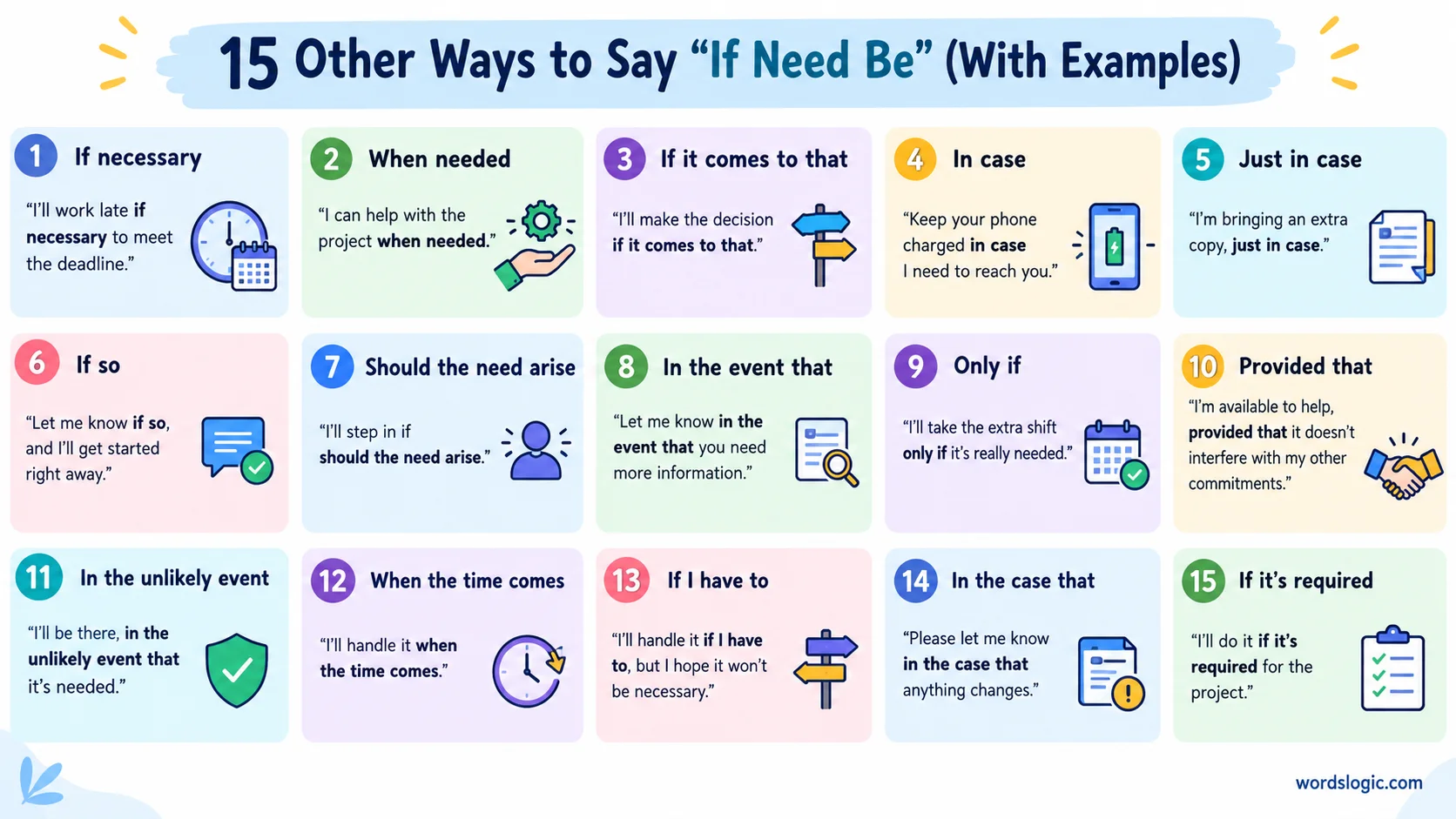
Other Ways to Say “If Need Be” can show that an action is necessary only when circumstances change, giving people a practical way to handle a condition or task.
Using If Need Be smartly helps explain when something is required but not always performed. This expression keeps things open, providing flexibility when the demand may change. It clearly implies that an action becomes necessary in certain situations, allowing us to respond responsibly.
For example, we may call someone, ask them to stay home, or leave without worrying that the choice will cause harm. This approach is effective because it signals the measure that is essential at the right moment. It also works when explaining plans, making adjustments, or showing that immediate attention may be needed, especially when a choice is taken as a last resort.
What Does “If Need Be” Mean?
“If need be” means “if it becomes necessary” or “if the situation requires it.” It describes something that may be done later if circumstances make it necessary. For example, “We can postpone the meeting if need be” means the meeting can be postponed if circumstances require postponement. The expression is grammatically correct and widely understood, although it can sound somewhat formal, literary, or old-fashioned compared with simpler alternatives such as “if necessary” or “if needed.”
The phrase often suggests that an action is not currently necessary but remains available as an option. It can therefore communicate flexibility and preparedness without saying that something definitely needs to happen.
Common Situations Where “If Need Be” Is Used
“If need be” can appear in conversation, emails, workplace communication, and formal writing. Someone might say, “I can stay later if need be,” to show that they are willing to remain available if circumstances change. In professional communication, it can express flexibility without making a commitment that may not be required.
The phrase is less common in casual texting than simpler wording such as “if needed,” “if necessary,” or “if required.” In formal or carefully written communication, however, “if need be” can still work well when its slightly traditional tone fits the message.
Is It Professional or Polite to Say “If Need Be”?
Yes. “If need be” is polite and grammatically acceptable, and it can sound professional in the right context. Its main characteristic is that it feels somewhat formal or traditional rather than casual. It does not sound rude or overly direct, but a simpler alternative may feel more natural in modern workplace emails or everyday conversation.
For example, “I can provide additional information if need be” is perfectly understandable in a professional setting. However, “if needed” or “if necessary” may sound more straightforward and contemporary. The best choice depends on whether you want your wording to feel formal, conversational, concise, or particularly polished.
Advantages and Disadvantages of Saying “If Need Be”
Advantages
The phrase “if need be” is concise and communicates conditional availability clearly. It tells the other person that an action can happen when circumstances make it necessary, without suggesting that the action is already required. It can also add a slightly formal or polished quality to professional and written communication.
Disadvantages
The main limitation is its formal and somewhat old-fashioned feel. Some readers may find “if need be” less natural than “if needed” or “if necessary,” especially in casual conversation. It may also sound more literary than intended when a simple, direct expression would communicate the same idea more clearly.
Synonyms for “If Need Be”
- If necessary
- If needed
- If required
- When necessary
- When needed
- As needed
- If the need arises
- If the situation calls for it
- If circumstances require it
- If circumstances demand it
- Should the need arise
- Should it become necessary
- If necessary at a later stage
- If the situation requires
- If it becomes necessary
1. If Necessary
Meaning
“If necessary” means that something will happen only when circumstances make it necessary. It is one of the closest and most natural alternatives to “if need be.”
Definition
If necessary: only if a particular action becomes needed or required.
Detailed Explanation
“If necessary” is usually more direct and modern than “if need be.” It works especially well when you want to make a conditional statement without adding unnecessary formality. The phrase is neutral enough for both everyday and professional communication. It can also fit naturally into instructions, plans, and formal writing.
Scenario Examples
Scenario: You are explaining that you can provide more information later.
Example: “I can send the full report if necessary.”
Scenario: A colleague may need additional help with a project.
Example: “I’ll stay late if necessary to finish the presentation.”
Scenario: You are giving instructions for handling a problem.
Example: “Contact the support team if necessary.”
Best Use
Use “if necessary” in professional emails, instructions, formal writing, and everyday conversation when you want a clear and neutral expression.
Tone
Tone: Neutral, professional, direct.
It sounds polished without being overly formal.
2. If Needed
Meaning
“If needed” means that something can be done when it becomes necessary or useful.
Definition
If needed: when something is required or would be helpful.
Detailed Explanation
This is one of the most natural modern alternatives to “if need be.” It is shorter and more conversational while preserving the original conditional meaning. “If needed” works particularly well when talking about help, information, resources, or actions that may become necessary. It is common in both spoken and written English.
Scenario Examples
Scenario: You are offering to help a coworker.
Example: “Let me know if you need help, and I can step in if needed.”
Scenario: You are sending documents to a client.
Example: “I can provide the original files if needed.”
Scenario: You are talking to a friend about transportation.
Example: “I can pick you up if needed.”
Best Use
Use it for emails, texts, workplace conversations, customer communication, and everyday speech.
Tone
Tone: Friendly, neutral, practical.
Its simple wording makes it feel natural and approachable.
3. If Required
Meaning
“If required” means something will happen when it is formally or practically required.
Definition
If required: only when a rule, situation, person, or circumstance makes something necessary.
Detailed Explanation
“If required” has a stronger sense of requirement or obligation than “if need be.” It is particularly useful when discussing procedures, documents, responsibilities, or official requirements. The phrase can sound more formal than “if needed.” Choose it when the situation involves a specific requirement rather than merely something that might be useful.
Scenario Examples
Scenario: A company explains what documents an applicant may need.
Example: “Additional identification will be requested if required.”
Scenario: A project manager discusses extra testing.
Example: “We can conduct another review if required.”
Best Use
Use it in professional communication, policies, procedures, applications, and formal writing.
Tone
Tone: Formal, professional, precise.
It emphasizes necessity connected to a requirement.
4. When Necessary
Meaning
“When necessary” refers to an action that should happen whenever circumstances make it necessary.
Definition
When necessary: at any time that something becomes necessary.
Detailed Explanation
Unlike “if necessary,” which emphasizes a possibility, “when necessary” can suggest that the action should be taken whenever the need actually occurs. It is useful for general instructions and recurring situations. The expression sounds natural in both spoken and written English. It can therefore be a good choice when discussing an ongoing process.
Scenario Examples
Scenario: You are explaining how often equipment should be checked.
Example: “Clean the filter when necessary.”
Scenario: A manager explains how employees should ask for assistance.
Example: “Contact your supervisor when necessary.”
Best Use
Use it for instructions, procedures, workplace guidance, and everyday advice.
Tone
Tone: Neutral, practical, instructional.
It focuses on responding appropriately when a need occurs.
5. When Needed
Meaning
“When needed” means whenever something becomes necessary or useful.
Definition
When needed: at the time something is required.
Detailed Explanation
“When needed” is a simple, flexible phrase that emphasizes timing. It often sounds more conversational than “when necessary,” especially when referring to help, resources, or support. It can describe something that should be available whenever circumstances call for it. The expression is easy to understand and rarely sounds overly formal.
Scenario Examples
Scenario: You are telling a new employee where to find support.
Example: “The team is available to assist you when needed.”
Scenario: A parent talks about helping a child with homework.
Example: “I’ll help you when needed, but I want you to try first.”
Best Use
Use it in friendly conversations, workplace messages, support situations, and practical instructions.
Tone
Tone: Warm, neutral, supportive.
It often suggests availability rather than obligation.
6. As Needed
Meaning
“As needed” means according to the need that arises.
Definition
As needed: whenever and to whatever extent something is necessary.
Detailed Explanation
“As needed” is slightly different from “if need be” because it often describes an action or resource that can be used whenever circumstances call for it. It is especially common in professional, medical, technical, and instructional contexts. The phrase can suggest flexibility and ongoing availability. It is concise and highly practical.
Scenario Examples
Scenario: A manager explains how staff can request additional materials.
Example: “Additional supplies can be ordered as needed.”
Scenario: A teacher explains access to extra practice.
Example: “Students may request extra exercises as needed.”
Scenario: A project team discusses meetings.
Example: “We’ll schedule additional meetings as needed.”
Best Use
Use it for workplace communication, instructions, procedures, planning, and practical situations.
Tone
Tone: Professional, concise, flexible.
It communicates that something is available according to circumstances.
7. If the Need Arises
Meaning
“If the need arises” means if circumstances create a need for something.
Definition
If the need arises: if a particular situation occurs that makes something necessary.
Detailed Explanation
This expression sounds slightly more polished than “if needed.” It focuses on the appearance of a need rather than simply stating that something may be required. It works well when discussing future possibilities that cannot yet be predicted. The phrase is especially useful when you want to reassure someone that action can be taken later.
Scenario Examples
Scenario: You are reassuring a client about future support.
Example: “If the need arises, we can arrange an additional consultation.”
Scenario: A friend offers help during a move.
Example: “Call me if the need arises and you want another pair of hands.”
Best Use
Use it in professional emails, thoughtful personal messages, and situations involving future possibilities.
Tone
Tone: Polished, reassuring, considerate.
It sounds prepared without making the situation seem urgent.
8. If the Situation Calls for It
Meaning
“If the situation calls for it” means if the circumstances make a particular action appropriate or necessary.
Definition
If the situation calls for it: if the circumstances justify or require taking a particular action.
Detailed Explanation
This phrase focuses on whether the circumstances justify an action, rather than simply whether something is technically needed. It can be useful when the appropriate response depends on what happens. Compared with “if need be,” it has a more contextual and conversational feel. It works well when discussing decisions, responses, or changes in plans.
Scenario Examples
Scenario: A team is discussing whether to change its approach.
Example: “We can adjust the plan if the situation calls for it.”
Scenario: You are talking about handling a difficult conversation.
Example: “I’ll speak up if the situation calls for it.”
Best Use
Use it in conversation, workplace discussions, planning, and situations where judgment matters.
Tone
Tone: Thoughtful, flexible, conversational.
It suggests responding according to the circumstances.
9. If Circumstances Require It
Meaning
“If circumstances require it” means if particular conditions make an action necessary.
Definition
If circumstances require it: if the existing situation makes something necessary.
Detailed Explanation
This expression is more formal than most everyday alternatives. It places emphasis on external circumstances rather than personal preference. It can be useful when explaining that a decision may change because conditions change. The wording fits careful professional and formal communication particularly well.
Scenario Examples
Scenario: A company explains that its schedule may change.
Example: “The deadline may be adjusted if circumstances require it.”
Scenario: A project leader discusses additional resources.
Example: “We can bring in another specialist if circumstances require it.”
Best Use
Use it in formal emails, reports, business communication, and official explanations.
Tone
Tone: Formal, measured, professional.
It sounds deliberate and emphasizes changing circumstances.
10. If Circumstances Demand It
Meaning
“If circumstances demand it” means if the situation becomes serious enough to require a particular action.
Definition
If circumstances demand it: if the conditions make an action strongly necessary.
Detailed Explanation
This phrase is stronger than “if needed” because “demand” suggests a compelling requirement. It is useful when circumstances may force someone to take action rather than merely make it convenient. Because of that stronger meaning, it should not be used when the action is only mildly useful. It works best when the situation could genuinely require a firm response.
Scenario Examples
Scenario: A business is discussing emergency arrangements.
Example: “We’ll extend operating hours if circumstances demand it.”
Scenario: Someone is explaining how they will respond to a serious problem.
Example: “I’ll take further action if circumstances demand it.”
Best Use
Use it in serious discussions, formal statements, planning, and situations involving significant changes.
Tone
Tone: Strong, serious, determined.
The word “demand” gives the expression more urgency than the original phrase.
11. Should the Need Arise
Meaning
“Should the need arise” means “if a need develops or becomes apparent.”
Definition
Should the need arise: if it becomes necessary at some point in the future.
Detailed Explanation
This is a polished conditional expression often used in formal or professional writing. It has essentially the same conditional idea as “if the need arises,” but its structure sounds more formal. It can make an offer of assistance sound courteous without being overly familiar. Because of its formal character, it is less common in casual speech.
Scenario Examples
Scenario: A consultant offers future assistance.
Example: “Should the need arise, I would be happy to discuss the matter further.”
Scenario: A business explains that extra support remains available.
Example: “Should the need arise, additional staff can be assigned.”
Best Use
Use it in formal emails, business correspondence, official communication, and polished written English.
Tone
Tone: Formal, courteous, polished.
Its traditional conditional structure gives it a refined written style.
12. Should It Become Necessary
Meaning
“Should it become necessary” means if something becomes necessary in the future.
Definition
Should it become necessary: if circumstances later make a particular action necessary.
Detailed Explanation
This phrase is a formal way to discuss a possibility that may arise later. It highlights a change in circumstances: something is not necessary now but could become necessary. It is particularly suitable when writing about future actions or contingency plans. Compared with “if needed,” it sounds more deliberate and formal.
Scenario Examples
Scenario: A company discusses possible changes to a project.
Example: “Should it become necessary, we can revise the schedule.”
Scenario: You are writing a formal message to a client.
Example: “Should it become necessary, I will provide further documentation.”
Best Use
Use it in formal correspondence, business writing, reports, and contingency planning.
Tone
Tone: Formal, cautious, professional.
It communicates preparedness without assuming that further action will be needed.
13. If Necessary at a Later Stage
Meaning
“If necessary at a later stage” means if something becomes necessary as a situation develops.
Definition
If necessary at a later stage: only if circumstances later make an action necessary.
Detailed Explanation
This expression adds a time element that “if need be” does not always make explicit. It is useful when you want to reassure someone that a decision or action does not have to happen immediately. The wording works particularly well in planning and project discussions. It makes the sequence of events clearer by indicating that the action may be considered later.
Scenario Examples
Scenario: A team is deciding whether to add another phase to a project.
Example: “We can introduce another stage if necessary at a later stage.”
Scenario: A manager discusses additional training.
Example: “We can arrange further training if necessary at a later stage.”
Best Use
Use it in planning discussions, project communication, workplace emails, and formal explanations.
Tone
Tone: Professional, cautious, future-focused.
It clearly separates the current situation from a possible future need.
14. If the Situation Requires
Meaning
“If the situation requires” means if the circumstances make a particular response necessary.
Definition
If the situation requires: if the circumstances call for a specific action.
Detailed Explanation
This expression connects the decision directly to the situation itself. It can sound more objective than saying “if I need to,” because the focus is on circumstances rather than personal preference. It is useful when discussing plans that may need to change. In some sentences, “if the situation requires it” is more complete and natural, but the shorter version can work when the intended action is already clear.
Scenario Examples
Scenario: A manager discusses changing staffing levels.
Example: “We can bring in additional staff if the situation requires.”
Scenario: A team is discussing whether to alter its strategy.
Example: “We’ll make adjustments if the situation requires.”
Best Use
Use it in workplace discussions, planning, professional communication, and decision-making contexts.
Tone
Tone: Professional, direct, objective.
It emphasizes the circumstances behind a possible decision.
15. If It Becomes Necessary
Meaning
“If it becomes necessary” means if something that is not currently required becomes necessary later.
Definition
If it becomes necessary: if circumstances change so that an action is needed.
Detailed Explanation
This is a very clear alternative when you want to emphasize future necessity. It makes the timing explicit and is easy for almost any reader to understand. Compared with “if need be,” it sounds more modern and conversational. It is especially useful when discussing plans that may change as circumstances develop.
Scenario Examples
Scenario: A team is discussing whether additional testing may be required.
Example: “We can run another test if it becomes necessary.”
Scenario: You are reassuring someone that you can provide more information later.
Example: “I’ll send the remaining details if it becomes necessary.”
Scenario: A friend asks whether you can change your plans.
Example: “I can stay longer if it becomes necessary.”
Best Use
Use it in everyday conversation, workplace communication, emails, and planning discussions.
Tone
Tone: Neutral, clear, flexible.
It sounds natural while clearly showing that the need may arise later.
FAQs
What is another way to say “if need be”?
Common alternatives include “if necessary,” “if needed,” “if required,” “when necessary,” and “if the need arises.” The best choice depends on whether you want your wording to sound casual, professional, formal, or conversational.
What does “if need be” mean?
“If need be” means “if necessary” or “if circumstances make it necessary.” It describes an action that may be taken if a particular need arises.
Is “if need be” professional?
Yes. “If need be” is grammatically correct and can be professional, although it has a somewhat formal or traditional feel. In modern workplace communication, “if needed” or “if necessary” may sound more natural.
What is a more polite way to say “if need be”?
The phrase itself is already polite, but “should the need arise” can sound especially courteous and polished in formal communication. “If the need arises” is another considerate option.
Which alternative works best in formal communication?
“If required,” “should the need arise,” and “should it become necessary” are useful in formal contexts. For most professional emails, however, “if necessary” is often clearer and more straightforward.
Conclusion
Choosing another way to say “if need be” can make your communication sound more natural and better suited to the situation. “If necessary” is a clear all-purpose option, while “if needed” feels more conversational and “if required” adds a stronger sense of obligation. More formal expressions such as “should the need arise” can work well in polished business writing, while “if it becomes necessary” clearly emphasizes a possible future need.
The key is to consider your audience, context, tone, and intended meaning rather than treating every alternative as interchangeable. When you choose wording that matches the situation, your message becomes easier to understand and more natural to read.