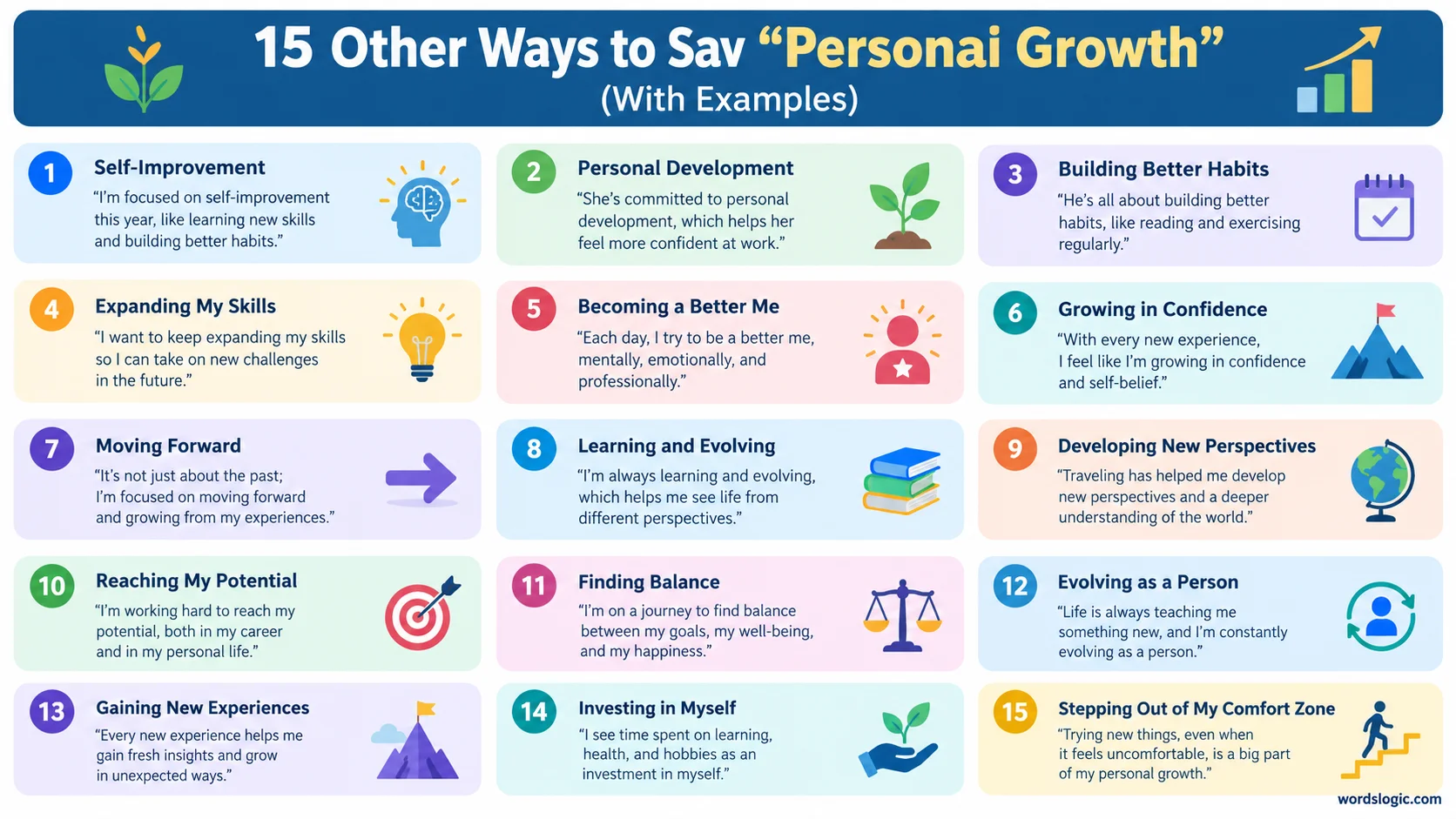
Other Ways to Say “Personal Growth” helps express self-development, positive change, and becoming a better version of yourself through small steps and steady effort. Personal growth is a gradual process that builds confidence through self-empowerment, self-guided learning, and daily habits.
Practices such as meditation, mindfulness, and positive self-talk can strengthen self-mastery, self-confidence, and awareness of your potential. With regular self-reflection and a willingness to learn, you can make real progress, achieve personal betterment, and experience personal evolution, flourishing, and transformation.
There are many strong alternatives and powerful phrases that describe different aspects of growth. Expressions such as personal development, self-improvement, inner growth, holistic growth, individual growth, and personal advancement describe ways to improve your life.
What Does “Personal Growth” Mean?
Personal growth means the ongoing process of improving yourself emotionally, mentally, socially, or personally. It involves learning from experiences, understanding your strengths and weaknesses, developing healthier habits, and becoming better equipped to handle life’s challenges. People often associate personal growth with self-awareness, emotional maturity, confidence, and continuous learning.
The phrase can describe both small, everyday improvements and major life changes. For example, learning to communicate more honestly, becoming more patient, setting healthy boundaries, or developing a new skill can all contribute to personal growth. It does not mean becoming perfect; instead, it means making a conscious effort to understand yourself and move toward a more fulfilling life.
Common Situations Where “Personal Growth” Is Used
The expression appears in many areas of everyday life because improvement can happen in different ways.
- Everyday conversations: People discuss personal growth when talking about lessons learned, changing habits, or becoming more confident.
- Relationships: It can describe learning to communicate better, understand others, and manage disagreements more maturely.
- Education: Students may use the term when reflecting on new skills, independence, or lessons gained through challenges.
- Workplace communication: Employees and managers may discuss personal growth in connection with leadership, communication, and professional development.
- Journaling and personal reflection: Writers use the phrase to describe changes in their mindset, values, and behavior.
- Social media: Motivational posts often use it to discuss self-improvement, resilience, and becoming a better version of oneself.
- Formal writing: Essays, development plans, and reflective statements may use the phrase to describe progress over time.
An alternative can make the intended meaning more specific. For instance, self-development emphasizes deliberate improvement, while emotional maturity focuses on handling feelings and relationships more thoughtfully.
Is It Professional or Polite to Say “Personal Growth”?
Yes, personal growth is a professional, polite, and widely understood expression. It works well in reflective writing, career conversations, educational settings, and discussions about individual development. Its tone is generally positive and thoughtful rather than overly formal or emotional.
In the workplace, however, the phrase may be less precise when discussing a specific job-related objective. Professional development or skill development may be more suitable when the focus is on workplace abilities, training, or career progression. In personal conversations, self-discovery or becoming a better version of yourself may sound warmer and more relatable. The best choice depends on whether you want to emphasize learning, emotional change, practical improvement, or a broader life journey.
Advantages and Disadvantages of Saying “Personal Growth”
Advantages
- Broad meaning: It covers emotional, mental, social, and behavioral improvement.
- Positive tone: The phrase communicates hope, reflection, and a willingness to improve.
- Versatility: It fits conversations, personal essays, social media posts, and professional discussions.
- Encourages reflection: It invites people to think about what they have learned and how they have changed.
- Easy to understand: Most English speakers can understand the general idea without additional explanation.
Disadvantages
- Can sound vague: Without examples, it may be unclear what kind of improvement someone means.
- May feel overused: In motivational writing, the expression can lose impact when repeated too often.
- Does not identify a specific goal: It does not explain whether someone is improving communication, emotional control, knowledge, or practical skills.
- May sound abstract: In professional plans, concrete terms such as skill development or leadership development can communicate measurable objectives more clearly.
Synonyms for “Personal Growth”
- Self-development
- Self-improvement
- Personal development
- Self-discovery
- Emotional maturity
- Continuous learning
- Inner growth
- Character development
- Becoming a better version of yourself
- Self-awareness
- Life development
- Individual progress
- Mindset development
- Emotional development
- Becoming your best self
1. Self-Development
Meaning
Self-development refers to intentionally building your abilities, habits, knowledge, and personal qualities. It emphasizes the active steps you take to improve yourself.
Definition
Self-development is the deliberate process of strengthening personal skills, qualities, and capabilities.
Detailed Explanation
Self-development is one of the closest alternatives to personal growth, especially when improvement involves specific actions. It suggests taking responsibility for your progress rather than waiting for change to happen naturally. You might focus on communication, discipline, confidence, or learning a new skill. Compared with personal growth, it often sounds more intentional and goal-oriented.
Scenario Examples
Scenario: A friend wants to become more organized.
Example: “I’ve started planning my week every Sunday as part of my self-development.”
Scenario: An employee wants to improve their communication skills.
Example: “Self-development has helped me become more confident when presenting ideas.”
Scenario: Someone is discussing future goals.
Example: “I want to make more time for self-development this year.”
Best Use
Use this expression in personal development plans, professional conversations, reflective writing, and discussions about building better habits.
Tone
Tone: Purposeful, thoughtful, professional.
It highlights personal responsibility and the effort involved in becoming more capable.
2. Self-Improvement
Meaning
Self-improvement means making changes to become better at something or improve an aspect of your life. It often focuses on practical actions and noticeable progress.
Definition
Self-improvement is the process of working to improve your habits, abilities, behavior, or overall well-being.
Detailed Explanation
Self-improvement is particularly useful when you want to emphasize concrete changes rather than a broad life journey. It may involve exercising regularly, managing time better, learning a language, or becoming more patient. The phrase can sound more practical than personal growth because it suggests identifying an area that needs improvement and taking steps to address it. However, it does not necessarily imply that someone is unhappy with themselves; it can simply reflect a desire to keep learning.
Scenario Examples
Scenario: A friend is trying to develop healthier habits.
Example: “I’ve been focusing on self-improvement by getting enough sleep and exercising regularly.”
Scenario: Someone wants to become a better public speaker.
Example: “Practicing in front of small groups is part of my self-improvement plan.”
Scenario: A person shares a motivational message.
Example: “Self-improvement starts when you decide to take small steps consistently.”
Best Use
Use it in habit-building discussions, motivational writing, personal goals, and conversations about making practical changes.
Tone
Tone: Encouraging, practical, goal-oriented.
It emphasizes taking action to improve particular areas of life.
3. Personal Development
Meaning
Personal development describes the process of expanding your abilities, understanding, confidence, and personal qualities. It can include both emotional development and practical learning.
Definition
Personal development is the ongoing effort to strengthen the skills and qualities that support a person’s life and goals.
Detailed Explanation
Personal development is very close in meaning to personal growth and is often suitable in both professional and everyday settings. It can refer to structured activities, such as attending workshops, setting goals, or working with a mentor, as well as informal learning through life experiences. The phrase sounds slightly more organized and structured than personal growth. It is especially useful when discussing a plan for improvement rather than simply reflecting on how you have changed.
Scenario Examples
Scenario: A university student discusses goals beyond academic grades.
Example: “My university experience has supported my personal development in many ways.”
Scenario: A manager discusses an employee’s long-term goals.
Example: “We included communication training in her personal development plan.”
Scenario: Someone reflects on living independently.
Example: “Moving away from home contributed greatly to my personal development.”
Best Use
Choose this phrase for workplace discussions, educational settings, development plans, reflective essays, and formal writing.
Tone
Tone: Professional, balanced, constructive.
It communicates improvement in a clear and organized way without sounding overly technical.
4. Self-Discovery
Meaning
Self-discovery is the process of learning more about your identity, values, interests, needs, and beliefs. It focuses on understanding who you are rather than simply improving what you do.
Definition
Self-discovery is the process of gaining a deeper understanding of yourself.
Detailed Explanation
Self-discovery is related to personal growth, but the two expressions are not exact synonyms. Growth emphasizes change and improvement, while self-discovery emphasizes awareness and understanding. Someone may experience self-discovery after traveling, changing careers, spending time alone, or reflecting on a difficult experience. It is particularly appropriate when the most important change is realizing what matters to you or recognizing a part of yourself that you had not previously understood.
Scenario Examples
Scenario: A person takes a solo trip to reflect on their priorities.
Example: “Traveling alone gave me time for self-discovery.”
Scenario: A young adult considers different career paths.
Example: “Trying different subjects helped me discover what I genuinely enjoy.”
Scenario: Someone writes about a major life transition.
Example: “That difficult year became a period of self-discovery for me.”
Best Use
Use it in personal essays, journal entries, conversations about identity, and reflections on life transitions.
Tone
Tone: Introspective, personal, reflective.
It emphasizes understanding yourself rather than measuring your progress.
5. Emotional Maturity
Meaning
Emotional maturity refers to the ability to understand and manage your emotions, respond thoughtfully, and consider other people’s feelings. It is one specific aspect of personal growth.
Definition
Emotional maturity is the ability to handle emotions and relationships with awareness, balance, and responsibility.
Detailed Explanation
Emotional maturity is more specific than personal growth because it focuses on emotional responses and interpersonal behavior. It may involve listening without immediately becoming defensive, accepting criticism, apologizing sincerely, or handling disappointment calmly. The phrase suggests that someone can respond thoughtfully even when a situation feels difficult. It is not about suppressing emotions or never feeling upset; it is about responding to feelings in a constructive way.
Scenario Examples
Scenario: Two partners discuss a disagreement.
Example: “We’ve both developed more emotional maturity since we learned to listen before reacting.”
Scenario: A colleague receives difficult feedback.
Example: “She showed emotional maturity by considering the feedback instead of taking it personally.”
Scenario: A person reflects on past arguments.
Example: “I can see how much I’ve changed in the way I handle conflict.”
Best Use
Use it when discussing relationships, conflict resolution, emotional regulation, communication, and responsible behavior.
Tone
Tone: Thoughtful, mature, respectful.
It emphasizes the quality of your emotional responses rather than personal improvement in general.
6. Continuous Learning
Meaning
Continuous learning means regularly gaining new knowledge, skills, or understanding throughout life. It emphasizes curiosity and the willingness to keep learning.
Definition
Continuous learning is the ongoing process of acquiring knowledge and improving skills over time.
Detailed Explanation
Continuous learning is an excellent alternative when personal growth happens mainly through education, experience, or practice. It is commonly used in professional settings, where industries and responsibilities change over time. Unlike personal growth, it does not necessarily refer to emotional development or changes in character. Instead, it highlights the belief that learning does not stop when formal education ends.
Scenario Examples
Scenario: An employee learns a new software tool.
Example: “Continuous learning helps me stay adaptable as my responsibilities change.”
Scenario: A student explores a topic beyond the classroom.
Example: “Reading outside my course is part of my commitment to continuous learning.”
Scenario: A professional discusses career goals.
Example: “I want to make continuous learning a regular part of my career.”
Best Use
Choose this expression for professional development, education, training, career planning, and discussions about gaining new knowledge.
Tone
Tone: Professional, curious, forward-looking.
It communicates a commitment to learning rather than a broader emotional or personal transformation.
7. Inner Growth
Meaning
Inner growth refers to changes in your mindset, values, emotional understanding, and sense of purpose. It emphasizes changes that happen within you rather than outward achievements.
Definition
Inner growth is the development of a person’s internal understanding, emotional strength, and personal values.
Detailed Explanation
Inner growth is useful when you want to describe changes that may not be immediately visible to others. Becoming more patient, letting go of resentment, understanding your priorities, or learning to accept uncertainty can all be examples. The expression often sounds more reflective and personal than personal development. It does not necessarily imply that someone has acquired a measurable skill; instead, it points to a deeper change in perspective or character.
Scenario Examples
Scenario: Someone learns to stop comparing themselves with others.
Example: “I’ve experienced a lot of inner growth since I stopped measuring my life against other people’s achievements.”
Scenario: A friend discusses recovering from a difficult period.
Example: “That experience challenged me, but it also encouraged inner growth.”
Scenario: A person writes a thoughtful journal entry.
Example: “Sometimes inner growth means accepting what you cannot control.”
Best Use
Use it in journaling, reflective writing, personal conversations, and discussions about values, resilience, and changing perspectives.
Tone
Tone: Reflective, gentle, introspective.
It focuses on personal changes that develop beneath the surface.
8. Character Development
Meaning
Character development refers to changes in a person’s qualities, values, and behavior. It emphasizes becoming more responsible, honest, patient, courageous, or considerate.
Definition
Character development is the process of shaping and strengthening the personal qualities that influence how someone behaves.
Detailed Explanation
Character development is a more specific alternative to personal growth when the main focus is on values and behavior. It may involve learning to take responsibility, keeping promises, admitting mistakes, or treating others fairly. The expression also appears frequently in literature and film, where it describes how a fictional character changes throughout a story. In personal contexts, it suggests growth in integrity and character, rather than improvement in every area of life.
Scenario Examples
Scenario: A teenager learns to take responsibility for mistakes.
Example: “Accepting the consequences of his choices became an important part of his character development.”
Scenario: A mentor discusses leadership.
Example: “Good leadership requires character development as well as technical knowledge.”
Scenario: A writer explains a novel.
Example: “The main character’s development becomes clear when she chooses honesty over personal gain.”
Best Use
Use it in discussions about values, leadership, responsibility, moral choices, education, and storytelling.
Tone
Tone: Serious, thoughtful, values-focused.
It emphasizes how a person’s qualities and conduct develop over time.
9. Becoming a Better Version of Yourself
Meaning
Becoming a better version of yourself means making positive changes while remaining true to who you are. It emphasizes personal progress without suggesting that you must become someone completely different.
Definition
This expression describes the effort to improve your habits, choices, abilities, or behavior in ways that support the person you want to become.
Detailed Explanation
This phrase expresses personal growth in a warm, accessible way. Unlike technical terms such as personal development, it sounds natural in everyday conversation and motivational writing. It can refer to becoming kinder, more disciplined, more confident, or more thoughtful in relationships. The wording should not suggest that a person has no value as they are; its strongest meaning is about building on your existing strengths while working toward meaningful change.
Scenario Examples
Scenario: A friend is setting goals for the new year.
Example: “I’m focusing on becoming a better version of myself, one habit at a time.”
Scenario: A person wants to improve a relationship.
Example: “I want to become a better version of myself so I can communicate more honestly.”
Scenario: Someone shares a personal reflection online.
Example: “You don’t have to change everything overnight to become a better version of yourself.”
Best Use
Choose this phrase for casual conversations, encouraging messages, social media captions, personal reflections, and motivational writing.
Tone
Tone: Warm, encouraging, optimistic.
It presents improvement as an ongoing journey rather than a demand for perfection.
10. Self-Awareness
Meaning
Self-awareness means understanding your own emotions, habits, motivations, strengths, and weaknesses. It is an important part of personal growth because it helps you recognize what may need to change.
Definition
Self-awareness is the ability to recognize and understand your own thoughts, feelings, and behavior.
Detailed Explanation
Self-awareness is not the same as personal growth, but it can be a major step toward it. Before changing an unhelpful habit, you often need to recognize when and why it occurs. Greater self-awareness can help you notice emotional triggers, understand your communication style, and recognize how your actions affect others. The phrase is best when the emphasis is on understanding yourself, rather than on the entire process of improvement.
Scenario Examples
Scenario: Someone notices they interrupt others during conversations.
Example: “Developing self-awareness helped me realize that I sometimes interrupt before people finish speaking.”
Scenario: A manager reflects on their leadership style.
Example: “Self-awareness has helped me understand how my feedback affects the team.”
Scenario: A person considers their reaction to stress.
Example: “I’m working on my self-awareness so I can recognize when I need a break.”
Best Use
Use it in leadership discussions, relationship conversations, coaching, journaling, and reflective writing.
Tone
Tone: Analytical, thoughtful, constructive.
It highlights the ability to recognize your own patterns and understand their effects.
11. Life Development
Meaning
Life development can refer to the way a person changes and develops through different stages and experiences of life. It emphasizes the broader journey rather than a single skill or personal quality.
Definition
Life development is the process of changing, learning, and adapting throughout different stages of life.
Detailed Explanation
Life development may fit discussions about becoming independent, adjusting to new responsibilities, or learning from major life transitions. However, it is less idiomatic and less established than personal growth or personal development in everyday English. It can also sound broad or academic, depending on the context. When you mean the general process of improving yourself, personal development is usually the more natural choice; life development works best when you specifically mean changes across a person’s life stages.
Scenario Examples
Scenario: A student reflects on moving away from home.
Example: “Living independently taught me lessons that shaped my life.”
Scenario: A person discusses adjusting to parenthood.
Example: “Becoming a parent brought major changes to my priorities and responsibilities.”
Scenario: A writer discusses the different stages of adulthood.
Example: “The book explores how family, work, and relationships influence development throughout life.”
Best Use
Use this expression selectively in discussions about life stages, personal transitions, and broad developmental changes. In ordinary conversation, a more specific phrase may sound clearer.
Tone
Tone: Broad, reflective, somewhat formal.
It draws attention to development across life rather than one particular area of improvement.
12. Individual Progress
Meaning
Individual progress refers to the improvement a person makes toward personal goals or a particular standard. It emphasizes movement forward and the results of effort.
Definition
Individual progress is the advancement a person makes in developing abilities, changing habits, or achieving goals.
Detailed Explanation
Individual progress works well when you want to highlight how far someone has come. It may refer to improved confidence, better study habits, stronger communication, or progress toward a personal milestone. Unlike personal growth, which can include changes in values and understanding that are difficult to measure, individual progress often suggests observable improvement over time. It is also useful when comparing someone’s current performance with their own starting point rather than with another person’s achievements.
Scenario Examples
Scenario: A teacher discusses a student’s improvement.
Example: “We focus on individual progress rather than expecting every student to learn at the same pace.”
Scenario: Someone tracks a fitness goal.
Example: “I’m proud of my individual progress, even though I haven’t reached my final goal yet.”
Scenario: A team leader encourages a new employee.
Example: “Your individual progress over the past few months has been encouraging.”
Best Use
Use it in education, coaching, goal tracking, performance discussions, and personal reflections on achievement.
Tone
Tone: Encouraging, objective, progress-focused.
It emphasizes improvement over time, especially when there is a clear goal or starting point.
13. Mindset Development
Meaning
Mindset development refers to changing or strengthening the ways you think about challenges, abilities, opportunities, and yourself. It focuses on the beliefs and attitudes that influence your decisions.
Definition
Mindset development is the process of building more useful and constructive patterns of thinking.
Detailed Explanation
Mindset development is a suitable alternative when personal growth involves changing limiting beliefs or learning to approach challenges differently. For example, someone might become more open to feedback, less afraid of making mistakes, or more willing to try unfamiliar tasks. The phrase is narrower than personal growth because it focuses on thought patterns rather than every aspect of a person’s life. It is particularly useful when explaining how a shift in perspective can influence behavior.
Scenario Examples
Scenario: An employee learns to accept constructive criticism.
Example: “A willingness to learn from mistakes has been central to my mindset development.”
Scenario: A student struggles with a difficult subject.
Example: “Changing my mindset helped me see challenging assignments as opportunities to learn.”
Scenario: A person reflects on setbacks.
Example: “Mindset development has taught me to focus on what I can control.”
Best Use
Choose this phrase for coaching, educational discussions, leadership training, goal-setting, and reflections on beliefs or attitudes.
Tone
Tone: Motivational, thoughtful, improvement-focused.
It suggests a deliberate change in the way someone thinks and responds to challenges.
14. Emotional Development
Meaning
Emotional development describes changes in how a person understands, expresses, and manages emotions. It can involve becoming better at recognizing feelings, coping with frustration, or responding appropriately to others.
Definition
Emotional development is the process of developing emotional understanding and the ability to respond to feelings in increasingly effective ways.
Detailed Explanation
Emotional development overlaps with personal growth, particularly when the focus is on emotional understanding and regulation. The expression is also commonly used in discussions of children and adolescents, whose emotional abilities change as they mature. When applied to adults, it can describe learning to communicate feelings, manage stress, or respond to disappointment more constructively. Unlike emotional maturity, which often describes a person’s current ability, emotional development highlights the process of change over time.
Scenario Examples
Scenario: A parent discusses a child learning to name feelings.
Example: “Helping children talk about their emotions can support their emotional development.”
Scenario: Someone learns to manage frustration at work.
Example: “I’ve noticed emotional development in the way I respond to stressful meetings.”
Scenario: A couple improves how they communicate.
Example: “Being honest about our feelings has supported our emotional development as a couple.”
Best Use
Use it in parenting discussions, education, relationship reflections, and conversations about understanding and managing emotions.
Tone
Tone: Caring, developmental, reflective.
It focuses on how emotional understanding and responses evolve over time.
15. Becoming Your Best Self
Meaning
Becoming your best self means working toward a version of yourself that reflects your values, strengths, and meaningful goals. It suggests personal improvement while leaving room for individual differences.
Definition
Becoming your best self is the ongoing effort to live in a way that makes good use of your abilities and reflects the person you want to be.
Detailed Explanation
This expression is an uplifting way to describe personal growth, particularly when the emphasis is on potential and purposeful living. It can refer to strengthening relationships, pursuing meaningful goals, caring for yourself, or using your talents more effectively. Compared with becoming a better version of yourself, it can sound slightly more aspirational and motivational. The phrase is subjective, however, because each person has a different understanding of what their best self looks like.
Scenario Examples
Scenario: A friend encourages someone who feels discouraged.
Example: “Give yourself time; becoming your best self is a journey, not a competition.”
Scenario: Someone writes a personal mission statement.
Example: “I want to keep learning, treat people with kindness, and stay committed to becoming my best self.”
Scenario: A person sets goals for the coming year.
Example: “This year, I’m concentrating on becoming my best self without comparing my progress with anyone else’s.”
Best Use
Use this phrase in motivational messages, personal goal-setting, journaling, social media posts, and encouraging conversations.
Tone
Tone: Inspirational, positive, personal.
It communicates hope and ambition while emphasizing the individual’s own path.
FAQs
What is another way to say “personal growth”?
Self-development, self-improvement, and personal development are three strong alternatives. Self-development emphasizes intentional effort, self-improvement highlights practical changes, and personal development works well in both personal and professional contexts.
What does “personal growth” mean?
Personal growth is the process of learning about yourself, developing useful qualities, and making positive changes over time. It can involve emotional awareness, confidence, communication, habits, relationships, and new skills.
Is “personal growth” professional?
Yes. Personal growth is appropriate in professional conversations, reflective writing, and career discussions. When referring specifically to job-related skills or career advancement, professional development may be more precise.
What is a more natural phrase for personal growth in everyday conversation?
Becoming a better version of yourself is a natural, friendly expression for everyday conversations. Self-improvement also works well when discussing practical changes, such as developing healthier habits or improving communication.
Which alternative works best in formal communication?
Personal development is a strong choice for formal writing, workplace discussions, and development plans. If the subject is specifically about job-related abilities, use professional development or skill development to communicate the objective more clearly.
Conclusion
Choosing the right expression for personal growth helps you explain what is changing and why that change matters. Some alternatives, such as self-improvement and self-development, emphasize taking action, while self-discovery highlights understanding your identity and values. Other phrases, including emotional maturity and mindset development, describe specific areas of improvement. In professional settings, personal development may sound more structured, while becoming your best self feels more encouraging and personal.
Remember that these expressions are related, but they are not always interchangeable. Think about the situation, your audience, and the message you want to communicate before choosing your wording. The most effective phrase is the one that expresses your meaning clearly and naturally. After all, personal growth is not about becoming perfect; it is about learning, adapting, and making thoughtful progress over time.













