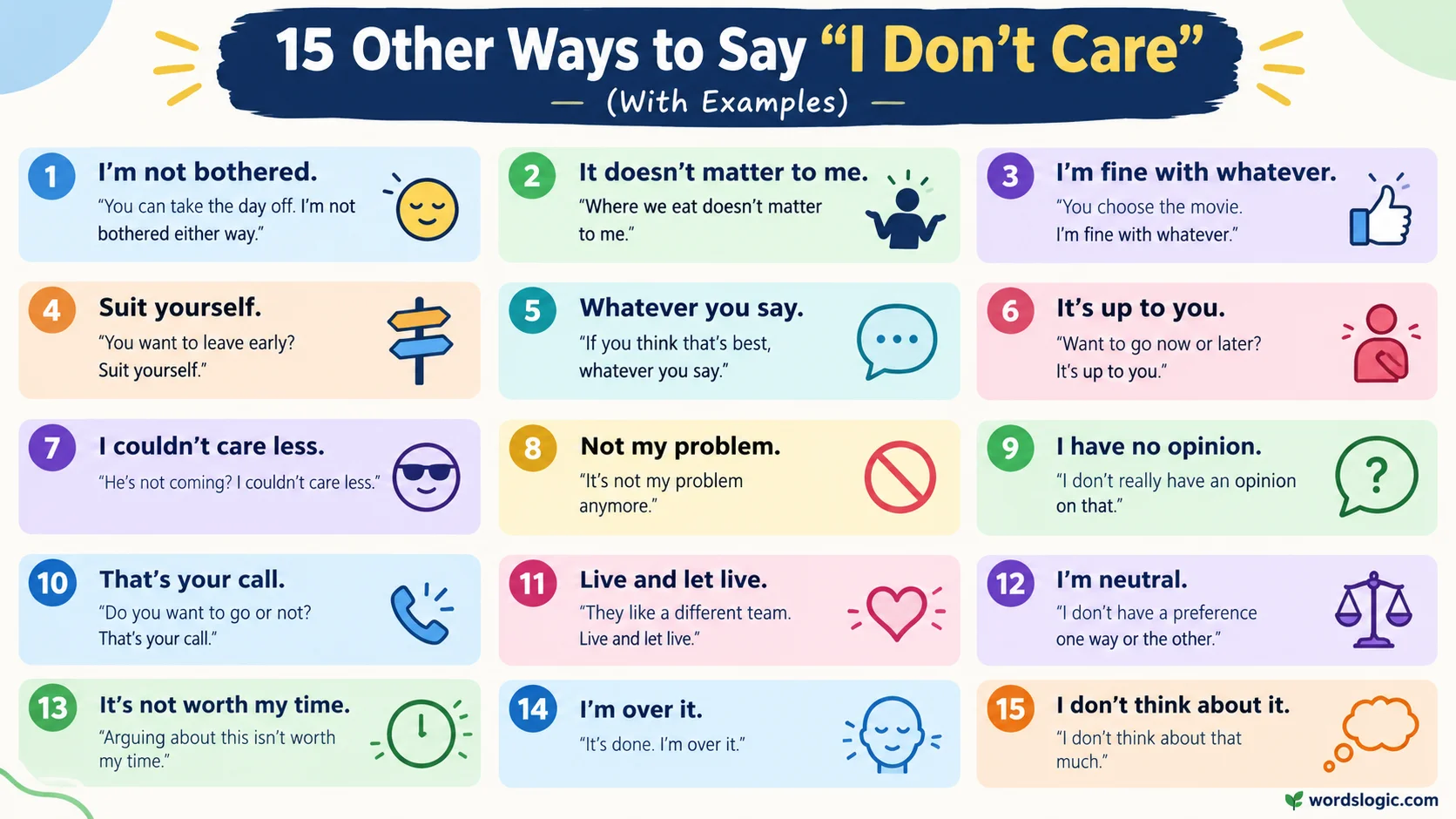
Other Ways to Say “I Don’t Care” help you express indifference politely, maintain clarity, and avoid sounding rude in everyday conversations. Choosing the right words helps you communicate with kindness, respect, and confidence.
The phrase “I Don’t Care” can express different feelings depending on the situation, tone, and relationship. Sometimes, it shows flexibility or means you are happy with any decision. Other times, it may sound cold, dismissive, or uninterested. For example, saying “It doesn’t matter to me” or “Your choice works for me” communicates a similar message in a more respectful way. These alternatives are useful when talking with friends, family, and coworkers, especially during sensitive conversations or serious discussions.
Learning these expressions can improve your professional communication, personal interactions, and social skills. Whether you are making a decision, discussing preferences, or trying to move on without creating a negative impression, thoughtful wording makes a difference. The following alternatives will help you express your true thoughts with empathy, emotional awareness, and a balanced tone while maintaining positive relationships.
What Does “I Don’t Care” Mean?
“I don’t care” means that something does not interest, concern, or matter to you. People use it to express indifference, show that they have no preference, or communicate that they do not want to spend time worrying about an issue. For example, “I don’t care which movie we watch” may simply mean that either choice is fine.
However, the phrase can carry different meanings depending on the speaker’s tone and the situation. It can sound relaxed and easygoing when discussing a small decision, but it may seem rude or dismissive during a serious conversation. Sometimes, people use it to express frustration, disappointment, or emotional distance. Understanding this difference helps you choose a more suitable expression.
Common Situations Where “I Don’t Care” Is Used
People commonly use this phrase in everyday conversations when discussing food, movies, plans, clothing, or other personal preferences. In text messages and social media comments, it can communicate indifference quickly, although the lack of vocal tone may make the message seem harsher than intended.
In relationships, the phrase can express genuine acceptance, but it can also make someone feel ignored if they are sharing something important. At work or school, saying “I don’t care” about a decision may sound dismissive, especially when other people need your input. In these situations, expressions such as “I’m fine with either option” or “I have no strong preference” communicate the same general idea more respectfully.
Is It Professional or Polite to Say “I Don’t Care”?
The phrase is casual, direct, and context-dependent. It can be perfectly natural among close friends when the subject is unimportant, but it may sound impatient or disrespectful when someone expects a thoughtful response. In professional communication, it is usually better to explain that you have no preference or that a decision does not affect your responsibilities.
For example, “I don’t care which time we choose” can sound dismissive in a work email. “Either time works for me” communicates flexibility without creating the same impression. However, if you need to set a boundary or explain that an issue is outside your responsibility, a firmer expression may be appropriate. The goal is not always to sound softer; it is to make your intended meaning clear.
Advantages and Disadvantages of Saying “I Don’t Care”
Advantages
The phrase is short, clear, and easy to understand. It can save time when a decision genuinely does not matter to you, and it may communicate that you are not interested in arguing over a minor issue. Among people who know each other well, its directness may feel natural rather than offensive.
Disadvantages
Its biggest limitation is that it can sound cold, dismissive, or insensitive, particularly when another person is discussing something meaningful. It also fails to distinguish between having no preference, feeling emotionally detached, and refusing to take responsibility. In professional settings or sensitive conversations, more specific wording can communicate your position without causing unnecessary misunderstanding.
15 Alternatives to “I Don’t Care”
- It Doesn’t Matter to Me
- I Have No Preference
- Either Way Is Fine
- I’m Not Bothered
- I’m Indifferent
- It Makes No Difference to Me
- I’m Fine Either Way
- Whatever Works for You
- I’m Not Concerned About It
- That’s Up to You
- I Can Live With That
- It’s Not a Big Deal
- I Don’t Mind
- I’m Unfazed
- Do What You Think Is Best
1. It Doesn’t Matter to Me
Meaning
“It doesn’t matter to me” means that a particular choice or outcome is not important to you. It often sounds less harsh than “I don’t care.”
Definition
A phrase used to express that something has little or no personal importance.
Detailed Explanation
This expression works well when you want to show that a decision will not affect you significantly. It focuses on the importance of the issue rather than suggesting that you disregard another person’s feelings. Depending on your delivery, it can sound neutral, flexible, or slightly detached. It is especially useful when discussing practical choices.
Scenario Examples
- Scenario: A friend asks which restaurant you prefer.
Example: “It doesn’t matter to me. I’m happy with either place.” - Scenario: Your team is choosing between two meeting formats.
Example: “It doesn’t matter to me which format we use, as long as everyone can participate.”
Best Use
Use it in everyday conversation, group decisions, and workplace discussions when a particular option has no meaningful effect on you.
Tone
Tone: Neutral, calm, flexible. It communicates a lack of strong preference without necessarily sounding dismissive.
2. I Have No Preference
Meaning
“I have no preference” means that you do not favor one option over another.
Definition
A direct statement that none of the available choices is your preferred option.
Detailed Explanation
This expression is more precise and professional than “I don’t care” when someone asks you to choose between alternatives. It does not imply that you are uninterested in the conversation or that the decision is unimportant to everyone. Instead, it simply explains that you are comfortable with the available choices. It is particularly useful when you want to sound neutral and cooperative.
Scenario Examples
- Scenario: A coworker asks whether you prefer a morning or afternoon meeting.
Example: “I have no preference, so please choose whichever time suits the team.” - Scenario: A friend asks which color to buy.
Example: “I have no preference. Both colors look great.”
Best Use
Use it in professional emails, surveys, planning discussions, and polite conversations where someone needs your opinion.
Tone
Tone: Professional, neutral, respectful. Its straightforward wording makes it suitable for situations where clarity matters.
3. Either Way Is Fine
Meaning
“Either way is fine” means that you are comfortable with either of two options.
Definition
A casual expression indicating that both choices are acceptable to you.
Detailed Explanation
This phrase communicates acceptance rather than emotional indifference. It is useful when you want to make a decision easier for someone else without sounding uninterested. Unlike “I don’t care,” it usually carries a cooperative and friendly feeling. It works best when the conversation involves two options that genuinely suit you.
Scenario Examples
- Scenario: Your friend asks whether you want to walk or take the bus.
Example: “Either way is fine. We have plenty of time.” - Scenario: A colleague asks whether to send a document as a PDF or Word file.
Example: “Either way is fine, provided the formatting stays intact.”
Best Use
Use it in casual conversations, friendly texts, and everyday planning when both choices are acceptable.
Tone
Tone: Friendly, relaxed, accommodating. It reassures the other person that they do not need to worry about your preference.
4. I’m Not Bothered
Meaning
“I’m not bothered” means that something does not upset, trouble, or concern you.
Definition
A statement indicating that a situation is not causing you annoyance or distress.
Detailed Explanation
This expression is especially natural in British English and can sound relaxed or reassuring. It focuses more on your emotional reaction than on whether something matters to you. For example, you might use it when someone apologizes for a small inconvenience. However, it is not always interchangeable with “I don’t care,” because it usually suggests that you are not upset rather than that you have no interest.
Scenario Examples
- Scenario: A friend apologizes for arriving five minutes late.
Example: “I’m not bothered. I only just got here myself.” - Scenario: Someone asks whether a change of plans has upset you.
Example: “I’m not bothered at all. We can do something else.”
Best Use
Use it in personal conversations and informal messages when you want to reassure someone that a minor issue has not upset you.
Tone
Tone: Casual, reassuring, easygoing. It works well when the goal is to reduce tension.
5. I’m Indifferent
Meaning
“I’m indifferent” means that you have little or no particular feeling, interest, or preference about something.
Definition
A statement expressing a neutral or emotionally uninvolved attitude.
Detailed Explanation
This phrase is more formal and detached than most everyday alternatives. It can describe a genuine lack of interest, but it may sound cold when used in a personal conversation. It is appropriate when discussing opinions, attitudes, or reactions rather than simply choosing between two options. If you want to sound friendly, “I have no preference” is often a better choice.
Scenario Examples
- Scenario: A class discusses opinions about a fictional character.
Example: “I’m indifferent toward the character because the story doesn’t give us much background.” - Scenario: Someone asks whether you feel strongly about a minor policy change.
Example: “I’m indifferent to the change as long as it doesn’t affect our work.”
Best Use
Use it in analytical discussions, essays, reviews, or thoughtful conversations where emotional neutrality is the intended meaning.
Tone
Tone: Detached, neutral, somewhat formal. It emphasizes a lack of strong feelings rather than friendly flexibility.
6. It Makes No Difference to Me
Meaning
“It makes no difference to me” means that the outcome will be equally acceptable regardless of which option is chosen.
Definition
An expression stating that different choices have no meaningful effect on your situation.
Detailed Explanation
This phrase emphasizes the effect of a decision rather than your personal feelings about it. It can sound more considered than “I don’t care,” especially when discussing schedules, arrangements, or practical matters. It does not automatically mean that you have no interest in the issue; it simply says that the available outcomes are equivalent from your perspective. A polite delivery makes it suitable for both personal and professional communication.
Scenario Examples
- Scenario: A project manager asks which presentation slot you prefer.
Example: “It makes no difference to me whether I present first or second.” - Scenario: Your family is deciding which day to shop.
Example: “It makes no difference to me. Saturday and Sunday both work.”
Best Use
Use it in planning, scheduling, and practical decision-making when the options have the same effect on you.
Tone
Tone: Neutral, practical, composed. It sounds focused on the decision rather than on personal feelings.
7. I’m Fine Either Way
Meaning
“I’m fine either way” means that you are comfortable with either available choice.
Definition
A friendly expression showing that both alternatives are acceptable.
Detailed Explanation
This phrase is similar to “either way is fine,” but it often sounds more personal and conversational. It tells the other person that you are comfortable with the options under discussion. It is useful when you want to show flexibility without making the decision seem unimportant. However, it should only be used when you genuinely feel comfortable with both choices.
Scenario Examples
- Scenario: Your partner asks whether you want to cook at home or order dinner.
Example: “I’m fine either way. We can cook if you feel like it.” - Scenario: A coworker asks whether to meet online or in person.
Example: “I’m fine either way, so go with whatever is easier for you.”
Best Use
Use it in friendly conversations, relationship discussions, and collaborative work arrangements when you are happy to accommodate either option.
Tone
Tone: Warm, flexible, cooperative. It conveys willingness to work with the other person’s preference.
8. Whatever Works for You
Meaning
“Whatever works for you” means that the other person can choose the option that best suits their needs or schedule.
Definition
A phrase giving someone freedom to decide based on their own circumstances.
Detailed Explanation
This expression shifts attention from your preference to the other person’s convenience. It can sound generous and accommodating when delivered warmly. However, a flat or irritated delivery may make it sound dismissive, as though you want to end the discussion. It is most appropriate when you are genuinely willing to let the other person decide.
Scenario Examples
- Scenario: A friend is trying to arrange a phone call.
Example: “Call me after work or tomorrow morning—whatever works for you.” - Scenario: A client asks whether to schedule a consultation on Tuesday or Thursday.
Example: “Whatever works for you. Let me know which time you prefer.”
Best Use
Use it in scheduling, customer communication, friendly texts, and collaborative planning when the other person’s convenience matters more than your preference.
Tone
Tone: Accommodating, casual, considerate. It offers flexibility while leaving the final choice to someone else.
9. I’m Not Concerned About It
Meaning
“I’m not concerned about it” means that you do not feel worried about a particular issue.
Definition
A statement indicating that something is not causing you significant worry or concern.
Detailed Explanation
This expression is more specific than “I don’t care” because it addresses worry rather than interest or preference. It can sound calm and confident when a problem is manageable or unlikely to affect your responsibilities. In professional settings, it may reassure someone that a minor issue does not require further attention. Avoid using it when the other person needs you to take a legitimate concern seriously.
Scenario Examples
- Scenario: A coworker worries that a small formatting change will delay the report.
Example: “I’m not concerned about it. We still have enough time to review everything.” - Scenario: A friend asks whether you are worried about a harmless rumor.
Example: “I’m not concerned about it because I know what actually happened.”
Best Use
Use it in work discussions and personal conversations when you want to communicate a lack of worry rather than a lack of interest.
Tone
Tone: Calm, confident, reassuring. It suggests that you are not troubled by the situation.
10. That’s Up to You
Meaning
“That’s up to you” means that another person has the freedom or responsibility to make the decision.
Definition
An expression that leaves a choice or decision to someone else.
Detailed Explanation
This phrase is not an exact synonym for “I don’t care.” It communicates that you are leaving the decision to another person, whether because you have no preference or because the choice belongs to them. Depending on your tone, it can sound trusting and respectful or cold and disengaged. Add a friendly explanation when you want to make it clear that you are comfortable with the other person’s choice.
Scenario Examples
- Scenario: Your friend asks whether to invite a few more people to a gathering.
Example: “That’s up to you. It’s your party, so invite whoever you’d like.” - Scenario: A team lead asks whether you want to take on an optional task.
Example: “That’s up to you, depending on how you want to divide the workload.”
Best Use
Use it when someone else owns the decision, especially in personal planning or situations where you want to respect their independence.
Tone
Tone: Direct, independent, context-dependent. It can convey trust when warm, but may sound detached if delivered abruptly.
11. I Can Live With That
Meaning
“I can live with that” means that you can accept a situation or outcome, even if it is not your first choice.
Definition
An informal expression of willingness to tolerate or accept something.
Detailed Explanation
This phrase communicates acceptance rather than complete indifference. It often suggests that the result is good enough, even if it is not ideal. Compared with “I don’t care,” it can imply that you have considered the options and are willing to compromise. It is usually casual and may sound slightly reluctant, so it is not the best choice when you want to express strong enthusiasm.
Scenario Examples
- Scenario: Your group chooses a meeting time that is not ideal but still possible for you.
Example: “Ten thirty is a little early, but I can live with that.” - Scenario: A friend suggests a restaurant that is not your first choice.
Example: “I was thinking of somewhere else, but I can live with that.”
Best Use
Use it in casual negotiations, group decisions, and informal discussions when you accept an outcome that is not perfect.
Tone
Tone: Casual, pragmatic, mildly reluctant. It communicates that a decision is acceptable without claiming that it is your favorite.
12. It’s Not a Big Deal
Meaning
“It’s not a big deal” means that something is not very important or serious.
Definition
An expression used to describe a problem, mistake, or inconvenience as relatively minor.
Detailed Explanation
This phrase focuses on the seriousness of a situation rather than your level of interest. It can reassure someone who is apologizing or worrying about a small mistake. However, it may sound dismissive if the other person considers the issue important. Use it when you genuinely believe the situation is minor, and avoid assuming that everyone shares your perspective.
Scenario Examples
- Scenario: A classmate apologizes for borrowing your pen without asking.
Example: “It’s not a big deal. Just ask me next time.” - Scenario: A teammate apologizes for sending a document a few minutes late.
Example: “It’s not a big deal. I can still finish the review this afternoon.”
Best Use
Use it in everyday conversations, apologies, and minor workplace mishaps when you want to reduce unnecessary worry.
Tone
Tone: Reassuring, casual, forgiving. It works best when the other person needs reassurance rather than criticism.
13. I Don’t Mind
Meaning
“I don’t mind” means that you do not object to something or that you are comfortable with a particular choice.
Definition
A polite expression showing that a situation or option is acceptable to you.
Detailed Explanation
This phrase is often softer and more polite than “I don’t care.” It communicates that you have no objection, but it does not necessarily mean that you lack interest in the subject. In British English, it is especially common in everyday conversation when responding to offers or suggestions. Be aware that it can sometimes sound less enthusiastic than “That sounds good,” so use a warmer response when you genuinely like the idea.
Scenario Examples
- Scenario: Someone asks whether they can open a window.
Example: “I don’t mind. A little fresh air would be nice.” - Scenario: A friend asks whether you would like to watch another episode.
Example: “I don’t mind. I’m not ready to go to bed yet.”
Best Use
Use it in polite everyday conversation, friendly requests, and informal workplace exchanges when you want to show that you have no objection.
Tone
Tone: Polite, relaxed, agreeable. It sounds considerate because it addresses whether something bothers you.
14. I’m Unfazed
Meaning
“I’m unfazed” means that you remain calm and are not noticeably upset, surprised, or disturbed by something.
Definition
A statement describing someone who is not troubled or unsettled by a situation.
Detailed Explanation
This expression emphasizes emotional composure rather than a lack of preference. It can suggest confidence, resilience, or an ability to remain calm under pressure. Unlike “I don’t care,” it does not necessarily mean that the issue is unimportant; you may care about the outcome while refusing to let the situation upset you. Because it can sound self-assured, it fits better in descriptions of reactions than in ordinary choices such as picking a restaurant.
Scenario Examples
- Scenario: A teammate receives criticism during a presentation review.
Example: “She seemed unfazed by the feedback and focused on improving the slides.” - Scenario: A friend asks whether a sudden change in plans stressed you out.
Example: “I’m unfazed. We’ll figure out another plan.”
Best Use
Use it in personal descriptions, reflective writing, and conversations about handling pressure when you want to emphasize composure.
Tone
Tone: Confident, composed, self-assured. It suggests emotional steadiness rather than indifference.
15. Do What You Think Is Best
Meaning
“Do what you think is best” means that you trust someone else to make the decision they believe is right.
Definition
A phrase that gives another person permission to choose the course of action they consider most suitable.
Detailed Explanation
This expression goes beyond simply having no preference. It communicates trust in the other person’s judgment and allows them to take responsibility for the outcome. It can be supportive when someone needs freedom to make a decision, but it may sound frustrated if delivered sarcastically. In a professional setting, it works best when the other person has the authority or knowledge needed to make the choice.
Scenario Examples
- Scenario: Your colleague asks how to organize a presentation after discussing the available options.
Example: “You’ve reviewed the material, so do what you think is best.” - Scenario: A friend asks whether to change their travel plans.
Example: “You’ve thought it through carefully. Do what you think is best for you.”
Best Use
Use it in trusted relationships, collaborative projects, and situations where another person is responsible for the decision.
Tone
Tone: Supportive, trusting, respectful. It shows that you are willing to let someone else exercise their judgment.
FAQs
What are some polite ways to say “I don’t care”?
You can say “It doesn’t matter to me,” “I’m fine with anything,” or “Your choice works for me.” These expressions show flexibility and respect without sounding rude or dismissive.
How can I say “I don’t care” professionally?
In a professional setting, try “I’m comfortable with either option,” “I’m happy to go with your recommendation,” or “I have no strong preference.” These phrases maintain a respectful tone during workplace discussions.
Does saying “I don’t care” sound rude?
It can sound rude, cold, or dismissive, depending on your tone, situation, and relationship with the listener. Choosing thoughtful words helps you express indifference without creating a negative impression.
What is a casual alternative to “I don’t care”?
In everyday conversations, you can say “Whatever works for you,” “I don’t mind,” or “Either way is fine.” These phrases sound natural when talking with friends or family about everyday decisions.
Why should I use alternatives to “I don’t care”?
Using alternatives helps you communicate with kindness, clarity, and emotional awareness. It also strengthens relationships, prevents misunderstandings, and makes your message sound more considerate in personal and professional conversations.
Conclusion
Learning Other Ways to Say “I Don’t Care” can improve how you express your feelings in everyday life. Instead of using words that might sound blunt, cold, or uninterested, choose expressions that communicate your thoughts with respect and confidence. Phrases such as “It doesn’t matter to me,” “I’m fine with anything,” and “Your choice works for me” help you show flexibility while keeping conversations friendly and comfortable.
The best expression depends on the situation, your relationship with the listener, and the message you want to convey. In professional communication, choose polite and clear wording. In casual conversations, use natural phrases that fit your personality. With practice, you can develop stronger communication skills, show empathy, and maintain positive connections without hiding your true feelings. Remember that effective communication is not just about what you say; it is also about how your words make others feel.













