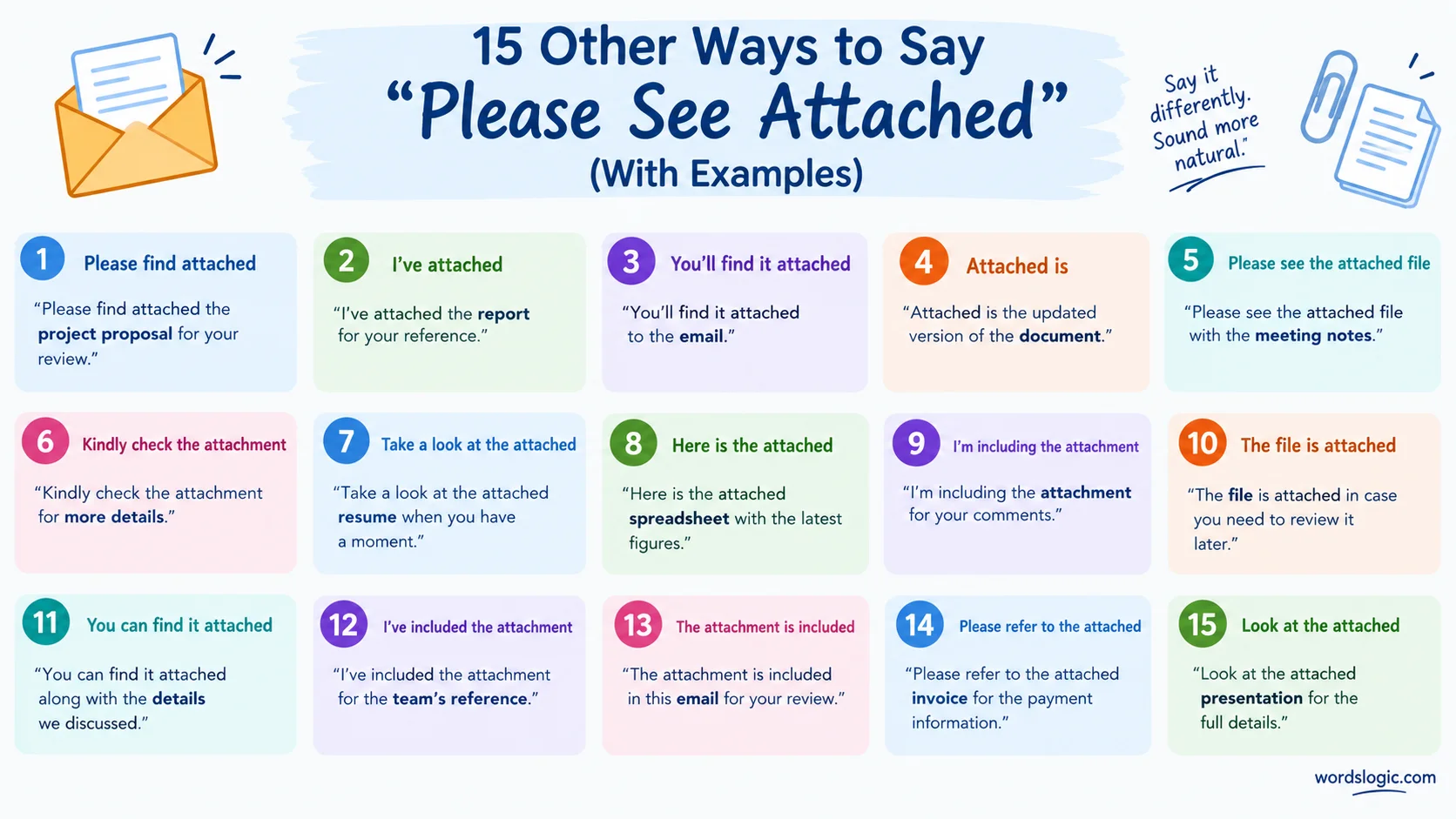
Other Ways to Say “Please See Attached” can make an email feel warm, clear, and professional, while giving the reader a smoother message. In daily writing, choosing the right words can change how an email wording choice feels.
A simple change can turn a cold, robotic phrase into something thoughtful and approachable. In a professional email, formal email, or business email, phrases such as please find attached the report and please find attached may sound boring, dry, or mechanical when repeated too often. Creative alternatives, different words, and alternative expressions can create a human tone and leave a stronger impression.
Whether you are emailing a boss, client, or even using romantic messaging with a crush, an attached file, attached document, or PDF should have clear references that improve message clarity and keep reader attention on the report, proposal, contract, spreadsheet, resume, photo, or image you have included.
What Does “Please See Attached” Mean?
“Please see attached” is commonly used in emails and other written communication to tell the recipient that a file or document has been included with the message. It asks the reader to look at the attachment for additional information, instructions, evidence, or material related to the email. The phrase is usually understood as a polite and direct request to review an attached file. It can refer to documents, photographs, reports, forms, spreadsheets, presentations, or other digital files.
The expression is especially common in workplace emails and formal correspondence, although it can also appear in everyday messages. Its meaning is straightforward: the sender wants the recipient to notice and examine the attached material. Depending on the context, the wording can sound somewhat standard or formulaic, which is why writers sometimes choose more specific language.
Common Situations Where “Please See Attached” Is Used
People commonly use “Please see attached” when sending a document that supports or completes the information in an email. For example, someone might use it when submitting a report, sending requested paperwork, sharing a proposal, or providing a file for review. It is particularly common in professional communication, where attachments are frequently exchanged between colleagues, clients, customers, teachers, students, and organizations.
The phrase can also appear in more personal or informal communication, but it may sound more formal than necessary in a casual message. In those situations, a more conversational expression can make the message feel friendlier and less mechanical. In professional settings, meanwhile, a more specific expression can tell the recipient exactly what they are expected to do with the attachment.
Is It Professional or Polite to Say “Please See Attached”?
Yes. “Please see attached” is generally polite, direct, and professional, especially in workplace emails. It clearly directs the recipient toward a file without sounding demanding. The word “please” adds politeness, while “attached” tells the reader where to find the relevant material.
However, the phrase can sometimes feel generic or formulaic, particularly when it is used repeatedly. A more specific expression may be better when you want to explain whether the recipient should review, complete, sign, or simply keep the attachment for reference. The original wording is perfectly suitable when a simple and neutral instruction is all that is needed.
Advantages and Disadvantages of Saying “Please See Attached”
Advantages
One advantage of “Please see attached” is its clarity. The recipient immediately understands that an attachment accompanies the email and that they should look at it. The phrase is also concise, polite, and widely recognized in professional correspondence. It works well when the attachment is straightforward and no additional explanation is necessary.
Disadvantages
The main limitation is that the wording can feel routine or impersonal when used frequently. It also does not explain what the recipient should do with the file beyond looking at it. If the sender needs the reader to review, approve, complete, sign, or respond to something, more precise wording can communicate the purpose more effectively.
Synonyms for “Please See Attached”
- Attached is the document
- Please find the attached document
- I’ve attached the document
- I’ve included the document for your review
- The document is attached for your reference
- For your review, I’ve attached the document
- You’ll find the document attached
- I’m sharing the attached document
- The requested document is attached
- Attached for your reference
- Please refer to the attached document
- I’ve enclosed the document
- Here is the document you requested
- Please take a look at the attached document
- I’ve attached the relevant file
1. Attached is the document
Meaning
“Attached is the document” directly tells the recipient that the document has been included with the message. It is a simple way to point someone toward an attachment without making the sentence unnecessarily long.
Definition
Definition: A concise statement indicating that a particular document has been included with the email or message.
Detailed Explanation
This wording is direct and professional while remaining easy to understand. It focuses on the location of the document rather than giving the recipient a specific instruction. It works particularly well when the attachment itself is the main point of the message. Compared with “Please see attached,” it can sound slightly more confident and matter-of-fact.
Scenario Examples
Scenario: You are sending a report to a colleague.
Example: “Attached is the document containing the updated sales figures.”
Scenario: You are sending paperwork to a customer.
Example: “Attached is the document you requested during our call.”
Best Use
Use this expression in professional emails, business correspondence, and straightforward document-sharing messages.
Tone
Tone: Professional, concise, direct
It gives the recipient clear information without adding unnecessary formality.
2. Please find the attached document
Meaning
“Please find the attached document” politely directs the recipient to the file included with the message. It is a traditional expression frequently associated with formal written communication.
Definition
Definition: A polite request for the recipient to locate and review a document included with an email.
Detailed Explanation
This expression has a formal and courteous feel. It is especially suitable when communicating with clients, organizations, or people you do not know well. Although it is common in business correspondence, it can sound somewhat traditional in very casual communication. It is useful when you want your wording to maintain a clearly professional register.
Scenario Examples
Scenario: You are submitting a proposal to a business contact.
Example: “Please find the attached document outlining our proposed services.”
Scenario: You are sending a completed application.
Example: “Please find the attached document with the completed application details.”
Best Use
This works best in formal emails, business correspondence, applications, and official communication.
Tone
Tone: Formal, polite, respectful
The wording creates a courteous distance that can suit professional relationships.
3. I’ve attached the document
Meaning
“I’ve attached the document” simply tells the recipient that you personally included the document with your message.
Definition
Definition: A straightforward statement confirming that the sender has added a document to an email or message.
Detailed Explanation
This expression sounds more natural and conversational than highly formal attachment language. It makes the sentence feel personal because the sender uses “I’ve,” clearly stating what they have done. It is suitable when you want to be professional without sounding stiff. The wording also works well when the attachment is one part of a larger conversation.
Scenario Examples
Scenario: A coworker asks you to send a copy of a presentation.
Example: “I’ve attached the document with the revised presentation slides.”
Scenario: You are following up after a phone conversation.
Example: “Thanks for speaking with me earlier. I’ve attached the document we discussed.”
Best Use
Use it for work emails, follow-up messages, client communication, and everyday professional correspondence.
Tone
Tone: Friendly, professional, natural
It sounds like something a person would commonly write rather than a fixed business formula.
4. I’ve included the document for your review
Meaning
“I’ve included the document for your review” tells the recipient that the document has been provided and that you would like them to examine it.
Definition
Definition: A polite statement indicating that a document has been provided specifically so the recipient can review it.
Detailed Explanation
This wording adds useful information that “Please see attached” does not always communicate: it explains the purpose of the attachment. The phrase “for your review” suggests that the recipient should read or examine the material rather than merely notice it. It is appropriate when feedback, consideration, or evaluation is expected. The expression can therefore make an email feel more purposeful and organized.
Scenario Examples
Scenario: You send a draft policy to your manager.
Example: “I’ve included the document for your review before tomorrow’s meeting.”
Scenario: You send a proposal to a potential client.
Example: “I’ve included the document for your review and consideration.”
Best Use
This is particularly useful for professional reviews, drafts, proposals, reports, and documents requiring feedback.
Tone
Tone: Professional, respectful, purposeful
The phrase clearly communicates that the attachment deserves the recipient’s attention.
5. The document is attached for your reference
Meaning
“The document is attached for your reference” tells the recipient that a document is available as supporting information that they may consult when needed.
Definition
Definition: A statement explaining that an attached document has been provided as a source of information or background.
Detailed Explanation
Unlike wording that asks someone to actively review a file, this expression suggests that the document is available for information or future consultation. It does not necessarily require an immediate response or detailed review. This makes it useful when the attachment supports the main message but is not the main subject of the email. It has a calm and professional quality.
Scenario Examples
Scenario: You send meeting notes to a team.
Example: “The document is attached for your reference as you prepare for next week’s meeting.”
Scenario: You provide background information to a customer.
Example: “The document is attached for your reference should you need additional details.”
Best Use
Use it in business emails, informational messages, reports, meeting follow-ups, and customer communication.
Tone
Tone: Professional, neutral, informative
It communicates that the file is useful without placing pressure on the recipient.
6. For your review, I’ve attached the document
Meaning
“For your review, I’ve attached the document” tells the recipient both that the document is included and that you want them to examine it.
Definition
Definition: A professional statement explaining that a document has been attached for the recipient to evaluate or read.
Detailed Explanation
The phrase places emphasis on the purpose of the attachment. It is slightly more intentional than simply saying that a document is attached. The wording works especially well when you expect comments, corrections, approval, or consideration. It can also help the recipient understand why the attachment matters before opening it.
Scenario Examples
Scenario: You send a draft contract to a colleague.
Example: “For your review, I’ve attached the document with the latest revisions.”
Scenario: You send a project plan to a supervisor.
Example: “For your review, I’ve attached the document ahead of our discussion on Friday.”
Best Use
This expression fits workplace emails, document reviews, proposals, project plans, and formal correspondence.
Tone
Tone: Professional, focused, courteous
It sounds respectful while clearly identifying the recipient’s expected task.
7. You’ll find the document attached
Meaning
“You’ll find the document attached” politely tells the recipient where to locate the document.
Definition
Definition: A friendly statement directing the recipient to a document included with the message.
Detailed Explanation
This expression feels natural and approachable while remaining professional. It does not strongly instruct the recipient to perform a particular action, so it can work when simply drawing attention to the attachment. The use of “you’ll find” gives the sentence a slightly warmer conversational quality. It is a good choice when you want to avoid overly formal wording.
Scenario Examples
Scenario: You are sending a customer a copy of their receipt.
Example: “You’ll find the document attached to this email for your records.”
Scenario: You are sending a colleague information they asked for.
Example: “You’ll find the document attached with the details from yesterday’s meeting.”
Best Use
It works well in friendly professional emails, customer communication, workplace messages, and routine correspondence.
Tone
Tone: Friendly, professional, conversational
It feels less rigid than traditional formal attachment language.
8. I’m sharing the attached document
Meaning
“I’m sharing the attached document” tells the recipient that you are providing a document for them to access.
Definition
Definition: A straightforward statement indicating that the sender is providing a document as part of the message.
Detailed Explanation
This expression emphasizes the act of sharing information rather than simply pointing out an attachment. It can sound collaborative and appropriate when the document is being distributed among colleagues or project participants. The wording is less formal than some traditional business expressions but still suitable for professional communication. It is particularly natural when several people are exchanging information.
Scenario Examples
Scenario: You are sending project materials to your team.
Example: “I’m sharing the attached document so everyone has the latest project information.”
Scenario: You send background material to a colleague.
Example: “I’m sharing the attached document ahead of our meeting.”
Best Use
Use it for team communication, collaborative projects, workplace emails, and information sharing.
Tone
Tone: Collaborative, friendly, professional
The wording creates a sense of openness and cooperation.
9. The requested document is attached
Meaning
“The requested document is attached” confirms that the specific document the recipient asked for has been included.
Definition
Definition: A direct statement confirming that a previously requested document accompanies the message.
Detailed Explanation
This expression is useful because it connects the attachment directly to a previous request. The recipient immediately knows that the file they asked for is included. It is especially effective in customer service, administrative communication, and workplace exchanges where documents are regularly requested. The wording is factual and avoids unnecessary explanation.
Scenario Examples
Scenario: A client asks for a copy of an invoice.
Example: “The requested document is attached for your records.”
Scenario: An administrator asks you to provide a completed form.
Example: “The requested document is attached with all the required information.”
Best Use
This works particularly well in customer service, administrative emails, business communication, and formal document exchanges.
Tone
Tone: Professional, direct, responsive
It reassures the recipient that their specific request has been addressed.
10. Attached for your reference
Meaning
“Attached for your reference” indicates that a file has been provided mainly as supporting information or something the recipient can consult later.
Definition
Definition: A concise phrase explaining that an attachment is included for informational or future reference.
Detailed Explanation
This is a brief and efficient expression that works well when the attachment does not require immediate action. It is particularly useful when the main email already explains the situation and the file simply provides supporting details. Because it is short, it can fit naturally into a busy professional email. Its purpose is informational rather than strongly directive.
Scenario Examples
Scenario: You send supporting records after a meeting.
Example: “Attached for your reference are the records discussed during the meeting.”
Scenario: You provide background information to a colleague.
Example: “Attached for your reference is the information from last quarter.”
Best Use
Use it in professional emails, reference materials, records, reports, and informational correspondence.
Tone
Tone: Concise, professional, neutral
Its short form keeps the message efficient without sounding impolite.
11. Please refer to the attached document
Meaning
“Please refer to the attached document” politely asks the recipient to consult a specific document for relevant information.
Definition
Definition: A formal request for someone to consult an attached document when considering or understanding the message.
Detailed Explanation
This expression is slightly more directive than simply pointing out that a file exists. It suggests that the attached material contains information the recipient should use or consider. That makes it suitable when the attachment is important to the subject of the email. It can sound formal, so it is more appropriate for professional or official communication than casual messages.
Scenario Examples
Scenario: You send instructions with supporting documentation.
Example: “Please refer to the attached document for the complete submission requirements.”
Scenario: You provide a policy document to an employee.
Example: “Please refer to the attached document for the updated procedures.”
Best Use
This works well in formal emails, workplace instructions, official correspondence, policies, and procedural communication.
Tone
Tone: Formal, polite, direct
It clearly tells the reader that the attachment contains information relevant to the matter.
12. I’ve enclosed the document
Meaning
“I’ve enclosed the document” indicates that the sender has included a document with the correspondence.
Definition
Definition: A formal expression stating that a document has been included with a letter or message.
Detailed Explanation
The word “enclosed” traditionally refers to something placed inside an envelope, so it has a stronger connection with formal letters and physical correspondence. It can also appear in digital communication, but “attached” is generally more natural for ordinary email attachments. This expression therefore carries a more traditional and formal feeling. Use it when the style of the correspondence calls for that level of formality.
Scenario Examples
Scenario: You are writing a formal business letter.
Example: “I’ve enclosed the document requested in your previous correspondence.”
Scenario: You are sending physical paperwork.
Example: “I’ve enclosed the document with the completed form for your records.”
Best Use
It is best suited to formal letters, official correspondence, physical documents, and traditional business writing.
Tone
Tone: Formal, traditional, respectful
Its wording reflects the conventions of formal written correspondence.
13. Here is the document you requested
Meaning
“Here is the document you requested” directly tells the recipient that you are providing the specific document they previously asked for.
Definition
Definition: A friendly and direct statement presenting a requested document to the recipient.
Detailed Explanation
This wording feels personal and helpful because it directly connects the file to the recipient’s request. It is less formulaic than traditional attachment language and works naturally in an ongoing conversation. The expression is especially useful when the recipient has already asked for a particular file. It also avoids making the attachment sound like an afterthought.
Scenario Examples
Scenario: A colleague asks for a copy of a report.
Example: “Here is the document you requested. I’ve also updated the final section.”
Scenario: A customer asks for paperwork by email.
Example: “Here is the document you requested for your records.”
Best Use
Use it in customer communication, workplace emails, follow-ups, and friendly professional exchanges.
Tone
Tone: Helpful, friendly, direct
It sounds like a natural response to someone’s request.
14. Please take a look at the attached document
Meaning
“Please take a look at the attached document” politely asks the recipient to examine the document that accompanies the message.
Definition
Definition: A friendly request for someone to review an attached document.
Detailed Explanation
This expression is more conversational than highly formal attachment wording. The phrase “take a look” makes the request feel approachable and relatively relaxed. It is useful when you want the recipient to examine something without making the request sound overly demanding. However, because “take a look” is conversational, a more formal expression may be preferable in official correspondence.
Scenario Examples
Scenario: You want a coworker to check a draft.
Example: “Please take a look at the attached document and let me know if anything needs to be changed.”
Scenario: You send a friend information they asked about.
Example: “Please take a look at the attached document when you have a chance.”
Best Use
This works well for friendly workplace messages, informal professional emails, personal communication, and collaborative work.
Tone
Tone: Friendly, polite, conversational
The wording softens the request and makes it feel less formal.
15. I’ve attached the relevant file
Meaning
“I’ve attached the relevant file” tells the recipient that you have included the file containing information connected to the subject of the message.
Definition
Definition: A professional statement confirming that the appropriate file has been included with the email.
Detailed Explanation
This wording is useful when the attachment is one of several possible documents and you want to identify it as the relevant material. It sounds natural and professional without being excessively formal. The phrase can also make an email more informative because it tells the recipient that the file has a direct connection to the issue being discussed. It works particularly well in workplace communication where several files may be exchanged.
Scenario Examples
Scenario: You send supporting material about a project issue.
Example: “I’ve attached the relevant file with the information we discussed this morning.”
Scenario: You provide a customer with supporting records.
Example: “I’ve attached the relevant file so you can review the details.”
Best Use
Use it in professional emails, project communication, customer correspondence, and situations involving multiple files.
Tone
Tone: Professional, clear, practical
It identifies the attachment as useful and connected to the subject without adding unnecessary formality.
FAQs
What is another way to say “Please see attached”?
There are several natural alternatives, including “I’ve attached the document,” “Attached is the document,” and “You’ll find the document attached.” The best choice depends on whether you want the message to sound formal, conversational, direct, or friendly.
What does “Please see attached” mean?
“Please see attached” means that a file has been included with the message and that the recipient should look at it. It is commonly used when sending documents, reports, forms, images, or other digital files.
Is “Please see attached” professional?
Yes. “Please see attached” is generally professional and polite, particularly in workplace emails and formal correspondence. However, it can sound somewhat routine, so a more specific expression may be useful when you want to explain the purpose of the attachment.
What is a more polite way to say “Please see attached”?
A polite option is “I’ve included the document for your review.” It not only points the recipient toward the attachment but also explains that you would like them to examine it. For a more formal message, “Please refer to the attached document” can also work well.
Which alternative works best in formal communication?
For formal communication, expressions such as “Please find the attached document” or “Please refer to the attached document” can fit well. The appropriate wording depends on whether you are simply identifying the attachment or asking the recipient to consult it for specific information.
Conclusion
Choosing the right wording for an attachment can make a small email feel much more clear, natural, and considerate. “Please see attached” is perfectly understandable and professional, but it does not always communicate the exact purpose or tone you want. Some expressions are better for formal correspondence, while others feel warmer and more conversational.
If you want the recipient to review something, make that purpose clear; if the file is simply supporting information, concise wording may be enough. Think about the relationship, context, level of formality, and action you expect before choosing your expression. A thoughtful alternative to “Please see attached” can make your communication sound less routine and more purposeful.













