Other Ways to Say “Please Note” can make workplace messages clearer and more natural while keeping important details easy to understand.
In workplace communication, emails, reports, conversations, and formal letters, “Please Note” is a common phrase used to highlight important information. However, using the same phrase too often may sound formal, repetitive, or impersonal. Smarter alternatives such as be advised, kindly note, be informed, kindly be aware, and I’d like to highlight can make a message more professional, respectful, and easier for the reader to follow. The right choice depends on the speaker, listener, and purpose of the communication. In professional experience, choosing the right words and knowing when to pay attention to specific details, instructions, a date, or a rule helps prevent readers from overlooking something important.
A good simple phrasing can work better than overly formal wording because it clarifies the meaning, reinforces understanding, and keeps the message clear. This approach is useful when sharing information, giving company updates, discussing potential issues, or preparing instructional messages, warnings, and notices. A polite, warm, and approachable style can also help colleagues, clients, teams, coworkers, students, and friends focus on the key points without making the message feel rude.
What Does “Please Note” Mean?
“Please note” is used to ask someone to pay attention to specific information. It tells the reader that the following detail is important, relevant, or worth considering. For example, “Please note that the office will be closed on Monday” draws attention to a schedule change. The phrase is polite and professional, making it common in emails, announcements, instructions, policies, and business communication. Depending on the context, you can replace it with a softer expression such as “keep in mind” or a more direct one such as “be aware.”
Is “Please Note” Professional?
Yes. “Please note” is professional, polite, and widely used in formal communication. It is especially suitable when introducing an important detail, requirement, deadline, change, or reminder. However, if you use it too often, your writing may sound repetitive. Alternatives such as “please be aware,” “keep in mind,” “take note,” or “it is important to remember” can make your communication more varied while keeping the same basic meaning.
When Should You Use Alternatives to “Please Note”?
Choose an alternative based on what you want the reader to do. If you’re simply highlighting information, “please be aware” works well. If you’re offering a reminder, “keep in mind” sounds more conversational. For formal documents, “it is important to note” may be appropriate. If you need the reader to pay close attention to a specific instruction, “take note of” can be more direct.
The goal isn’t always to find a word-for-word replacement. Instead, choose wording that matches the purpose and tone of your message.
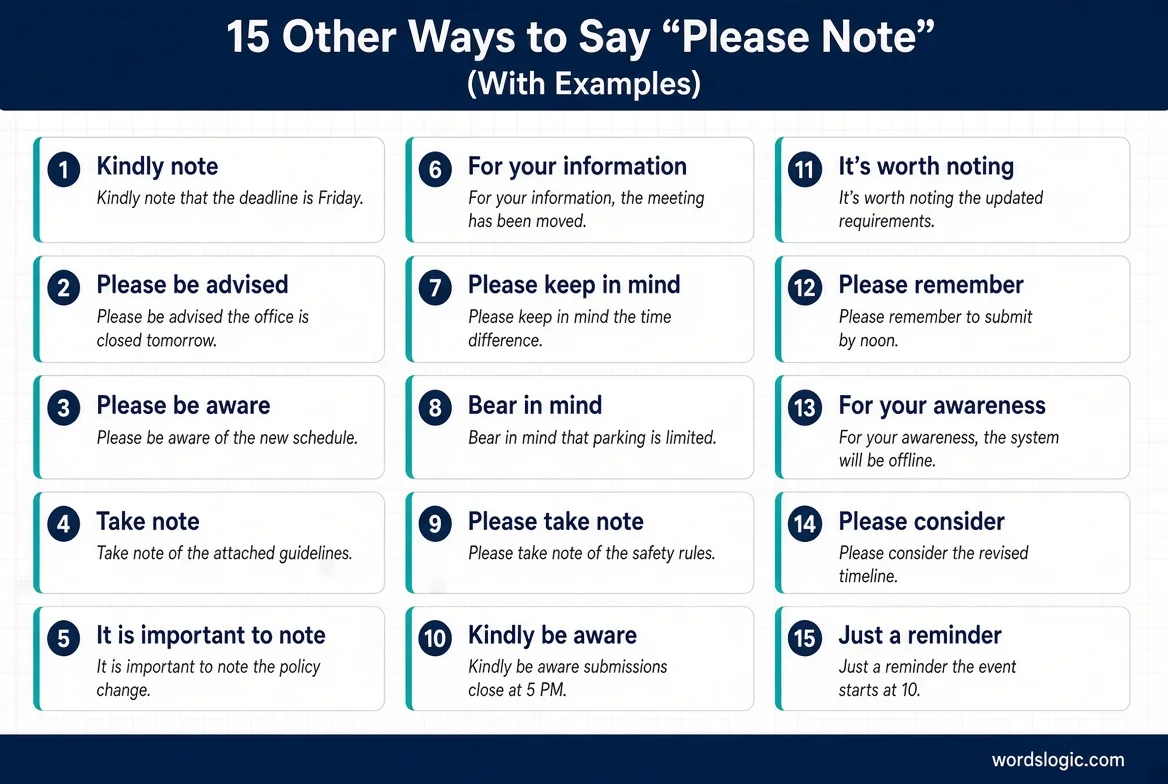
Synonyms for “Please Note”
- Please be aware
- Kindly note
- Please keep in mind
- Take note of
- Be advised
- Please remember
- It is important to note
- Keep in mind
- Please bear in mind
- Please take into consideration
- I’d like to point out
- I’d like to draw your attention to
- Please pay attention to
- It’s worth noting
- One important thing to remember is
1. Please Be Aware
Meaning
“Please be aware” asks someone to pay attention to information that may affect them.
Definition
A polite and professional way to highlight an important fact, condition, change, or potential issue.
Detailed Explanation
“Please be aware” is one of the closest alternatives to “please note.” It works particularly well when the information could affect the reader’s actions or expectations. It has a professional tone without sounding overly formal. You can use it in workplace emails, customer messages, notices, and instructions.
Scenario Examples
Scenario: A company is changing its opening hours.
Example: “Please be aware that our office will close at 3 p.m. on Friday.”
Scenario: You’re sending an important reminder to a client.
Example: “Please be aware that payment must be received before the order can be processed.”
Best Use
Best for professional emails, notices, policies, reminders, and customer communication.
Tone
Tone: Professional, polite, informative
2. Kindly Note
Meaning
“Kindly note” politely asks the reader to pay attention to specific information.
Definition
A concise and formal alternative to “please note.”
Detailed Explanation
This expression is especially common in professional and formal written communication. It can introduce a deadline, instruction, requirement, or important update. While polite, it can sound more formal than everyday alternatives, so it may be less natural in casual messages.
Scenario Examples
Scenario: You’re informing a customer about a deadline.
Example: “Kindly note that all applications must be submitted by Friday.”
Scenario: You’re sending instructions to coworkers.
Example: “Kindly note that the meeting room has been changed to Room 204.”
Best Use
Best for formal emails, business notices, applications, and official communication.
Tone
Tone: Formal, polite, professional
3. Please Keep in Mind
Meaning
“Please keep in mind” asks someone to remember or consider particular information.
Definition
A polite expression used to highlight something the reader should remember while making a decision or taking action.
Detailed Explanation
This phrase is softer and more conversational than “please note.” It works well when the information is something the reader should consider rather than simply observe. It is useful in workplace messages, advice, instructions, and everyday communication.
Scenario Examples
Scenario: You’re explaining a project deadline.
Example: “Please keep in mind that we have a limited amount of time to complete the project.”
Scenario: You’re giving someone advice.
Example: “Please keep in mind that prices may change during the holiday season.”
Best Use
Best for advice, reminders, explanations, and friendly professional communication.
Tone
Tone: Polite, conversational, considerate
4. Take Note of
Meaning
“Take note of” means to pay attention to or remember something important.
Definition
A direct expression used to highlight specific information or details.
Detailed Explanation
This phrase can sound slightly more direct than “please note.” It works well when you want readers to remember a particular detail. It is suitable for instructions, educational material, workplace communication, and formal writing. Depending on the context, it can sound like a clear instruction.
Scenario Examples
Scenario: You’re giving instructions to a team.
Example: “Take note of the updated submission deadline.”
Scenario: A teacher highlights an important point.
Example: “Take note of these key differences before the exam.”
Best Use
Best for instructions, education, workplace communication, and important reminders.
Tone
Tone: Direct, informative, professional
5. Be Advised
Meaning
“Be advised” tells someone that they should be aware of important information.
Definition
A formal expression used to provide notice, warning, or official information.
Detailed Explanation
“Be advised” is more formal and direct than “please note.” It is often used in official notices, policies, customer communication, and situations where the reader needs to understand a condition or change. Because it can sound authoritative, it may not be the best choice for friendly conversations.
Scenario Examples
Scenario: A business is informing customers about a service interruption.
Example: “Be advised that online payments will be unavailable tonight.”
Scenario: You’re providing a formal reminder.
Example: “Be advised that late applications may not be accepted.”
Best Use
Best for official notices, warnings, policies, and formal communication.
Tone
Tone: Formal, direct, authoritative
6. Please Remember
Meaning
“Please remember” politely reminds someone about information they should not forget.
Definition
A simple and friendly alternative for reminders and important details.
Detailed Explanation
This expression is more personal and conversational than “please note.” It is especially useful when you’re reminding someone about a deadline, appointment, responsibility, or requirement. It can be used in both professional and everyday communication.
Scenario Examples
Scenario: You’re reminding an employee about a deadline.
Example: “Please remember to submit your timesheet by Friday.”
Scenario: You’re sending a reminder to a friend.
Example: “Please remember to bring your ID tomorrow.”
Best Use
Best for reminders, emails, instructions, personal messages, and workplace communication.
Tone
Tone: Friendly, polite, straightforward
7. It Is Important to Note
Meaning
“It is important to note” emphasizes that the following information deserves particular attention.
Definition
A formal expression used to introduce significant information or an important qualification.
Detailed Explanation
This alternative works particularly well in formal writing because it clearly signals that the information matters. It is common in reports, business documents, academic writing, and professional explanations. It can sound more serious than the shorter “please note.”
Scenario Examples
Scenario: You’re writing a business report.
Example: “It is important to note that the figures are based on preliminary data.”
Scenario: You’re explaining a policy.
Example: “It is important to note that this policy applies to all employees.”
Best Use
Best for reports, formal documents, professional writing, and academic contexts.
Tone
Tone: Formal, serious, informative
8. Keep in Mind
Meaning
“Keep in mind” asks someone to remember or consider a particular fact.
Definition
A natural and conversational expression for drawing attention to relevant information.
Detailed Explanation
This is one of the most flexible alternatives to “please note.” It sounds less formal and more natural in everyday conversation. You can use it when giving advice, explaining a situation, or helping someone make a decision. Adding “please” makes it slightly more polite when necessary.
Scenario Examples
Scenario: You’re helping a friend plan a trip.
Example: “Keep in mind that the weather can change quickly.”
Scenario: You’re advising a coworker.
Example: “Keep in mind that the client requested a shorter report.”
Best Use
Best for casual conversations, advice, workplace messages, and explanations.
Tone
Tone: Casual, helpful, conversational
9. Please Bear in Mind
Meaning
“Please bear in mind” means to remember or consider something when thinking about a situation.
Definition
A polite and somewhat formal expression meaning “please keep this in consideration.”
Detailed Explanation
This phrase is especially useful when you’re providing context or explaining a limitation. It asks the reader to consider a particular factor before making a judgment or decision. It is more formal than “keep in mind,” making it suitable for professional communication.
Scenario Examples
Scenario: You’re explaining a delivery delay.
Example: “Please bear in mind that delivery times may vary by location.”
Scenario: You’re discussing a project.
Example: “Please bear in mind that the budget is limited.”
Best Use
Best for professional emails, explanations, advice, and formal reminders.
Tone
Tone: Polite, thoughtful, moderately formal
10. Please Take Into Consideration
Meaning
“Please take into consideration” asks someone to consider a particular factor before making a decision.
Definition
A formal expression used when a specific circumstance, requirement, or factor should influence someone’s thinking.
Detailed Explanation
This phrase is more specific than “please note.” Instead of simply asking the reader to notice information, it asks them to consider it when making a decision. It is useful in requests, applications, business communication, and formal discussions.
Scenario Examples
Scenario: You’re making a request to a manager.
Example: “Please take into consideration the additional hours the team has worked.”
Scenario: You’re explaining a decision.
Example: “Please take into consideration the current project deadline.”
Best Use
Best for formal requests, workplace discussions, applications, and decision-making.
Tone
Tone: Formal, respectful, thoughtful
11. I’d Like to Point Out
Meaning
“I’d like to point out” introduces information you want someone to notice or consider.
Definition
A conversational and professional way to draw attention to a specific detail.
Detailed Explanation
This phrase is useful when you’re actively bringing something to someone’s attention. It can sound more personal than “please note” because you’re directly explaining what you want the reader or listener to notice. It works well in emails, discussions, presentations, and explanations.
Scenario Examples
Scenario: You’re discussing a report with a colleague.
Example: “I’d like to point out that the latest figures are different from last month’s results.”
Scenario: You’re clarifying a situation.
Example: “I’d like to point out that the deadline was moved to Thursday.”
Best Use
Best for workplace discussions, presentations, explanations, and professional emails.
Tone
Tone: Professional, direct, conversational
12. I’d Like to Draw Your Attention to
Meaning
“I’d like to draw your attention to” politely directs someone’s focus toward specific information.
Definition
A formal expression used to highlight something particularly important.
Detailed Explanation
This is a polished alternative that works especially well in formal communication. It clearly tells the reader that a particular detail deserves attention. You might see this wording in reports, business correspondence, presentations, and official documents.
Scenario Examples
Scenario: You’re writing a formal email.
Example: “I’d like to draw your attention to the changes outlined below.”
Scenario: You’re presenting a report.
Example: “I’d like to draw your attention to the final section of the report.”
Best Use
Best for formal emails, reports, presentations, and official communication.
Tone
Tone: Formal, professional, polished
13. Please Pay Attention To
Meaning
“Please pay attention to” directly asks someone to focus on particular information.
Definition
A clear expression used when something requires careful attention or observation.
Detailed Explanation
This phrase is more direct than “please note.” It is useful when missing the information could lead to a mistake or misunderstanding. Although polite when preceded by “please,” it can sound stronger than softer alternatives such as “keep in mind.”
Scenario Examples
Scenario: You’re giving important instructions.
Example: “Please pay attention to the safety instructions before beginning.”
Scenario: You’re explaining a form.
Example: “Please pay attention to the required fields marked with an asterisk.”
Best Use
Best for instructions, warnings, training, safety information, and important details.
Tone
Tone: Direct, clear, instructional
14. It’s Worth Noting
Meaning
“It’s worth noting” means that a particular detail is useful or important to consider.
Definition
A softer way to introduce relevant or noteworthy information.
Detailed Explanation
This phrase doesn’t directly instruct the reader to pay attention. Instead, it suggests that the information has enough importance to deserve consideration. That makes it a natural choice for reports, articles, explanations, and professional writing. It can sound less demanding than “please note.”
Scenario Examples
Scenario: You’re writing a report.
Example: “It’s worth noting that sales increased during the final quarter.”
Scenario: You’re explaining a situation to a colleague.
Example: “It’s worth noting that the customer has already contacted us twice.”
Best Use
Best for reports, articles, professional explanations, and informative writing.
Tone
Tone: Neutral, thoughtful, professional
15. One Important Thing to Remember Is
Meaning
“One important thing to remember is” introduces a detail that the reader should keep in mind.
Definition
A natural and reader-friendly way to emphasize one particularly important point.
Detailed Explanation
This expression is less formal than “it is important to note” but still clearly signals that the following information matters. It works well when you’re explaining a process, giving advice, or guiding someone through a situation. Because it sounds conversational, it can make instructional writing feel more approachable.
Scenario Examples
Scenario: You’re explaining a workplace process.
Example: “One important thing to remember is that all requests must be approved first.”
Scenario: You’re giving advice to a friend.
Example: “One important thing to remember is that you don’t have to make the decision immediately.”
Best Use
Best for guides, advice, explanations, instructions, and conversational writing.
Tone
Tone: Friendly, clear, helpful
Which Alternative to “Please Note” Should You Use?
The right alternative depends on the situation and the level of formality you need.
| Situation | Suitable Alternative |
| Professional email | Please be aware |
| Formal notice | Be advised |
| Friendly reminder | Please remember |
| Casual conversation | Keep in mind |
| Formal report | It is important to note |
| Business communication | Kindly note |
| Giving instructions | Take note of |
| Asking someone to consider something | Please take into consideration |
| Drawing attention to a detail | I’d like to point out |
| Formal presentation | I’d like to draw your attention to |
| Safety instructions | Please pay attention to |
| Informative writing | It’s worth noting |
Frequently Asked Questions
What is another way to say “please note” professionally?
Professional alternatives include “please be aware,” “kindly note,” “it is important to note,” and “I’d like to draw your attention to.” The best choice depends on how formal your message needs to be.
What is a polite way to say “please note”?
“Please be aware,” “please keep in mind,” and “please remember” are polite alternatives. They can sound softer and more natural depending on the context.
What is a formal way to say “please note”?
For formal writing, you can use “it is important to note,” “kindly note,” “be advised,” or “I’d like to draw your attention to.”
What can I say instead of “please note” in an email?
In an email, you could write “Please be aware that…,” “I’d like to point out that…,” “Please keep in mind that…,” or “It’s worth noting that…” Choose the option that best matches your relationship with the recipient and the importance of the information.
Is “kindly note” better than “please note”?
Both expressions are polite and professional. “Kindly note” generally sounds a little more formal, while “please note” is more common and neutral. Neither is automatically better; the appropriate choice depends on your audience and context.
Is “please note” rude?
No. “Please note” is not inherently rude. It is normally a polite way to direct attention to important information. However, repeated use or a very direct sentence following it can sometimes make a message feel more formal or authoritative than intended.
Conclusion
“Please note” is a useful phrase for highlighting important information, but you don’t have to use it in every email, notice, or document. For a professional tone, try “please be aware” or “kindly note.” For a softer approach, “please keep in mind” or “please remember” works well. If you’re writing something formal, “it is important to note” and “I’d like to draw your attention to” can sound polished. Choosing an alternative based on your audience, purpose, and tone will make your communication clearer and more natural.