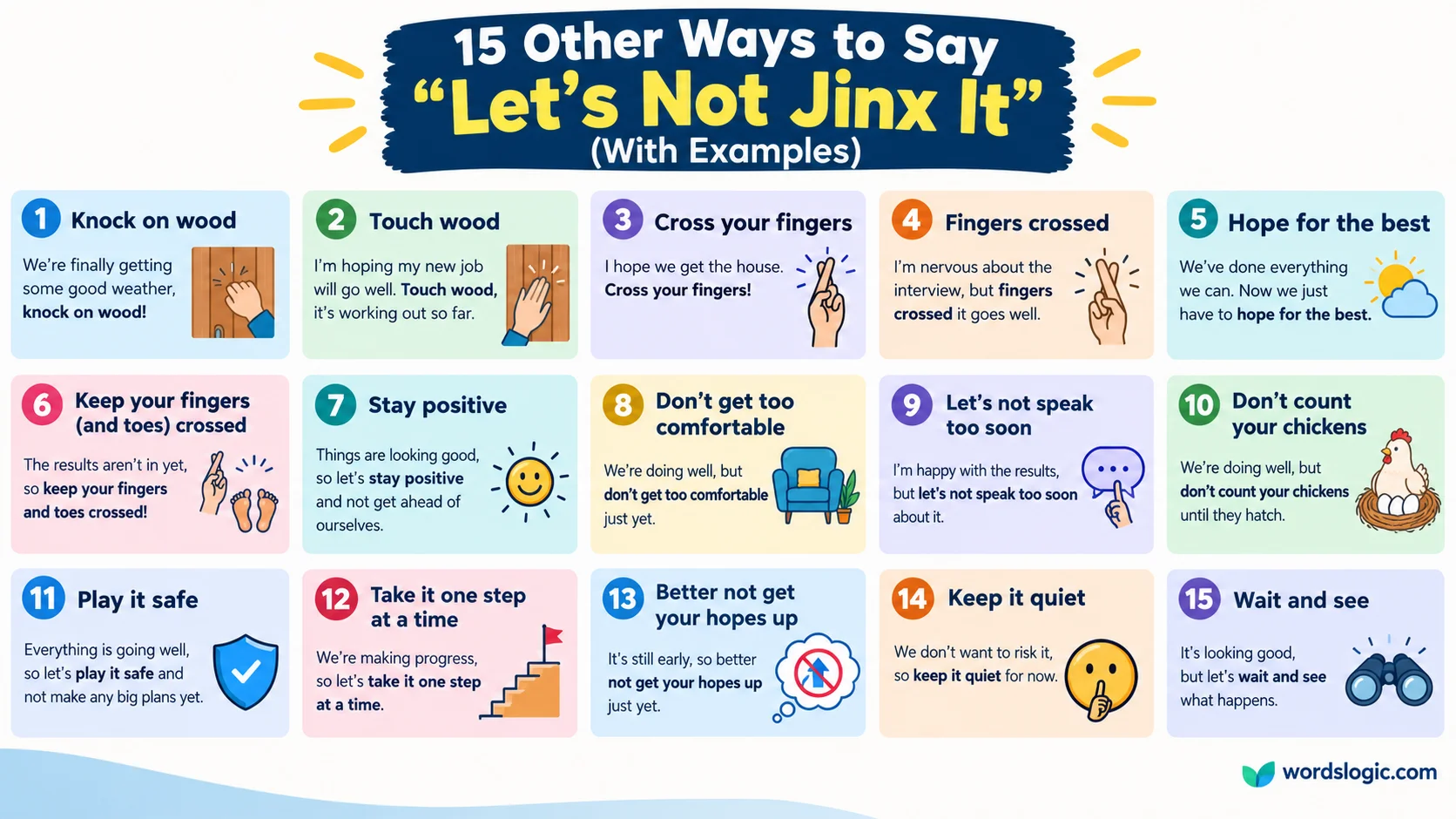
Other Ways to Say “Let’s Not Jinx It” helps you express hope when things are going well but the final outcome remains uncertain. This common idiom encourages you to stay positive without celebrating success too soon.
People use “Let’s Not Jinx It” in everyday American English when waiting for good news, completing a successful project, or watching their favorite team approach a win. From personal observation, I find that this expression reflects cautious optimism rather than a need to expect bad luck. It reminds us to enjoy positive moments while understanding that future outcomes are uncertain.
Learning alternative expressions can improve your English vocabulary and communication skills. Phrases such as “Let’s wait and see,” “I don’t want to speak too soon,” and “Fingers crossed” help you balance excitement with caution. Whether you are speaking with friends, coworkers, or sports fans, these expressions let you maintain hope, practice patience, and appreciate progress without making premature celebrations.
What Does “Let’s Not Jinx It” Mean?
“Let’s not jinx it” means that we should avoid saying or doing something that we jokingly fear might cause a good situation to go wrong. People commonly use this expression when something is going well but has not yet reached a successful conclusion. For example, if your team is close to winning a match, you might say, “We’re doing great, but let’s not jinx it.” The phrase reflects a superstitious belief that talking too confidently about a positive outcome might somehow bring bad luck. Most people use it humorously rather than as a serious statement about cause and effect.
The expression also communicates cautious optimism. You feel hopeful, but you recognize that the result is not certain yet. It can be a lighthearted way to manage expectations without discouraging others or dismissing their excitement.
Common Situations Where “Let’s Not Jinx It” Is Used
People use this phrase in everyday conversations when something promising is happening but the outcome remains uncertain. Friends might say it before an important exam, during a sports match, or while waiting for good news. Couples may use it when discussing future plans, a new relationship, or an exciting opportunity.
It also appears in text messages and social media conversations. For example, someone might write, “My interview went really well! I might finally get the job.” A friend could respond, “That sounds promising! Let’s not jinx it.” The reply expresses support without assuming the job is guaranteed.
In professional settings, the phrase can work among colleagues who share a relaxed relationship. A team might use it when a project is progressing smoothly but still needs final approval. However, formal reports and client emails usually benefit from more precise wording, such as “The results look promising, although the outcome is not yet confirmed.”
People often choose alternatives when they want to sound more professional, less superstitious, more reassuring, or more direct about an uncertain outcome.
Is It Professional or Polite to Say “Let’s Not Jinx It”?
“Let’s not jinx it” is generally casual, friendly, and polite. It does not normally sound rude or offensive. The phrase works well with friends, family members, teammates, and familiar colleagues because its meaning is usually playful rather than critical.
In a workplace conversation, it can help create a relaxed atmosphere. For example, a colleague might say, “The client seems happy with our proposal. Let’s not jinx it until we get the final confirmation.” This sounds natural in an informal team discussion.
However, the expression may be less suitable for formal presentations, official reports, or client-facing correspondence. Some readers may interpret it as overly informal or overly focused on superstition. In those situations, alternatives such as “Let’s remain cautiously optimistic” or “Let’s wait for confirmation before celebrating” communicate the same general idea more professionally.
The best wording depends on your audience, relationship, and purpose. Use the original phrase when a lighthearted tone fits, and choose a more precise alternative when clarity and professionalism matter most.
Advantages and Disadvantages of Saying “Let’s Not Jinx It”
Advantages
The phrase is short, memorable, and easy to understand in casual conversation. It allows people to express excitement without acting as though success is guaranteed. Its playful tone can also build a sense of connection, especially when several people are hoping for the same positive outcome. Because it is widely recognizable in everyday English, it often communicates cautious optimism without requiring a lengthy explanation.
Disadvantages
The expression can sound too casual or superstitious in formal situations. It may also make a genuinely excited person feel that they should not celebrate or discuss their hopes. In some contexts, it fails to explain the real reason for caution, such as pending approval, incomplete results, or an unresolved decision. A more specific phrase can communicate uncertainty more clearly, particularly in professional communication.
15 Alternatives to “Let’s Not Jinx It”
- Knock on wood.
- Let’s not speak too soon.
- Don’t count your chickens before they hatch.
- Let’s wait and see.
- Fingers crossed.
- Let’s not get ahead of ourselves.
- Better not tempt fate.
- Let’s hope for the best.
- Let’s keep our expectations in check.
- It’s not over until it’s over.
- Let’s wait until it’s official.
- So far, so good.
- Let’s not celebrate just yet.
- We shouldn’t take anything for granted.
- Let’s remain cautiously optimistic.
1. Knock on Wood
Meaning
“Knock on wood” is a superstitious expression used to protect a good situation from imagined bad luck. It is closely related to “Let’s not jinx it” because both expressions suggest that you do not want to interfere with a positive outcome.
Definition
A phrase people say, sometimes while physically tapping wood, to express hope that good circumstances will continue.
Detailed Explanation
“Knock on wood” is often used after mentioning something positive that you hope will remain true. It can refer to good health, a smooth project, or a fortunate situation. Unlike “Let’s not jinx it,” it is often a brief response or an addition to a statement rather than a request directed at a group. Its tone is playful and superstitious, making it especially suitable for informal conversations.
Scenario Examples
- Scenario: Talking about staying healthy.
Example: “I haven’t caught a cold all winter, knock on wood!” - Scenario: Discussing a smooth work project.
Example: “Everything has gone according to plan so far. Knock on wood.” - Scenario: Messaging a friend about a long-running relationship.
Example: “We’ve barely argued this year, knock on wood!”
Best Use
Use this expression in casual conversations, friendly messages, and lighthearted discussions about good fortune. It is particularly natural when you want something positive to continue.
Tone
Tone: Playful, hopeful, superstitious.
The expression adds a little humor while showing that you do not want your good luck to change.
2. Let’s Not Speak Too Soon
Meaning
“Let’s not speak too soon” means that you should avoid making a confident statement before you know how a situation will turn out. It preserves the cautious meaning of the original phrase without relying on superstition.
Definition
An expression encouraging people to wait for a result before making a prediction or confident claim.
Detailed Explanation
This alternative focuses on uncertainty and timing rather than the idea of causing bad luck. It is useful when a situation looks promising but still has obstacles ahead. For example, you might use it before receiving a final job offer or finding out whether a deal has been approved. It sounds slightly more practical than “Let’s not jinx it” because it emphasizes the lack of confirmed results.
Scenario Examples
- Scenario: Waiting for a job offer.
Example: “The interview went really well, but let’s not speak too soon until they contact me.” - Scenario: Watching your favorite team lead a match.
Example: “We’re ahead by two goals, but let’s not speak too soon.” - Scenario: Discussing a possible business agreement.
Example: “The client seems interested. Let’s not speak too soon until we receive their decision.”
Best Use
Use it when a result remains uncertain, particularly in conversations about interviews, competitions, negotiations, and important decisions.
Tone
Tone: Cautious, sensible, conversational.
It encourages patience without suggesting that hope or excitement is inappropriate.
3. Don’t Count Your Chickens Before They Hatch
Meaning
This familiar proverb means that you should not assume you will receive a benefit or achieve a goal before it actually happens.
Definition
A warning against treating an expected result as certain before it becomes reality.
Detailed Explanation
The expression is more specific than “Let’s not jinx it.” It warns against assuming success too early, especially when you are already planning around an outcome that has not happened. For instance, someone might start spending money they expect to earn before their payment arrives. The proverb highlights practical judgment rather than supernatural bad luck. It can sound slightly cautionary, so use it gently when you do not want to dampen someone’s enthusiasm.
Scenario Examples
- Scenario: A friend expects to win a competition.
Example: “You might win the prize, but don’t count your chickens before they hatch.” - Scenario: Planning a purchase before receiving a bonus.
Example: “Let’s wait until the bonus arrives before booking the trip. Don’t count your chickens before they hatch.” - Scenario: Expecting a contract to be finalized.
Example: “The negotiations look good, but we shouldn’t count our chickens before they hatch.”
Best Use
Choose this proverb when discussing expected rewards, financial plans, promotions, or future achievements that are not yet confirmed.
Tone
Tone: Practical, cautionary, familiar.
It can offer sensible advice, although it may sound a little patronizing if directed at someone who is simply excited.
4. Let’s Wait and See
Meaning
“Let’s wait and see” means that you should allow events to unfold before deciding what will happen. It communicates patience without assuming either success or failure.
Definition
A phrase suggesting that more time or information is needed before reaching a conclusion.
Detailed Explanation
This expression is more neutral than “Let’s not jinx it” because it does not refer to luck or superstition. It simply acknowledges that the outcome is unknown. You can use it when waiting for an exam result, a medical appointment, a project decision, or a response from another person. Its calm wording makes it useful when you want to avoid unnecessary speculation.
Scenario Examples
- Scenario: Waiting to hear whether a friend got accepted into a university.
Example: “Your application sounds strong. Let’s wait and see what the admissions office says.” - Scenario: A new product has just launched.
Example: “The first customer reviews are encouraging. Let’s wait and see how sales develop.” - Scenario: Discussing a possible weekend outing.
Example: “The forecast might improve, so let’s wait and see before canceling.”
Best Use
Use this expression in everyday conversation, work discussions, and situations involving incomplete information.
Tone
Tone: Calm, neutral, patient.
It keeps expectations realistic without making the conversation overly serious.
5. Fingers Crossed
Meaning
“Fingers crossed” expresses hope that something good will happen. It is related to “Let’s not jinx it,” but its main purpose is to show optimism rather than warn against speaking too soon.
Definition
A common expression used to wish for a favorable outcome when success is uncertain.
Detailed Explanation
This phrase emphasizes hope and encouragement. It works especially well when someone is waiting for news or preparing for an important event. Unlike the original expression, it does not ask people to avoid talking about the outcome. Instead, it shows that you are wishing for success. You can use it independently or at the end of a sentence to make a message feel supportive.
Scenario Examples
- Scenario: A friend has a job interview.
Example: “You’ve prepared so well for this interview. Fingers crossed!” - Scenario: Waiting for a university application result.
Example: “I should hear back tomorrow. Fingers crossed I get accepted.” - Scenario: Hoping a delivery arrives on time.
Example: “The package is supposed to arrive before the party. Fingers crossed!”
Best Use
Use it in text messages, friendly conversations, encouraging notes, and informal workplace chats when you want to express hope.
Tone
Tone: Warm, optimistic, supportive.
It helps you share someone’s excitement without claiming that a good result is guaranteed.
6. Let’s Not Get Ahead of Ourselves
Meaning
This expression means that you should not assume too much, celebrate prematurely, or make plans based on an outcome that remains uncertain.
Definition
A caution against moving mentally or practically beyond what the current facts support.
Detailed Explanation
“Let’s not get ahead of ourselves” is useful when enthusiasm starts turning into assumptions. It can refer to making future plans, announcing success, or acting as though a decision has already been made. Compared with “Let’s not jinx it,” this phrase is more direct and practical. It does not imply that words cause bad luck; it encourages everyone to focus on what is actually known. Depending on delivery, it can sound sensible or slightly dismissive.
Scenario Examples
- Scenario: Colleagues discuss a possible promotion before a decision is made.
Example: “The manager gave me positive feedback, but let’s not get ahead of ourselves.” - Scenario: Friends begin planning a celebration before tickets are confirmed.
Example: “We haven’t secured the tickets yet, so let’s not get ahead of ourselves.” - Scenario: A team receives promising early results.
Example: “The initial numbers look great. Let’s not get ahead of ourselves until we review the full report.”
Best Use
Use it in planning, decision-making, workplace discussions, and conversations where expectations are becoming too confident.
Tone
Tone: Sensible, measured, direct.
It helps bring a conversation back to reality without necessarily dismissing the possibility of success.
7. Better Not Tempt Fate
Meaning
“Better not tempt fate” means that you should avoid acting too confidently because an unfavorable outcome might follow. Like the original expression, it reflects the idea that challenging luck could lead to trouble.
Definition
An expression suggesting that people should avoid unnecessary confidence or actions that might invite misfortune.
Detailed Explanation
This phrase is one of the closest alternatives to “Let’s not jinx it” in terms of its superstitious undertone. It is commonly used when someone is tempted to declare that nothing can go wrong. For example, you might say it after a smooth journey when the trip is not yet over. The wording can sound slightly dramatic, but it is usually lighthearted in everyday conversation. Unlike “Let’s not jinx it,” it often warns against provoking fate rather than merely talking about success.
Scenario Examples
- Scenario: Friends are traveling through bad weather.
Example: “We’ve had clear roads all morning, but we’d better not tempt fate by speeding.” - Scenario: A colleague says a project cannot possibly fail.
Example: “The launch is going well, but let’s not tempt fate just yet.” - Scenario: Someone celebrates a winning streak.
Example: “You’ve won five games in a row. Better not tempt fate by boasting about the next one.”
Best Use
Choose it for informal conversations about luck, risks, winning streaks, and situations that have not fully played out.
Tone
Tone: Playful, cautious, slightly dramatic.
It adds a humorous warning while encouraging people not to become overconfident.
8. Let’s Hope for the Best
Meaning
“Let’s hope for the best” means that you should remain hopeful even though the final result is uncertain. It encourages a positive outlook without promising success.
Definition
A phrase expressing hope for a favorable outcome when the situation cannot be fully controlled.
Detailed Explanation
This expression places more emphasis on optimism and emotional reassurance than on avoiding bad luck. It can help people stay positive when they have done what they can but must wait for events to unfold. Unlike “Let’s not jinx it,” it does not suggest that discussing success could cause a problem. It can also acknowledge uncertainty in difficult situations, so its meaning depends on context. Use it when encouragement matters more than caution.
Scenario Examples
- Scenario: A friend is waiting for an important exam result.
Example: “You’ve worked hard all semester. Let’s hope for the best.” - Scenario: A team has submitted a proposal.
Example: “We’ve sent everything the client requested. Now let’s hope for the best.” - Scenario: A family is waiting for travel arrangements to be confirmed.
Example: “The documents are submitted, so let’s hope for the best and wait for an update.”
Best Use
Use it in supportive messages, uncertain situations, personal conversations, and discussions where people need encouragement.
Tone
Tone: Hopeful, reassuring, encouraging.
It communicates a positive attitude without pretending that the result is guaranteed.
9. Let’s Keep Our Expectations in Check
Meaning
This phrase means that people should remain realistic rather than expecting too much from an uncertain situation.
Definition
A suggestion to maintain reasonable expectations until more information or a confirmed result becomes available.
Detailed Explanation
“Let’s keep our expectations in check” is more measured and analytical than “Let’s not jinx it.” It focuses on managing expectations rather than superstition. The phrase is useful when early signs look promising but there is not enough evidence to make a reliable prediction. It can be especially helpful in team discussions, planning, and situations where disappointment would be costly. However, if delivered bluntly, it may sound as though you are discouraging others from feeling hopeful.
Scenario Examples
- Scenario: A business receives strong interest in a new service.
Example: “The response has been encouraging, but let’s keep our expectations in check until the campaign ends.” - Scenario: Friends discuss a possible vacation deal.
Example: “The price looks amazing, but let’s keep our expectations in check until we read the full terms.” - Scenario: A student expects an excellent result after one successful test.
Example: “That score is a great sign. Let’s keep our expectations in check until the final grades come out.”
Best Use
Choose this expression for professional communication, project planning, forecasting, and conversations about uncertain results.
Tone
Tone: Realistic, measured, professional.
It encourages balanced thinking, especially when enthusiasm could lead to unrealistic assumptions.
10. It’s Not Over Until It’s Over
Meaning
“It’s not over until it’s over” means that the final outcome cannot be known until the situation has actually ended. It reminds people that circumstances can still change.
Definition
An expression emphasizing that a result remains uncertain until the final stage of an event or process.
Detailed Explanation
This phrase is particularly useful when a competition, negotiation, or difficult process is still underway. Unlike “Let’s not jinx it,” it can express either caution or determination. Someone might use it to avoid celebrating too early, but another person could use it to encourage a team that is falling behind. Its meaning depends on whether the speaker is warning against overconfidence or resisting premature defeat. It is more energetic than the original phrase in many situations.
Scenario Examples
- Scenario: A team is trailing near the end of a match.
Example: “We’re behind by one goal, but it’s not over until it’s over.” - Scenario: A business negotiation has reached its final stage.
Example: “The client hasn’t signed yet, so it’s not over until it’s over.” - Scenario: A student worries about an exam after finding one section difficult.
Example: “You still have two sections left. It’s not over until it’s over.”
Best Use
Use it in sports, competitions, negotiations, challenges, and situations where the outcome can still change.
Tone
Tone: Determined, encouraging, realistic.
It reminds people to avoid final judgments before the actual conclusion.
11. Let’s Wait Until It’s Official
Meaning
This expression means that people should wait for formal confirmation before treating an expected outcome as a fact.
Definition
A direct request to postpone conclusions or announcements until an authorized decision or final confirmation is available.
Detailed Explanation
“Let’s wait until it’s official” is a practical alternative when the uncertainty involves approval, confirmation, or an announcement. It avoids the superstitious element of “Let’s not jinx it” and replaces it with a clear reason to wait. The phrase is especially useful at work, where announcing unconfirmed information can create confusion. It may sound more authoritative than the original expression, but it is not necessarily unfriendly. The wording is strongest when an actual confirmation process exists.
Scenario Examples
- Scenario: A colleague believes they have received a promotion.
Example: “That sounds promising, but let’s wait until it’s official before sharing the news.” - Scenario: A customer asks whether a service request has been approved.
Example: “The request is under review. Let’s wait until it’s official before confirming the change.” - Scenario: Friends hear a rumor about a concert announcement.
Example: “I hope the band is coming, but let’s wait until it’s official.”
Best Use
Use it in workplace emails, customer communication, announcements, hiring decisions, and situations requiring verified information.
Tone
Tone: Professional, factual, measured.
It prioritizes accuracy and prevents people from presenting an expectation as a confirmed result.
12. So Far, So Good
Meaning
“So far, so good” means that something has gone well up to the present moment, although its future success is not guaranteed.
Definition
An expression describing a positive situation that has not yet reached its final outcome.
Detailed Explanation
This phrase is often used to acknowledge progress without making a promise about what will happen next. It is related to “Let’s not jinx it” because both expressions can signal cautious optimism. However, “So far, so good” describes the situation rather than asking people to avoid speaking about it. It works well for ongoing tasks, journeys, routines, and projects. Its positive but restrained tone makes it a natural way to recognize progress while leaving room for uncertainty.
Scenario Examples
- Scenario: Someone is trying a new study routine.
Example: “I’ve followed the schedule for two weeks, and so far, so good.” - Scenario: A project is moving through its early stages.
Example: “We’ve completed the first milestone. So far, so good.” - Scenario: A friend is traveling to another city.
Example: “The train is on time, and the weather is lovely. So far, so good!”
Best Use
Choose it for progress updates, casual conversations, travel, ongoing projects, and situations where things are working well at the moment.
Tone
Tone: Positive, relaxed, cautiously optimistic.
It recognizes current success without claiming that everything will continue perfectly.
13. Let’s Not Celebrate Just Yet
Meaning
This phrase means that people should delay celebrating because the desired outcome has not been fully achieved or confirmed.
Definition
A reminder to postpone celebration until success becomes certain or the necessary steps are complete.
Detailed Explanation
“Let’s not celebrate just yet” is more specific than “Let’s not jinx it.” It directly addresses premature celebration rather than the idea that talking about success could bring bad luck. It works when a team has made progress but still needs to finish the job. The phrase can sound playful among friends or firm in a professional setting. If you want to preserve someone’s excitement, you can soften it by acknowledging the progress first.
Scenario Examples
- Scenario: A team has completed most of a major project.
Example: “We’ve finished the main presentation, but let’s not celebrate just yet. We still need final approval.” - Scenario: A sports team has taken an early lead.
Example: “It’s only halftime, so let’s not celebrate just yet.” - Scenario: A friend believes a difficult task is finished.
Example: “The application is submitted, which is great. Let’s not celebrate just yet until the acceptance comes through.”
Best Use
Use it in competitions, project milestones, application processes, and situations where a final step remains.
Tone
Tone: Cautious, direct, sometimes playful.
It keeps attention on the remaining work rather than allowing an unfinished outcome to feel final.
14. We Shouldn’t Take Anything for Granted
Meaning
This expression means that you should not assume a positive situation, opportunity, or benefit will always be available or guaranteed.
Definition
A reminder to appreciate what you have while recognizing that it may change or depend on circumstances.
Detailed Explanation
“We shouldn’t take anything for granted” has a broader meaning than “Let’s not jinx it.” It can express caution about an uncertain outcome, but it also encourages appreciation and humility. For example, a team that is performing well might use it to remember that continued success still requires effort. In relationships, it can mean valuing another person’s care instead of assuming it will always be there. Because the expression can carry a serious or reflective tone, it is not always a direct substitute for the playful original phrase.
Scenario Examples
- Scenario: A team has won several important matches.
Example: “We’ve had a great season, but we shouldn’t take anything for granted.” - Scenario: A person reflects on a supportive friendship.
Example: “She’s always there when I need help. I shouldn’t take that for granted.” - Scenario: A business has enjoyed steady customer demand.
Example: “Sales have been strong, but we shouldn’t take our customers’ loyalty for granted.”
Best Use
Use it in reflective conversations, relationships, teamwork, leadership, and discussions about appreciating ongoing success.
Tone
Tone: Thoughtful, humble, sincere.
It encourages gratitude and responsibility rather than focusing only on uncertainty.
15. Let’s Remain Cautiously Optimistic
Meaning
This phrase means that people can feel hopeful about a possible positive outcome while remaining aware that success is not certain.
Definition
A measured expression of confidence that balances positive expectations with a realistic understanding of uncertainty.
Detailed Explanation
“Let’s remain cautiously optimistic” is one of the strongest alternatives for professional and formal communication. It acknowledges encouraging signs without suggesting that the outcome is guaranteed. Unlike “Let’s not jinx it,” it does not depend on superstition or a playful warning. It is useful when discussing forecasts, negotiations, project results, or unresolved challenges. Although the phrase sounds more formal, it can also work in personal conversations when you want to express a thoughtful, balanced attitude.
Scenario Examples
- Scenario: A manager discusses encouraging early business results.
Example: “The first figures are positive, so let’s remain cautiously optimistic while we review the full quarter.” - Scenario: A family is waiting for confirmation of travel plans.
Example: “Everything seems to be in order. Let’s remain cautiously optimistic until the tickets are confirmed.” - Scenario: A project team receives positive feedback from a client.
Example: “The feedback is encouraging, but let’s remain cautiously optimistic until the client approves the final proposal.”
Best Use
Use it in professional emails, meetings, reports, project updates, and discussions where balanced judgment matters.
Tone
Tone: Professional, measured, reassuring.
It communicates confidence without ignoring the possibility that circumstances may change.
FAQs
What does “Let’s Not Jinx It” mean?
“Let’s Not Jinx It” means you do not want to celebrate or speak too confidently about something before the final result is certain. People use this common idiom when things are going well and they hope nothing will change.
Is “Let’s Not Jinx It” a common expression in American English?
Yes, “Let’s Not Jinx It” is a familiar expression in everyday American English. Friends, coworkers, and sports fans often use it when waiting for good news, working toward success, or hoping their team wins.
What are some other ways to say “Let’s Not Jinx It”?
Some common alternatives include “Let’s wait and see,” “I don’t want to speak too soon,” “Fingers crossed,” “Knock on wood,” and “Hopefully, things keep going well.” Each phrase expresses hope and cautious optimism, although some have stronger connections to superstition than others.
Is “Let’s Not Jinx It” appropriate for professional situations?
Yes, you can use it in casual workplace conversations, especially when discussing a promising project or waiting for results. In more formal communication, expressions such as “Let’s wait for the final outcome” or “Hopefully, everything continues to go smoothly” may sound more professional.
Why do people say “Let’s Not Jinx It” when things are going well?
People say it because they want to protect their hope and excitement without assuming success is guaranteed. Some use it playfully, while others connect it to superstition or the idea of tempting fate. The phrase helps people acknowledge uncertainty while remaining optimistic.
Conclusion
“Let’s Not Jinx It” is a useful expression for situations where things are going well, but the final outcome remains uncertain. It allows you to express hope, show cautious optimism, and avoid celebrating success too early. Whether you are waiting for good news, completing a project, or cheering for your favorite team, this familiar idiom fits naturally into everyday conversations. Learning alternatives such as “Let’s wait and see,” “Fingers crossed,” and “I don’t want to speak too soon” also helps you communicate your feelings more clearly.
Choosing the right phrase depends on your audience, tone, and situation. Informal expressions work well with friends, while more professional alternatives suit workplace discussions. Remember that not jinxing something does not mean ignoring success or expecting bad luck. Instead, it means enjoying the present, practicing patience, and recognizing that future results are not always certain. By using these expressions thoughtfully, you can strengthen your English vocabulary, improve your communication skills, and express optimism without making assumptions about what happens next.













