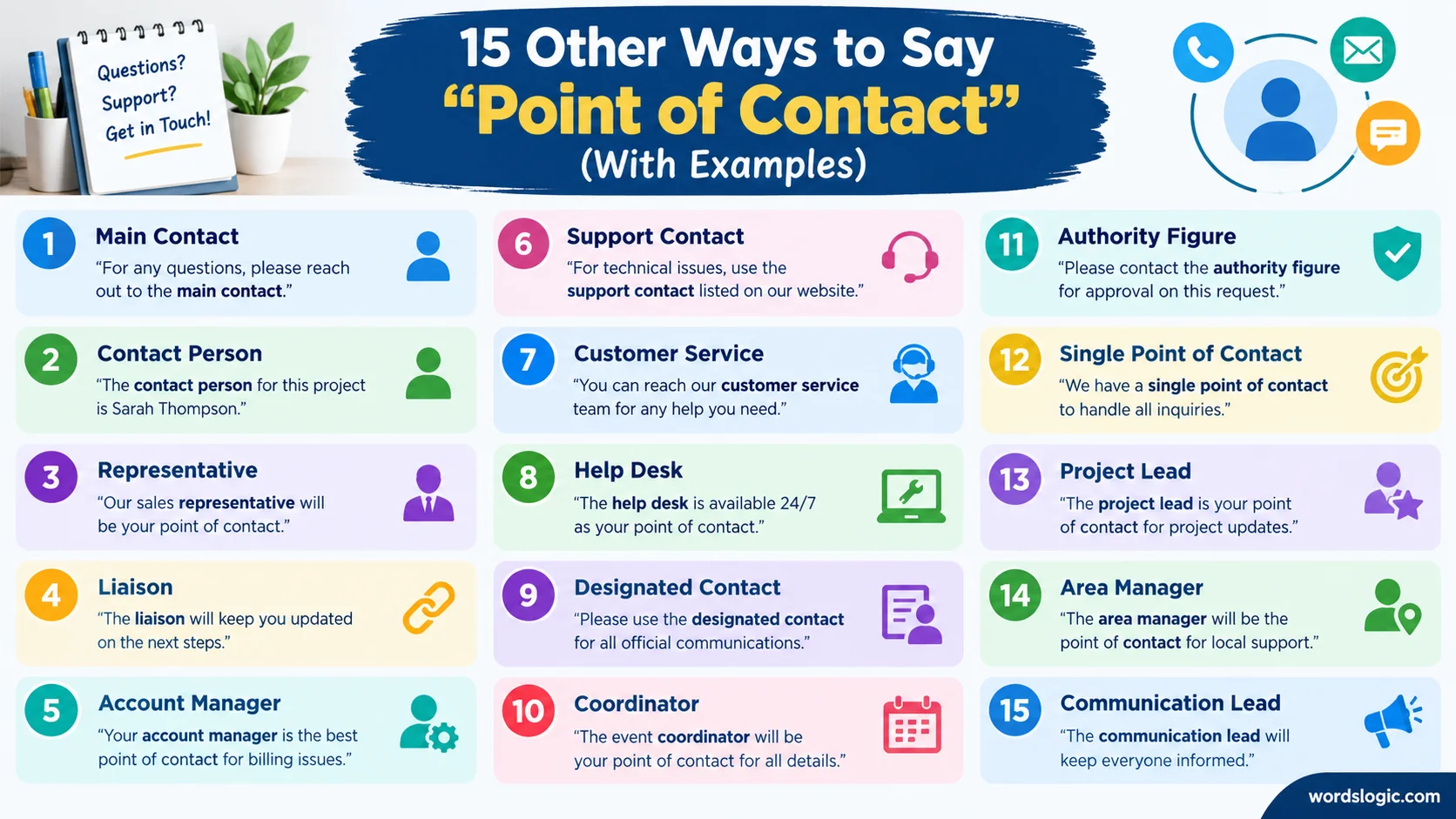
Other Ways to Say “Point of Contact” helps you choose clear, professional alternatives for emails, resumes, and workplace communication.
The phrase point of contact is common in business, but repeating it can make your writing sound stiff or impersonal. Choosing alternatives such as primary contact, client liaison, project coordinator, or designated representative makes your message more specific and natural. These terms help explain responsibilities, improve role clarity, and strengthen professional communication. The best choice depends on your audience, workplace situation, and the duties involved.
For example, instead of writing, “I served as the point of contact for clients,” you could say, “I managed client communication and coordinated project updates.” This wording highlights your responsibilities and creates a stronger impression on hiring managers. Whether you are writing a resume, sending a professional email, or coordinating a project, the right phrase helps you communicate clearly, build trust, and avoid unnecessary repetition.
What Does “Point of Contact” Mean?
A point of contact (POC) is a person who serves as the main connection between an individual, team, organization, or customer and another party. This person provides information, answers questions, shares updates, or directs requests to the appropriate people. For example, a project manager might introduce a team member as the point of contact for questions about deadlines and deliverables.
The phrase is especially common in professional communication, where people need to know whom to approach for a particular matter. It doesn’t necessarily mean that the person makes every decision or solves every problem. Instead, they act as an accessible connection who helps communication run smoothly. Depending on the situation, the role might belong to a customer service representative, project coordinator, account manager, or designated team member.
Common Situations Where “Point of Contact” Is Used
People use “point of contact” when they need to identify someone responsible for handling questions, requests, updates, or communication. In the workplace, a manager might name a team member as the main contact for a project. A customer service department may assign a representative to handle a client’s concerns.
The phrase also appears in business emails, service agreements, school administration, event planning, and client onboarding. For example, a school might provide a staff member’s details to parents who need assistance, while an event organizer might designate someone to answer questions from vendors.
Sometimes, an alternative works better because it explains the person’s role more precisely. “Account representative” may suit a client relationship, while “project coordinator” identifies someone who organizes project activities. Choosing the right expression helps readers understand not just whom to contact, but also what that person can help them with.
Is It Professional or Polite to Say “Point of Contact”?
Yes. “Point of contact” is professional, neutral, and widely suitable for workplace communication. It works well in formal emails, business proposals, project documents, customer service messages, and organizational announcements. For example, writing “Please contact Maria, our point of contact for this project” sounds clear and respectful.
However, the expression can sometimes feel corporate or impersonal in a casual conversation. If you’re writing to a familiar colleague, “main contact” or “the person to contact” may sound more natural. In client communication, “account representative” can feel more specific, provided the person actually serves in that role.
The best alternative depends on the person’s responsibilities and your relationship with the reader. Choose wording that is clear, accurate, and appropriate to the situation rather than making every message sound more formal than necessary.
Advantages and Disadvantages of Saying “Point of Contact”
Advantages
The phrase “point of contact” identifies a clear communication channel. It helps prevent confusion by showing people where to direct their questions instead of contacting several employees. It also works across industries and can describe many different professional roles without requiring a specific job title.
Another advantage is its neutral and professional tone. It suits both internal communication and external messages to clients, suppliers, or partners. When responsibilities are clearly defined, the expression can help people understand whom to approach for information or assistance.
Disadvantages
Although the phrase is useful, it can sound formal, impersonal, or repetitive when used too frequently. In a friendly email, saying “your point of contact will reach out” may feel less personal than naming the person directly.
The phrase can also be vague if the person’s responsibilities aren’t explained. A point of contact might answer general questions but lack the authority to approve requests or resolve technical problems. In such cases, a more specific title, such as project coordinator or account representative, can provide better guidance. The key is to choose an alternative that accurately describes the person’s role.
15 Alternatives to “Point of Contact”
- Main Contact
- Primary Contact
- Designated Contact
- Contact Person
- Liaison
- Point Person
- Go-To Person
- Project Coordinator
- Account Representative
- Customer Service Representative
- Lead Contact
- Person to Contact
- Communication Lead
- Authorized Representative
- Primary Liaison
1. Main Contact
Meaning
Main contact refers to the person people should approach first when they have questions or need information. It emphasizes accessibility and responsibility for general communication.
Definition
The main contact is the principal person to reach about a particular issue, project, service, or organization.
Detailed Explanation
“Main contact” is a straightforward alternative that works in many professional and everyday situations. It sounds slightly less corporate than “point of contact” while keeping the same general meaning. The expression doesn’t automatically suggest that the person has decision-making authority. It simply tells readers whom they should approach first.
Scenario Examples
- Scenario: A team introduces the person handling project questions.
Example: “Daniel is our main contact for the website redesign.” - Scenario: A community organization shares contact details.
Example: “Please make our main contact aware of any schedule changes.”
Best Use
Use main contact in business emails, team introductions, community projects, and general instructions. It’s particularly useful when you want clear wording without sounding overly formal.
Tone
Tone: Professional, clear, approachable.
The expression feels natural and practical because it communicates responsibility without unnecessary corporate language.
2. Primary Contact
Meaning
Primary contact identifies the principal person responsible for receiving communication about a particular matter. It emphasizes priority rather than simply accessibility.
Definition
The primary contact is the first or principal person designated to receive inquiries and updates.
Detailed Explanation
“Primary contact” is a good choice for situations where an organization has several people who may be contacted. It makes the communication hierarchy clearer by identifying the preferred person. The wording sounds slightly more formal and administrative than “main contact.” However, it doesn’t necessarily mean that secondary contacts cannot help or that the primary contact has final authority.
Scenario Examples
- Scenario: A supplier needs one person to coordinate deliveries.
Example: “Please list Ayesha as the primary contact for all delivery updates.” - Scenario: A company completes a client’s onboarding paperwork.
Example: “Who should we record as your primary contact for account notifications?”
Best Use
Choose primary contact for official forms, business agreements, client onboarding, vendor relationships, and administrative communication.
Tone
Tone: Professional, formal, organized.
Its structured wording works well when responsibilities need to be documented clearly.
3. Designated Contact
Meaning
A designated contact is someone specifically selected to handle communication for a particular purpose. The phrase emphasizes an assigned responsibility.
Definition
A designated contact is a person formally or deliberately appointed to receive questions, requests, or updates.
Detailed Explanation
This expression is especially useful when a team or organization has intentionally assigned one person to handle communication. Unlike “main contact,” which emphasizes the person’s central role, “designated contact” highlights the act of choosing or appointing them. It sounds more official and procedural. Use it when the assignment matters, such as during an event, a safety procedure, or a formal project.
Scenario Examples
- Scenario: An event organizer assigns someone to work with vendors.
Example: “Rina is the designated contact for vendor registration.” - Scenario: A school shares its arrangements for a field trip.
Example: “Please call the designated contact if your child will arrive late.”
Best Use
Use designated contact in policies, event instructions, school communications, emergency procedures, and formal project documents.
Tone
Tone: Formal, precise, administrative.
The word “designated” makes the assigned responsibility especially clear.
4. Contact Person
Meaning
A contact person is an individual someone can approach to ask questions, request assistance, or obtain information.
Definition
A contact person is the individual identified as available for communication about a specific matter.
Detailed Explanation
“Contact person” is a simple, widely understandable expression. It works well when readers need a name or person to approach but don’t need a detailed explanation of the person’s authority. Compared with “primary contact,” it places less emphasis on hierarchy. It’s also easy for English learners to understand. In some contexts, it can sound slightly administrative, especially on forms or official notices.
Scenario Examples
- Scenario: A workshop organizer provides assistance details.
Example: “If you have questions about registration, Nina is the contact person.” - Scenario: A new employee needs help with office procedures.
Example: “Your contact person during the first week will be James from HR.”
Best Use
Choose contact person for application forms, school notices, training programs, event details, and straightforward professional messages.
Tone
Tone: Neutral, polite, accessible.
Its uncomplicated wording makes it useful for readers with different levels of English proficiency.
5. Liaison
Meaning
A liaison is a person who helps two individuals, teams, or organizations communicate and work together. It suggests a connecting or coordinating role.
Definition
A liaison is an individual who facilitates communication and cooperation between different parties.
Detailed Explanation
“Liaison” can replace “point of contact” when the person does more than receive messages. A liaison may share information, coordinate discussions, clarify expectations, and help different groups work together. The term often sounds more specialized than “contact person.” However, it doesn’t simply mean anyone whose name appears on a contact list. Use it when the person genuinely supports communication between parties.
Scenario Examples
- Scenario: A company works with an outside design agency.
Example: “Priya will serve as our liaison with the design team.” - Scenario: A university department communicates with local businesses.
Example: “The industry liaison will coordinate meetings with our partners.”
Best Use
Use liaison in partnerships, cross-department projects, community relations, public relations, and situations involving multiple organizations.
Tone
Tone: Professional, collaborative, diplomatic.
It emphasizes cooperation and connection rather than simply being the person who answers questions.
6. Point Person
Meaning
A point person is the individual responsible for organizing or handling communication about a particular task, project, or activity.
Definition
A point person is the person primarily responsible for coordinating a specific matter.
Detailed Explanation
“Point person” is a close alternative to “point of contact,” particularly in workplace conversation. It often suggests more involvement in coordination and follow-up than the original phrase alone. The expression is common in professional English, although it feels less formal than “designated contact.” A point person may coordinate tasks without having managerial authority. Its exact meaning depends on the responsibilities assigned.
Scenario Examples
- Scenario: A team needs someone to coordinate a product launch.
Example: “Marcus is the point person for the launch preparations.” - Scenario: Colleagues need someone to collect feedback.
Example: “I’ll be the point person for questions about the new schedule.”
Best Use
Choose point person for team projects, workplace discussions, event planning, and informal professional emails.
Tone
Tone: Direct, practical, conversational.
It sounds natural among colleagues who need to identify the person coordinating a task.
7. Go-To Person
Meaning
A go-to person is someone people regularly turn to because that person is helpful, knowledgeable, or well placed to assist.
Definition
A go-to person is the trusted individual people approach first for guidance or support.
Detailed Explanation
This expression adds a sense of familiarity and trust that “point of contact” doesn’t always convey. A go-to person is often someone people rely on for answers, practical advice, or assistance. However, the term doesn’t necessarily indicate an officially assigned communication role. It may describe an informal reputation rather than a formal responsibility. Use it when the person’s experience or helpfulness is an important part of the message.
Scenario Examples
- Scenario: A new employee needs help using internal software.
Example: “Ask Leena; she’s our go-to person for software questions.” - Scenario: A friend needs advice about planning a trip.
Example: “Sam is my go-to person for travel recommendations.”
Best Use
Use go-to person in friendly workplace communication, casual conversation, team introductions, and messages about trusted sources of advice.
Tone
Tone: Friendly, confident, informal.
The expression feels warmer because it suggests trust and reliability rather than just an assigned role.
8. Project Coordinator
Meaning
A project coordinator is a person who helps organize a project’s activities, schedules, information, and communication.
Definition
A project coordinator is an individual who supports the planning and coordination of project tasks and participants.
Detailed Explanation
“Project coordinator” is more specific than “point of contact.” It identifies a role focused on keeping project activities organized and helping participants stay informed. A coordinator may also serve as the project’s main contact, but the two terms are not automatically interchangeable. Some projects assign communication to a different team member. Use this alternative only when the person’s actual responsibilities include project coordination.
Scenario Examples
- Scenario: A client needs updates about project milestones.
Example: “Please contact our project coordinator for the latest timeline.” - Scenario: Team members need to confirm a meeting.
Example: “The project coordinator will send the revised meeting schedule.”
Best Use
Choose project coordinator in project plans, client updates, team introductions, implementation schedules, and project-related emails.
Tone
Tone: Professional, organized, specific.
The job title clarifies the person’s function instead of relying on a general communication label.
9. Account Representative
Meaning
An account representative is a person who manages or supports communication with a customer or business account.
Definition
An account representative is a professional who handles customer or client account-related communication and support.
Detailed Explanation
This phrase works particularly well in sales, business services, and ongoing client relationships. It suggests that the person helps manage an account rather than merely passing along messages. Depending on the organization, an account representative may answer questions, provide updates, or help resolve account concerns. The title can imply broader responsibilities than “point of contact,” so it should match the person’s actual job.
Scenario Examples
- Scenario: A business customer needs assistance with an existing service agreement.
Example: “Your account representative can explain the available service options.” - Scenario: A company introduces a new contact for a client account.
Example: “Jordan will be your account representative starting next month.”
Best Use
Use account representative in client onboarding, sales communication, service agreements, account management, and business-to-business relationships.
Tone
Tone: Professional, customer-focused, formal.
It gives clients a clearer understanding of the person’s account-related responsibilities.
10. Customer Service Representative
Meaning
A customer service representative is an employee who assists customers with questions, service issues, complaints, or requests.
Definition
A customer service representative is a person whose role involves helping customers and addressing service-related needs.
Detailed Explanation
This title is more specific than “point of contact” because it identifies a customer support function. It works well when the person helps customers with product information, billing questions, returns, or service problems. However, not every point of contact works in customer service. A project manager or account executive may handle communication without being a customer service representative. Use the title only when customer support is genuinely part of the role.
Scenario Examples
- Scenario: A customer wants help with an order.
Example: “A customer service representative will contact you about your delivery.” - Scenario: A shopper has a question about a refund.
Example: “Please speak with a customer service representative for assistance with your refund.”
Best Use
Choose customer service representative in support emails, help-center instructions, order updates, complaint handling, and customer-facing service messages.
Tone
Tone: Professional, helpful, service-oriented.
It clearly identifies a support role and helps customers understand where to direct their concerns.
11. Lead Contact
Meaning
A lead contact is the principal person who leads or manages communication within a particular arrangement. Its exact meaning can vary by organization.
Definition
A lead contact is the person identified as the leading communication contact for a specific activity or relationship.
Detailed Explanation
“Lead contact” can be useful when one person takes the lead in communication while other people remain involved. It may suggest greater responsibility for coordinating messages or keeping parties informed. However, it is less standardized than “primary contact” and may not be the clearest choice in every workplace. If the person simply receives inquiries, “main contact” may be more natural. Use “lead contact” when a leading communication role is genuinely intended.
Scenario Examples
- Scenario: Several departments collaborate on an internal initiative.
Example: “Olivia will act as the lead contact for communications between the departments.” - Scenario: A supplier needs one person to coordinate routine updates.
Example: “Please direct initial project updates to our lead contact.”
Best Use
Use lead contact in collaborative projects, multi-team initiatives, and situations where one person coordinates communication among several participants.
Tone
Tone: Professional, direct, responsibility-focused.
The word “lead” emphasizes coordination, although the term should be clarified if the role isn’t familiar to the audience.
12. Person to Contact
Meaning
Person to contact directly identifies the individual someone should reach for information, help, or follow-up.
Definition
The person to contact is the individual someone should communicate with about a particular question or task.
Detailed Explanation
This expression is one of the clearest alternatives because it focuses on the reader’s next action. Unlike “liaison” or “account representative,” it doesn’t imply a particular job title or level of authority. It works in formal and informal writing, depending on the surrounding sentence. The wording may be less compact than “point of contact,” but it is easy to understand. It’s especially useful when clarity matters more than corporate terminology.
Scenario Examples
- Scenario: A school shares details about an upcoming trip.
Example: “Ms. Khan is the person to contact if you have questions about transportation.” - Scenario: A customer needs help with a booking.
Example: “Your confirmation email includes the person to contact about changes.”
Best Use
Choose person to contact for instructions, public notices, school communication, customer information, and messages intended for a broad audience.
Tone
Tone: Clear, neutral, practical.
The phrase makes the next step obvious without adding unnecessary formality.
13. Communication Lead
Meaning
A communication lead is a person who takes responsibility for coordinating or overseeing communication related to a project, team, campaign, or organization.
Definition
A communication lead is the person responsible for guiding or coordinating communications within a defined area of work.
Detailed Explanation
“Communication lead” suggests a more active role than simply being available for inquiries. This person may organize announcements, coordinate messages, maintain communication plans, or ensure that information reaches the right people. The title can imply leadership, so it isn’t always an accurate replacement for “point of contact.” In some organizations, it may refer specifically to communications, marketing, or public relations. Use it when the role includes responsibility for communication strategy or coordination.
Scenario Examples
- Scenario: A company prepares an internal policy announcement.
Example: “Please send your draft questions to the communication lead before Friday.” - Scenario: A campaign team needs consistent public messaging.
Example: “The communication lead will coordinate updates across all campaign channels.”
Best Use
Use communication lead in communications teams, campaigns, organizational announcements, cross-functional projects, and roles involving message coordination.
Tone
Tone: Professional, strategic, leadership-focused.
It conveys responsibility for managing communication rather than simply receiving questions.
14. Authorized Representative
Meaning
An authorized representative is someone who has permission to act or communicate on behalf of another person or organization.
Definition
An authorized representative is an individual formally permitted to represent another party within a defined scope of responsibility.
Detailed Explanation
This expression is more formal and carries a stronger implication of authority than “point of contact.” An authorized representative may communicate official decisions, submit documents, or act on an organization’s behalf, depending on the authorization granted. Not every contact person has that permission. Using the term incorrectly could mislead readers about someone’s authority. Choose it only when the person is genuinely authorized to represent the relevant party.
Scenario Examples
- Scenario: A company identifies someone who can discuss an official agreement.
Example: “Please direct contract-related questions to our authorized representative.” - Scenario: An organization submits paperwork through an appointed representative.
Example: “The authorized representative will sign the documents on behalf of the organization.”
Best Use
Choose authorized representative for formal agreements, official documentation, administrative processes, and situations where the person’s authority matters.
Tone
Tone: Formal, official, precise.
The phrase communicates permission to represent someone, not merely responsibility for receiving messages.
15. Primary Liaison
Meaning
A primary liaison is the main person responsible for helping two parties communicate and cooperate.
Definition
A primary liaison is the principal communication link between individuals, teams, or organizations working together.
Detailed Explanation
“Primary liaison” combines the priority implied by “primary” with the collaborative function of “liaison.” It works when a person serves as the main bridge between groups and helps information move between them. Unlike “primary contact,” which can simply identify whom to approach first, this phrase suggests ongoing coordination. It may sound more formal or specialized, so a simpler alternative can be better for general audiences. Use it when both the central role and the relationship-building aspect matter.
Scenario Examples
- Scenario: A nonprofit works with a corporate partner on a shared initiative.
Example: “Amir will be our primary liaison with the corporate partnership team.” - Scenario: A university collaborates with an outside research organization.
Example: “Please send coordination requests to the primary liaison for the research partnership.”
Best Use
Use primary liaison in partnerships, institutional collaborations, interdepartmental work, and projects involving regular communication between separate organizations.
Tone
Tone: Formal, collaborative, relationship-focused.
It highlights both the person’s central position and their responsibility for maintaining communication between parties.
FAQs
What is another way to say “point of contact”?
You can use primary contact, contact person, designated representative, main contact, or key contact. The best option depends on the person’s role and the situation.
What is a professional alternative to “point of contact”?
Primary liaison, client representative, project coordinator, and designated representative are professional alternatives. Choose a term that accurately describes the person’s responsibilities.
How can I say “point of contact” on a resume?
On a resume, describe your actual duties instead of relying on a general phrase. For example, write, “Managed client communication and coordinated project updates” to highlight your responsibilities and achievements.
Is “point of contact” formal or informal?
Point of contact is a standard phrase used in professional communication, business emails, project management, and customer service. However, alternatives such as primary liaison or designated representative may sound more specific in formal documents.
What is the difference between a point of contact and a liaison?
A point of contact is the person someone approaches for information or assistance. A liaison usually helps maintain communication and cooperation between people, teams, or organizations. One person can perform both roles.
Conclusion
Choosing the right alternative to point of contact can make your writing clearer, more natural, and more professional. Terms such as primary contact, client liaison, project coordinator, and designated representative help explain responsibilities without unnecessary repetition. For resumes, focus on specific duties and achievements, while professional emails may benefit from simple, direct wording. Always consider your audience, context, and purpose before selecting an alternative.
Strong professional communication depends on using words that accurately describe your role and make your message easy to understand. Whether you are communicating with clients, coordinating with colleagues, managing projects, or preparing a job application, the right phrase can improve clarity, build trust, and support collaboration. Keep your language concise, choose terms that fit the situation, and make every sentence meaningful.