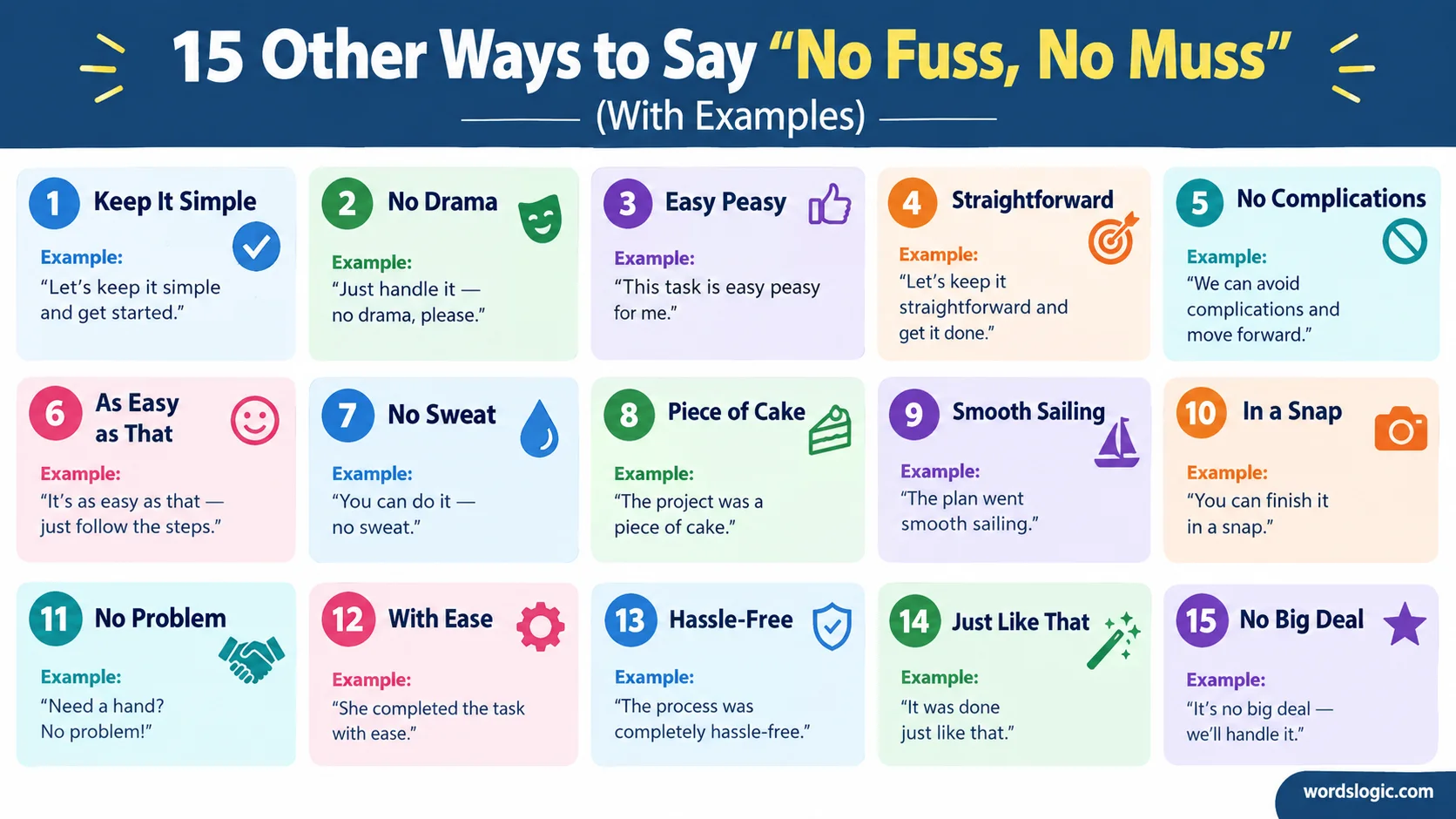
For Other Ways to Say “No Fuss, No Muss”, simple wording can bring clarity, ease, and calm to everyday communication in daily work. In my real experience, the idea behind No Fuss, No Muss is simplicity, ease, clarity, and calm choices that guide steady progress. When tasks are simple, smooth, stress-free, straightforward, quick, easy, effortless, clean, or plain, things usually feel manageable.
A ride, sailing, or pie can offer a simple comparison when there is a clear path and a lack of complication. With fewer complications, hassles, and trouble, you can focus on saving time, avoiding confusion, and reducing unnecessary effort while keeping your mind calm. The phrase perfectly captures a way of handling small, informal parties hosted by friends, where everything flows easily. You may pack for tonight, leave the first thing in the morning, and complete the whole process without difficulty. The same idea can describe preparing ingredients, watching a mixture rise in the oven for half an hour, using one bowl, or applying a spray cleaner in the shower when it ensures everything looks sparkling with no wasted time. The secret is avoiding trouble, doing what is needed, and leaving nothing that creates more work.
Imagine organizing a project at work when a colleague smiles and says, don’t worry. You instantly understand that the process should be organized, free from unnecessary complications, and easy to manage. This short phrase communicates convenience, efficiency, and confidence.
What Does “No Fuss, No Muss” Mean?
“No fuss, no muss” is an informal expression meaning that something can be done easily, without unnecessary trouble, complications, mess, or disturbance. It is similar to saying that a process will be simple and straightforward. For example, someone might describe an easy return process by saying, “Just bring the receipt and exchange it—no fuss, no muss.” The phrase has a relaxed, conversational quality and is often used to emphasize convenience and simplicity. “Fuss” suggests unnecessary concern or difficulty, while “muss” traditionally refers to disorder or mess, so the expression combines both ideas.
Common Situations Where “No Fuss, No Muss” Is Used
People use “no fuss, no muss” mainly in casual conversation, advertising-style language, personal messages, and everyday situations where they want to emphasize that something will be easy. It can describe a simple task, an uncomplicated arrangement, a convenient service, or a decision that does not require much effort.
You might hear it when someone explains how to solve a small problem, organize an event, make a purchase, or complete a task. Because the expression is playful and informal, a different phrase may be better for a workplace email, formal writing, or a serious conversation. Alternatives such as “simple and straightforward” or “without any complications” can communicate the same general idea more clearly in those settings.
Is It Professional or Polite to Say “No Fuss, No Muss”?
“No fuss, no muss” is generally casual, friendly, and informal. It is not rude, but its playful wording may feel too relaxed for some professional or formal situations. It works naturally when talking with friends, family, customers in a friendly setting, or colleagues you know well. In a business email or formal document, phrases such as “a straightforward process” or “without any complications” may sound more polished. The phrase is best when you want to emphasize ease and convenience without sounding overly formal.
Advantages and Disadvantages of Saying “No Fuss, No Muss”
Advantages
The expression is memorable, lighthearted, and easy to understand in casual English. It quickly communicates that something will not involve unnecessary difficulty or inconvenience. Its playful rhythm also gives it a friendly quality that can make ordinary communication feel more relaxed.
Disadvantages
The main limitation is its informal and slightly playful tone. It may not fit formal reports, professional correspondence, academic writing, or serious discussions. It can also be somewhat vague because “no fuss, no muss” could refer to avoiding effort, drama, mess, delays, or complications depending on the context. A more specific alternative may therefore communicate your exact meaning better.
Synonyms for “No Fuss, No Muss”
- Simple and Straightforward
- Easy and Convenient
- No Trouble at All
- No Complications
- Without Any Hassle
- Smooth and Easy
- Quick and Easy
- Nothing Complicated
- No Need to Make It Complicated
- It’s a Piece of Cake
- It’s Easy as Pie
- Without Any Unnecessary Drama
- With Minimal Effort
- A Straightforward Process
- Easy Does It
1. Simple and Straightforward
Meaning
“Simple and straightforward” means something is easy to understand, handle, or complete without unnecessary complications.
Definition
An expression describing something that is clear, uncomplicated, and easy to deal with.
Detailed Explanation
This is one of the most useful polished alternatives to “no fuss, no muss.” It focuses on simplicity and clarity rather than the playful idea of avoiding fuss or mess. Unlike the original phrase, it works comfortably in professional communication. It is especially useful when describing a process, instruction, solution, or arrangement.
Scenario Examples
Scenario: You are explaining a workplace procedure.
Example: “The application process is simple and straightforward.”
Scenario: A friend asks how to return an item.
Example: “It’s simple and straightforward—just take it back with your receipt.”
Best Use
Best for professional communication, emails, instructions, business writing, and everyday conversation.
Tone
Tone: Clear, professional, practical. It communicates simplicity without sounding overly casual.
2. Easy and Convenient
Meaning
“Easy and convenient” describes something that requires little effort and fits comfortably into someone’s needs or schedule.
Definition
A phrase describing something that is simple to use or do and does not create unnecessary inconvenience.
Detailed Explanation
This alternative emphasizes both ease and convenience. It is particularly useful when discussing services, arrangements, purchases, schedules, or solutions. Compared with “no fuss, no muss,” it sounds more neutral and polished. It is also useful when the main benefit is saving someone time or effort.
Scenario Examples
Scenario: A company explains its delivery service.
Example: “We offer an easy and convenient way to receive your order.”
Scenario: You suggest a meeting location.
Example: “Meeting online would be easy and convenient for everyone.”
Best Use
Best for customer communication, services, scheduling, workplace messages, and everyday suggestions.
Tone
Tone: Friendly, practical, positive. It highlights convenience rather than simply the absence of trouble.
3. No Trouble at All
Meaning
“No trouble at all” means something will not cause difficulty, inconvenience, or concern.
Definition
A reassuring expression meaning there is no problem or burden involved.
Detailed Explanation
This phrase works especially well when someone is worried about asking for help or causing inconvenience. It is more directly reassuring than “no fuss, no muss.” It can also be used after someone thanks you for doing something. The expression sounds warm and natural in personal conversations and many informal professional situations.
Scenario Examples
Scenario: A friend asks if you can give them a ride.
Example: “No trouble at all. I’ll pick you up at seven.”
Scenario: A customer apologizes for asking another question.
Example: “No trouble at all. I’m happy to clarify that for you.”
Best Use
Best for reassurance, customer service, friendly conversations, favors, and polite replies.
Tone
Tone: Warm, reassuring, helpful. It makes the other person feel that their request is not a burden.
4. No Complications
Meaning
“No complications” means there are no unnecessary difficulties, problems, or complex issues involved.
Definition
A concise expression indicating that something is free from complications or additional problems.
Detailed Explanation
This phrase is more direct and neutral than “no fuss, no muss.” It works especially well when discussing procedures, arrangements, or situations where avoiding problems matters. It does not have the playful rhythm of the original expression. Because of that, it can fit professional contexts more naturally.
Scenario Examples
Scenario: You are describing a simple contract process.
Example: “We can handle the renewal online with no complications.”
Scenario: A friend asks whether changing plans will cause problems.
Example: “There should be no complications if we leave an hour earlier.”
Best Use
Best for professional communication, practical discussions, processes, arrangements, and everyday planning.
Tone
Tone: Direct, neutral, practical. It emphasizes the absence of problems.
5. Without Any Hassle
Meaning
“Without any hassle” means without unnecessary difficulty, inconvenience, or annoyance.
Definition
A phrase describing something that can happen easily and without causing problems or frustration.
Detailed Explanation
This is a very close everyday alternative to “no fuss, no muss.” It emphasizes convenience and freedom from difficulty. The word “hassle” is informal, so this expression remains conversational rather than highly formal. It works naturally when talking about services, errands, travel, purchases, or practical tasks.
Scenario Examples
Scenario: You explain an online return.
Example: “You can return the item without any hassle.”
Scenario: A friend asks whether changing the reservation will be difficult.
Example: “We can change it without any hassle.”
Best Use
Best for casual conversation, customer service, travel, shopping, texting, and practical advice.
Tone
Tone: Casual, reassuring, convenient. It highlights freedom from annoyance or difficulty.
6. Smooth and Easy
Meaning
“Smooth and easy” describes something that happens without significant problems, delays, or effort.
Definition
A phrase describing a process or experience that is comfortable, uncomplicated, and free from major difficulties.
Detailed Explanation
This expression focuses on how smoothly something happens rather than on avoiding drama or mess. It is useful when describing an experience, transition, process, or task. It can sound more positive than simply saying “no problems.” The phrase is natural in both personal and workplace conversations.
Scenario Examples
Scenario: You describe moving to a new apartment.
Example: “The whole move was surprisingly smooth and easy.”
Scenario: A manager explains a new software transition.
Example: “We want to make the transition as smooth and easy as possible.”
Best Use
Best for workplace communication, transitions, events, travel, personal experiences, and planning.
Tone
Tone: Positive, reassuring, relaxed. It suggests that everything is progressing comfortably.
7. Quick and Easy
Meaning
“Quick and easy” means something can be completed in little time and without much effort.
Definition
A phrase describing a task or process that is fast and uncomplicated.
Detailed Explanation
This alternative is useful when the important part of “no fuss, no muss” is that something does not take much time or energy. It does not necessarily mean there will be no mess or drama; instead, it highlights speed and simplicity. It is especially common in everyday speech and practical instructions. It can also work well in informal promotional language.
Scenario Examples
Scenario: A friend needs a simple dinner idea.
Example: “I’ll make something quick and easy tonight.”
Scenario: You explain how to complete a form.
Example: “It’s quick and easy—you only need to fill in these three sections.”
Best Use
Best for everyday tasks, recipes, instructions, errands, texting, and casual communication.
Tone
Tone: Casual, upbeat, practical. It makes the task sound manageable.
8. Nothing Complicated
Meaning
“Nothing complicated” means there is nothing difficult, confusing, or elaborate involved.
Definition
An informal expression used to describe something as simple and easy to understand or complete.
Detailed Explanation
This phrase is particularly natural when someone is concerned that a task might be difficult. It reassures them that the process is straightforward rather than complex. It is more specific than “no fuss, no muss” when the concern is difficulty or complexity. The expression works best in conversational English.
Scenario Examples
Scenario: Someone asks what they need to bring to an appointment.
Example: “Nothing complicated—just bring your ID.”
Scenario: A coworker asks how difficult the setup will be.
Example: “It’s nothing complicated. I can show you how it works.”
Best Use
Best for casual explanations, instructions, workplace conversations, and reassuring someone about a task.
Tone
Tone: Casual, reassuring, straightforward. It makes a task sound manageable.
9. No Need to Make It Complicated
Meaning
“No need to make it complicated” means there is no reason to add unnecessary difficulty to something that can remain simple.
Definition
A direct expression encouraging someone to keep a situation simple rather than adding unnecessary steps or problems.
Detailed Explanation
This alternative is more directive than “no fuss, no muss.” It works when someone is overthinking, overplanning, or adding unnecessary complexity to a situation. The wording can be helpful in collaborative settings, but it may sound critical if delivered too sharply. A calm tone makes it more constructive.
Scenario Examples
Scenario: A team is overcomplicating a simple presentation.
Example: “There’s no need to make it complicated. We can explain the main points clearly.”
Scenario: A friend is planning a simple dinner.
Example: “No need to make it complicated. We can order something and relax.”
Best Use
Best for planning, teamwork, problem-solving, casual conversations, and situations involving unnecessary complexity.
Tone
Tone: Direct, practical, reassuring. It encourages simplicity while gently correcting overthinking.
10. It’s a Piece of Cake
Meaning
“It’s a piece of cake” means something is very easy to do.
Definition
An informal idiom meaning a task requires very little difficulty or effort.
Detailed Explanation
This is a playful idiom rather than a direct synonym for “no fuss, no muss.” It works when you want to emphasize that something is extremely easy. Unlike the original expression, it says more about difficulty than about avoiding inconvenience or drama. Because it is highly informal, it is best reserved for relaxed communication.
Scenario Examples
Scenario: A friend is nervous about assembling simple furniture.
Example: “Don’t worry about it. It’s a piece of cake.”
Scenario: A student asks whether the software is difficult to use.
Example: “Once you get started, it’s a piece of cake.”
Best Use
Best for friends, family, casual conversation, texting, and informal encouragement.
Tone
Tone: Playful, casual, confident. It makes the task sound extremely easy.
11. It’s Easy as Pie
Meaning
“It’s easy as pie” means something is very easy to accomplish or understand.
Definition
An informal idiomatic expression meaning extremely easy or uncomplicated.
Detailed Explanation
This phrase is similar to “It’s a piece of cake,” but it has a slightly different traditional wording. It works when you want to reassure someone that a task will not be difficult. It does not directly address mess, inconvenience, or drama, so it should be used when ease is the main idea. Its playful character makes it unsuitable for very formal writing.
Scenario Examples
Scenario: A child asks whether making a simple craft will be difficult.
Example: “It’s easy as pie. I’ll show you the first step.”
Scenario: A friend worries about setting up an account.
Example: “It’s easy as pie. You’ll be finished in a few minutes.”
Best Use
Best for casual speech, children, friends, family, and lighthearted communication.
Tone
Tone: Playful, friendly, encouraging. It keeps the conversation relaxed.
12. Without Any Unnecessary Drama
Meaning
“Without any unnecessary drama” means without emotional conflict, exaggerated reactions, or avoidable problems.
Definition
An expression describing a situation handled calmly and without needless conflict or emotional intensity.
Detailed Explanation
This phrase captures the “fuss” side of “no fuss, no muss” more than the “muss” side. It is useful when people are concerned about arguments, emotional reactions, or unnecessary complications between people. It is informal and can sound humorous, but it may also sound judgmental if someone is genuinely upset. Context and delivery matter.
Scenario Examples
Scenario: Friends are organizing a group trip.
Example: “Let’s settle the schedule now and get everything sorted without any unnecessary drama.”
Scenario: A couple is discussing a change in plans.
Example: “We can talk it through without any unnecessary drama.”
Best Use
Best for personal conversations, relationships, group planning, and informal situations involving potential conflict.
Tone
Tone: Casual, humorous, direct. It emphasizes keeping emotions and conflict under control.
13. With Minimal Effort
Meaning
“With minimal effort” means something can be accomplished without requiring much physical, mental, or practical effort.
Definition
A phrase describing an outcome achieved with very little effort or exertion.
Detailed Explanation
This expression is more precise and formal than “no fuss, no muss.” It is useful when the main point is that a task requires little work, rather than that it avoids drama or mess. It can fit professional, instructional, and practical contexts. However, it does not necessarily imply that the process is completely trouble-free.
Scenario Examples
Scenario: A software tool simplifies a repetitive task.
Example: “The program organizes the files with minimal effort.”
Scenario: You explain how to maintain a small garden.
Example: “With regular watering, these plants can thrive with minimal effort.”
Best Use
Best for professional writing, instructions, productivity discussions, practical advice, and formal communication.
Tone
Tone: Practical, polished, efficient. It focuses on the amount of effort required.
14. A Straightforward Process
Meaning
“A straightforward process” describes something that is clear, uncomplicated, and easy to follow.
Definition
A process that has few unnecessary complications and can be understood or completed without difficulty.
Detailed Explanation
This is one of the strongest choices for professional communication. It replaces the casual charm of “no fuss, no muss” with clear and neutral language. It is particularly useful when discussing procedures, applications, services, workplace systems, or instructions. Unlike the original phrase, it sounds natural in formal writing.
Scenario Examples
Scenario: A company explains its onboarding procedure.
Example: “Our onboarding process is straightforward and takes only a few steps.”
Scenario: A customer asks about changing an appointment.
Example: “It’s a straightforward process, and we can help you with each step.”
Best Use
Best for professional emails, customer communication, business documents, instructions, and formal explanations.
Tone
Tone: Professional, clear, reassuring. It communicates simplicity without sounding informal.
15. Easy Does It
Meaning
“Easy does it” means take things calmly and carefully rather than rushing or making the situation harder than necessary.
Definition
An informal expression encouraging someone to proceed gently, carefully, or without unnecessary haste.
Detailed Explanation
This phrase is related to the spirit of “no fuss, no muss,” but it is not an exact synonym. It is most useful when someone is moving, handling something delicate, or approaching a situation too quickly. The expression emphasizes calm and careful action rather than simply saying that something is easy. Its informal tone makes it best for relaxed situations.
Scenario Examples
Scenario: Someone is carrying a heavy box down the stairs.
Example: “Easy does it. Watch that last step.”
Scenario: A friend is rushing to finish a task.
Example: “Easy does it—we have plenty of time.”
Best Use
Best for casual conversation, physical tasks, relaxed instructions, and situations where someone should slow down.
Tone
Tone: Friendly, calm, encouraging. It gently reminds someone not to rush or overcomplicate things.
FAQs
What is another way to say “No Fuss, No Muss”?
Natural alternatives include “simple and straightforward,” “without any hassle,” “no trouble at all,” and “easy and convenient.” The best option depends on whether you want to emphasize simplicity, convenience, lack of effort, or freedom from problems.
What does “No Fuss, No Muss” mean?
“No fuss, no muss” means that something can be done without unnecessary trouble, complications, drama, or mess. It is an informal expression that emphasizes simplicity and convenience.
Is “No Fuss, No Muss” professional?
It is generally informal and conversational. It can be used in friendly professional conversations, but phrases such as “a straightforward process” or “without any complications” are usually more suitable for formal writing.
What is a more polite way to say “No Fuss, No Muss”?
Depending on the situation, you could say “No trouble at all,” “There’s no need to worry,” or “It’s a straightforward process.” These alternatives can sound more considerate or professional.
Which alternative works best in formal communication?
“A straightforward process” is a strong choice for formal communication because it is clear, neutral, and professional. “Without any complications” can also work when you specifically want to emphasize that problems are unlikely.
Conclusion
“No fuss, no muss” is a friendly way to describe something that happens without unnecessary trouble, complications, or drama, but its playful tone does not fit every situation. For casual conversations, “without any hassle” or “no trouble at all” sounds natural. If you want to emphasize ease, “quick and easy” works well, while “simple and straightforward” is more polished.
In professional communication, “a straightforward process” can express the same general idea without sounding overly informal. The best wording depends on what you want to emphasize—simplicity, convenience, effort, or a lack of complications. Choose the expression that fits both your meaning and your audience.













