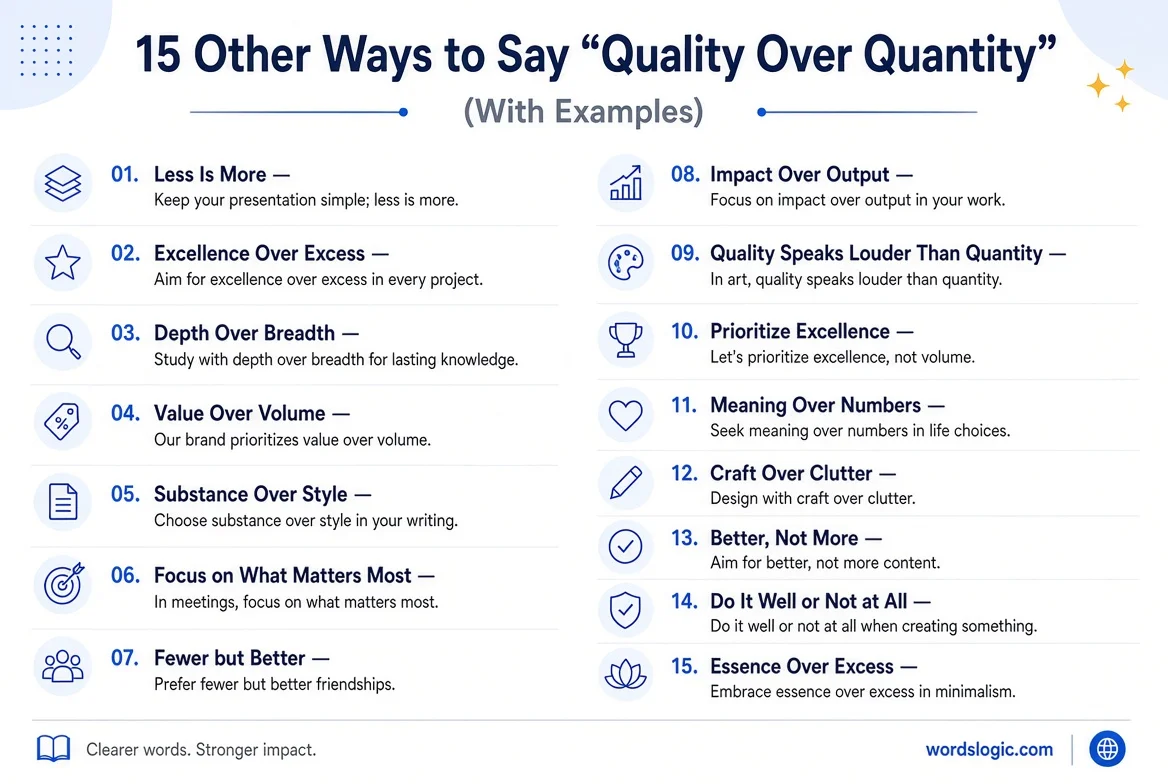
Other Ways to Say “Quality Over Quantity” explains why careful choices, lasting value, and meaningful results matter more than having more alone. In a fast-paced world, people often focus on having more, counting numbers, and expecting better results. However, the quality over quantity principle teaches a powerful lesson: choose what brings real value, excellence, and meaningful benefits instead of collecting a large number of ordinary things.
This idea applies to work projects, personal relationships, consumer choices, and lifestyle habits. From my personal experience, high-quality products, genuine relationships, and enriching experiences often bring deeper satisfaction, better outcomes, and lasting value. Choosing less but better creates greater meaning, a healthy balance, and more long-term joy in life. The goal is to recognize true value instead of chasing large quantities or big numbers.
There are other ways to say quality over quantity depending on your situation, audience, and desired tone. Expressions such as value over volume, prioritize excellence, and depth over numbers communicate the same sentiment through fresh alternatives.
What Does “Quality Over Quantity” Mean?
“Quality over quantity” means that the standard, value, or usefulness of something matters more than the number of items, activities, or results produced. Instead of trying to have more, the goal is to have something better. For example, a business might prefer ten loyal customers who value its services over a hundred customers who rarely return.
The phrase expresses a preference for excellence rather than abundance. It can apply to products, friendships, work, education, writing, and many other areas of life. However, it does not mean that quantity is always unimportant. It means that when quality and quantity compete, quality deserves greater consideration. The best choice depends on the situation, the available resources, and the results that matter most.
Common Situations Where “Quality Over Quantity” Is Used
People use this expression whenever they want to emphasize meaningful results instead of larger numbers.
- Work and business: Teams may focus on producing accurate, reliable work rather than rushing to complete as many tasks as possible.
- Education: Students can prioritize understanding a subject instead of memorizing large amounts of information without learning it deeply.
- Relationships: A few genuine friendships may provide more support and connection than a large circle of casual acquaintances.
- Writing and communication: A clear, thoughtful message can be more effective than a long message filled with unnecessary details.
- Shopping and products: Buyers may prefer durable, well-made items over numerous inexpensive products that do not last.
- Social media: Creators may value meaningful engagement and useful content instead of focusing entirely on follower counts.
- Personal goals: People can concentrate on making steady, meaningful progress rather than trying to accomplish everything at once.
In these situations, alternative expressions help make the message more specific. For instance, “substance over numbers” can emphasize meaningful results, while “less but better” works well when discussing simplicity and careful selection.
Is It Professional or Polite to Say “Quality Over Quantity”?
Yes. “Quality over quantity” is generally professional, polite, and easy to understand. It is suitable for workplace discussions, presentations, business strategies, educational settings, and everyday conversations. The phrase communicates a clear preference without criticizing people who approach a task differently.
In a professional setting, you might say, “Our priority is quality over quantity” when discussing standards, productivity, or customer service. If you want a more formal tone, “prioritize quality over volume” may sound more precise, especially when discussing production, reports, or deliverables. In casual conversation, “less but better” can feel more relaxed and memorable.
The expression can sound dismissive if someone uses it to suggest that another person’s efforts or achievements are worthless simply because they are numerous. To keep the message respectful, explain what quality means in the situation, such as accuracy, durability, usefulness, or customer satisfaction.
Advantages and Disadvantages of Saying “Quality Over Quantity”
Advantages
The phrase is concise, memorable, and versatile. It communicates a clear principle that people can apply to work, personal relationships, purchasing decisions, and creative projects. It also encourages careful decision-making by reminding people to consider long-term value rather than focusing only on numbers.
Another advantage is its positive emphasis on excellence and meaningful outcomes. In a team meeting, for example, it can help explain why checking work carefully may be more important than finishing every task as quickly as possible.
Disadvantages
The expression can be too general if the audience does not know which aspects of quality matter. A business, for example, may need both excellent products and enough production capacity to meet customer demand.
It can also create a false choice between quality and quantity. Some situations require both, such as delivering many accurate orders or publishing useful content consistently. In these cases, a more specific expression, such as “maintain high standards while scaling production,” communicates the goal more clearly.
Synonyms for “Quality Over Quantity”
- Less but Better
- Quality Before Quantity
- Excellence Over Abundance
- Substance Over Numbers
- Value Over Volume
- Focus on Excellence
- Choose Quality, Not Quantity
- Better Rather Than More
- Prioritize Quality Over Volume
- Meaningful Results Over High Numbers
- Depth Over Breadth
- Make Every Detail Count
- Invest in What Matters
- Small in Number, Big in Value
- Strive for Excellence, Not Excess
1. Less but Better
Meaning
“Less but better” means choosing fewer things while making sure each one offers greater value, usefulness, or quality. It reflects the idea that carefully selected items or activities can be more satisfying than having too many.
Definition
A principle of reducing quantity to improve overall quality.
Detailed Explanation
This expression is particularly useful when discussing simplicity, organization, and thoughtful choices. Compared with “quality over quantity,” it places more emphasis on having fewer things rather than simply ranking quality as more important. It can suggest a minimalist lifestyle, a smaller collection of carefully selected products, or a manageable workload. The tone is calm, practical, and memorable.
Scenario Examples
Scenario: A friend wants to simplify a crowded wardrobe.
Example: “I’m keeping only the clothes I love. Less but better!”
Scenario: A designer is deciding how many features to include in an app.
Example: “Let’s build three excellent features first. Less but better will give users a clearer experience.”
Best Use
Use this expression in casual conversations, lifestyle writing, product design, personal planning, and creative projects where simplicity improves the result.
Tone
Tone: Thoughtful, minimalist, practical. It encourages intentional choices without sounding overly formal.
2. Quality Before Quantity
Meaning
“Quality before quantity” means making quality the first consideration when making decisions. It communicates the same central idea as the original expression while emphasizing the order of priorities.
Definition
A principle of giving greater priority to quality than to numbers.
Detailed Explanation
This phrase is almost interchangeable with “quality over quantity,” so it works well when you want to retain the original meaning with slightly different wording. The word “before” emphasizes what should come first during planning or decision-making. It is suitable for professional discussions as well as personal goals. Unlike “less but better,” it does not necessarily suggest reducing the total number of things produced.
Scenario Examples
Scenario: A manager explains the team’s approach to reviewing reports.
Example: “We follow quality before quantity, so every report must be accurate.”
Scenario: A student plans a study schedule.
Example: “I’ll complete fewer practice questions and make sure I understand each answer. Quality before quantity.”
Best Use
Use it in workplace conversations, school assignments, presentations, team guidelines, and everyday advice.
Tone
Tone: Clear, balanced, professional. Its direct wording makes the priority easy to understand.
3. Excellence Over Abundance
Meaning
“Excellence over abundance” means preferring outstanding standards to a large supply or excessive number of things. It focuses on achieving a high standard instead of accumulating more.
Definition
A preference for exceptional quality rather than plentiful amounts.
Detailed Explanation
This alternative sounds more elevated and aspirational than the original phrase. “Excellence” emphasizes outstanding standards, while “abundance” refers to having plenty of something. It works particularly well when discussing craftsmanship, premium products, artistic work, or an organization’s values. It is less suitable when the main issue is simply completing routine tasks efficiently.
Scenario Examples
Scenario: A craft business describes its approach to making furniture.
Example: “We believe in excellence over abundance, creating fewer pieces with careful attention to craftsmanship.”
Scenario: A speaker discusses meaningful achievements.
Example: “A long list of accomplishments means little without real impact. Choose excellence over abundance.”
Best Use
Use this expression in brand messaging, creative writing, speeches, mission statements, and discussions of craftsmanship.
Tone
Tone: Aspirational, refined, formal. The word “excellence” gives the statement a more ambitious feel.
4. Substance Over Numbers
Meaning
“Substance over numbers” means valuing what something genuinely offers rather than judging it by numerical measures alone. The focus is on meaning, usefulness, and real impact.
Definition
A preference for meaningful content or genuine value over numerical totals.
Detailed Explanation
This phrase is especially useful when numbers can give a misleading impression of success. For example, a social media account might have many followers but little meaningful engagement. In contrast to “quality over quantity,” this alternative emphasizes the difference between what is genuinely valuable and what can merely be counted. It is most effective when the numbers being measured do not tell the whole story.
Scenario Examples
Scenario: A content creator discusses audience growth.
Example: “I’d rather have thoughtful comments from interested readers than thousands of empty clicks. Substance over numbers.”
Scenario: A company reviews a project report.
Example: “Let’s evaluate the actual customer benefits, not just the number of features delivered. We need substance over numbers.”
Best Use
Use it in marketing, content creation, performance reviews, presentations, and discussions of meaningful progress.
Tone
Tone: Analytical, thoughtful, direct. It encourages people to look beyond surface-level measurements.
5. Value Over Volume
Meaning
“Value over volume” means prioritizing the usefulness, benefit, or worth of something rather than how much of it is produced, sold, or delivered.
Definition
A preference for valuable outcomes over large quantities or output levels.
Detailed Explanation
This expression is particularly effective in business contexts. It connects quality with practical value, such as customer satisfaction, usefulness, or lasting benefits. Unlike “excellence over abundance,” it does not necessarily require something to be exceptional; it needs to provide meaningful value. The phrase can also help teams discuss growth without making high output the only measure of success.
Scenario Examples
Scenario: A marketing team plans its content calendar.
Example: “Let’s publish fewer articles that genuinely answer customer questions. Value over volume.”
Scenario: A consultant explains how a service creates results.
Example: “Our goal is to deliver value over volume by giving each client advice they can actually use.”
Best Use
Use it in business strategy, marketing, customer service, consulting, and productivity discussions.
Tone
Tone: Professional, practical, results-oriented. It links quality with real-world benefits.
6. Focus on Excellence
Meaning
“Focus on excellence” means concentrating on doing something exceptionally well. Rather than comparing numbers, it directs attention toward high standards and continuous improvement.
Definition
To give priority to achieving the best possible standard of performance or quality.
Detailed Explanation
This expression is more action-oriented than “quality over quantity.” It encourages people to improve their work instead of simply producing more. It does not directly say that quantity is unimportant, so it is a good choice when you want to motivate a team without creating a false choice between output and standards. It can also sound more encouraging because it tells people what to pursue rather than what to avoid.
Scenario Examples
Scenario: A teacher motivates students before a project.
Example: “Don’t rush through your presentation. Focus on excellence and explain your ideas clearly.”
Scenario: A team leader introduces a new work goal.
Example: “This quarter, let’s focus on excellence by improving accuracy and paying attention to customer needs.”
Best Use
Use it in leadership, education, professional development, personal goals, and motivational messages.
Tone
Tone: Encouraging, confident, purposeful. It emphasizes improvement and high standards.
7. Choose Quality, Not Quantity
Meaning
“Choose quality, not quantity” is a direct recommendation to select better options instead of simply choosing more. It is especially relevant when comparing products, opportunities, activities, or other alternatives.
Definition
An instruction to prefer better-quality choices over a greater number of choices.
Detailed Explanation
Unlike the original expression, which states a general principle, this version directly encourages the listener to make a decision. It is easy to understand and works well when someone is facing several options. The phrase can sound firm, but it is not inherently rude. If the situation requires both a high standard and sufficient output, it may be better to explain how the two goals can be balanced.
Scenario Examples
Scenario: A friend is deciding which online course to take.
Example: “Don’t enroll in ten courses at once. Choose quality, not quantity, and finish the one that teaches you the most.”
Scenario: A shopper compares inexpensive accessories with durable alternatives.
Example: “I’d rather buy two well-made bags than six that wear out quickly. Choose quality, not quantity.”
Best Use
Use it in advice, shopping decisions, personal development, educational planning, and persuasive writing.
Tone
Tone: Direct, practical, persuasive. The imperative wording makes it a recommendation rather than a neutral observation.
8. Better Rather Than More
Meaning
“Better rather than more” means aiming to improve the standard of something instead of increasing its amount. It emphasizes improvement over expansion.
Definition
A preference for improving quality instead of merely increasing quantity.
Detailed Explanation
This expression works well when a person or organization is deciding whether to expand or improve. It is broader than “less but better” because it does not necessarily suggest reducing the existing amount. Instead, it asks whether improvement would be more useful than simply adding more. Its wording is conversational and especially suitable for practical discussions about productivity or growth.
Scenario Examples
Scenario: A small business considers adding new services.
Example: “Before launching another service, let’s improve the ones customers already use. Better rather than more.”
Scenario: A student reviews an essay.
Example: “I’ll strengthen my arguments instead of adding another three pages. Better rather than more.”
Best Use
Use it in planning, writing, product development, business decisions, and everyday conversations about improvement.
Tone
Tone: Practical, reflective, solution-focused. It encourages progress without automatically favoring expansion.
9. Prioritize Quality Over Volume
Meaning
“Prioritize quality over volume” means making high standards more important than the amount of work, products, or material produced. It is particularly useful when discussing performance and production goals.
Definition
To give quality greater importance than total output when setting priorities.
Detailed Explanation
This expression is a strong choice for professional communication because it describes a clear operational priority. The word “prioritize” suggests a deliberate decision, while “volume” usually refers to the amount produced or handled. Unlike the broader original phrase, this version fits situations where output can be measured, such as manufacturing, writing, or customer support. It does not mean that output should be ignored; rather, it should not come at the expense of acceptable standards.
Scenario Examples
Scenario: A supervisor explains a new review process.
Example: “Please check every document carefully. We need to prioritize quality over volume.”
Scenario: A publishing team plans its weekly schedule.
Example: “Let’s prioritize quality over volume and give each article enough time for editing.”
Best Use
Use it in workplace emails, management meetings, production planning, editorial guidelines, and business reports.
Tone
Tone: Professional, decisive, results-oriented. It sounds appropriate when setting expectations or explaining a work policy.
10. Meaningful Results Over High Numbers
Meaning
“Meaningful results over high numbers” means valuing outcomes that make a genuine difference rather than focusing only on impressive numerical totals.
Definition
A preference for substantial, useful outcomes over large numerical measurements.
Detailed Explanation
This phrase is especially suitable when success should be measured by impact rather than volume alone. For instance, a training program may be more effective if fewer participants master a skill than if many attend without learning much. The expression is more explanatory than “quality over quantity,” making it useful when an audience needs to understand what quality actually means. It works best when meaningful results can be identified or evaluated.
Scenario Examples
Scenario: A nonprofit reviews its community program.
Example: “We want meaningful results over high numbers, so we’ll measure how much support families actually receive.”
Scenario: A manager discusses staff training.
Example: “Let’s focus on meaningful results over high numbers by checking whether employees can apply what they’ve learned.”
Best Use
Use it in project evaluations, education, nonprofit work, business presentations, and performance discussions.
Tone
Tone: Purposeful, thoughtful, analytical. It emphasizes impact rather than appearances.
11. Depth Over Breadth
Meaning
“Depth over breadth” means choosing a deeper understanding of a subject instead of covering a wide range of topics superficially. It emphasizes thoroughness and understanding rather than the number of subjects explored.
Definition
A preference for in-depth knowledge or detailed exploration over wide but shallow coverage.
Detailed Explanation
This expression is not a universal synonym for “quality over quantity.” It specifically applies when comparing the depth of knowledge, experience, or coverage with its breadth. A student might learn five concepts thoroughly rather than skim twenty concepts without understanding them. It can also apply to professional specialization or research. Choose it when the main concern is how deeply something is understood, not simply how well-made or valuable it is.
Scenario Examples
Scenario: A student prepares for an examination.
Example: “I’m going to master these three chapters first. Depth over breadth will help me understand the material properly.”
Scenario: A researcher plans a new project.
Example: “Rather than surveying every possible topic, we’ll explore these two questions in greater detail. Depth over breadth.”
Best Use
Use it in education, academic research, professional development, reading plans, and specialized learning.
Tone
Tone: Intellectual, thoughtful, focused. It highlights thorough understanding and careful exploration.
12. Make Every Detail Count
Meaning
“Make every detail count” means giving each part of a task, product, or experience a meaningful purpose. It encourages care and attention instead of careless or unnecessary additions.
Definition
To ensure that each detail contributes to the overall quality or effectiveness of something.
Detailed Explanation
This expression turns the broad principle of quality into a practical instruction. It is especially useful for work that depends on precision, such as writing, design, event planning, and craftsmanship. Unlike “quality over quantity,” it emphasizes the contribution of individual details rather than the overall number of items. It does not mean that every detail must be elaborate; the goal is to make each one useful and intentional.
Scenario Examples
Scenario: A writer edits a short article.
Example: “We have limited space, so make every detail count and remove anything that doesn’t help the reader.”
Scenario: A couple plans a small wedding.
Example: “We’re keeping the celebration simple, but we’ll make every detail count.”
Best Use
Use it in creative projects, editing, design, event planning, and tasks requiring careful attention.
Tone
Tone: Encouraging, precise, thoughtful. It motivates people to work carefully without demanding unnecessary complexity.
13. Invest in What Matters
Meaning
“Invest in what matters” means directing your time, money, energy, or attention toward the things that provide genuine value. It encourages thoughtful decisions about where resources should go.
Definition
To commit resources to the people, activities, or things that matter most.
Detailed Explanation
This expression focuses on the decision behind quality rather than on quality itself. For example, someone might spend more on a durable product because it will serve them better over time. A manager might invest in employee training instead of adding more short-term tasks. The phrase can apply to both material and nonmaterial priorities, including relationships and personal growth. Because it is broad, the surrounding context should clarify what matters and why.
Scenario Examples
Scenario: A friend considers buying a durable laptop instead of a cheaper model.
Example: “I’ll spend a little more on something reliable. It’s better to invest in what matters.”
Scenario: A team leader plans the department’s budget.
Example: “Let’s invest in what matters most: reliable tools, staff development, and better customer support.”
Best Use
Use it in financial decisions, personal development, business planning, relationships, and motivational writing.
Tone
Tone: Reflective, encouraging, purposeful. It reminds people to make decisions based on their priorities.
14. Small in Number, Big in Value
Meaning
“Small in number, big in value” means that a small collection of people or things can offer considerable worth. It emphasizes the importance of what something contributes rather than how many items there are.
Definition
A description of something that is limited in quantity but substantial in value or impact.
Detailed Explanation
This expression is particularly useful when describing a small group, a limited collection, or a few highly valuable items. It highlights the contrast between a low number and a high level of worth. Unlike “quality over quantity,” it describes the result rather than directly instructing someone to prioritize quality. It can also refer to value that comes from trust, usefulness, rarity, or emotional significance, not just physical quality.
Scenario Examples
Scenario: Someone describes a close circle of friends.
Example: “I don’t need a huge social circle. My closest friends are small in number, big in value.”
Scenario: A collector explains a carefully selected collection.
Example: “This collection has only twelve pieces, but each one has a unique story. Small in number, big in value.”
Best Use
Use it in personal messages, descriptions of close relationships, collection descriptions, and reflective writing.
Tone
Tone: Warm, appreciative, positive. It celebrates significance without requiring abundance.
15. Strive for Excellence, Not Excess
Meaning
“Strive for excellence, not excess” means working toward outstanding standards without adding unnecessary amounts, features, effort, or complexity.
Definition
To pursue high quality while avoiding unnecessary abundance or overdoing things.
Detailed Explanation
This expression combines the desire for excellence with a warning against excess. It is especially useful when adding more could make something less effective, more complicated, or wasteful. Compared with “quality over quantity,” it has a stronger emphasis on restraint and avoiding unnecessary additions. It works well as a guiding principle for creative work, product development, and personal habits. However, “excess” implies more than is needed, so the phrase is not appropriate for every situation involving high output.
Scenario Examples
Scenario: A designer reviews a website filled with unnecessary features.
Example: “Let’s remove the features users don’t need. Strive for excellence, not excess.”
Scenario: A person wants to simplify their daily routine.
Example: “I’d rather build a few healthy habits consistently than fill my schedule with too many goals. Strive for excellence, not excess.”
Best Use
Use it in design, lifestyle advice, creative work, productivity discussions, and motivational writing when simplicity and high standards both matter.
Tone
Tone: Motivational, disciplined, thoughtful. It encourages excellence while discouraging unnecessary complexity.
FAQs
What is another way to say “quality over quantity”?
Some useful alternatives are “less but better,” “quality before quantity,” “value over volume,” and “better rather than more.” Choose “value over volume” for business discussions, “less but better” for simplicity, and “quality before quantity” when you want to preserve the original meaning closely.
What does “quality over quantity” mean?
It means that the value, standard, or usefulness of something matters more than how many of it you have or produce. For example, a few well-written articles may be more useful than dozens of articles that contain little helpful information.
Is “quality over quantity” professional?
Yes. The phrase is generally professional, clear, and appropriate for meetings, presentations, reports, and workplace conversations. For a more specific business context, “prioritize quality over volume” can communicate the same priority more precisely.
What is a more polite way to express “quality over quantity”?
A considerate option is “Let’s focus on producing the best possible results.” This wording encourages high standards without suggesting that someone else’s output is excessive or unimportant. It is especially useful when discussing expectations with colleagues or team members.
Which alternative works best in formal communication?
“Prioritize quality over volume” is a strong option for formal workplace communication, particularly when discussing production, deliverables, or productivity. If the emphasis is on meaningful outcomes rather than numerical performance, “focus on meaningful results” may be more appropriate.
Conclusion
Choosing the right expression helps you communicate the value of doing something well rather than simply doing more. “Quality over quantity” remains a clear, versatile phrase, but alternatives such as “less but better,” “value over volume,” and “prioritize quality over volume” can make your message more specific to the situation.
The best choice depends on what you want to emphasize. Use “depth over breadth” when discussing learning, “make every detail count” when encouraging careful work, or “invest in what matters” when talking about priorities and resources. Remember that quality does not always require less quantity; many situations benefit from both high standards and sufficient output. Ultimately, focus on what makes something genuinely useful, meaningful, and effective, and choose wording that communicates that purpose clearly.













