Other Ways to Say “Can You Elaborate?” can help you ask for more detail, clearer explanation, and further information politely. When someone makes a point in conversations, you may need more context to understand the meaning fully. Instead of using the same phrase, you can politely invite the speaker to explain further, provide more detail, expand on a point, or clarify an idea.
These alternative phrases and synonyms can make your request feel like a gentle invitation to share more details, examples, ideas, or perspective.
A natural phrase such as say could you clarify this bit or would you mind providing a deeper explanation can help maintain a respectful, conversational tone. It shows that you appreciate the speaker’s effort and want to explore the topic rather than challenge what was said. Asking for additional information, clarification, or further information can help when important points are missing or extra examples would help you grasp the ideas better. This approach can improve communication, understanding, and connection while giving both the speaker and listener time to slow down, speak thoughtfully, and respond positively.
What Does “Can You Elaborate?” Mean?
“Can you elaborate?” is a request for someone to provide more information or explain something in greater detail. When you ask this question, you usually understand the general point the person has made but want them to expand on it. For example, if a coworker says, “We need to change our approach,” you might ask, “Can you elaborate?” because you want to know what should change and why.
The phrase is generally polite, neutral, and direct. It can be used in conversation, meetings, classrooms, interviews, emails, and other situations where additional explanation would be helpful. Depending on your relationship with the person, however, you may prefer a warmer or more specific expression, such as “Could you tell me more?” or “Could you explain that in more detail?”
Common Situations Where “Can You Elaborate?” Is Used
People commonly use “Can you elaborate?” when they want someone to expand on an idea, statement, opinion, explanation, or plan. In a workplace meeting, you might use it when a colleague introduces a proposal but does not explain how it would work. In school, a teacher or student might use it when discussing a complicated topic.
The phrase also works in everyday conversations and online communication. If a friend makes an interesting statement, “Can you elaborate?” can invite them to explain what they mean. In more casual situations, though, expressions like “What do you mean?” or “Can you tell me more?” may feel more natural and less formal.
Is It Professional or Polite to Say “Can You Elaborate?”
Yes. “Can you elaborate?” is generally professional and polite, especially when you genuinely want more information. It is common in meetings, presentations, interviews, academic discussions, and written communication. Its neutral wording makes it suitable when you want to ask for clarification without sounding overly emotional.
However, tone depends partly on delivery and context. Said warmly, it sounds like genuine interest. Said abruptly, it can sometimes feel demanding or overly formal. If you want a softer approach, “Could you tell me a little more?” works well. If you need precise clarification in a professional setting, “Could you provide more details?” may be more appropriate.
Advantages and Disadvantages of Saying “Can You Elaborate?”
Advantages
“Can you elaborate?” is short, clear, and versatile. It tells the other person exactly what you need: more explanation. It also avoids making assumptions about what they meant. Because the phrase is neutral, it can work in professional meetings, classroom discussions, interviews, and many everyday conversations.
Another advantage is that it encourages the speaker to decide which details are worth explaining. You are not necessarily asking one narrow question; you are giving them an opportunity to expand on their original point.
Disadvantages
The phrase can sound slightly formal or businesslike in very casual conversations. With close friends or family members, “Can you tell me more?” may feel warmer and more natural.
It can also be too broad when you need a specific answer. If someone has given a complicated explanation, simply asking them to elaborate may not tell them which part confused you. In those situations, a more targeted question such as “Could you explain how that would work?” can make the conversation more productive.
Synonyms for “Can You Elaborate?”
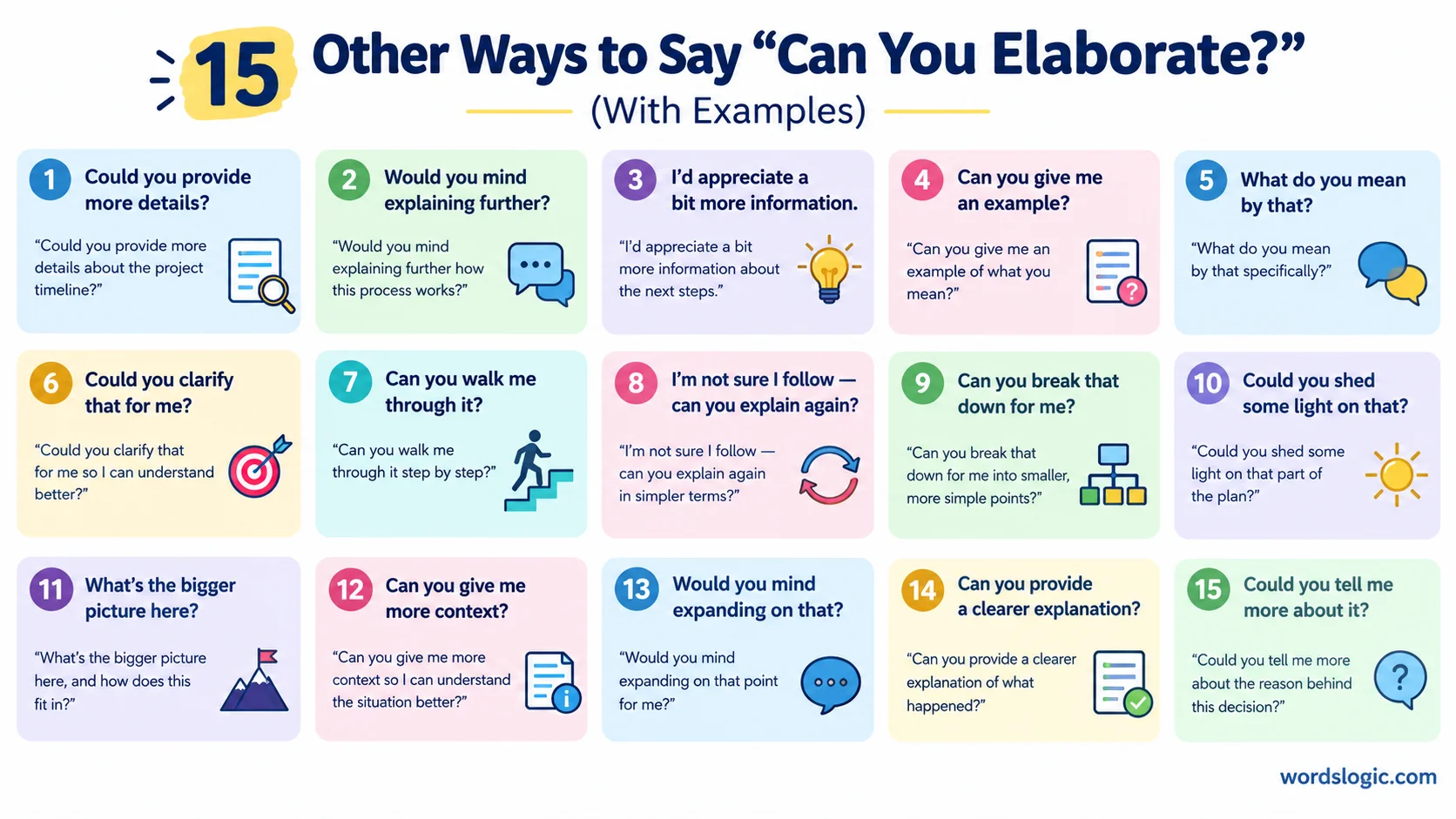
- Could You Tell Me More?
- Could You Explain That Further?
- Can You Give Me More Details?
- Could You Provide More Information?
- Can You Expand on That?
- What Do You Mean by That?
- Could You Clarify That?
- Could You Explain in More Detail?
- Can You Tell Me More About That?
- Could You Go Into More Detail?
- Would You Mind Explaining Further?
- Could You Give Me Some More Context?
- Can You Help Me Understand That Better?
- Could You Say a Little More About That?
- Can You Walk Me Through It?
1. Could You Tell Me More?
Meaning
“Could you tell me more?” is a warm and polite request for additional information. It invites the other person to continue explaining without making the request sound demanding.
Definition
A polite expression used when you want someone to provide more information, background, or explanation about something they have mentioned.
Detailed Explanation
This alternative is softer and more conversational than “Can you elaborate?” It works especially well when you are showing genuine interest rather than simply requesting clarification. It can also make the other person feel encouraged to share more rather than pressured to justify their statement. The wording is flexible enough for both personal and professional conversations.
Scenario Examples
Scenario: A friend mentions a new hobby.
Example: “That sounds interesting. Could you tell me more?”
Scenario: A coworker briefly describes a new project.
Example: “Could you tell me more about how the project will work?”
Scenario: Someone discusses a travel experience.
Example: “You said the town was beautiful. Could you tell me more?”
Best Use
Best for friendly conversations, personal messages, meetings, and informal professional communication.
Tone
Tone: Warm, curious, polite
It sounds interested without putting pressure on the speaker.
2. Could You Explain That Further?
Meaning
“Could you explain that further?” asks someone to develop or clarify an explanation they have already given.
Definition
A polite request for a person to provide a more complete explanation of a particular point.
Detailed Explanation
This expression is slightly more formal than “Could you tell me more?” It is useful when the speaker has already explained something but their explanation is not quite sufficient. The word “further” suggests that you want them to continue from what they have already said. It fits naturally into meetings, classrooms, interviews, and serious discussions.
Scenario Examples
Scenario: A manager introduces a change to company procedures.
Example: “Could you explain that further so we understand how it will affect the team?”
Scenario: A student gives a brief answer in class.
Example: “Could you explain that further? I’m interested in your reasoning.”
Best Use
Best for professional discussions, academic settings, meetings, and structured conversations.
Tone
Tone: Professional, respectful, direct
It clearly asks for additional explanation without sounding confrontational.
3. Can You Give Me More Details?
Meaning
“Can you give me more details?” directly asks for specific additional information.
Definition
A straightforward request for more facts, information, or specifics about something.
Detailed Explanation
This expression is useful when general elaboration is not enough and you actually need specific details. It is slightly more concrete than “Can you elaborate?” because it signals that you want particular information. You might use it when discussing schedules, plans, instructions, events, or practical arrangements.
Scenario Examples
Scenario: A coworker announces a meeting.
Example: “Can you give me more details about the meeting time and location?”
Scenario: A friend mentions an upcoming event.
Example: “That sounds fun. Can you give me more details?”
Scenario: A customer asks about a service.
Example: “Can you give me more details about what’s included?”
Best Use
Best for practical conversations, workplace communication, customer questions, and everyday planning.
Tone
Tone: Direct, neutral, practical
It focuses on obtaining useful information rather than inviting a broad discussion.
4. Could You Provide More Information?
Meaning
“Could you provide more information?” is a polite and professional request for additional information.
Definition
A formal or neutral expression asking someone to supply further facts, details, or explanations.
Detailed Explanation
This wording sounds more formal than “Can you elaborate?” and works particularly well in written communication. It is useful when communicating with clients, colleagues, organizations, or people you do not know well. Because it is broad, you can use it when you need additional information but do not yet know exactly which details you need.
Scenario Examples
Scenario: You are responding to a business inquiry.
Example: “Could you provide more information about the services included in the package?”
Scenario: A school administrator sends a short announcement.
Example: “Could you provide more information about the registration process?”
Best Use
Best for emails, business communication, customer service, formal requests, and administrative situations.
Tone
Tone: Formal, polite, professional
The wording sounds respectful and appropriate for written communication.
5. Can You Expand on That?
Meaning
“Can you expand on that?” asks someone to develop an idea they have already mentioned.
Definition
A request for someone to give additional explanation, examples, reasoning, or information about a particular point.
Detailed Explanation
This is one of the closest natural alternatives to “Can you elaborate?” It is particularly useful when you understand the basic idea but want the speaker to develop it further. “Expand on” often works well with ideas, opinions, arguments, plans, and statements rather than simple factual questions.
Scenario Examples
Scenario: A colleague presents an unusual marketing idea.
Example: “That’s an interesting approach. Can you expand on that?”
Scenario: A student gives an opinion during a discussion.
Example: “Can you expand on that and explain why you feel that way?”
Scenario: A friend shares an unexpected plan.
Example: “You’re thinking of moving? Can you expand on that?”
Best Use
Best for meetings, discussions, presentations, academic conversations, and thoughtful personal conversations.
Tone
Tone: Curious, thoughtful, neutral
It shows that you want the speaker to develop their existing idea.
6. What Do You Mean by That?
Meaning
“What do you mean by that?” asks someone to clarify the meaning behind their words.
Definition
A direct question used when you want someone to explain or clarify what they intended to say.
Detailed Explanation
This expression is useful when the issue is not simply a lack of detail but uncertainty about the meaning. It can be casual and natural, especially between people who know each other. However, the tone can change significantly depending on delivery, and a sharp version may sound skeptical or confrontational.
Scenario Examples
Scenario: A friend makes a confusing comment.
Example: “What do you mean by that? I’m not sure I understand.”
Scenario: A colleague uses an unfamiliar term.
Example: “What do you mean by that when you say the process needs to change?”
Best Use
Best for casual conversations, clarification, and situations where someone’s wording is unclear.
Tone
Tone: Direct, conversational, sometimes challenging
A friendly delivery makes it curious; a sharp delivery can make it sound defensive.
7. Could You Clarify That?
Meaning
“Could you clarify that?” asks someone to make an unclear point easier to understand.
Definition
A polite request for clarification when information, wording, or meaning is confusing or ambiguous.
Detailed Explanation
This expression is more focused on clearing up confusion than simply asking for more information. It is especially useful when someone has made a statement that could have several interpretations. In professional communication, it provides a concise and respectful way to request precision without criticizing the speaker.
Scenario Examples
Scenario: A coworker gives unclear instructions.
Example: “Could you clarify that? Should we submit both documents?”
Scenario: Someone makes an ambiguous statement during a discussion.
Example: “Could you clarify that point for me?”
Scenario: A customer receives unclear information.
Example: “Could you clarify that part of the policy?”
Best Use
Best for workplaces, emails, meetings, customer service, and formal discussions.
Tone
Tone: Professional, polite, precise
It focuses on understanding something that is unclear.
8. Could You Explain in More Detail?
Meaning
“Could you explain in more detail?” directly requests a more complete explanation.
Definition
A polite expression asking someone to provide additional details so that a subject can be understood more fully.
Detailed Explanation
This is a clear and useful alternative when the person has given only a brief explanation. It is more explicit than “Could you elaborate?” because it tells the speaker exactly what you want: more detail. The phrase works well when discussing procedures, ideas, instructions, plans, or complicated subjects.
Scenario Examples
Scenario: A colleague describes a new procedure.
Example: “Could you explain in more detail how we should handle these requests?”
Scenario: A teacher introduces a difficult concept.
Example: “Could you explain that in more detail? I’m still trying to understand it.”
Best Use
Best for professional communication, education, instructions, and detailed discussions.
Tone
Tone: Polite, clear, neutral
It makes your request specific without sounding demanding.
9. Can You Tell Me More About That?
Meaning
“Can you tell me more about that?” invites someone to continue talking about a subject they have introduced.
Definition
A friendly request for additional information or conversation about a particular topic.
Detailed Explanation
This wording is especially natural in spoken English. It feels more conversational than “Can you elaborate?” and often communicates genuine interest. It can be used when you want details, but it can also simply encourage someone to continue sharing their thoughts or experience.
Scenario Examples
Scenario: A friend talks about a new job.
Example: “You started a new job? Can you tell me more about that?”
Scenario: Someone mentions an interesting book.
Example: “Can you tell me more about that book?”
Scenario: A colleague discusses a new initiative.
Example: “Can you tell me more about that project?”
Best Use
Best for friendly conversations, networking, personal messages, and informal workplace discussions.
Tone
Tone: Friendly, curious, open
It encourages conversation and shows interest in the subject.
10. Could You Go Into More Detail?
Meaning
“Could you go into more detail?” asks someone to discuss a subject more thoroughly.
Definition
A polite request for a deeper or more detailed explanation of a particular subject.
Detailed Explanation
This expression is useful when you already understand the general topic but need a deeper explanation. It often appears in professional, academic, and presentation settings. Compared with “Can you give me more details?”, it can sound more focused on an explanation or discussion rather than simply collecting facts.
Scenario Examples
Scenario: A presenter briefly explains a proposal.
Example: “Could you go into more detail about the implementation plan?”
Scenario: A professor introduces a complex theory.
Example: “Could you go into more detail about how this theory applies here?”
Best Use
Best for presentations, meetings, academic discussions, interviews, and detailed explanations.
Tone
Tone: Professional, focused, respectful
It suggests that you want a deeper discussion of the subject.
11. Would You Mind Explaining Further?
Meaning
“Would you mind explaining further?” is a polite and considerate request for additional explanation.
Definition
A courteous expression asking someone whether they would be willing to provide more explanation.
Detailed Explanation
The phrase “would you mind” makes the request sound softer and more considerate. It is useful when you want to avoid sounding demanding, especially with someone you do not know well. It can sound slightly more formal than ordinary conversational alternatives, making it suitable for respectful workplace or academic communication.
Scenario Examples
Scenario: You need clarification from a senior colleague.
Example: “Would you mind explaining further? I want to make sure I understand the process.”
Scenario: Someone gives an unfamiliar explanation.
Example: “Would you mind explaining further what you mean by that?”
Best Use
Best for polite professional conversations, academic settings, respectful requests, and formal discussions.
Tone
Tone: Courteous, respectful, somewhat formal
The wording softens the request and gives the other person room to respond.
12. Could You Give Me Some More Context?
Meaning
“Could you give me some more context?” asks for background information that helps make something understandable.
Definition
A polite request for additional background, circumstances, or surrounding information.
Detailed Explanation
This alternative is not exactly the same as asking someone to elaborate on every detail. Instead, it is useful when you need to understand why something happened, where it came from, or what circumstances surround it. It is particularly valuable when a statement makes sense only with additional background information.
Scenario Examples
Scenario: A coworker refers to a previous decision.
Example: “Could you give me some more context about why that decision was made?”
Scenario: A friend mentions an argument you know nothing about.
Example: “Could you give me some more context before I comment?”
Scenario: You are reviewing a report.
Example: “Could you give me some more context around these figures?”
Best Use
Best for workplace discussions, research, reporting, sensitive conversations, and situations involving background information.
Tone
Tone: Thoughtful, professional, inquisitive
It shows that you want to understand the circumstances rather than simply demand more information.
13. Can You Help Me Understand That Better?
Meaning
“Can you help me understand that better?” asks for assistance in making something clearer or easier to understand.
Definition
A friendly and collaborative request for someone to explain a confusing or complicated idea.
Detailed Explanation
This expression places the emphasis on your understanding rather than on the other person’s need to provide more information. That makes it sound cooperative and less demanding. It is particularly helpful when discussing complicated subjects or when you want to acknowledge that you may need clarification.
Scenario Examples
Scenario: A coworker explains a technical process.
Example: “Can you help me understand that better? I’m not familiar with this system.”
Scenario: A teacher introduces a difficult concept.
Example: “Can you help me understand that better with an example?”
Scenario: A friend explains a complicated situation.
Example: “Can you help me understand that better? I think I’m missing something.”
Best Use
Best for learning, workplace discussions, personal conversations, and complicated explanations.
Tone
Tone: Humble, collaborative, friendly
It frames the request as a shared effort to improve understanding.
14. Could You Say a Little More About That?
Meaning
“Could you say a little more about that?” is a gentle invitation to continue explaining or sharing.
Definition
A polite expression asking someone to add a small amount of information or explanation to something they have already said.
Detailed Explanation
The phrase “a little more” makes this request sound softer than a direct demand for extensive details. It works particularly well when you do not need a long explanation but would like the speaker to develop their thought. The wording also sounds natural in conversations where you want to keep the exchange relaxed.
Scenario Examples
Scenario: A friend mentions a memorable experience.
Example: “That sounds like quite a day. Could you say a little more about that?”
Scenario: A colleague briefly mentions a concern.
Example: “Could you say a little more about that concern?”
Scenario: Someone shares an opinion in a group discussion.
Example: “Could you say a little more about that?”
Best Use
Best for casual conversations, discussions, interviews, meetings, and personal communication.
Tone
Tone: Gentle, curious, conversational
It encourages additional information without making the request feel heavy.
15. Can You Walk Me Through It?
Meaning
“Can you walk me through it?” asks someone to explain something step by step.
Definition
A conversational request for a detailed explanation of a process, procedure, plan, or sequence of events.
Detailed Explanation
This expression differs from “Can you elaborate?” because it usually asks for a structured explanation, often from beginning to end. It is particularly useful when you need to understand how something works or what you should do next. The phrase is common in workplace, technical, educational, and practical situations.
Scenario Examples
Scenario: A coworker explains a new software process.
Example: “Can you walk me through it? I haven’t used the system before.”
Scenario: A friend explains how to prepare a complicated recipe.
Example: “Can you walk me through it step by step?”
Scenario: A manager presents a new workflow.
Example: “Can you walk me through how the new process will work?”
Best Use
Best for instructions, processes, workplace training, technical discussions, and practical explanations.
Tone
Tone: Collaborative, practical, conversational
It suggests that you want guidance through the subject rather than simply more words.
FAQs
What is another way to say “Can You Elaborate?”
Natural alternatives include “Could you tell me more?”, “Can you expand on that?”, “Could you explain that further?”, and “Can you give me more details?” The best choice depends on whether you want a casual, professional, specific, or more detailed response.
What does “Can You Elaborate?” mean?
“Can you elaborate?” means “Can you provide more information or explain this in greater detail?” It is normally used when someone has made a statement or introduced an idea that you want them to develop further.
Is “Can You Elaborate?” professional?
Yes. “Can you elaborate?” is generally professional and neutral. It is common in meetings, presentations, interviews, classrooms, and business discussions. For very formal writing, “Could you provide more information?” may sound more appropriate.
What is a more polite way to say “Can You Elaborate?”
“Would you mind explaining further?” and “Could you tell me a little more?” are polite alternatives. The first is somewhat more formal, while the second sounds warmer and more conversational.
Which alternative works best in formal communication?
For formal communication, “Could you provide more information?”, “Could you clarify that?”, and “Could you explain that further?” are useful choices. The best expression depends on whether you need more facts, clarification, or a fuller explanation.
Conclusion
“Can you elaborate?” is a useful expression when you want someone to explain an idea in greater detail, but your choice of wording can change the feel of the conversation. “Could you tell me more?” sounds warm and inviting, while “Could you provide more information?” feels more formal. “Could you clarify that?” is better when something is unclear, and “Can you walk me through it?” works well when you need a step-by-step explanation.
The best alternative depends on your relationship with the speaker, the setting, and the kind of information you need. When choosing other ways to say “Can you elaborate?”, focus less on finding an exact synonym and more on expressing your actual purpose clearly and naturally.