Other Ways to Say “You Are Wasting My Time” help you set clear boundaries, protect focus, and keep difficult conversations respectful at work. Professional communication, time management, and healthy professional interactions depend on clarity, respect, and knowing when to redirect unhelpful discussions.
In my experience, using clear phrases, direct language, and polite expressions helps communicate urgency without unnecessary impoliteness. Whether speaking to a colleague, client, or another person, a thoughtful response can address concerns, reduce frustration, prevent misunderstandings, and help everyone stay on track. In today’s fast-paced digital world, time constraints, limited availability, deadlines, and time pressure make time awareness, time allocation, and productivity important for achieving goals and supporting professional growth.
Effective communication strategies can help manage unproductive discussions, unnecessary conversations, repetitive discussions, and irrelevant details. Instead of making a blunt remark, use assertive communication, a professional tone, diplomatic language, and tactful responses to explain your limits.
What Does “You Are Wasting My Time” Mean?
“You are wasting my time” means that someone is using your time in a way that you consider unnecessary, unproductive, or not worthwhile. The speaker usually feels that the other person is delaying something, repeating information, avoiding the main point, or keeping them occupied without a useful result.
The phrase can be understood literally, but it often carries frustration or irritation. For example, someone who keeps changing the requirements of a project might hear this phrase as a complaint that their time is being used without meaningful progress. Depending on the relationship and situation, the expression can sound direct, confrontational, or even rude.
Common Situations Where “You Are Wasting My Time” Is Used
People commonly use this phrase during frustrating conversations, especially when someone is delaying a decision, avoiding an answer, or asking for repeated explanations. It can also appear in text messages, arguments, customer interactions, workplace discussions, and everyday conversations.
At work, however, saying “You are wasting my time” may create unnecessary tension. A softer expression such as “This is taking longer than expected” can communicate the problem without directly blaming someone. In a personal conversation, a phrase such as “I need to move on” may work better when you want to set a boundary without escalating the situation.
Is It Professional or Polite to Say “You Are Wasting My Time”?
“You are wasting my time” is direct and understandable, but it is not usually the most polite or diplomatic choice. It places responsibility directly on the other person and can sound irritated, especially when spoken with a sharp tone.
In casual situations, the phrase may be acceptable when you know the person well and genuinely want to express frustration. In professional communication, a less accusatory alternative is often more appropriate. Expressions such as “This is taking longer than expected” or “Could we get to the main point?” focus more on the situation than on blaming the person.
Advantages and Disadvantages of Saying “You Are Wasting My Time”
Advantages
The main advantage is clarity. The listener immediately understands that you feel your time is being used unproductively. The phrase is also short and emotionally honest, which can be useful when you need to establish a firm boundary. In a close relationship or informal conversation, its directness may communicate the seriousness of your frustration without a long explanation.
Disadvantages
The biggest limitation is its confrontational tone. It can make the other person feel blamed or disrespected, even if your underlying concern is reasonable. In professional communication, it may damage cooperation or make a small problem feel like a personal conflict. A more specific alternative can also be more useful because it explains whether the issue is delay, repetition, lack of progress, or unnecessary discussion.
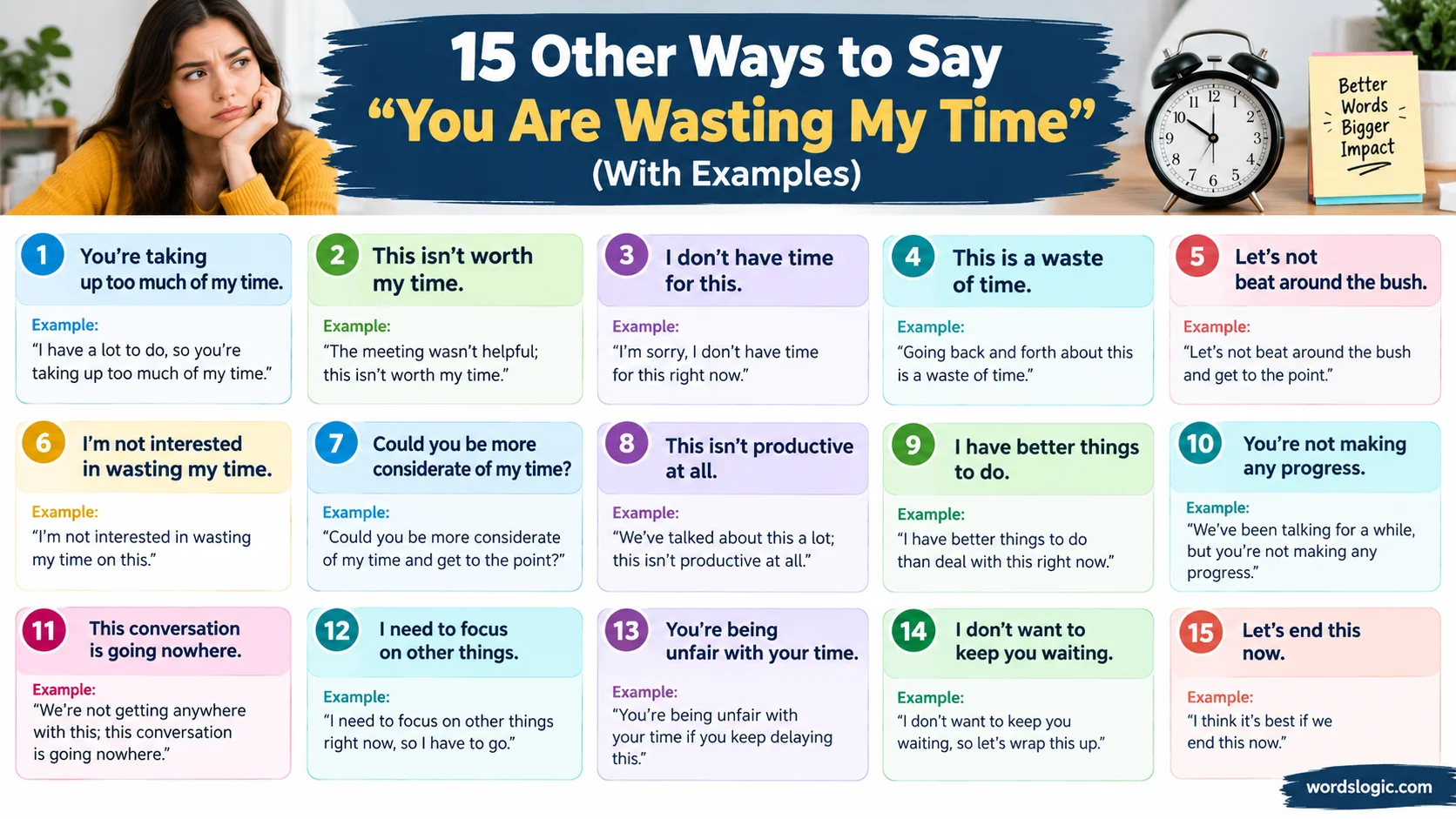
Synonyms for “You Are Wasting My Time”
- You’re Taking Up Too Much of My Time
- This Is a Waste of My Time
- This Is Taking Longer Than Expected
- I Don’t Have Time for This
- Let’s Not Waste Any More Time
- Could We Get to the Point?
- I Need to Move On
- We’re Going in Circles
- This Isn’t Productive
- You’re Holding Me Up
- I Have Other Priorities
- Could We Wrap This Up?
- Let’s Make This Quick
- I Can’t Keep Spending Time on This
- We Need to Focus on What Matters
1. You’re Taking Up Too Much of My Time
Meaning
“You’re taking up too much of my time” means that someone is occupying more of your time than you believe is reasonable.
Definition
It is a direct way to say that a person or activity is using more of your available time than you want to give.
Detailed Explanation
This expression is close in meaning to “You are wasting my time,” but it focuses more on time being occupied than on accusing someone of deliberately wasting it. That makes it slightly less harsh in some situations. It can still sound frustrated, particularly when said directly to another person.
Scenario Examples
Scenario: A colleague continues a discussion after the main decision has already been made.
Example: “I understand your concerns, but this is taking up too much of my time.”
Scenario: Someone keeps you on a phone call without getting to the issue.
Example: “I’m sorry, but you’re taking up too much of my time. Could we get to the main issue?”
Best Use
Best for direct conversations, workplace discussions, and personal situations when you want to set a clear time boundary.
Tone
Tone: Direct, firm, somewhat frustrated. It focuses on the amount of time being used rather than directly calling the other person wasteful.
2. This Is a Waste of My Time
Meaning
“This is a waste of my time” means that the activity, conversation, or situation does not seem valuable enough to justify the time you are spending on it.
Definition
A direct statement that something is not worth the time or effort being spent on it.
Detailed Explanation
This expression shifts attention from the person to the situation itself, which can make it slightly less personal than “You are wasting my time.” However, it remains quite strong. It is especially useful when you want to criticize an unproductive activity rather than directly blame someone.
Scenario Examples
Scenario: A meeting has no clear purpose or outcome.
Example: “If we’re not going to make a decision today, this is a waste of my time.”
Scenario: You are repeatedly asked to complete unnecessary paperwork.
Example: “Filling out the same form again feels like a waste of my time.”
Best Use
Best for situations, tasks, meetings, or processes that you consider unproductive.
Tone
Tone: Blunt, critical, direct. It clearly communicates dissatisfaction.
3. This Is Taking Longer Than Expected
Meaning
“This is taking longer than expected” means that something has continued for more time than originally anticipated.
Definition
A neutral way to describe an unexpected delay or extended process.
Detailed Explanation
This is considerably softer than “You are wasting my time” because it does not directly blame anyone. It can be particularly useful when you want to address a delay while keeping the conversation professional and cooperative. The phrase also leaves room for the possibility that the delay was unintentional.
Scenario Examples
Scenario: A work meeting continues past its scheduled end time.
Example: “This is taking longer than expected. Could we schedule another meeting to finish the discussion?”
Scenario: A customer service issue has not been resolved.
Example: “This is taking longer than expected, so I’d appreciate an update on the next step.”
Best Use
Best for work emails, customer communication, meetings, and professional conversations.
Tone
Tone: Professional, calm, diplomatic. It describes the delay without assigning blame
4. I Don’t Have Time for This
Meaning
“I don’t have time for this” means that you do not want or cannot afford to spend more time on the current situation.
Definition
A direct expression used to set a boundary around your available time.
Detailed Explanation
This phrase can communicate the same frustration as “You are wasting my time,” but it places the emphasis on your own availability. It can sound reasonable when you genuinely have another obligation. However, depending on your voice and context, it can also sound dismissive or irritated.
Scenario Examples
Scenario: You are preparing for an important appointment and someone starts an unnecessary argument.
Example: “I don’t have time for this right now. We can talk later.”
Scenario: A coworker starts discussing an unrelated issue during a deadline.
Example: “I don’t have time for this at the moment. Can we discuss it tomorrow?”
Best Use
Best for setting personal boundaries, especially in casual or time-sensitive situations.
Tone
Tone: Firm, impatient, boundary-setting. It can become harsh if delivered aggressively.
5. Let’s Not Waste Any More Time
Meaning
“Let’s not waste any more time” means that you want to stop spending time on something unproductive and move toward a useful action.
Definition
A phrase encouraging people to stop delaying and make progress.
Detailed Explanation
This is a useful alternative because it includes both people in the situation through the word “let’s.” Instead of accusing someone directly, you suggest that everyone should move forward. It can still imply that time has already been wasted, but the wording is often more constructive.
Scenario Examples
Scenario: A team keeps debating the same minor detail.
Example: “We’ve discussed this several times. Let’s not waste any more time and make a decision.”
Scenario: A friend keeps avoiding the main question.
Example: “Let’s not waste any more time. Just tell me what happened.”
Best Use
Best for meetings, teamwork, negotiations, and direct conversations where action is needed.
Tone
Tone: Direct, practical, action-oriented. It can sound firm without being openly insulting.
6. Could We Get to the Point?
Meaning
“Could we get to the point?” asks someone to stop giving unnecessary details and explain the main issue.
Definition
A request to focus on the central topic or important information.
Detailed Explanation
This phrase does not directly say that someone is wasting your time. Instead, it identifies a common reason people feel their time is being wasted: the conversation is not getting to the main issue. The question is useful when you need clarity quickly, although it can sound impatient if delivered sharply.
Scenario Examples
Scenario: Someone gives a long explanation before answering your question.
Example: “I appreciate the background, but could we get to the point?”
Scenario: A meeting has gone off topic.
Example: “Could we get to the point and decide what we’re going to do?”
Best Use
Best for meetings, conversations, interviews, and situations where you need a direct answer.
Tone
Tone: Direct, impatient, focused. Adding “please” or a softer introduction can make it more polite.
7. I Need to Move On
Meaning
“I need to move on” means that you need to stop spending time on the current matter and continue with something else.
Definition
A polite boundary-setting expression meaning you need to leave the current discussion or activity behind.
Detailed Explanation
This is softer than accusing someone of wasting your time. It communicates that your time is limited without necessarily criticizing the other person. It works particularly well when you want to end a conversation gracefully rather than argue about whether the conversation is useful.
Scenario Examples
Scenario: A customer has been discussing the same issue for a long time.
Example: “I understand your concern, but I need to move on to my next appointment.”
Scenario: A personal conversation is becoming repetitive.
Example: “We’ve talked about this already, and I need to move on.”
Best Use
Best for ending conversations, setting boundaries, and moving between tasks or commitments.
Tone
Tone: Calm, firm, respectful. It emphasizes your next step rather than blaming the other person.
8. We’re Going in Circles
Meaning
“We’re going in circles” means that a conversation or process keeps returning to the same points without making progress.
Definition
An expression describing repeated discussion without meaningful progress or resolution.
Detailed Explanation
This is a useful alternative when the problem is not simply that someone is taking your time but that nothing is being accomplished. It works well in disagreements, meetings, and negotiations. Because it uses “we,” it sounds less accusatory than directly saying “You are wasting my time.”
Scenario Examples
Scenario: Two coworkers keep revisiting the same disagreement.
Example: “We’re going in circles. Let’s take a break and come back with a different approach.”
Scenario: A couple repeatedly argues about the same issue.
Example: “We’re going in circles, and neither of us is getting anywhere.”
Best Use
Best for arguments, meetings, negotiations, and repeated discussions.
Tone
Tone: Frustrated, collaborative, practical. It identifies a lack of progress without placing all the blame on one person.
9. This Isn’t Productive
Meaning
“This isn’t productive” means that the current activity or conversation is not producing a useful result.
Definition
A relatively diplomatic way to say that something is not helping people make progress.
Detailed Explanation
This expression is often more appropriate in professional settings than “You are wasting my time.” It evaluates the effectiveness of the situation, not the character or intentions of the person involved. It can also open the door to a solution, such as changing the subject, taking a break, or choosing a different approach.
Scenario Examples
Scenario: A team meeting has become an argument.
Example: “This isn’t productive. Let’s focus on possible solutions instead.”
Scenario: A discussion keeps returning to personal criticism.
Example: “I don’t think this is productive, so I’d rather discuss the actual problem.”
Best Use
Best for workplace communication, meetings, negotiations, and difficult discussions.
Tone
Tone: Professional, calm, constructive. It communicates concern without an openly hostile accusation.
10. You’re Holding Me Up
Meaning
“You’re holding me up” means that someone is delaying you or preventing you from continuing with what you need to do.
Definition
An informal expression meaning someone is causing a delay in your plans or progress.
Detailed Explanation
This phrase is more specific than “You are wasting my time” because it focuses on delay or obstruction. It is natural in everyday speech, especially when you have somewhere else to be. It can sound impatient, so it is usually better suited to casual conversations than formal emails.
Scenario Examples
Scenario: A friend is taking too long to leave the house.
Example: “Come on, you’re holding me up. We’re already late.”
Scenario: A coworker has not provided information you need to finish a task.
Example: “I’m waiting for those figures, and they’re holding me up.”
Best Use
Best for casual conversations, travel, schedules, deadlines, and everyday delays.
Tone
Tone: Casual, impatient, direct. It is natural in speech but can sound too informal for some professional messages.
11. I Have Other Priorities
Meaning
“I have other priorities” means that you have other tasks, responsibilities, or commitments that need your attention.
Definition
A professional way to communicate that your time needs to be directed toward more important or urgent matters.
Detailed Explanation
This expression avoids directly accusing someone of wasting your time. Instead, it explains why you cannot continue giving attention to the current issue. It is particularly useful when you want to set a boundary professionally without creating unnecessary conflict.
Scenario Examples
Scenario: A colleague asks you to spend another hour discussing a minor issue.
Example: “I’d like to help, but I have other priorities I need to handle this afternoon.”
Scenario: Someone asks you to continue an unnecessary discussion.
Example: “I understand your point, but I have other priorities right now.”
Best Use
Best for workplace communication, emails, scheduling, and professional boundaries.
Tone
Tone: Professional, firm, respectful. It communicates limited availability without direct blame.
12. Could We Wrap This Up?
Meaning
“Could we wrap this up?” means that you would like to finish the conversation, meeting, or activity soon.
Definition
A polite request to bring something to an end.
Detailed Explanation
This expression is softer than “You are wasting my time” because it does not accuse anyone of doing something wrong. It simply signals that you are ready to finish. The wording can be especially useful when you want to remain courteous while still making your time limit clear.
Scenario Examples
Scenario: A meeting has gone beyond its scheduled time.
Example: “We’re almost out of time. Could we wrap this up?”
Scenario: You need to leave a social conversation.
Example: “I’d love to stay longer, but could we wrap this up? I have an early morning.”
Best Use
Best for meetings, conversations, professional communication, and polite exits.
Tone
Tone: Polite, practical, courteous. It is less confrontational than the original phrase.
13. Let’s Make This Quick
Meaning
“Let’s make this quick” means that you want to keep an activity or conversation brief.
Definition
A casual expression used to encourage speed and efficiency.
Detailed Explanation
This phrase works when you do not necessarily want to accuse anyone of wasting time but need to make it clear that you cannot spend long on the matter. It is often useful before a short conversation, task, or explanation. The expression can sound slightly impatient if the situation is sensitive.
Scenario Examples
Scenario: You have only a few minutes before another appointment.
Example: “I have a meeting in ten minutes, so let’s make this quick.”
Scenario: A colleague wants to ask you a quick question while you are busy.
Example: “Sure, let’s make this quick. What do you need?”
Best Use
Best for casual workplace conversations, quick discussions, and everyday situations.
Tone
Tone: Casual, efficient, slightly impatient. It emphasizes limited time rather than blame.
14. I Can’t Keep Spending Time on This
Meaning
“I can’t keep spending time on this” means that you have already devoted enough time to something and do not want to continue.
Definition
A firm statement that you need to stop giving additional time to a particular issue.
Detailed Explanation
This phrase communicates a stronger boundary than “I need to move on.” It suggests that you have already tried to address the matter and have reached a limit. It does not necessarily accuse the other person of intentionally wasting your time, which can make it useful when you want to express frustration without making a personal accusation.
Scenario Examples
Scenario: A disagreement has continued for hours without resolution.
Example: “I’ve explained my position, and I can’t keep spending time on this.”
Scenario: A work task keeps being revised without a clear reason.
Example: “We’ve changed this several times. I can’t keep spending time on this without a final decision.”
Best Use
Best for repeated problems, workplace issues, disagreements, and firm personal boundaries.
Tone
Tone: Firm, frustrated, serious. It clearly signals that your patience or available time is limited.
15. We Need to Focus on What Matters
Meaning
“We need to focus on what matters” means that attention should be directed toward the most important issue instead of less useful details.
Definition
A constructive expression encouraging people to prioritize important information, decisions, or goals.
Detailed Explanation
This is one of the more constructive ways to address an unproductive conversation. Rather than saying someone is wasting your time, it redirects attention toward the important objective. It is especially useful when you want to keep a discussion productive while avoiding personal criticism.
Scenario Examples
Scenario: A project team is spending too much time discussing minor details.
Example: “We can revisit those details later. Right now, we need to focus on what matters.”
Scenario: A personal argument has moved away from the original problem.
Example: “Let’s put the side issues aside and focus on what matters.”
Best Use
Best for team discussions, workplace communication, problem-solving, and serious conversations.
Tone
Tone: Constructive, focused, professional. It redirects the conversation instead of directly blaming someone.
FAQs
What is another way to say “You Are Wasting My Time”?
Natural alternatives include “This is taking longer than expected,” “We’re going in circles,” “This isn’t productive,” and “I can’t keep spending time on this.” The best choice depends on whether you want to sound polite, professional, frustrated, or firm.
What does “You Are Wasting My Time” mean?
It means that you believe someone or something is using your time unnecessarily or without producing a worthwhile result. The phrase usually communicates frustration and can sound accusatory when directed at another person.
Is “You Are Wasting My Time” professional?
It can be used in professional communication, but it is generally quite direct and potentially confrontational. In a workplace, alternatives such as “This isn’t productive” or “This is taking longer than expected” may communicate the same concern more diplomatically.
What is a more polite way to say “You Are Wasting My Time”?
A more polite option is “Could we wrap this up?” or “This is taking longer than expected.” These expressions focus on ending or managing the situation rather than directly blaming the other person.
Which alternative works best in formal communication?
For formal communication, “This is taking longer than expected” and “This isn’t productive” are useful choices because they focus on the situation and its effect rather than making a personal accusation. For workplace emails, “I have other priorities” can also be a respectful way to communicate a time constraint.
Conclusion
Choosing different wording can change how a message is received. “You are wasting my time” is clear and direct, but it can also sound frustrated or confrontational. A softer expression such as “This is taking longer than expected” may work better in professional communication, while “We’re going in circles” can describe a repeated discussion without placing all the blame on one person.
The right alternative depends on your relationship, purpose, tone, and situation. If you need to set a firm boundary, you might say, “I can’t keep spending time on this.” If you simply want to move a conversation forward, “Could we get to the point?” may be enough. Good communication is not only about what you mean; it is also about choosing wording that helps the other person understand your concern without creating unnecessary tension.