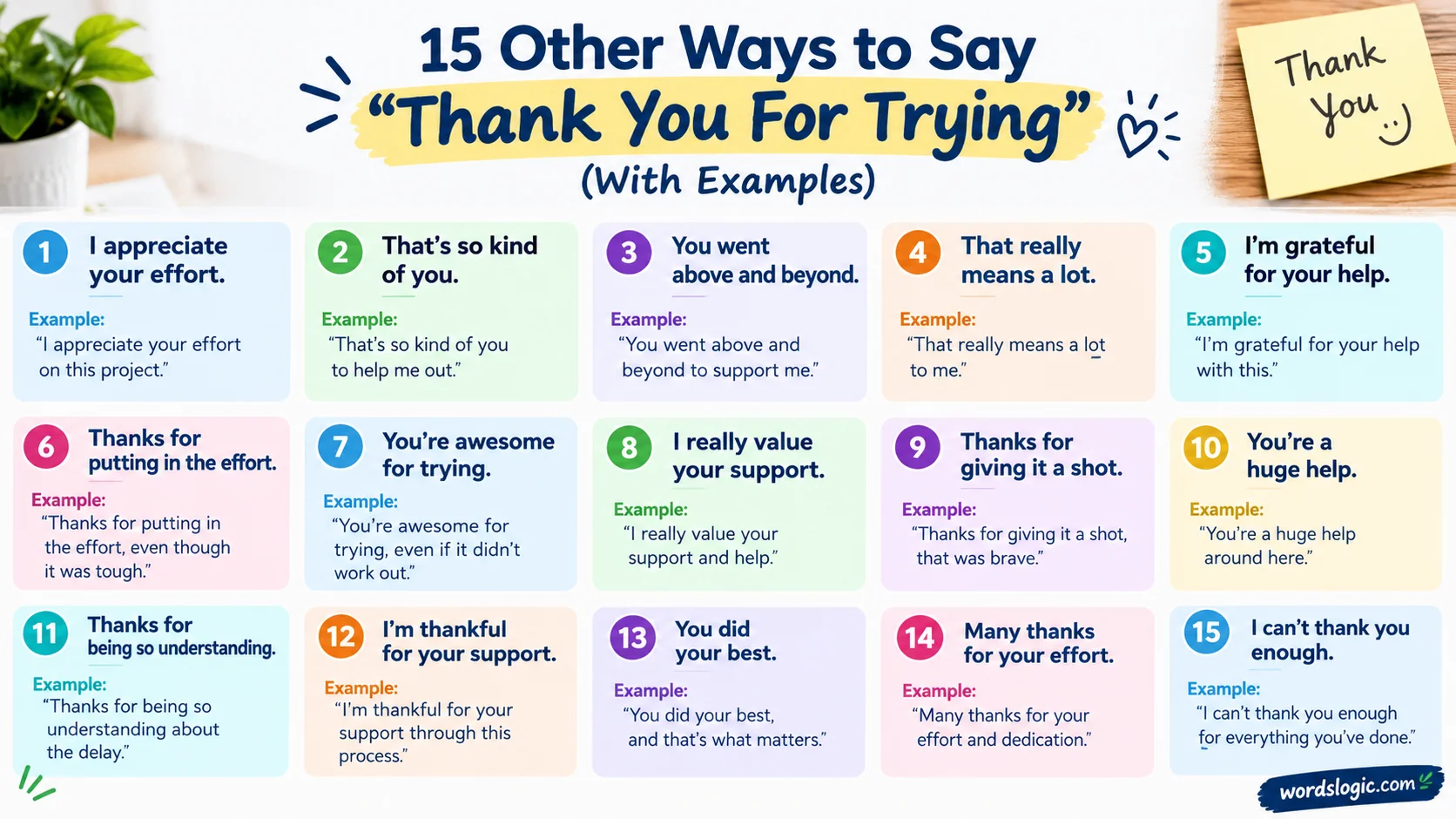
Other Ways to Say “Thank You For Trying” helps express gratitude when an imperfect outcome still shows effort and commitment. The phrase is a valuable and meaningful expression of appreciation when a colleague’s effort, work, or sincere attempt deserves to be acknowledged.
In the workplace, saying thank you can strengthen relationships, enhance motivation, and promote a supportive atmosphere where dedication, hard work, and willingness to try are valued. Even a small expression of gratitude can make a difference, especially when someone takes the initiative to go forward with courage. A person may not always be successful, but recognition, positive reinforcement, and encouragement can inspire them to strive for excellence, support teamwork, and contribute to an environment conducive to progress and success.
There are more than ways to express this idea across different situations and different tones. Professional alternatives can sound formal and respectful, while friendly alternatives may feel warm, and heartfelt alternatives can be motivational, personal, or impactful
What Does “Thank You For Trying” Mean?
“Thank you for trying” is a way of expressing gratitude for someone’s effort, even when their attempt did not completely solve the problem or produce the desired result. It recognizes that the person made an attempt and took some action rather than simply doing nothing. For example, if a friend tries to fix your computer but cannot solve the problem, you might say, “Thank you for trying.” The phrase focuses more on appreciating the effort than on the outcome.
The expression can sound warm, polite, encouraging, or slightly bittersweet, depending on the situation and tone of voice. In some contexts, it can reassure someone that their unsuccessful attempt was still meaningful. However, if said too briefly or with a certain tone, it may sometimes sound like the speaker has already accepted that the attempt failed.
Common Situations Where “Thank You For Trying” Is Used
People commonly say “Thank you for trying” when someone has made a genuine effort to help, fix something, explain something, or achieve a particular result. You might use it with a friend who tried to cheer you up, a colleague who attempted to solve a work problem, or a family member who made an effort to help you.
It can also work in text messages, personal conversations, workplace communication, and customer interactions, although the wording may change with the setting. In professional situations, a phrase such as “I appreciate your effort” may sound more polished. In a close relationship, “Thanks for giving it a shot” may feel more relaxed and natural.
Is It Professional or Polite to Say “Thank You For Trying”?
Yes, “Thank you for trying” is polite, but its tone depends heavily on context. It is generally friendly and appreciative because it acknowledges another person’s effort. In everyday conversation, it sounds natural and sincere when someone has genuinely attempted to help.
In professional communication, the phrase can sometimes sound slightly informal or may unintentionally emphasize that the attempt did not succeed. If you want to keep the focus on appreciation, expressions such as “I appreciate your effort” or “Thank you for taking the time” can be more suitable. The best wording depends on your relationship with the person and whether you want to emphasize effort, time, willingness, or persistence.
Advantages and Disadvantages of Saying “Thank You For Trying”
Advantages
The main advantage is that the phrase recognizes effort rather than just results. It can make someone feel appreciated when they have genuinely tried to help but could not achieve the intended outcome. It is also simple, clear, and easy to use in everyday conversations.
Disadvantages
The phrase can sometimes draw attention to an unsuccessful result, especially when said after something has gone wrong. Depending on tone, it may sound slightly dismissive or final, as if the speaker is saying, “Your attempt did not work, but I appreciate it.” In professional or emotionally sensitive situations, a more specific expression can communicate gratitude with greater warmth or nuance.
Synonyms for “Thank You For Trying”
- I Appreciate Your Effort
- Thank You for Making an Effort
- I Appreciate You Trying
- Thanks for Giving It a Shot
- Thank You for Putting in the Effort
- I Appreciate Your Help
- Thanks for Doing What You Could
- I Appreciate You Taking the Time
- Thank You for Your Effort
- Thanks for Trying to Help
- I’m Grateful You Tried
- Thank You for Giving It Your Best Shot
- I Appreciate Your Willingness to Help
- Thanks for Taking a Stab at It
- I Appreciate You Going Out of Your Way
1. I Appreciate Your Effort
Meaning
“I appreciate your effort” expresses gratitude for the work, energy, or attention someone put into an attempt. It is especially useful when you want to recognize the person’s hard work rather than focus on the final result.
Definition
I appreciate your effort means that you value and recognize the work someone made to accomplish something.
Detailed Explanation
This expression is slightly more polished and professional than “Thank you for trying.” It focuses attention on the person’s effort instead of whether the attempt succeeded. It works particularly well when someone has spent significant time or energy helping you. It can also sound sincere without being overly emotional.
Scenario Examples
Scenario: A colleague spends an afternoon trying to solve a technical issue.
Example: “I appreciate your effort in trying to get this resolved.”
Scenario: A friend tries to organize something for you, but the plan falls through.
Example: “I appreciate your effort. It really means a lot that you tried.”
Best Use
Best for workplace communication, emails, personal conversations, and situations where someone has made a noticeable effort.
Tone
Tone: Appreciative, professional, respectful
The wording emphasizes recognition and gratitude without sounding overly casual.
2. Thank You for Making an Effort
Meaning
“Thank you for making an effort” directly acknowledges that someone took action and tried to improve a situation.
Definition
It means thank you for taking the time or trouble to try to accomplish something.
Detailed Explanation
This phrase is close to the original but puts stronger emphasis on the fact that the person actively tried. It can be warmer than a simple “thanks” when the effort itself is meaningful. It is suitable for both personal and professional situations. However, context matters because “making an effort” can occasionally sound critical if the listener feels their effort was being judged.
Scenario Examples
Scenario: Your coworker rearranges their schedule to help you.
Example: “Thank you for making an effort to help me with this.”
Scenario: A family member tries to attend an important event.
Example: “Thank you for making an effort to be there.”
Best Use
Best for personal messages, workplace communication, relationships, and situations involving noticeable effort.
Tone
Tone: Warm, appreciative, direct
It clearly recognizes that the person went beyond simply doing nothing.
3. I Appreciate You Trying
Meaning
“I appreciate you trying” expresses gratitude for someone’s attempt, even when the attempt did not work.
Definition
It means I recognize and value the fact that you made an attempt to help or solve something.
Detailed Explanation
This expression sounds natural in everyday spoken English. It is personal because it directly acknowledges what the other person did. Compared with “I appreciate your effort,” it can sound a little more conversational and less formal. It is especially useful when you want to reassure someone that you are not upset about the outcome.
Scenario Examples
Scenario: A friend tries to find a lost item but cannot locate it.
Example: “I appreciate you trying. I know you spent a lot of time looking.”
Scenario: Someone attempts to fix a misunderstanding.
Example: “I appreciate you trying to make things right.”
Best Use
Best for friends, family, partners, informal workplace conversations, and supportive messages.
Tone
Tone: Friendly, sincere, supportive
It has a personal quality that makes it feel natural between people who know each other.
4. Thanks for Giving It a Shot
Meaning
“Thanks for giving it a shot” means thank you for trying something, especially when success was uncertain.
Definition
It is a casual expression meaning thank you for attempting something.
Detailed Explanation
This is a more casual and relaxed alternative. The phrase “give it a shot” means to try something without knowing whether it will work. It can make a disappointing result feel less serious because the emphasis is on taking the chance. It is usually better suited to conversation than formal business writing.
Scenario Examples
Scenario: Your friend tries to repair a small household problem.
Example: “Thanks for giving it a shot. I guess we’ll need to call someone now.”
Scenario: A teammate tries a new approach during a project.
Example: “Thanks for giving it a shot. It was worth testing.”
Best Use
Best for texting, casual conversation, friends, teammates, and informal situations.
Tone
Tone: Casual, encouraging, friendly
The idiom makes the message sound relaxed rather than formal.
5. Thank You for Putting in the Effort
Meaning
“Thank you for putting in the effort” recognizes the time, energy, and work someone invested in an attempt.
Definition
It means thank you for working hard or making a serious attempt.
Detailed Explanation
This phrase places strong emphasis on work and commitment. It can be useful when someone has clearly invested energy even though the outcome was not ideal. Compared with “Thank you for trying,” it often sounds more deliberate and substantial. It works well when the effort itself deserves recognition.
Scenario Examples
Scenario: A colleague spends extra time preparing a presentation.
Example: “Thank you for putting in the effort to improve the presentation.”
Scenario: Someone prepares a thoughtful surprise that does not go according to plan.
Example: “Thank you for putting in the effort. I really appreciate it.”
Best Use
Best for work, school, projects, personal relationships, and situations involving substantial effort.
Tone
Tone: Respectful, appreciative, encouraging
It highlights the work behind the attempt.
6. I Appreciate Your Help
Meaning
“I appreciate your help” thanks someone for providing assistance, regardless of whether their help completely solved the problem.
Definition
It means I am grateful for the assistance you gave me.
Detailed Explanation
This alternative shifts the focus from the attempt itself to the help provided. That makes it especially useful when you do not want to draw attention to whether the person’s attempt succeeded. It is natural in both professional and personal settings. However, use it when the person actually provided some form of assistance rather than merely offering to help.
Scenario Examples
Scenario: A coworker spends time investigating a problem for you.
Example: “I appreciate your help with this issue.”
Scenario: A friend listens while you work through a difficult situation.
Example: “I appreciate your help. It was good to have someone listen.”
Best Use
Best for emails, workplace communication, customer communication, friends, and everyday conversations.
Tone
Tone: Polite, warm, professional
Its versatility makes it appropriate in many different relationships and settings.
7. Thanks for Doing What You Could
Meaning
“Thanks for doing what you could” acknowledges that someone helped as much as they reasonably could.
Definition
It means thank you for making the effort that was possible under the circumstances.
Detailed Explanation
This expression is useful when the person had limited control over the outcome. It recognizes their effort without blaming them for what they could not accomplish. Because it can imply that the situation remained unresolved, it should be used thoughtfully. In the right context, it sounds understanding and reassuring.
Scenario Examples
Scenario: A customer-service representative cannot provide the exact solution you wanted.
Example: “Thanks for doing what you could to help.”
Scenario: A friend tries to support you during a difficult situation.
Example: “Thanks for doing what you could. I know you were trying to help.”
Best Use
Best for difficult situations, customer interactions, personal conversations, and circumstances where someone had limited options.
Tone
Tone: Understanding, appreciative, compassionate
It communicates gratitude while recognizing the limits of the situation.
8. I Appreciate You Taking the Time
Meaning
“I appreciate you taking the time” thanks someone specifically for giving their time and attention.
Definition
It means I am grateful that you spent time dealing with this or helping me.
Detailed Explanation
This is an excellent choice when the person’s main contribution was their time and attention. It does not necessarily suggest that they solved the problem, which makes it useful when the outcome was incomplete. The phrase is also common in professional communication because it sounds courteous without being excessively formal. It can be followed by “to help,” “to meet with me,” or another specific activity.
Scenario Examples
Scenario: A manager meets with you to discuss a problem.
Example: “I appreciate you taking the time to speak with me.”
Scenario: A friend spends an evening helping you prepare for an exam.
Example: “I appreciate you taking the time to help me study.”
Best Use
Best for emails, meetings, professional communication, personal favors, and thoughtful messages.
Tone
Tone: Polite, respectful, professional
It places the emphasis on the person’s time, which many people value highly.
9. Thank You for Your Effort
Meaning
“Thank you for your effort” is a straightforward way to recognize someone’s work or attempt.
Definition
It means thank you for the work and energy you put into something.
Detailed Explanation
This expression is concise and slightly more formal than “Thanks for trying.” It can be useful when you want to acknowledge someone’s contribution without discussing the outcome in detail. It fits situations where a person has clearly invested work in a task. In a formal setting, it can sound more appropriate than a highly emotional expression.
Scenario Examples
Scenario: A student puts significant effort into a group project.
Example: “Thank you for your effort on the project.”
Scenario: An employee works hard to meet a difficult deadline.
Example: “Thank you for your effort and commitment throughout the project.”
Best Use
Best for workplace communication, school, formal messages, projects, and situations involving measurable effort.
Tone
Tone: Professional, appreciative, straightforward
It is simple and clear without sounding overly personal.
10. Thanks for Trying to Help
Meaning
“Thanks for trying to help” thanks someone specifically for attempting to provide assistance.
Definition
It means thank you for making an effort to assist me.
Detailed Explanation
This phrase is particularly useful when the person wanted to help but could not fully resolve the situation. Adding “to help” makes the purpose of their effort clear. It sounds natural in conversation and personal messages. In some situations, however, it can still highlight that the help was unsuccessful.
Scenario Examples
Scenario: A friend tries to give you advice that does not solve the problem.
Example: “Thanks for trying to help. I think I need to handle it differently.”
Scenario: A colleague attempts to troubleshoot an issue.
Example: “Thanks for trying to help with the problem.”
Best Use
Best for friends, colleagues, family members, informal conversations, and supportive messages.
Tone
Tone: Friendly, appreciative, gentle
It acknowledges the person’s intention to help, even if the result was limited.
11. I’m Grateful You Tried
Meaning
“I’m grateful you tried” expresses heartfelt appreciation for someone’s attempt.
Definition
It means I feel thankful that you made an effort, regardless of the result.
Detailed Explanation
This expression can sound more emotionally sincere than a simple “Thank you for trying.” The word “grateful” adds weight to the message and can make it appropriate when the person’s effort had personal meaning. It is less common in routine workplace exchanges because it carries a stronger emotional tone. Use it when you genuinely want to emphasize how much the attempt mattered to you.
Scenario Examples
Scenario: A loved one tries to support you during a difficult time.
Example: “I’m grateful you tried to make things easier for me.”
Scenario: A friend makes an unsuccessful attempt to help with an important decision.
Example: “I’m grateful you tried. Your support means a lot.”
Best Use
Best for personal relationships, emotional situations, heartfelt messages, and meaningful acts of support.
Tone
Tone: Warm, sincere, heartfelt
It communicates more than simple politeness; it conveys genuine gratitude.
12. Thank You for Giving It Your Best Shot
Meaning
“Thank you for giving it your best shot” thanks someone for making their strongest or most sincere effort.
Definition
It means thank you for trying as hard as you could.
Detailed Explanation
This expression is stronger than simply thanking someone for trying because it recognizes a serious effort. It suggests that the person did what they reasonably could, even if the result was not successful. “Best shot” is conversational, so the phrase is more natural in speech than highly formal writing. It can also be encouraging when someone feels disappointed with the outcome.
Scenario Examples
Scenario: A teammate works hard to meet a difficult target.
Example: “Thank you for giving it your best shot. I know the deadline was tough.”
Scenario: A friend tries to help you resolve a personal problem.
Example: “Thanks for giving it your best shot. I really appreciate it.”
Best Use
Best for casual workplace conversations, friends, teammates, personal messages, and encouraging situations.
Tone
Tone: Encouraging, appreciative, supportive
It recognizes maximum effort rather than simply acknowledging an attempt.
13. I Appreciate Your Willingness to Help
Meaning
“I appreciate your willingness to help” recognizes someone’s readiness and openness to provide assistance.
Definition
It means I am grateful that you were willing and prepared to help me.
Detailed Explanation
This expression focuses on willingness, not necessarily on what the person actually accomplished. That makes it useful when someone offered assistance or was ready to help even if circumstances prevented them from doing much. It sounds more formal and polished than “Thanks for trying.” It is particularly suitable when you want to show respect for someone’s helpful attitude.
Scenario Examples
Scenario: A colleague offers to assist with a difficult assignment.
Example: “I appreciate your willingness to help with the project.”
Scenario: A neighbor offers support during a busy weekend.
Example: “I really appreciate your willingness to help.”
Best Use
Best for professional emails, workplace communication, formal thank-you messages, and polite personal interactions.
Tone
Tone: Professional, respectful, gracious
The wording emphasizes the person’s positive intention and readiness to assist.
14. Thanks for Taking a Stab at It
Meaning
“Thanks for taking a stab at it” is a casual way to thank someone for attempting something.
Definition
It means thanks for trying to do or solve something, especially when the result was uncertain.
Detailed Explanation
“Take a stab at it” is an informal idiom meaning try something. It can make the conversation sound relaxed and good-natured, particularly when the attempt was unsuccessful. Because it is idiomatic and casual, it is not a good choice for formal business correspondence. It works best when the relationship allows for conversational language.
Scenario Examples
Scenario: A friend attempts to assemble a complicated piece of furniture.
Example: “Thanks for taking a stab at it. I think we need to read the instructions again.”
Scenario: A teammate tests a new solution.
Example: “Thanks for taking a stab at it. We learned something useful from the attempt.”
Best Use
Best for casual conversations, texting, friends, teammates, and informal workplace settings.
Tone
Tone: Casual, lighthearted, friendly
The idiom keeps the message relaxed rather than formal.
15. I Appreciate You Going Out of Your Way
Meaning
“I appreciate you going out of your way” thanks someone for making an extra effort or doing more than was expected.
Definition
It means I am grateful that you made a special effort to help me.
Detailed Explanation
This expression is especially meaningful when someone had to make an extra effort or inconvenience themselves to help. It communicates more than simple appreciation for an attempt because it recognizes that the person did something beyond what was expected. It can work in both personal and professional situations. Use it when you want the other person to know that you noticed the additional effort they made.
Scenario Examples
Scenario: A coworker stays late to help you finish an urgent task.
Example: “I appreciate you going out of your way to help me finish this.”
Scenario: A friend drives across town to bring you something you need.
Example: “I really appreciate you going out of your way for me.”
Best Use
Best for personal favors, workplace assistance, meaningful acts of kindness, emails, and appreciative messages.
Tone
Tone: Warm, grateful, respectful
It communicates strong appreciation because it recognizes extra effort, not merely an ordinary attempt.
FAQs
What is another way to say “Thank You For Trying”?
Natural alternatives include “I appreciate your effort,” “I appreciate you trying,” “Thank you for making an effort,” and “Thanks for giving it a shot.” The best choice depends on the situation. For example, “I appreciate your effort” works well professionally, while “Thanks for giving it a shot” is more casual.
What does “Thank You For Trying” mean?
“Thank you for trying” means that you appreciate someone for making an attempt, even if they did not achieve the intended result. The phrase recognizes the person’s effort and willingness to help rather than focusing only on success.
Is “Thank You For Trying” professional?
Yes, it can be polite in professional communication, but it is generally conversational rather than highly formal. In an email or workplace message, “I appreciate your effort” or “I appreciate you taking the time” may communicate the same gratitude in a more polished way.
What is a more polite way to say “Thank You For Trying”?
“I appreciate your effort” is a polite and versatile option. If you want to emphasize someone’s time, “I appreciate you taking the time” is also effective. For a warmer personal message, “I’m grateful you tried” can sound more heartfelt.
Which alternative works best in formal communication?
For formal communication, “I appreciate your effort,” “Thank you for your effort,” and “I appreciate your willingness to help” are useful choices. They sound respectful and keep the focus on the person’s contribution without relying on a casual idiom.
Conclusion
Choosing the right expression can make a simple thank-you feel much more meaningful. “Thank you for trying” is useful when you want to recognize someone’s attempt, but different situations may call for different wording. “I appreciate your effort” can sound professional, while “Thanks for giving it a shot” feels more casual. If someone spent extra time helping you, “I appreciate you going out of your way” gives that effort more recognition.
The key is to consider the relationship, situation, tone, and result before choosing your words. You do not always need to focus on whether an attempt succeeded. Sometimes, simply showing someone that you noticed their effort is the most thoughtful thing you can say.













