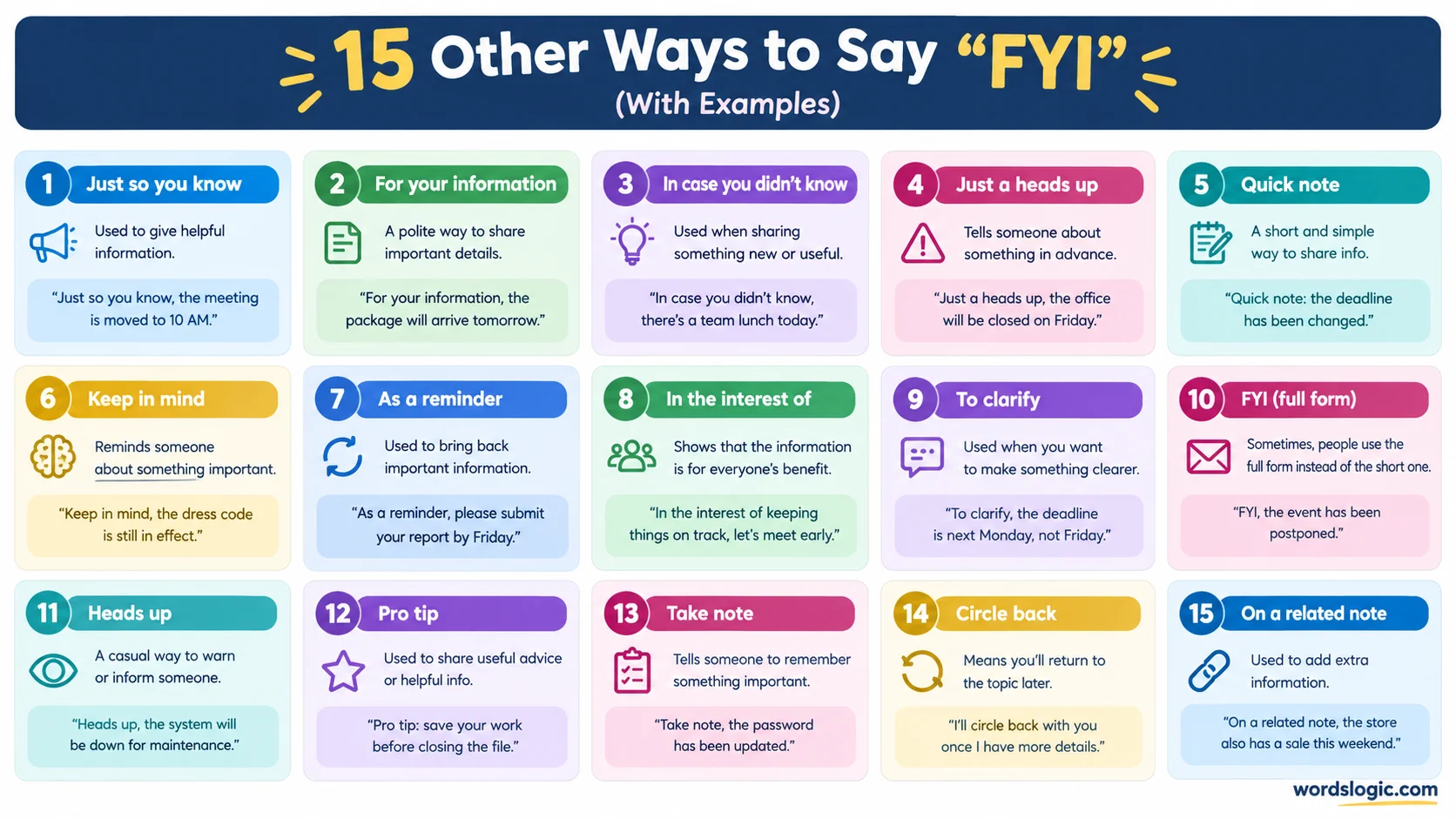
Other Ways to Say “FYI” help you share information in a clear, friendly, and professional way. Choosing the right words makes your messages sound more natural.
FYI is a common English phrase used in spoken English, written English, and everyday conversations. However, this three-letter shorthand can sound blunt, curt, cold, or impersonal, depending on the context, audience, and tone. Alternatives such as For Your Information, Heads Up, Quick Note, Just a Reminder, and In the Loop help you communicate the same message with more politeness and respect. You can also say just to let you know, just so you know, or for your reference when sharing details or providing an update.
In a professional setting, choose formal alternatives that suit business emails, workplace chats, and professional correspondence. Phrases such as For Your Information and Just a Reminder work well when sharing documents, reports, resources, or important details. For informal conversations, Quick Note and In the Loop feel more relaxed. From my experience, colleagues and friends respond better to messages that sound thoughtful, warm, and natural rather than dull or overly formal. A little humor, creativity, and personality can make communication more engaging, while clear wording helps prevent misunderstandings and builds stronger relationships.
What Does “FYI” Mean?
FYI stands for “for your information.” It is a common abbreviation used to share information that someone may find useful, relevant, or important. People often use it in emails, text messages, workplace conversations, and online discussions. For example, “FYI, the meeting starts at 10 a.m.” tells someone about the meeting time without necessarily asking them to do anything.
The expression is usually informative rather than demanding. However, its tone depends on the context. In a friendly message, it can sound casual and helpful. In a tense workplace conversation, it may sound abrupt or even slightly passive-aggressive. Choosing a more specific expression can clarify whether you’re sharing an update, giving a reminder, or asking someone to take action.
Common Situations Where “FYI” Is Used
FYI is especially common in workplace emails and professional messages when sharing schedules, project updates, meeting notes, or policy changes. For instance, a colleague might write, “FYI, the client has moved the deadline to Friday.” It helps deliver information quickly without adding unnecessary explanation.
People also use FYI in text messages, group chats, school announcements, and everyday conversations. A friend might use it to mention a change of plans, while a student might share an assignment deadline with classmates. In customer communication, a clearer phrase such as “Please note” or “I wanted to let you know” may be more appropriate because it explains the purpose of the message more directly.
Alternatives are useful when you want to avoid repetitive wording, make an important detail stand out, or adjust your tone for a particular audience.
Is It Professional or Polite to Say “FYI”?
Yes, FYI can be professional and polite, especially when communicating with colleagues who are familiar with informal workplace language. It is concise, widely understood, and useful for sharing routine updates. In an internal email, for example, “FYI, I’ve uploaded the revised report” is usually clear and natural.
However, FYI can sometimes sound blunt or impersonal, particularly when sent without context. In a formal email to a client, senior manager, or unfamiliar recipient, “For your reference,” “Please note,” or “I wanted to bring this to your attention” may sound more considerate. The best choice depends on the importance of the information, your relationship with the recipient, and whether you expect them to take action.
Advantages and Disadvantages of Saying “FYI”
Advantages
- Concise: FYI communicates the purpose of a message in just three letters.
- Widely understood: Most people who regularly use email or messaging recognize the abbreviation.
- Convenient: It works well for quick updates, reminders, and shared information.
- Low-pressure: It often communicates information without directly requesting a response or action.
Disadvantages
- Can sound abrupt: A message that begins with FYI may feel impersonal without a friendly explanation.
- Limited emotional tone: It does not naturally express warmth, concern, or appreciation.
- May seem passive-aggressive: In a disagreement, FYI can sound like a pointed correction.
- Not ideal for every audience: Some formal communications benefit from complete, courteous phrases instead of abbreviations.
Synonyms for Say “FYI”
- For your reference
- Just so you know
- I wanted to let you know
- Please note
- For your awareness
- Just a heads-up
- I thought you should know
- For your information
- To keep you informed
- In case you weren’t aware
- I wanted to bring this to your attention
- As a quick update
- For your records
- Worth mentioning
- In case it’s helpful
1. For Your Reference
Meaning
For your reference means that you are sharing information someone can consult whenever needed. It is particularly useful when attaching documents, sharing links, or providing background material.
Definition
A polite expression used to introduce information or resources that may be useful later.
Detailed Explanation
Unlike FYI, which can introduce almost any kind of update, “for your reference” often points to specific supporting information. It sounds organized and professional without being overly formal. The expression does not necessarily ask the recipient to read or act on the material immediately. It works especially well when you want someone to have access to a document, report, or set of instructions.
Scenario Examples
Scenario: Sending a report to a colleague.
Example: “I’ve attached the latest sales report for your reference.”
Scenario: Sharing a useful resource with a student.
Example: “Here’s the grammar guide for your reference before the exam.”
Scenario: Providing background information to a client.
Example: “For your reference, I’ve included a copy of our updated service terms.”
Best Use
Use this expression in professional emails, document sharing, reports, and formal correspondence when the recipient may need to consult the information later.
Tone
Tone: Professional, neutral, helpful.
It emphasizes usefulness and organization rather than urgency.
2. Just So You Know
Meaning
Just so you know introduces information that you want someone to be aware of. It is a natural alternative to FYI in casual conversations and everyday messages.
Definition
An informal expression used to tell someone something that may be relevant to them.
Detailed Explanation
This phrase sounds more conversational than FYI and often feels natural between friends, family members, and familiar coworkers. It can introduce a simple update without making the message sound like an official announcement. Depending on your wording, it can also sound defensive or slightly pointed, especially when correcting someone. Adding a friendly explanation helps keep the message neutral.
Scenario Examples
Scenario: Updating a friend about a change of plans.
Example: “Just so you know, we’re meeting at the café instead of the restaurant.”
Scenario: Giving a coworker a quick update.
Example: “Just so you know, Maya has already sent the revised figures.”
Scenario: Clarifying a personal preference.
Example: “Just so you know, I prefer calls after 6 p.m.”
Best Use
Choose this phrase for texts, casual emails, everyday conversations, and friendly workplace chats.
Tone
Tone: Casual, direct, conversational.
It sounds approachable, although a sharp delivery can make it seem like a warning or correction.
3. I Wanted to Let You Know
Meaning
I wanted to let you know introduces information in a considerate, personal way. It signals that you are taking the time to communicate something directly to the recipient.
Definition
A polite expression used to share an update or important information with someone.
Detailed Explanation
This phrase is warmer than FYI because it focuses on the act of informing the other person. It is useful when the information affects someone’s plans, expectations, or responsibilities. Although the wording is longer, it often sounds more thoughtful in personal and professional communication. It can introduce positive news, routine updates, or sensitive information without sounding unnecessarily formal.
Scenario Examples
Scenario: Informing a client about a delivery.
Example: “I wanted to let you know that your order is scheduled to arrive tomorrow.”
Scenario: Updating a friend about an event.
Example: “I wanted to let you know that the tickets are now available.”
Scenario: Sharing a workplace change.
Example: “I wanted to let you know that our team meeting has been moved to Thursday.”
Best Use
Use it in professional emails, customer messages, personal updates, and situations where a considerate tone matters.
Tone
Tone: Polite, warm, thoughtful.
It feels personal without being overly emotional or formal.
4. Please Note
Meaning
Please note directs the reader’s attention to a particular detail, instruction, or requirement. It is especially useful when the information deserves careful attention.
Definition
A formal or semi-formal expression asking someone to notice or consider specific information.
Detailed Explanation
Compared with FYI, “please note” places greater emphasis on the importance of the information. It is common in announcements, instructions, policy updates, and official emails. Although the word “please” adds courtesy, the expression can still sound firm because it directs the reader’s attention. Use it when clarity matters more than conversational warmth.
Scenario Examples
Scenario: Announcing a schedule change.
Example: “Please note that the office will close at 3 p.m. on Friday.”
Scenario: Giving students an assignment instruction.
Example: “Please note that all submissions must include your student ID.”
Scenario: Updating customers about a policy.
Example: “Please note that returns must be requested within 14 days of delivery.”
Best Use
Choose this phrase for official announcements, instructions, customer service, workplace emails, and formal notices.
Tone
Tone: Professional, direct, authoritative.
It is courteous but more instruction-focused than FYI.
5. For Your Awareness
Meaning
For your awareness means that you are sharing information so the recipient understands a situation, development, or issue.
Definition
A professional expression used to make someone aware of relevant information.
Detailed Explanation
This phrase is particularly suitable for workplace communication involving project developments, potential risks, or organizational changes. It sounds more formal than “just so you know” and often highlights information that could affect someone’s understanding of a situation. However, it is not always a natural substitute for FYI in casual messages. In everyday English, “I wanted to make you aware” may sound smoother in a full sentence.
Scenario Examples
Scenario: Informing a manager about a project delay.
Example: “For your awareness, the supplier has revised the delivery date.”
Scenario: Sharing an operational concern.
Example: “For your awareness, the building’s front entrance will be unavailable tomorrow.”
Scenario: Updating a department about a policy change.
Example: “For your awareness, the new approval process takes effect next month.”
Best Use
Use it in internal business communication, project updates, operational notices, and discussions involving relevant developments.
Tone
Tone: Formal, informative, neutral.
It focuses on keeping people informed rather than encouraging a casual conversation.
6. Just a Heads-Up
Meaning
Just a heads-up is a friendly way to alert someone to something they may need to know or prepare for.
Definition
An informal warning or advance notice about a relevant event, change, or possible problem.
Detailed Explanation
This expression is more anticipatory than FYI because it often prepares the recipient for something that is about to happen. It can communicate a simple reminder or a mild warning without sounding alarming. It works naturally in conversations with colleagues and friends, but it may be too casual for certain formal documents. When the information requires immediate action, explain that action separately rather than relying on the phrase alone.
Scenario Examples
Scenario: Warning a colleague about an upcoming deadline.
Example: “Just a heads-up, the final draft is due first thing tomorrow.”
Scenario: Informing a friend about traffic.
Example: “Just a heads-up, there’s heavy traffic near the stadium.”
Scenario: Preparing a team for maintenance.
Example: “Just a heads-up, the shared drive will be unavailable tonight.”
Best Use
Choose this expression for team chats, friendly emails, text messages, and advance warnings.
Tone
Tone: Friendly, casual, alert.
It feels approachable while signaling that the information may help someone prepare.
7. I Thought You Should Know
Meaning
I thought you should know communicates that you believe certain information is relevant enough for the other person to hear.
Definition
An expression used to share information because the speaker believes it may matter to the recipient.
Detailed Explanation
This phrase can sound more personal than FYI because it suggests that you have considered the recipient’s interests or circumstances. It is useful when sharing something meaningful, sensitive, or potentially unexpected. Depending on the situation, it can also suggest concern or imply that the information is important. For a more natural and grammatically complete version in many contexts, use “I thought you should know that…” followed by the information.
Scenario Examples
Scenario: Telling a friend about a change affecting them.
Example: “I thought you should know that the event has been postponed.”
Scenario: Informing a colleague about client feedback.
Example: “I thought you should know that the client was pleased with your presentation.”
Scenario: Sharing a personal concern.
Example: “I thought you should know that your parcel was left with the neighbor.”
Best Use
Use it in personal conversations, thoughtful messages, and workplace situations where the information could affect the recipient.
Tone
Tone: Considerate, personal, sometimes serious.
It can communicate care, although the recipient may interpret it as a sign that something important has happened.
8. For Your Information
Meaning
For your information is the full form of FYI. It introduces information that the recipient may need or find useful.
Definition
A phrase used to share information without necessarily requesting a response or action.
Detailed Explanation
Because it expands the abbreviation, this phrase can feel slightly more explicit than FYI while keeping essentially the same meaning. It is appropriate in many professional and everyday situations. However, tone matters: when used alone in a disagreement, it may sound defensive or confrontational, particularly if it introduces a correction. A complete sentence with a clear purpose usually makes the message easier to interpret.
Scenario Examples
Scenario: Sharing a project document.
Example: “For your information, the final version is available in the shared folder.”
Scenario: Correcting a scheduling misunderstanding.
Example: “For your information, the appointment was confirmed for Tuesday, not Wednesday.”
Scenario: Updating a colleague about a request.
Example: “For your information, the finance team has approved the expense.”
Best Use
Choose it for general workplace updates, emails, written notices, and situations where you want to spell out the abbreviation.
Tone
Tone: Neutral, informative, potentially firm.
It is straightforward, but the surrounding words determine whether it feels helpful or confrontational.
9. To Keep You Informed
Meaning
To keep you informed expresses the intention to provide someone with updates as a situation develops.
Definition
A phrase used to explain that information is being shared to maintain someone’s awareness of ongoing developments.
Detailed Explanation
Unlike FYI, which often introduces a single detail, this expression can suggest continued communication over time. It is particularly useful when someone expects updates about a project, application, order, or decision. The phrase sounds professional and reassuring, especially when used to explain why you are sending an update. It does not automatically promise a specific schedule, so include details if the recipient needs to know when the next update will arrive.
Scenario Examples
Scenario: Updating a customer about a delayed order.
Example: “I’m writing to keep you informed about the progress of your shipment.”
Scenario: Communicating with a project manager.
Example: “I’ll keep you informed as we receive feedback from the client.”
Scenario: Updating a parent about a school activity.
Example: “We’re sharing these updates to keep you informed about the upcoming school trip.”
Best Use
Use it in customer service, project management, ongoing email correspondence, and situations where regular updates are valuable.
Tone
Tone: Professional, reassuring, responsible.
It emphasizes transparency and ongoing communication rather than simply passing along a fact.
10. In Case You Weren’t Aware
Meaning
In case you weren’t aware introduces information that the recipient may not know.
Definition
A phrase used to share a fact or update while acknowledging that the other person may already know it.
Detailed Explanation
This expression is useful when you want to provide information without assuming the recipient has missed it. It is more qualified than FYI because it allows for the possibility that the person is already aware. However, it can sound condescending if the information is obvious or if the sentence implies that the recipient should have known better. A neutral, helpful context makes the phrase more considerate.
Scenario Examples
Scenario: Telling a coworker about an office closure.
Example: “In case you weren’t aware, the office will be closed next Monday.”
Scenario: Sharing a community announcement.
Example: “In case you weren’t aware, registration for the workshop ends this week.”
Scenario: Updating a friend about a local event.
Example: “In case you weren’t aware, the museum is offering free admission on Sundays.”
Best Use
Choose this expression for friendly reminders, informational emails, community messages, and updates where prior knowledge is uncertain.
Tone
Tone: Informative, cautious, conversational.
It avoids assuming what the recipient knows, but careful wording prevents it from sounding patronizing.
11. I Wanted to Bring This to Your Attention
Meaning
I wanted to bring this to your attention signals that a particular issue, detail, or development deserves the recipient’s notice.
Definition
A formal expression used to highlight information that may require consideration or awareness.
Detailed Explanation
This phrase is more deliberate and formal than FYI. It often suggests that the information is significant, unusual, or relevant to a decision. It can be used to raise a concern without sounding openly accusatory, although the issue itself may still be serious. Because it draws special attention to a matter, it is usually excessive for trivial updates such as sharing an ordinary meeting reminder.
Scenario Examples
Scenario: Reporting a problem to a supervisor.
Example: “I wanted to bring this to your attention because the report contains a discrepancy.”
Scenario: Informing a property manager about a repair issue.
Example: “I wanted to bring the leaking pipe in the kitchen to your attention.”
Scenario: Raising a concern with a project team.
Example: “I wanted to bring this delay to your attention before we finalize the schedule.”
Best Use
Use it in formal workplace emails, professional complaints, issue reporting, and communications requiring careful attention.
Tone
Tone: Formal, respectful, serious.
It emphasizes the importance of a matter without necessarily demanding immediate action.
12. As a Quick Update
Meaning
As a quick update introduces new information about a situation, project, plan, or activity.
Definition
An expression used to present a brief update about recent developments.
Detailed Explanation
This phrase is more specific than FYI because it frames the message as an update rather than general information. It is particularly effective when recipients already know about a situation and need to hear what has changed. The word “quick” suggests that the message will be brief, so a long explanation may make the opening feel misleading. It is a natural option for team communication and routine professional correspondence.
Scenario Examples
Scenario: Updating colleagues on a project.
Example: “As a quick update, we’ve completed the first round of testing.”
Scenario: Sharing a change with a client.
Example: “As a quick update, your revised proposal is ready for review.”
Scenario: Informing a group about event preparations.
Example: “As a quick update, we’ve confirmed the venue and catering.”
Best Use
Choose this expression for project emails, team meetings, client updates, and messages about ongoing plans.
Tone
Tone: Professional, concise, practical.
It signals that the message contains a short summary of recent developments.
13. For Your Records
Meaning
For your records means that you are providing information or documentation that the recipient may want or need to keep.
Definition
A phrase used when sharing material for documentation, future reference, or recordkeeping.
Detailed Explanation
This expression has a narrower meaning than FYI because it emphasizes keeping information on file. It works well for receipts, confirmations, contracts, invoices, and official correspondence. The phrase does not necessarily mean that the recipient must take action; it simply indicates that the material may be useful as a record. Avoid using it for casual news that has no practical recordkeeping purpose.
Scenario Examples
Scenario: Sending a payment confirmation.
Example: “I’ve attached your payment receipt for your records.”
Scenario: Confirming a business agreement.
Example: “For your records, the agreed delivery date is October 20.”
Scenario: Sharing an employment document.
Example: “Please keep the signed copy of the agreement for your records.”
Best Use
Use it in administrative emails, financial correspondence, business transactions, and document-sharing situations.
Tone
Tone: Formal, practical, neutral.
It focuses on documentation and future reference rather than conversational interaction.
14. Worth Mentioning
Meaning
Worth mentioning introduces a detail that the speaker believes is relevant, interesting, or useful.
Definition
An expression used to highlight a point that deserves consideration or attention.
Detailed Explanation
This phrase is more selective than FYI because it suggests that a detail has particular value. It is often used when discussing options, explaining a decision, or adding context to a larger conversation. It can sound conversational in speech and polished in writing, depending on the sentence. Unlike a formal instruction, it presents the information as something useful to consider rather than something the recipient must follow.
Scenario Examples
Scenario: Discussing a travel plan.
Example: “It’s worth mentioning that the museum offers free entry on Thursdays.”
Scenario: Reviewing a job candidate.
Example: “One detail worth mentioning is her experience managing international projects.”
Scenario: Explaining a product choice.
Example: “It’s worth mentioning that this model comes with a longer warranty.”
Best Use
Choose this expression for discussions, reports, presentations, reviews, and messages that add useful context to an existing topic.
Tone
Tone: Thoughtful, conversational, informative.
It highlights relevance without making the information sound like an urgent announcement.
15. In Case It’s Helpful
Meaning
In case it’s helpful introduces information that the recipient may find useful, while leaving them free to decide whether to use it.
Definition
A considerate expression used to offer information or a resource that might benefit someone.
Detailed Explanation
This phrase sounds softer and more supportive than FYI because it focuses on the possible usefulness of the information. It is especially suitable when offering suggestions, links, advice, or resources without assuming that the recipient needs them. It can also make an unsolicited recommendation feel less forceful. However, it is not the best choice for mandatory instructions or information that requires immediate attention.
Scenario Examples
Scenario: Helping a colleague prepare a presentation.
Example: “In case it’s helpful, I’ve shared the template our team used last quarter.”
Scenario: Supporting a friend who is planning a trip.
Example: “In case it’s helpful, here’s the train schedule for the weekend.”
Scenario: Sharing a resource with a student.
Example: “In case it’s helpful, I’ve included a practice worksheet for the next lesson.”
Best Use
Use this expression for friendly emails, optional resources, supportive messages, recommendations, and situations where you want to be helpful without applying pressure.
Tone
Tone: Warm, considerate, supportive.
It makes the information feel like an offer rather than a demand.
FAQs
1. What does FYI mean in a text message?
FYI means “For Your Information.” People use it in text messages, emails, and online conversations to share information, provide updates, or point out important details. Its tone can sound friendly, neutral, or blunt depending on the context.
2. What are the best professional alternatives to FYI?
Some of the best professional alternatives include For Your Reference, Please Note, I wanted to let you know, For Your Awareness, and Please Keep in Mind. These phrases work well in business emails, workplace communication, and formal correspondence.
3. What can I say instead of FYI in a casual conversation?
For casual conversations, try Heads Up, Quick Note, Just so you know, Just to let you know, or Thought you should know. These natural expressions make everyday messages sound more relaxed and approachable.
4. Can FYI sound rude or passive-aggressive?
Yes, FYI can sometimes sound blunt, cold, or passive-aggressive, especially when someone uses it without explaining the purpose of a message. However, it isn’t automatically rude. Your tone, wording, and relationship with the reader all affect how the message comes across.
5. How do I choose the right alternative to FYI?
Choose a phrase based on your audience, purpose, and level of formality. Use For Your Reference in formal emails, Heads Up for a quick warning or useful update, and Just so you know in casual conversations. Clear wording helps you share information without creating confusion.
Conclusion
Choosing the right Other Ways to Say “FYI” can make your messages sound more natural, polite, and professional. Expressions such as For Your Information, Heads Up, Quick Note, For Your Reference, and Just to let you know help you share information while matching your tone to the situation. Whether you’re writing a business email, messaging a colleague, or chatting with friends, thoughtful word choices can improve clarity and reduce misunderstandings.
The key is to consider your audience, purpose, and communication style before choosing an alternative. Use formal phrases when professionalism matters and casual expressions when you want a friendly tone. By using varied wording, you can avoid repetitive messages, build stronger relationships, and make everyday communication more clear, respectful, and engaging.













