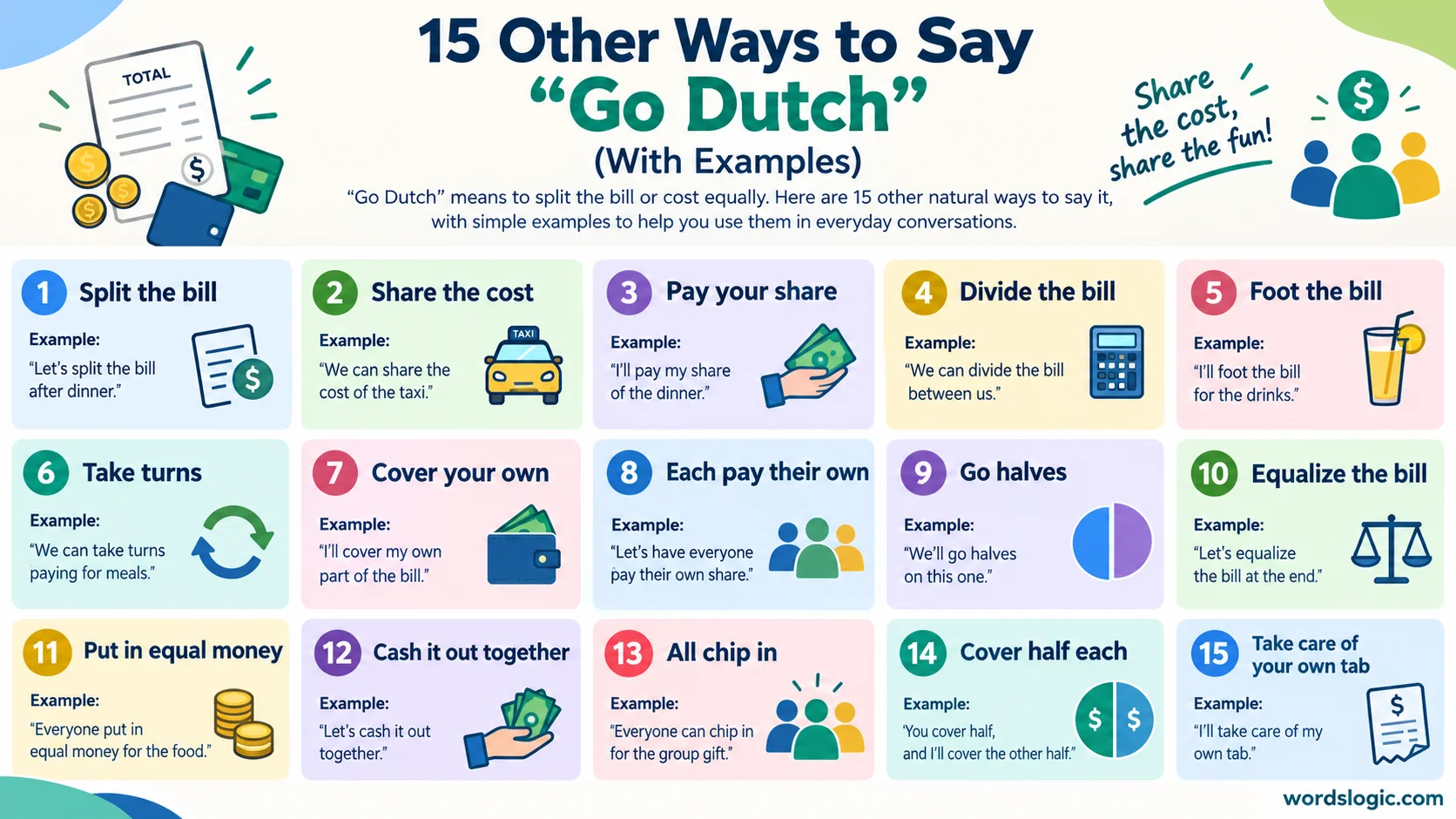
Other Ways to Say “Go Dutch” helps you explain fair bill splitting, shared expenses, and clear payment expectations in everyday dining situations.
Imagine having dinner with three coworkers after a conference at a restaurant abroad. When the check arrives, each person agrees to pay their own share rather than expecting one person to cover the entire bill. This simple moment shows how Go Dutch became a familiar phrase in everyday American English and Western dining. Over the decades, this expression has grown beyond informal slang and gained significance around the world. Whether couples, friends, or colleagues are sharing drinks, food, or a meal, this modern habit helps everyone manage costs fairly and enjoy social interactions without hesitation.
From my experience, going Dutch is more than random etiquette. It connects to history, cultural values, and the desire for equal treatment. This practice supports independence and equality by helping people handle expenses fairly and socially. For example, a group meeting at a café for a light snack or choosing a small gift can agree on a balanced approach to avoid awkwardness and financial pressure. When people understand what each person pays, they can build trust and comfort during dining and casual meetups. This habit also strengthens fairness in social behavior, builds financial independence, and encourages shared responsibility.
In today’s dining culture, knowing Other Ways to Say “Go Dutch” is useful because the expression can sound informal or ambiguous in professional, international, or sensitive situations. Saying “split the bill” or “pay our share” provides clearer wording when people want to divide the cost of a shared meal or another activity. The best wording depends on your relationship, the setting, and whether the cost division is divided equally or based on individual spending. This everyday payment practice fits into modern etiquette, restaurant culture, and casual dining, where group payment settings, bill splitting, and cost sharing create a smoother collective experience.
What Does “Go Dutch” Mean?
“Go Dutch” means that each person pays their own share of a bill, usually when dining out or enjoying an activity together. For example, if two friends have dinner and each pays for their own food and drinks, they are going Dutch. The expression is commonly used in casual conversations about restaurants, coffee dates, group outings, and other shared activities. Depending on the arrangement, people might divide the bill equally or pay only for what they ordered. These are slightly different approaches, so it’s helpful to clarify the plan before paying. Although the expression is widely understood in everyday English, “split the bill” or “pay separately” may sound clearer in some situations.
Common Situations Where “Go Dutch” Is Used
People commonly use “Go Dutch” when arranging meals with friends, classmates, colleagues, or romantic partners. For example, someone might suggest going Dutch before meeting a friend for lunch so neither person expects the other to cover the whole bill. The phrase also works in group chats when people are planning birthdays, casual dinners, or weekend activities.
In professional settings, colleagues may discuss paying separately for lunch, while friends might use the expression when arranging a coffee date. However, the phrase is less suitable when you need to explain a specific payment arrangement in a formal email or invoice. In those cases, expressions such as “pay individually” or “divide the cost equally” provide more precise information. Choosing the right wording helps avoid confusion about whether everyone pays for their own items or contributes an equal amount.
Is It Professional or Polite to Say “Go Dutch”?
“Go Dutch” is generally casual, neutral, and acceptable in everyday conversation. It can sound friendly and practical when friends or colleagues want to share expenses fairly. For example, asking a colleague, “Shall we go Dutch for lunch?” is usually a straightforward way to discuss payment. It isn’t inherently rude or impolite, although the situation and the people involved can affect how the suggestion is received.
In formal business communication, “pay separately,” “split the expenses,” or “share the cost” may sound more precise. On a date, it’s often helpful to discuss payment expectations before ordering rather than assuming both people have the same idea. A polite suggestion such as “Would you be comfortable splitting the bill?” gives the other person room to respond. The goal is to make the arrangement clear without making anyone feel pressured or embarrassed.
Advantages and Disadvantages of Saying “Go Dutch”
Advantages
- Clear payment expectations: The phrase signals that everyone will contribute rather than expecting one person to pay for the entire outing.
- Casual and convenient: It’s short, familiar, and easy to use with friends or colleagues.
- Encourages independence: Each person can take responsibility for their own expenses.
- Helps with planning: Discussing the arrangement beforehand can prevent surprises when the bill arrives.
Disadvantages
- It can be ambiguous: Some people interpret sharing a bill as paying equally, while others expect everyone to pay for their own items.
- It may feel too casual: In formal emails or business arrangements, a more precise expression can sound more appropriate.
- It may not fit every social expectation: A host who invited everyone and offered to pay might not intend to divide the expenses.
- It can feel awkward without prior discussion: On a date or at a special occasion, unexpected payment arrangements may create confusion.
The best alternative depends on whether you want to emphasize individual responsibility, equal sharing, politeness, or a specific payment method.
15 Alternatives to “Go Dutch”
- Split the Bill
- Pay Separately
- Split the Cost
- Share the Expenses
- Each Pay Our Own Way
- Pay for What You Order
- Divide the Bill Equally
- Contribute Equally
- Go Halves
- Split It 50/50
- Cover Your Own Meal
- Settle Individually
- Share the Tab
- Divide the Expenses
- Each Cover Our Own Share
1. Split the Bill
Meaning
“Split the bill” means dividing a bill among two or more people instead of having one person pay the entire amount. It’s one of the clearest alternatives to “Go Dutch” when talking about restaurant meals.
Definition
To divide the total amount owed among the people sharing a meal or service.
Detailed Explanation
This expression works well when everyone agrees to share the payment. It can mean dividing the bill equally or allocating different amounts to each person, depending on the arrangement. Unlike “Go Dutch,” it focuses directly on the bill rather than the broader idea of sharing expenses. If you want everyone to pay the same amount, specify that the split should be equal.
Scenario Examples
Scenario: You’re planning dinner with a friend.
Example: “Let’s split the bill tonight so we’re both covered.”
Scenario: Your friends have finished a group meal.
Example: “Should we split the bill or work out what each person ordered?”
Scenario: You’re arranging a casual lunch with a colleague.
Example: “We can split the bill when we’re ready to leave.”
Best Use
Use this expression in restaurants, cafés, casual outings, and group meals. It’s also useful when discussing payment arrangements before ordering.
Tone
Tone: Casual, clear, and practical.
It communicates a straightforward plan without making the conversation overly formal.
2. Pay Separately
Meaning
“Pay separately” means each person makes an individual payment instead of combining everyone’s purchases into one shared payment.
Definition
To pay for your own purchases in a separate transaction.
Detailed Explanation
This expression is especially useful when people want to avoid calculating shares after receiving one combined bill. It may mean asking the server for separate checks or paying individually at the counter. Unlike “Go Dutch,” it describes how payment happens rather than whether everyone contributes equally. It’s also a useful choice in professional settings because it sounds direct and neutral.
Scenario Examples
Scenario: You’re ordering lunch with a coworker.
Example: “Let’s pay separately so we can expense our meals individually.”
Scenario: You and a friend are buying coffee.
Example: “Can we pay separately? I’ll cover my drink.”
Best Use
Choose this phrase at restaurants, cafés, food counters, and business lunches when each person needs an individual payment.
Tone
Tone: Neutral, practical, and professional.
The wording focuses on the payment process rather than the social expectations around sharing costs.
3. Split the Cost
Meaning
“Split the cost” means dividing the price of something among the people involved. It applies to meals as well as tickets, travel, accommodation, and shared purchases.
Definition
To share an expense between two or more people.
Detailed Explanation
This phrase is broader than “Go Dutch” because it doesn’t refer only to meals or social outings. Friends can split the cost of concert tickets, coworkers can share a taxi fare, and roommates can divide the price of household supplies. The expression doesn’t automatically mean an equal division. If everyone should pay the same amount, make that expectation clear.
Scenario Examples
Scenario: You’re planning a weekend trip with friends.
Example: “Let’s split the cost of the rental car between us.”
Scenario: You and a friend are buying event tickets.
Example: “We can split the cost of the booking fee.”
Best Use
Use it for shared purchases, travel plans, entertainment, accommodation, and group activities.
Tone
Tone: Friendly, flexible, and practical.
It sounds cooperative without specifying exactly how the final payment will be calculated.
4. Share the Expenses
Meaning
“Share the expenses” means that two or more people contribute money toward the costs of an activity, arrangement, or purchase.
Definition
To distribute financial responsibilities among several people.
Detailed Explanation
This phrase works well when you’re discussing several costs rather than one restaurant bill. For example, friends planning a holiday might share expenses for transportation, accommodation, and food. It can suggest an ongoing arrangement rather than a single payment. Unlike “Go Dutch,” it doesn’t necessarily mean everyone pays for their own items or contributes an identical amount.
Scenario Examples
Scenario: Friends are organizing a holiday.
Example: “Let’s share the expenses so the trip is affordable for everyone.”
Scenario: Roommates are discussing household costs.
Example: “We can share the expenses for cleaning supplies and groceries.”
Best Use
Use this expression for trips, household budgets, group events, and recurring shared costs.
Tone
Tone: Cooperative, considerate, and slightly formal.
It emphasizes shared responsibility rather than the mechanics of paying a bill.
5. Each Pay Our Own Way
Meaning
“Each pay our own way” means that everyone pays their own expenses instead of relying on someone else to cover them.
Definition
For each person to take responsibility for their own costs.
Detailed Explanation
This wording is helpful when you want to establish expectations before an outing. It can include meals, transportation, tickets, or other personal expenses. Unlike splitting a bill equally, paying your own way generally means paying for what you personally use or purchase. The phrase is particularly useful when people have different budgets or plan to order different things.
Scenario Examples
Scenario: You’re inviting friends to a concert.
Example: “Let’s each pay our own way for the tickets and dinner.”
Scenario: You’re organizing a weekend outing.
Example: “Everyone can pay their own way, so nobody has to cover the group.”
Best Use
Use it when planning group outings, trips, entertainment, or activities where individual costs may vary.
Tone
Tone: Independent, straightforward, and fair-minded.
It sets expectations clearly, although it can sound firm if the conversation is sensitive.
6. Pay for What You Order
Meaning
“Pay for what you order” means that each person pays for their own food and drinks rather than dividing the entire bill equally.
Definition
To cover the price of your individual selections.
Detailed Explanation
This expression is especially helpful when people order items at different prices. One person might choose a salad and water while another orders a large meal and dessert. Dividing the bill equally could leave one person paying more than the cost of their own order. This wording makes the arrangement more specific than “Go Dutch,” but it may not cover shared appetizers, taxes, or tips unless those are discussed separately.
Scenario Examples
Scenario: Your friends have different food preferences.
Example: “Let’s pay for what we order so everyone covers their own meal.”
Scenario: You’re arranging lunch with classmates.
Example: “Everyone can pay for what they order at the counter.”
Best Use
Choose this phrase for restaurants, food courts, cafés, and group meals with different-sized orders.
Tone
Tone: Clear, practical, and matter-of-fact.
It works well when fairness means paying according to individual consumption rather than splitting everything evenly.
7. Divide the Bill Equally
Meaning
“Divide the bill equally” means sharing the total amount so that everyone pays the same amount.
Definition
To distribute a bill into equal financial portions among the people paying.
Detailed Explanation
This phrase removes much of the uncertainty around sharing a restaurant bill. Everyone contributes an equal amount, even if some people ordered more expensive dishes than others. That’s an important difference from paying for what you order. The arrangement works best when everyone agrees that an equal split is reasonable, particularly when the group shares food or drinks.
Scenario Examples
Scenario: A group shares several pizzas.
Example: “Let’s divide the bill equally among the six of us.”
Scenario: Friends order a variety of shared appetizers.
Example: “Since we’re all sharing the food, we can divide the bill equally.”
Best Use
Use it when everyone has agreed to an equal payment arrangement, especially for shared meals or group activities.
Tone
Tone: Direct, organized, and neutral.
It makes the payment method explicit and helps prevent misunderstandings.
8. Contribute Equally
Meaning
“Contribute equally” means that everyone provides the same amount of money toward a shared expense.
Definition
To make an equal financial contribution toward a common cost.
Detailed Explanation
This phrase is broader and slightly more formal than “Go Dutch.” It works for shared dinners, group gifts, celebrations, and events that require a common budget. Unlike paying for individual orders, it emphasizes equal contributions from everyone involved. It is most suitable when the group has agreed on a shared amount or budget in advance.
Scenario Examples
Scenario: Friends are arranging a birthday dinner.
Example: “We can contribute equally toward the cost of the meal.”
Scenario: Colleagues are purchasing a retirement gift.
Example: “Would everyone be happy to contribute equally to the gift?”
Best Use
Choose this phrase for group gifts, shared events, celebrations, and organized budgets.
Tone
Tone: Cooperative, respectful, and moderately formal.
It emphasizes fairness and teamwork without focusing on the payment transaction itself.
9. Go Halves
Meaning
“Go halves” means that two people share a cost equally, with each person paying half.
Definition
To divide an expense into two equal parts.
Detailed Explanation
This expression is a natural alternative when exactly two people are sharing a bill or purchase. It’s common in British English and is also understood in other varieties of English. Unlike “Go Dutch,” which can involve several people paying their individual shares, “Go halves” specifically suggests a 50/50 arrangement between two people. It may not be suitable if one person ordered substantially more or if the group has more than two members.
Scenario Examples
Scenario: You’re sharing a takeaway meal with a friend.
Example: “Shall we go halves on the order?”
Scenario: You and your sibling are buying a present.
Example: “Let’s go halves on Mum’s birthday gift.”
Best Use
Use it for two-person meals, gifts, purchases, and shared expenses when both people will pay the same amount.
Tone
Tone: Casual, friendly, and collaborative.
It sounds natural in conversation, particularly in British English.
10. Split It 50/50
Meaning
“Split it 50/50” means dividing a cost into two equal shares.
Definition
To share an expense equally, with each person paying half.
Detailed Explanation
This expression is direct and easy to understand, especially when discussing money with a friend, partner, or roommate. The numbers make the arrangement explicit, so there’s little doubt about how much each person is expected to contribute. However, it generally describes a two-person split and may not suit a larger group without further explanation. Unlike “Go Dutch,” it specifically emphasizes an equal division rather than separate payments based on individual purchases.
Scenario Examples
Scenario: You’re planning dinner with your partner.
Example: “Would you like to split it 50/50 tonight?”
Scenario: You and a friend are booking a hotel room.
Example: “The room costs $200, so we can split it 50/50 and pay $100 each.”
Best Use
Use it for shared bills, accommodation, tickets, and other expenses involving two people who agree to contribute equally.
Tone
Tone: Casual, clear, and confident.
It communicates the arrangement directly, making it especially useful when the exact division matters.
11. Cover Your Own Meal
Meaning
“Cover your own meal” means paying for the food and drinks you personally order instead of expecting another person to pay for you.
Definition
To pay for your own dining expenses.
Detailed Explanation
This phrase is useful when discussing restaurant plans and making sure everyone understands their financial responsibility. It is more specific than “Go Dutch” because it focuses on the cost of each person’s meal. It can be a practical option when people have different budgets or dietary preferences. However, the word “own” can sound slightly firm, so a softer question may work better when you’re speaking with someone you don’t know well.
Scenario Examples
Scenario: You’re organizing dinner with a group of friends.
Example: “Just so everyone’s clear, we’ll each cover our own meal.”
Scenario: You’re planning lunch with a new acquaintance.
Example: “Would you be comfortable covering your own meal?”
Best Use
Use it when arranging restaurant visits, casual lunches, and dinners where everyone pays for their own food.
Tone
Tone: Direct, practical, and independent.
It sets a clear expectation, although a polite introduction can make it sound more welcoming.
12. Settle Individually
Meaning
“Settle individually” means that each person handles their own payment rather than making one combined payment for the group.
Definition
To complete a payment separately from other people.
Detailed Explanation
This expression sounds more formal than “Go Dutch” and is useful when discussing organized payments. For example, colleagues attending a business lunch might settle individually to keep their expenses separate. The phrase describes how payments are handled, not necessarily whether each person pays an equal share. In a casual conversation, “pay separately” is often more natural, but this alternative can fit professional or administrative settings.
Scenario Examples
Scenario: You’re coordinating a business lunch.
Example: “Attendees can settle individually at the restaurant.”
Scenario: A group is booking a meal at a venue that offers separate payments.
Example: “Please let the staff know if you’d prefer to settle individually.”
Best Use
Choose this phrase for business lunches, organized group meals, event arrangements, and payment instructions.
Tone
Tone: Professional, neutral, and administrative.
It works best when clarity and organization matter more than casual friendliness.
13. Share the Tab
Meaning
“Share the tab” means that two or more people share responsibility for paying a running bill, usually at a bar or restaurant.
Definition
To share the amount owed on a restaurant or bar bill.
Detailed Explanation
The word “tab” commonly refers to a bill that accumulates as people order food or drinks. Sharing the tab suggests that several people will contribute toward the total, although it doesn’t automatically establish equal shares. This makes it similar to “Go Dutch” in social settings but less precise about the payment method. If everyone needs to pay a different amount, explain how the total will be divided.
Scenario Examples
Scenario: Friends are having dinner and drinks.
Example: “Let’s share the tab tonight instead of asking one person to cover everything.”
Scenario: You’re chatting with friends at a casual bar.
Example: “Are we sharing the tab, or is everyone paying separately?”
Best Use
Use it in casual restaurant conversations, bars, and social gatherings where a shared bill is involved.
Tone
Tone: Relaxed, conversational, and friendly.
It sounds informal and fits social settings better than formal payment instructions.
14. Divide the Expenses
Meaning
“Divide the expenses” means distributing costs among the people responsible for paying them.
Definition
To allocate shared costs between multiple people.
Detailed Explanation
This expression works particularly well when an outing involves more than one expense. A group might divide the expenses for transportation, accommodation, meals, and entrance tickets during a weekend trip. It is broader than “Go Dutch” and doesn’t necessarily mean that everyone contributes equally. You can use it when discussing an overall budget rather than a single bill.
Scenario Examples
Scenario: Friends are planning a road trip.
Example: “We’ll divide the expenses for fuel, accommodation, and meals.”
Scenario: Students are organizing a class event.
Example: “Let’s divide the expenses among the organizing team before we book the venue.”
Best Use
Use it for group trips, events, shared projects, and multiple expenses that need to be allocated.
Tone
Tone: Organized, practical, and slightly formal.
It emphasizes planning and financial responsibility rather than the social experience of paying together.
15. Each Cover Our Own Share
Meaning
“Each cover our own share” expresses the idea that everyone will be responsible for paying their individual portion of a shared expense.
Definition
For each person to pay the portion assigned to them.
Detailed Explanation
This wording emphasizes individual responsibility while allowing the group to share a larger expense. It can be useful when people are discussing a restaurant bill, a group booking, or another shared purchase. Unlike an equal split, individual shares can vary depending on what each person ordered or agreed to pay. In everyday conversation, “We’ll each cover our own share” sounds more natural and complete than the shortened phrase alone.
Scenario Examples
Scenario: Friends are organizing a dinner with different menu choices.
Example: “Let’s each cover our own share when the bill arrives.”
Scenario: You’re planning an outing with classmates.
Example: “We’ll book everything together, but we’ll each cover our own share.”
Best Use
Choose this expression for group meals, shared bookings, and outings where people need to take responsibility for their portions.
Tone
Tone: Fair, collaborative, and straightforward.
It balances the idea of doing something together with the expectation that everyone pays their agreed share.
FAQs
What does “Go Dutch” mean?
Go Dutch means that each person pays their own share of a meal, activity, or expense instead of expecting one person to cover the entire bill. It is a common way to handle shared expenses fairly with friends, coworkers, or family.
Is “Go Dutch” formal or informal?
Go Dutch is an informal expression commonly used in everyday conversations. In professional settings, you can say “Let’s split the bill” or “We can each pay our share” to sound clearer and more appropriate.
What is another way to say “Go Dutch”?
Some useful alternatives to Go Dutch include “split the bill,” “pay our own way,” “share the cost,” “pay separately,” and “each cover our share.” Choose an expression that fits the situation and makes the payment arrangement clear.
Does “Go Dutch” mean splitting the bill equally?
Not always. Going Dutch usually means that everyone pays their own portion. Sometimes people split the total bill equally, while other groups calculate each person’s cost according to what they ordered. It is best to agree on the payment method before paying.
Is it rude to suggest going Dutch on a date?
No, suggesting going Dutch is not automatically rude. Many people appreciate financial independence and fairness when dating. However, expectations can differ, so use polite wording such as “Would you like to split the bill?” to make the suggestion comfortable and respectful.
Conclusion
Learning Other Ways to Say “Go Dutch” helps you communicate clearly when sharing meals, activities, and expenses. Expressions such as “split the bill,” “pay our own way,” and “share the cost” can make conversations easier in casual dining, professional settings, and social situations. The best phrase depends on your relationship with the other people and the payment arrangement you agree on.
A simple conversation about money can prevent awkwardness and support fairness, trust, and financial independence. Whether you’re dining with friends, meeting colleagues, or going on a date, explain the arrangement politely before the bill arrives. This small step helps everyone understand their responsibility, manage their own expenses, and enjoy a more comfortable shared experience.













