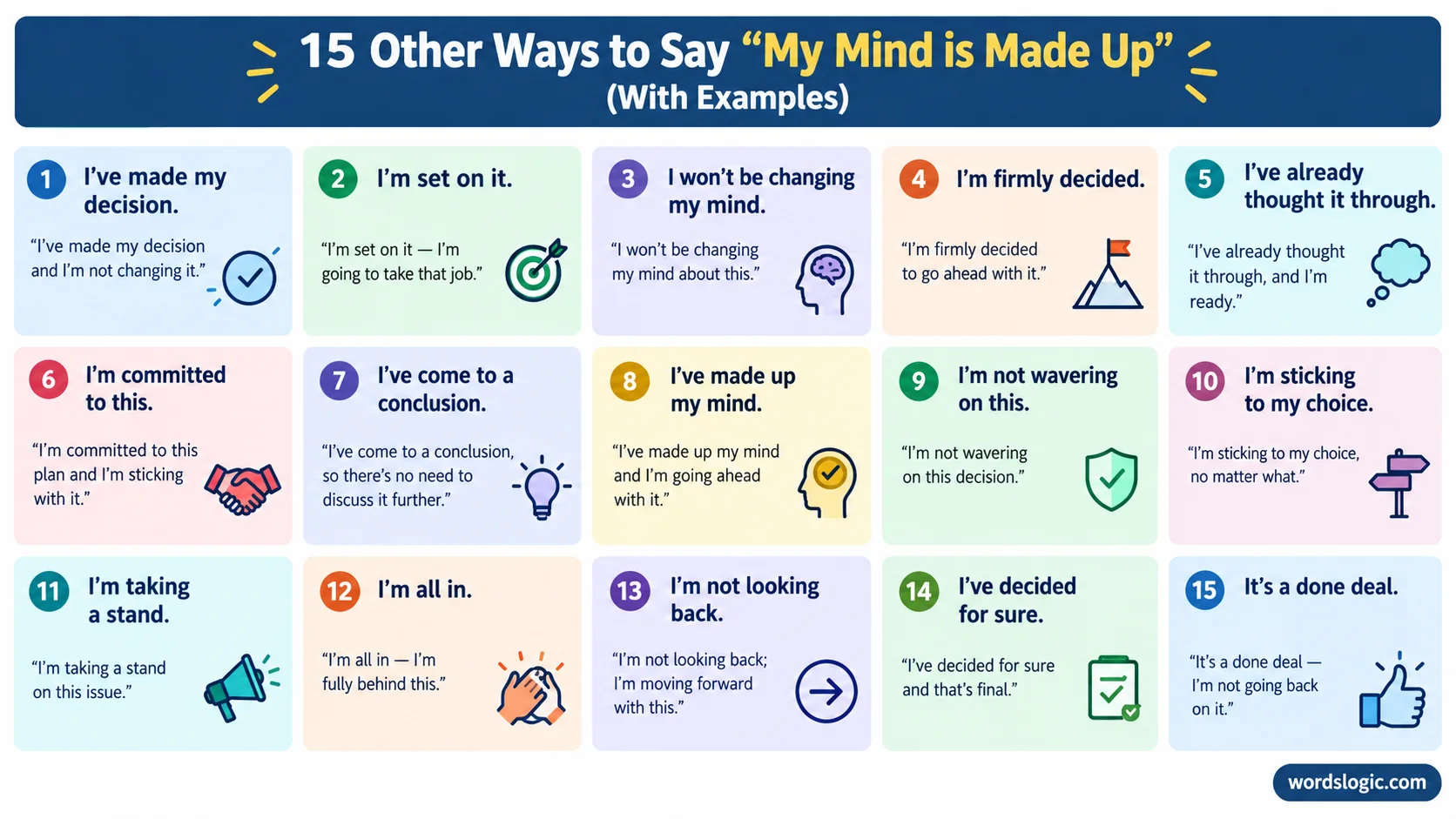
Other Ways to Say “My Mind is Made Up” can express a clear choice after reflection, helping you sound confident, calm, certain, and respectful. When doubt, reflection, and considering each option have led to a clear choice, phrases such as I’m determined, I’ve decided, I’ve reached a decision, and This is what I want can communicate a firm decision with greater clarity and confidence.
Whether the situation is professional, romantic, friendly, or connected to spiritual contexts, these expressions show that you are no longer indecisive. A calm mindset, inner peace, self respect, and steady direction can also help you stand by your choice without creating unnecessary emotions or conflict.
A long discussion, deep thought, or quiet reflection can help you move from uncertainty to a resolved mindset. Once you feel certain, settled, and committed to your final choice, you can explain that you have made your decision and do not plan to change your mind. This can show strong confidence, calm focus, and determination while still leaving room for respect, sympathy, encouragement, and understanding. It can also support setting boundaries, protecting time, maintaining emotional balance, and choosing to follow through when your decision needs action.
What Does “My Mind is Made Up” Mean?
“My mind is made up” means that you have made a decision and do not intend to change it. The phrase communicates certainty and finality after considering a choice, opinion, or course of action. For example, someone might say, “I’m moving to another city, and my mind is made up,” to show that they have decided and are unlikely to reconsider. Depending on the situation and tone, it can sound confident and determined or slightly dismissive if another person is still trying to persuade you.
Common Situations Where “My Mind is Made Up” Is Used
People use “my mind is made up” in everyday conversations, personal decisions, relationships, family discussions, and informal messages. It often appears when someone has been encouraged to reconsider a choice but wants to make clear that the decision is already settled.
It can also appear in workplace conversations when someone has authority to make a decision, although the tone matters. In a formal setting, a phrase such as “I’ve made my decision” may sound more professional. Alternatives are especially useful when you want to communicate the same certainty while sounding firm, respectful, diplomatic, or less confrontational.
Is It Professional or Polite to Say “My Mind is Made Up”?
“My mind is made up” is clear, confident, and fairly informal. It is not inherently rude, but it can sound blunt when used during a disagreement or when someone is offering advice. The phrase strongly emphasizes that the speaker is no longer considering other options.
In professional communication, a more neutral expression such as “I’ve made my decision” or “I’ve decided to move forward with this” may sound more polished. With friends or family, however, “my mind is made up” can be perfectly natural, particularly when the relationship allows for direct communication.
Advantages and Disadvantages of Saying “My Mind is Made Up”
Advantages
The phrase is clear and decisive. It tells the listener that you have considered the matter and reached a conclusion. It can be useful when you need to establish a boundary or stop an ongoing attempt to persuade you. Its conversational style also makes it natural in personal discussions.
Disadvantages
Because it strongly emphasizes finality, it can sometimes sound stubborn, dismissive, or unwilling to listen, especially during an argument. It may also feel too casual for formal workplace writing. If you want to remain firm while leaving the conversation respectful, a more measured alternative may work better.
Synonyms for “My Mind is Made Up”
- I’ve Made My Decision
- I’ve Made Up My Mind
- I’ve Decided
- I’ve Reached My Decision
- My Decision Is Final
- I’m Set on This
- I’m Firm on This
- I’m Determined to Do This
- I’ve Chosen My Path
- I Know What I Want
- I’m Going Through With It
- I’ve Settled on This
- I’m Committed to This Decision
- I Won’t Be Changing My Mind
- I’m Standing by My Decision
1. I’ve Made My Decision
Meaning
“I’ve made my decision” means you have considered your options and have now chosen what you intend to do.
Definition
It is a direct statement that a decision has been reached.
Detailed Explanation
This is one of the most useful alternatives because it communicates finality without sounding unnecessarily emotional. It is slightly more neutral and professional than “my mind is made up.” You can use it when someone is asking you to explain or reconsider a choice. The phrase can still sound firm, but it leaves room for a calmer conversation about the reasons behind the decision.
Scenario Examples
Scenario: A colleague asks whether you are still considering another job offer.
Example: “Thanks for asking, but I’ve made my decision. I’m staying with the current team.”
Scenario: A friend keeps encouraging you to change your travel plans.
Example: “I appreciate your advice, but I’ve made my decision.”
Best Use
Best for workplace communication, personal decisions, disagreements, and serious conversations.
Tone
Tone: Firm, neutral, and professional. It communicates certainty without sounding overly aggressive.
2. I’ve Made Up My Mind
Meaning
“I’ve made up my mind” means you have reached a decision and are no longer undecided.
Definition
It means you have decided what you want to do after considering the options.
Detailed Explanation
This expression is extremely close to “my mind is made up” but uses a more active structure. It sounds natural in everyday English and can emphasize that the decision-making process is complete. It is often used when someone else is trying to persuade you. The phrase can be warm or firm depending on the surrounding conversation.
Scenario Examples
Scenario: Your family is trying to convince you to choose another college.
Example: “I’ve made up my mind. This is the school I want to attend.”
Scenario: A friend asks whether you are going to the event.
Example: “I’ve made up my mind—I’m going.”
Best Use
Best for casual conversation, family discussions, friendships, and personal decisions.
Tone
Tone: Confident, conversational, and decisive. It feels natural in spoken English.
3. I’ve Decided
Meaning
“I’ve decided” simply tells someone that you have reached a conclusion.
Definition
It means you have chosen a particular option or course of action.
Detailed Explanation
This is a short and flexible alternative that avoids emphasizing stubbornness or absolute finality. It can sound firm without suggesting that you are unwilling to discuss the matter. Because it is so concise, the words that follow usually provide the important context. It works equally well in casual and professional situations.
Scenario Examples
Scenario: You are telling your manager about a project approach.
Example: “I’ve decided to use the original proposal.”
Scenario: Your partner asks what you want to do this weekend.
Example: “I’ve decided. Let’s take the day trip.”
Best Use
Best for everyday conversation, workplace communication, emails, and personal decisions.
Tone
Tone: Neutral, clear, and confident. It is less forceful than some alternatives.
4. I’ve Reached My Decision
Meaning
“I’ve reached my decision” means you have completed your consideration and arrived at a conclusion.
Definition
It means you have reached a final or settled conclusion after considering the matter.
Detailed Explanation
This expression has a more formal and deliberate quality than “I’ve decided.” It suggests that some thought or evaluation took place before the conclusion was reached. That makes it particularly useful when communicating an important decision. It does not necessarily sound emotional or defensive.
Scenario Examples
Scenario: A hiring manager has completed an interview process.
Example: “After reviewing the candidates, I’ve reached my decision.”
Scenario: You have spent several days considering a major purchase.
Example: “I’ve reached my decision, and I’m going to buy the smaller model.”
Best Use
Best for professional communication, formal discussions, important personal decisions, and written communication.
Tone
Tone: Thoughtful, formal, and decisive. It suggests careful consideration.
5. My Decision Is Final
Meaning
“My decision is final” means the decision has been made and will not be changed.
Definition
It means there will be no further reconsideration of the decision.
Detailed Explanation
This is a much stronger and more final expression than “I’ve decided.” It is useful when you need to establish a firm boundary or end repeated requests to reconsider. Because it leaves very little room for discussion, it can sound authoritative. Use it carefully when maintaining a positive relationship is important.
Scenario Examples
Scenario: Someone repeatedly asks you to reverse a decision.
Example: “I understand your concerns, but my decision is final.”
Scenario: An organization communicates a settled administrative decision.
Example: “After reviewing the matter, the committee’s decision is final.”
Best Use
Best for formal decisions, firm boundaries, authority-based situations, and serious discussions.
Tone
Tone: Firm, authoritative, and final. It should be used when strong certainty is genuinely intended.
6. I’m Set on This
Meaning
“I’m set on this” means you strongly prefer or intend to follow a particular choice.
Definition
It means you are firmly committed to a particular option or plan.
Detailed Explanation
This expression is more casual and conversational than “my decision is final.” It communicates strong preference without necessarily sounding confrontational. Depending on context, it can mean that you have already decided or simply that you are strongly leaning toward something. It is therefore slightly less absolute than saying your decision cannot change.
Scenario Examples
Scenario: Your friend suggests another restaurant.
Example: “That place looks good, but I’m set on trying the new Italian restaurant.”
Scenario: You have chosen a destination for your vacation.
Example: “I’m set on visiting the coast this summer.”
Best Use
Best for casual conversations, plans, preferences, friendships, and personal choices.
Tone
Tone: Casual, confident, and relaxed. It communicates strong preference without sounding harsh.
7. I’m Firm on This
Meaning
“I’m firm on this” means your position or decision is not easily open to change.
Definition
It means you intend to maintain your position despite disagreement or pressure.
Detailed Explanation
This expression focuses more on steadfastness than simply reaching a decision. It can be useful when discussing a specific boundary, condition, or principle. It sounds more serious than “I’m set on this,” especially during a disagreement. Because it emphasizes firmness, it should be used when you genuinely want to communicate that your position is important.
Scenario Examples
Scenario: You are discussing a condition in a business negotiation.
Example: “I’m flexible on the timeline, but I’m firm on this requirement.”
Scenario: A family member challenges an important personal boundary.
Example: “I understand your point, but I’m firm on this.”
Best Use
Best for boundaries, negotiations, workplace discussions, and serious personal conversations.
Tone
Tone: Firm, serious, and assertive. It signals that the speaker is unlikely to compromise on the specific point.
8. I’m Determined to Do This
Meaning
“I’m determined to do this” communicates a strong intention to follow through with a chosen action.
Definition
It means you are strongly committed to achieving or carrying out something.
Detailed Explanation
Unlike “my mind is made up,” this phrase emphasizes motivation and commitment to action. It suggests that you are not merely decided but prepared to make the decision happen. It works particularly well when discussing goals, plans, or difficult choices. The expression can sound encouraging and purposeful rather than defensive.
Scenario Examples
Scenario: You have decided to learn a new skill.
Example: “I know it will take time, but I’m determined to do this.”
Scenario: You have committed to finishing a difficult project.
Example: “There are challenges ahead, but I’m determined to do this.”
Best Use
Best for personal goals, major plans, motivation, commitments, and conversations about persistence.
Tone
Tone: Strong, motivated, and confident. It emphasizes determination rather than simply finality.
9. I’ve Chosen My Path
Meaning
“I’ve chosen my path” means you have selected the direction you want your life, work, or plans to take.
Definition
It means you have chosen a particular direction or course of action.
Detailed Explanation
This is a more reflective and expressive alternative. It is not appropriate for every ordinary decision because “path” often suggests a meaningful direction rather than a simple choice. It can work beautifully when discussing careers, relationships, personal growth, or major life decisions. The phrase emphasizes personal direction rather than resistance to persuasion.
Scenario Examples
Scenario: Someone has chosen a new career direction.
Example: “I’ve considered several options, but I’ve chosen my path.”
Scenario: A person explains a major personal decision.
Example: “It took me time to get here, but I’ve chosen my path.”
Best Use
Best for personal reflections, life decisions, creative writing, speeches, and meaningful conversations.
Tone
Tone: Reflective, confident, and thoughtful. It gives the decision a sense of personal direction.
10. I Know What I Want
Meaning
“I know what I want” communicates confidence about your preference or desired outcome.
Definition
It means you are clear about what you want and are not confused about your preference.
Detailed Explanation
This phrase does not always mean that a final decision has been made, so it is a softer alternative to “my mind is made up.” It works when the important point is confidence about your preference rather than absolute finality. In personal conversations, it can sound assertive and self-assured. The phrase is particularly useful when discussing choices, relationships, purchases, or goals.
Scenario Examples
Scenario: A friend keeps suggesting different career options.
Example: “I appreciate the suggestions, but I know what I want.”
Scenario: You are choosing between two vacation plans.
Example: “I know what I want. I’d rather spend the week somewhere quiet.”
Best Use
Best for personal decisions, relationships, preferences, goals, and confident everyday communication.
Tone
Tone: Confident, assertive, and personal. It emphasizes self-awareness more than finality.
11. I’m Going Through With It
Meaning
“I’m going through with it” means you intend to carry out a decision or plan that has already been made.
Definition
It means you will proceed with something despite possible doubts or objections.
Detailed Explanation
This expression focuses on action and follow-through rather than the decision-making process itself. It is often used when other people have questioned whether you will proceed. The phrase can carry a sense of determination, especially when the decision involves risk or difficulty. It is generally informal and conversational.
Scenario Examples
Scenario: Your friends are surprised that you are moving to another city.
Example: “I know it’s a big change, but I’m going through with it.”
Scenario: You have decided to make a difficult purchase.
Example: “I’ve thought about the cost, and I’m going through with it.”
Best Use
Best for casual conversations, personal plans, difficult decisions, and situations involving follow-through.
Tone
Tone: Determined, informal, and resolute. It emphasizes action after a decision.
12. I’ve Settled on This
Meaning
“I’ve settled on this” means you have considered several options and chosen one.
Definition
It means you have selected one option after considering alternatives.
Detailed Explanation
This expression highlights the process of choosing among possibilities. It usually sounds less dramatic than “my mind is made up” because it focuses on reaching a practical choice. It is useful for decisions about products, plans, schedules, designs, or other options. It can suggest that the decision is settled without sounding confrontational.
Scenario Examples
Scenario: You are choosing a design for a project.
Example: “I compared the options and settled on this layout.”
Scenario: You are deciding where to eat.
Example: “I’ve settled on this café because it’s close to the office.”
Best Use
Best for practical decisions, work projects, purchases, plans, and everyday choices.
Tone
Tone: Calm, practical, and decisive. It suggests a considered choice rather than an emotional stand.
13. I’m Committed to This Decision
Meaning
“I’m committed to this decision” means you intend to support and follow through with the decision you have made.
Definition
It means you are firmly dedicated to carrying out a chosen course of action.
Detailed Explanation
This phrase is more formal and deliberate than “my mind is made up.” It emphasizes commitment and responsibility, making it particularly useful in professional or serious settings. It can also communicate that you have considered potential difficulties but still intend to continue. Unlike “my decision is final,” it focuses more on your commitment than on shutting down discussion.
Scenario Examples
Scenario: A project leader explains a strategic choice.
Example: “We’ve reviewed the alternatives, and I’m committed to this decision.”
Scenario: Someone discusses a personal change.
Example: “It won’t be easy, but I’m committed to this decision.”
Best Use
Best for workplace communication, leadership, formal discussions, commitments, and serious personal decisions.
Tone
Tone: Professional, confident, and purposeful. It communicates dedication without sounding unnecessarily confrontational.
14. I Won’t Be Changing My Mind
Meaning
“I won’t be changing my mind” directly states that you do not intend to reconsider your decision.
Definition
It means your decision is settled and you do not plan to reverse it.
Detailed Explanation
This is one of the strongest alternatives in the list because it explicitly tells the listener that further persuasion will not work. It is useful when someone repeatedly challenges or questions your choice. However, its directness can sound defensive or confrontational in some conversations. A softer alternative may be better when preserving harmony is more important than emphasizing finality.
Scenario Examples
Scenario: Someone repeatedly pressures you to cancel your plans.
Example: “I appreciate your concern, but I won’t be changing my mind.”
Scenario: You have firmly chosen a career path.
Example: “I’ve thought carefully about this, and I won’t be changing my mind.”
Best Use
Best for firm boundaries, persistent disagreements, personal decisions, and situations requiring clear finality.
Tone
Tone: Very firm, direct, and final. It leaves little room for further persuasion.
15. I’m Standing by My Decision
Meaning
“I’m standing by my decision” means you continue to support the choice you have made.
Definition
It means you are maintaining your decision despite questions, criticism, or pressure.
Detailed Explanation
This phrase emphasizes confidence in a decision after it has been made. It is especially useful when someone challenges your choice or asks whether you regret it. Compared with “I won’t be changing my mind,” it can sound more composed and less confrontational. It is also suitable for professional settings when you need to explain that you continue to support a decision.
Scenario Examples
Scenario: A manager is asked about a decision that received criticism.
Example: “I understand the concerns, but I’m standing by my decision.”
Scenario: A friend questions a personal choice you made.
Example: “I’ve heard what you have to say, but I’m standing by my decision.”
Best Use
Best for workplace discussions, disagreements, personal decisions, leadership situations, and formal responses.
Tone
Tone: Confident, composed, and firm. It communicates conviction without necessarily sounding hostile.
FAQs
What is another way to say “My Mind is Made Up”?
Some natural alternatives include “I’ve made my decision,” “I’ve decided,” “I’ve made up my mind,” and “I’m standing by my decision.” The best expression depends on whether you want to sound casual, professional, firm, or reflective.
What does “My Mind is Made Up” mean?
“My mind is made up” means you have made a decision and do not intend to change it. It usually communicates certainty and finality, particularly when another person is trying to persuade you to reconsider.
Is “My Mind is Made Up” professional?
The phrase is understandable in professional communication, but it is generally conversational rather than formal. In a workplace setting, “I’ve made my decision” or “I’m committed to this decision” may sound more polished.
What is a more polite way to say “My Mind is Made Up”?
“I’ve made my decision” is a polite, neutral choice. If you want to acknowledge another person’s opinion while remaining firm, you could say, “I appreciate your perspective, but I’ve decided to move forward with my original choice.”
Which alternative works best in formal communication?
For formal situations, “I’ve reached my decision,” “I’m committed to this decision,” or “I’m standing by my decision” can work well. They communicate certainty while sounding more measured than “I won’t be changing my mind.”
Conclusion
There are several ways to express the idea behind “My Mind is Made Up,” and each one carries a slightly different tone. “I’ve decided” is simple and neutral, while “I’ve made my decision” works well when you want to sound clear and professional. Stronger expressions such as “My decision is final” and “I won’t be changing my mind” emphasize complete finality. On the other hand, “I’ve settled on this” sounds practical, while “I’m committed to this decision” highlights dedication and follow-through.
The best wording depends on what you want the listener to understand: certainty, determination, confidence, or simply that you have finished considering your options. Choose the expression that matches both your decision and the relationship you have with the person hearing it.