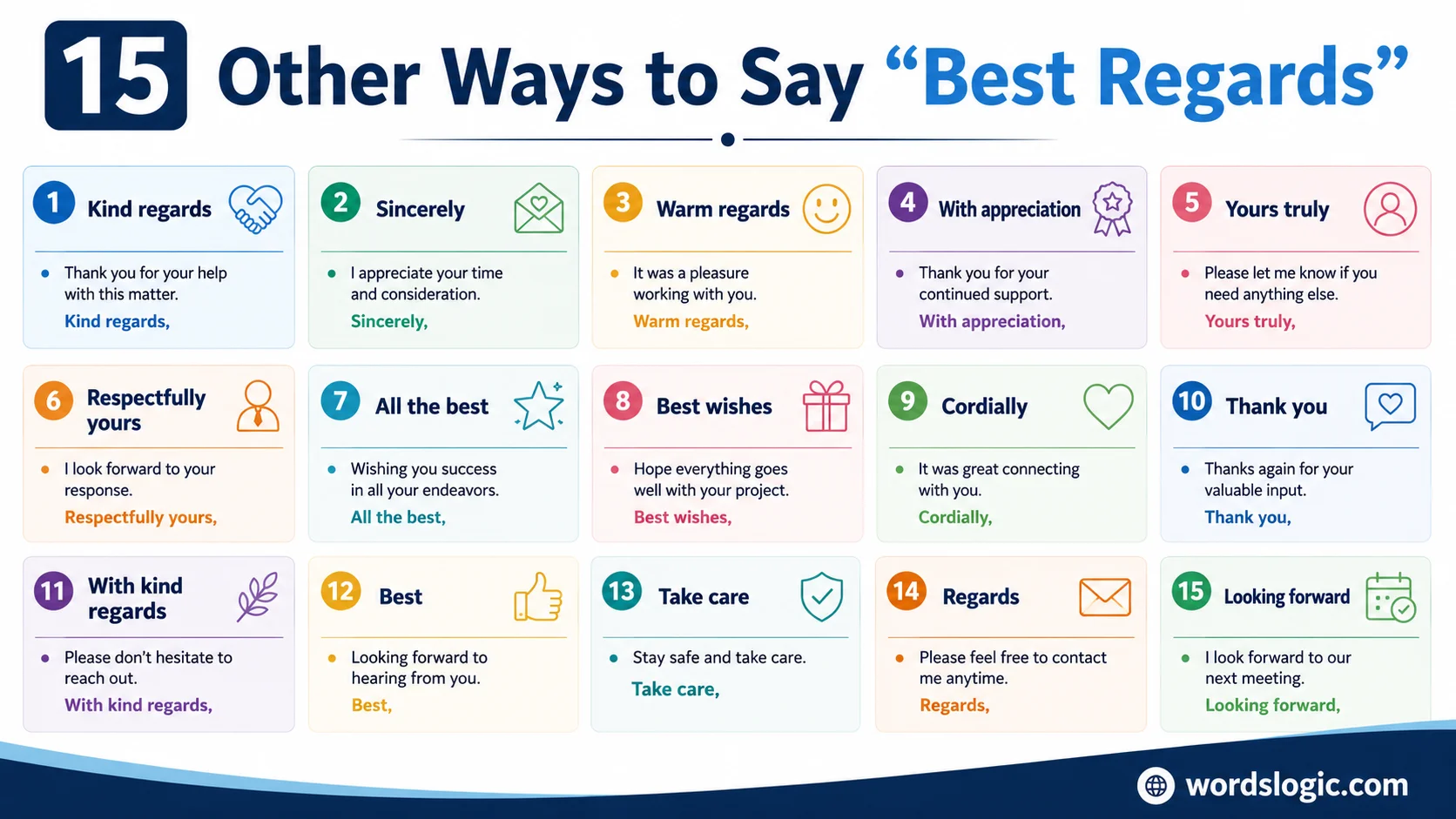
For natural email choices, Other Ways to Say “Best Regards” can help you choose a closing that feels polite, professional, warm, and appropriate. If you’re tired of typing the same email closing at the end of every email, trying different alternatives can make your messages feel less repetitive.
This classic email closing sign off is polite, respectful, and extremely common, but the right alternative often depends on who you’re speaking to, your relationship with the recipient, and the purpose of your message. A friendly email may call for a warmer and more personal closing, while work-related emails may need something more professional or formal.
Choosing the right phrase is an essential communication skill in the business world. The way you end an email can shape how the whole message feels, while your sign, name, and words can show a certain level of respect when signing off.
What Does “Best Regards” Mean?
“Best Regards” is a polite email and letter closing that expresses goodwill toward the recipient. It is commonly used at the end of professional messages, especially when you want to sound respectful, friendly, and professional without being overly formal.
The phrase is generally neutral in tone. It can work when writing to a colleague, client, manager, customer, recruiter, or business contact. It is less personal than a closing such as “Warm Regards” but friendlier than a very formal ending such as “Yours Sincerely.”
Common Situations Where “Best Regards” Is Used
“Best Regards” is frequently used in professional emails, business correspondence, job applications, follow-ups, customer communication, and workplace messages. It can also work when you are communicating with someone you know but want to maintain a professional tone.
You may want an alternative when you are writing to a close colleague, expressing genuine appreciation, making a formal request, or sending a message that calls for a warmer or more personal ending. The right closing can add a small but meaningful touch to your communication.
Is It Professional or Polite to Say “Best Regards”?
Yes. “Best Regards” is professional and polite in most workplace and business settings. It is neither excessively formal nor overly casual, which makes it a flexible choice for everyday professional correspondence.
However, the best closing depends on the relationship and situation. A formal application may call for a more traditional sign-off, while a friendly note to a colleague may sound more natural with a warmer expression. “Best Regards” is a safe neutral option, but it is not the only suitable choice.
Advantages and Disadvantages of Saying “Best Regards”
Advantages
“Best Regards” is polite, professional, and versatile. It works with people you know well and with people you have only recently started communicating with. It also avoids sounding too distant or too familiar, making it useful for routine business emails.
Disadvantages
Because it is so common, “Best Regards” can sometimes feel routine or impersonal, particularly when you want to show strong appreciation or warmth. Repeating the same closing in every email may also make your messages feel formulaic. In a highly formal or highly personal situation, another expression may communicate your intended tone more clearly.
Synonyms for “Best Regards”
- Kind Regards
- Warm Regards
- Regards
- Sincerely
- Yours Sincerely
- With Appreciation
- With Thanks
- Thank You
- All the Best
- Best Wishes
- Warmly
- Respectfully
- Cordially
- Take Care
- Looking Forward to Hearing From You
1. Kind Regards
Meaning
“Kind Regards” is a polite and professional email closing that expresses goodwill while maintaining a respectful distance.
Definition
It means something similar to sending polite or friendly regards to the recipient.
Detailed Explanation
“Kind Regards” is very close in meaning and use to “Best Regards.” It works particularly well in professional correspondence because it sounds courteous without being stiff. It can feel slightly warmer than a bare “Regards.” Choose it when you want a dependable closing for routine workplace or business communication.
Scenario Examples
Scenario: You are following up with a client about a document.
Example: “I’ve attached the revised proposal for your review. Kind Regards, Sarah”
Scenario: You are responding to a colleague you do not know very well.
Example: “Please let me know if you need any additional information. Kind Regards, Daniel”
Best Use
Use it for professional emails, client communication, workplace messages, and business correspondence.
Tone
Tone: Polite, professional, friendly. It maintains courtesy without sounding overly personal.
2. Warm Regards
Meaning
“Warm Regards” adds more warmth and personal goodwill than “Best Regards.”
Definition
It is a professional closing that communicates friendly and sincere goodwill.
Detailed Explanation
This closing works well when you have an established relationship with the recipient. It can make an email feel more personal without becoming informal. Compared with “Best Regards,” it carries a slightly more affectionate or appreciative feeling. It is especially suitable when the conversation has been positive or collaborative.
Scenario Examples
Scenario: You are thanking a long-term business partner.
Example: “Thank you for your continued support. Warm Regards, Michael”
Scenario: You are writing to a colleague after completing a successful project.
Example: “It was a pleasure working with you on this project. Warm Regards, Lisa”
Best Use
Use it in friendly professional emails, relationship-based business communication, and messages to familiar colleagues.
Tone
Tone: Warm, professional, personable. It shows more emotional warmth than a neutral closing.
3. Regards
Meaning
“Regards” is a shorter and more neutral version of “Best Regards.”
Definition
It is a concise email sign-off expressing polite goodwill.
Detailed Explanation
“Regards” is useful when you want to keep your email brief and professional. It does not add much emotional emphasis, so it can suit routine communication. Some readers may find it slightly more abrupt than “Best Regards,” particularly in a friendly conversation. It is best when the message itself already establishes a courteous tone.
Scenario Examples
Scenario: You are sending a routine workplace update.
Example: “The report has been uploaded to the shared folder. Regards, James”
Scenario: You are responding to a straightforward business question.
Example: “The requested figures are included below. Regards, Emma”
Best Use
Use it for brief professional emails, routine updates, and straightforward business communication.
Tone
Tone: Neutral, concise, professional. It keeps the focus on the message rather than the closing.
4. Sincerely
Meaning
“Sincerely” is a traditional and respectful closing used in formal correspondence.
Definition
It expresses genuine respect and goodwill toward the recipient.
Detailed Explanation
“Sincerely” is more formal than “Best Regards” and is common in official letters and formal applications. It can sound somewhat traditional in everyday email, but it remains appropriate when the situation calls for formality. It works especially well when addressing someone in a formal professional context.
Scenario Examples
Scenario: You are submitting a formal application.
Example: “Thank you for considering my application. Sincerely, David Khan”
Scenario: You are writing an official business letter.
Example: “I appreciate your attention to this matter. Sincerely, Maria”
Best Use
Use it for formal letters, applications, official correspondence, and serious professional communication.
Tone
Tone: Formal, respectful, professional. It creates a more traditional impression than “Best Regards.”
5. Yours Sincerely
Meaning
“Yours Sincerely” is a formal letter closing traditionally used when you address the recipient by name.
Definition
It is a conventional sign-off expressing respectful goodwill in formal correspondence.
Detailed Explanation
This expression is especially associated with traditional formal letter writing. In British English, it is commonly used when the letter begins with the recipient’s name, such as “Dear Mr. Ahmed.” It is more formal than “Best Regards” and can feel unnecessarily formal in a casual email. Use it when the format and relationship justify a traditional closing.
Scenario Examples
Scenario: You are writing a formal business letter to a named recipient.
Example: “Thank you for your consideration. Yours Sincerely, Ahmed”
Scenario: You are submitting a formal written request.
Example: “I look forward to your response. Yours Sincerely, Laura”
Best Use
Use it for formal letters, official requests, and traditional business correspondence.
Tone
Tone: Formal, respectful, traditional. It gives the message a conventional letter-writing style.
6. With Appreciation
Meaning
“With Appreciation” expresses gratitude and recognition toward the recipient.
Definition
It is a closing that communicates sincere appreciation.
Detailed Explanation
This expression is useful when the main purpose of your message involves thanking someone. It adds more emotional meaning than “Best Regards” because it directly acknowledges the recipient’s contribution or support. It may feel unusual in a purely routine email where no appreciation is involved. Choose it when gratitude is genuinely part of the message.
Scenario Examples
Scenario: A colleague helped you meet a deadline.
Example: “Thank you for helping me complete the report on time. With Appreciation, James”
Scenario: You are thanking a customer for their patience.
Example: “We appreciate your patience while we resolved the issue. With Appreciation, Customer Support”
Best Use
Use it for thank-you messages, appreciation emails, professional recognition, and supportive correspondence.
Tone
Tone: Appreciative, sincere, professional. The closing makes gratitude the main emotional note.
7. With Thanks
Meaning
“With Thanks” is a concise way to close a message while emphasizing gratitude.
Definition
It means you are sending the message with thanks or appreciation.
Detailed Explanation
This closing is particularly natural when you have asked someone for help or received something useful from them. It is less neutral than “Best Regards” because it specifically communicates thanks. It works well in professional correspondence without becoming overly formal. Make sure the email genuinely involves something you are thankful for.
Scenario Examples
Scenario: A colleague sends you the information you needed.
Example: “I’ve received the figures. With Thanks, Olivia”
Scenario: Someone agrees to assist with your request.
Example: “I appreciate your help with this matter. With Thanks, Daniel”
Best Use
Use it for professional thank-you emails, requests involving assistance, and appreciative workplace messages.
Tone
Tone: Grateful, polite, professional. It gives the closing a clear note of appreciation.
8. Thank You
Meaning
“Thank You” closes an email by directly expressing gratitude.
Definition
It is a simple sign-off that communicates appreciation or thanks.
Detailed Explanation
“Thank You” is especially useful when the recipient is expected to take an action, provide assistance, or respond to your request. It can sound more direct than “Best Regards” because the closing itself carries a specific purpose. In some professional emails, it may be more natural than a generic sign-off. The tone depends heavily on the message that comes before it.
Scenario Examples
Scenario: You are asking a colleague to review a document.
Example: “Could you please review the attached file by Friday? Thank You, Emma”
Scenario: You are asking a customer to provide additional information.
Example: “Please send us your order number so we can assist you. Thank You, Support Team”
Best Use
Use it for requests, assistance, customer communication, and messages where appreciation is relevant.
Tone
Tone: Polite, direct, appreciative. It connects the closing closely to the requested action.
9. All the Best
Meaning
“All the Best” expresses friendly goodwill and positive wishes.
Definition
It is a warm closing that essentially wishes the recipient well in the future.
Detailed Explanation
“All the Best” is more relaxed and personal than “Best Regards.” It can work well with colleagues, acquaintances, clients you know reasonably well, and people you have developed a friendly relationship with. It may feel too casual for highly formal correspondence. Use it when you want your closing to sound natural and personable.
Scenario Examples
Scenario: You are saying goodbye to a colleague who is changing jobs.
Example: “I’ve really enjoyed working with you. All the Best, Mark”
Scenario: You are ending a friendly professional conversation.
Example: “I hope the presentation goes well tomorrow. All the Best, Sarah”
Best Use
Use it for friendly emails, farewell messages, colleagues, and familiar professional contacts.
Tone
Tone: Warm, friendly, relaxed. It feels more personal than a standard business sign-off.
10. Best Wishes
Meaning
“Best Wishes” expresses positive thoughts and goodwill toward the recipient.
Definition
It is a friendly closing that conveys good wishes for the recipient.
Detailed Explanation
This expression is warmer and more personal than a neutral business closing. It works naturally when someone is beginning something new, leaving a workplace, celebrating an occasion, or moving into a new stage of life. It is not always the best choice for highly routine business emails. The context should support the personal goodwill it expresses.
Scenario Examples
Scenario: A colleague is starting a new position.
Example: “Congratulations on your new role. Best Wishes, Hannah”
Scenario: You are responding to someone before an important event.
Example: “I hope everything goes smoothly tomorrow. Best Wishes, Tom”
Best Use
Use it for personal messages, congratulations, farewells, and friendly professional communication.
Tone
Tone: Warm, friendly, encouraging. It communicates positive personal goodwill.
11. Warmly
Meaning
“Warmly” is a personal closing that expresses genuine warmth toward the recipient.
Definition
It is a sign-off that communicates friendly affection or sincere goodwill.
Detailed Explanation
“Warmly” is more personal than “Best Regards” and is usually better suited to people you already know. It can work in professional relationships where there is genuine familiarity, but it may sound too intimate for a first contact or highly formal message. The relationship should guide your choice. When used appropriately, it gives an email a sincere and human feel.
Scenario Examples
Scenario: You are writing to a longtime professional contact.
Example: “Thank you again for all your support over the years. Warmly, Rebecca”
Scenario: You are sending a personal note to a friend.
Example: “It was wonderful hearing from you. Warmly, Alex”
Best Use
Use it for personal correspondence and warm relationships with familiar contacts.
Tone
Tone: Warm, personal, affectionate. It carries more emotional closeness than standard professional closings.
12. Respectfully
Meaning
“Respectfully” emphasizes respect toward the recipient.
Definition
It is a formal closing that communicates courtesy and respect.
Detailed Explanation
“Respectfully” is more formal than “Best Regards” and can be appropriate when addressing someone in a position of authority or writing about a serious matter. It can also sound somewhat solemn, so it is not ideal for every everyday workplace email. Use it when respect and formality are central to the communication. In casual situations, it may feel unnecessarily stiff.
Scenario Examples
Scenario: You are writing a formal request to an organization.
Example: “Thank you for taking the time to consider my request. Respectfully, Ahmed”
Scenario: You are responding to a serious professional matter.
Example: “I appreciate your consideration of these concerns. Respectfully, Maria”
Best Use
Use it for formal requests, serious correspondence, official communication, and situations involving authority.
Tone
Tone: Formal, respectful, serious. It gives the message a noticeably more dignified tone.
13. Cordially
Meaning
“Cordially” is a formal closing that communicates polite friendliness.
Definition
It means in a courteous and friendly manner.
Detailed Explanation
“Cordially” has a traditional business tone and is more formal than most everyday email closings. It can work in invitations, formal correspondence, and professional letters. In modern casual email, it may sound somewhat old-fashioned. Choose it when you intentionally want a polished and formal style.
Scenario Examples
Scenario: You are sending a formal business invitation.
Example: “We hope you can attend the event. Cordially, The Events Team”
Scenario: You are writing a traditional professional letter.
Example: “Thank you for your attention to this matter. Cordially, James”
Best Use
Use it for formal letters, invitations, professional events, and traditional business correspondence.
Tone
Tone: Formal, courteous, traditional. It has a polished style that may feel more formal than everyday email language.
14. Take Care
Meaning
“Take Care” expresses friendly concern for the recipient’s well-being.
Definition
It is a casual closing that means look after yourself or stay well.
Detailed Explanation
“Take Care” is much more personal and casual than “Best Regards.” It works naturally with friends, familiar colleagues, and people with whom you have an informal relationship. It generally does not fit highly formal business communication. Because it carries a personal feeling, it can make a short message sound warmer and more genuine.
Scenario Examples
Scenario: You are ending a casual conversation with a colleague you know well.
Example: “Thanks for catching up today. Take Care, Nina”
Scenario: You are saying goodbye to a friend.
Example: “I’ll talk to you soon. Take Care, Sam”
Best Use
Use it for friends, familiar colleagues, personal emails, and casual messages.
Tone
Tone: Casual, caring, friendly. It expresses personal goodwill rather than formal professionalism.
15. Looking Forward to Hearing From You
Meaning
“Looking Forward to Hearing From You” expresses anticipation of a reply or continued communication.
Definition
It is a professional closing that indicates you expect or welcome a response.
Detailed Explanation
Unlike “Best Regards,” this expression has a specific purpose: it connects the closing to the next step in the conversation. It is useful after making a request, asking a question, or sending information that requires a response. It should not be used as a generic closing when no reply is expected. The wording can also be adjusted depending on how formal or direct you want to sound.
Scenario Examples
Scenario: You have sent a proposal and need the client’s feedback.
Example: “Please let me know if you have any questions. I look forward to hearing from you.”
Scenario: You have applied for an opportunity and are awaiting a response.
Example: “Thank you for considering my application. I look forward to hearing from you.”
Best Use
Use it for professional emails, applications, proposals, requests, and follow-ups where a response is expected.
Tone
Tone: Professional, courteous, expectant. It encourages continued communication without being overly forceful.
FAQs
What is another way to say “Best Regards”?
Common alternatives include “Kind Regards,” “Warm Regards,” “Regards,” “Sincerely,” and “All the Best.” The best choice depends on the relationship, level of formality, and purpose of the message.
What does “Best Regards” mean?
“Best Regards” is a polite email closing that expresses goodwill and respect. It is widely used in professional communication because it sounds friendly without being overly personal.
Is “Best Regards” professional?
Yes. “Best Regards” is generally professional and polite. It is suitable for many workplace, business, client, and customer emails.
What is a warmer way to say “Best Regards”?
“Warm Regards,” “Warmly,” and “All the Best” can feel warmer and more personal. Your relationship with the recipient should determine whether that additional warmth is appropriate.
Which alternative works best in formal communication?
For highly formal communication, “Sincerely,” “Yours Sincerely,” or “Respectfully” may fit better than “Best Regards.” The appropriate choice also depends on the type of correspondence and the relationship between the writer and recipient.
Conclusion
“Best Regards” remains a useful and professional email closing, but it does not have to be your only choice. Small changes in wording can make a message feel warmer, more appreciative, more formal, or more personal. “Kind Regards” works well for routine professional emails, while “Warm Regards” adds friendliness.
“Sincerely” suits formal correspondence, and “With Thanks” makes gratitude more obvious. For casual communication, expressions such as “All the Best” or “Take Care” may feel more natural. The important thing is to match your closing with the relationship, purpose, and tone of the message. Choose the expression that says what you actually want the reader to feel—not simply the one you use out of habit.













