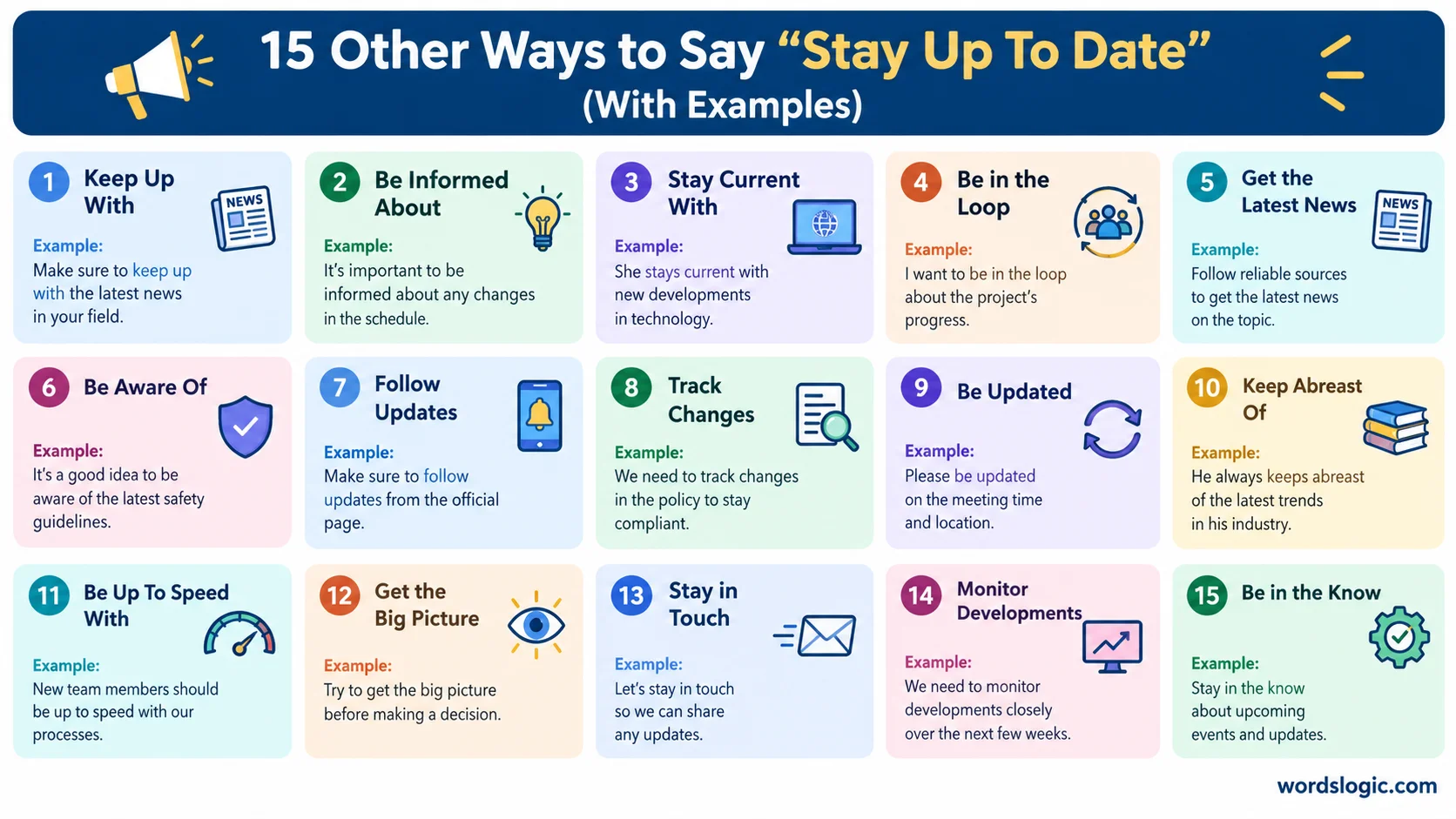
For Other Ways to Say “Stay Up To Date”, clear communication helps professionals use alternatives with a better tone in work. In a professional journey, different phrases and thoughtful expressions can make emails, reports, and meetings more engaging and effective. Instead of repeating stay up to date, you can share information with colleagues and clients through flexible language, clearer updates, and wording that avoids repetition while creating a stronger impact through professionalism and care.
A fresh, relevant, and competitive approach may use stay informed, keeping up, current events, trends, developments, industry updates, and information from your field. These expressions help people follow recent information, latest information, and updated knowledge, supporting better decisions, productivity, and saves time when changes and new challenges arise. Through deep research, written English, notes, reflection, real-world practice, a personal database, and a knowledge base, continuous learning becomes easier, while innovation, progress, professional awareness, an awareness mindset, and growth become part of regular work.
Over the years, I have built practical experience through research, consistent efforts, and learning habits that support the learning process, continuous learning, and adapting to change.
What Does “Stay Up To Date” Mean?
“Stay up to date” means to keep yourself informed about the latest information, changes, developments, or events related to a particular subject. It suggests that you regularly check new information so your knowledge does not become outdated.
For example, if someone says, “Stay up to date with company policies,” they mean that you should keep checking for changes to those policies. The phrase can apply to many areas, including current events, work, technology, education, regulations, and personal interests.
Common Situations Where “Stay Up To Date” Is Used
“Stay up to date” is commonly used when discussing news, workplace information, industry trends, technology, rules, schedules, and changing circumstances. You might tell a colleague to stay up to date with a project, encourage a student to stay informed about a subject, or remind readers to follow the latest developments.
An alternative can be useful when you want to make the wording more specific. For example, “keep informed” emphasizes knowledge, while “keep abreast of” has a more formal business tone. “Follow the latest developments” works particularly well when discussing an evolving topic.
Is It Professional or Polite to Say “Stay Up To Date”?
Yes. “Stay up to date” is professional, neutral, and polite in most contexts. It works naturally in workplace emails, instructions, educational material, websites, and everyday conversations.
The phrase itself is not overly formal, so you may choose a different expression when writing highly formal or specialized content. For example, “keep abreast of” can sound more formal, while “keep in the loop” is more conversational and usually refers to information that directly affects a person or group.
Advantages and Disadvantages of Saying “Stay Up To Date”
Advantages
“Stay up to date” is clear, familiar, and versatile. Most English speakers understand it immediately, and it works across professional, educational, personal, and digital contexts. It can also refer to both actively checking information and generally maintaining current knowledge.
Disadvantages
Because the phrase is so common, it can sometimes feel generic or repetitive, especially in professional writing. It may also be less precise than an alternative that explains exactly what the reader should do, such as “monitor the latest updates” or “follow the latest developments.”
Synonyms for “Stay Up To Date”
- Stay Informed
- Keep Up to Date
- Keep Informed
- Keep Up With the Latest
- Keep Abreast of
- Stay Current
- Keep Current
- Keep in the Loop
- Stay in the Know
- Follow the Latest Developments
- Monitor the Latest Updates
- Keep Track of the Latest Changes
- Remain Informed
- Stay on Top of Things
- Keep Yourself Updated
1. Stay Informed
Meaning
“Stay informed” means to continue learning about the latest information concerning a particular subject.
Definition
To stay informed means to keep yourself aware of relevant facts, news, changes, or developments.
Detailed Explanation
“Stay informed” is one of the closest natural alternatives to “stay up to date.” It focuses particularly on having current knowledge rather than simply checking for updates. The expression works well in both professional and everyday communication. It is also useful when discussing news, policies, public information, or important developments.
Scenario Examples
Scenario: A company wants employees to know about policy changes.
Example: “Please stay informed about any updates to our workplace policies.”
Scenario: You are encouraging a friend to follow an important issue.
Example: “It’s worth staying informed about the latest changes.”
Best Use
Use it for professional communication, news, education, public information, and general advice.
Tone
Tone: Professional, neutral, informative. It emphasizes awareness and knowledge.
2. Keep Up to Date
Meaning
“Keep up to date” means to continue maintaining current knowledge or information.
Definition
It means to remain current by learning about new information or changes.
Detailed Explanation
“Keep up to date” is extremely close in meaning to “stay up to date.” The two expressions can often be used interchangeably. “Keep” emphasizes the ongoing effort to remain current. It is natural in both spoken and written English and works well with subjects such as technology, records, policies, and professional knowledge.
Scenario Examples
Scenario: A manager reminds employees to check new procedures.
Example: “Make sure you keep up to date with the latest procedures.”
Scenario: You are talking about professional development.
Example: “I try to keep up to date with developments in my field.”
Best Use
Use it for work, education, technology, professional development, and everyday communication.
Tone
Tone: Neutral, practical, professional. It clearly communicates the idea of maintaining current knowledge.
3. Keep Informed
Meaning
“Keep informed” means to continue receiving or seeking information about something.
Definition
It means to remain aware of relevant information or developments.
Detailed Explanation
“Keep informed” places more emphasis on continuing awareness. It is useful when people are expected to receive updates or actively seek information. The phrase can sound slightly more formal than “stay informed,” particularly in written communication. It works well when discussing policies, projects, decisions, or ongoing situations.
Scenario Examples
Scenario: A team is waiting for project updates.
Example: “We’ll keep everyone informed as the project progresses.”
Scenario: You want customers to know about service changes.
Example: “Please keep informed about any changes to our opening hours.”
Best Use
Use it for business communication, announcements, project updates, customer messages, and formal writing.
Tone
Tone: Professional, informative, slightly formal. It emphasizes continued communication and awareness.
4. Keep Up With the Latest
Meaning
“Keep up with the latest” means to remain aware of the newest information or developments.
Definition
It means to follow what is new or recently changed in a particular area.
Detailed Explanation
This expression is conversational and flexible. It can refer to news, trends, technology, entertainment, fashion, or developments in a professional field. Unlike “stay informed,” it often has a stronger sense of actively following what is new. It works especially well in friendly or promotional writing.
Scenario Examples
Scenario: A website publishes technology news.
Example: “Follow our newsletter to keep up with the latest in technology.”
Scenario: Friends are discussing a television series.
Example: “I haven’t had time to keep up with the latest.”
Best Use
Use it for casual conversation, websites, newsletters, technology, entertainment, and trend-related topics.
Tone
Tone: Casual, current, engaging. It sounds more conversational than “keep informed.”
5. Keep Abreast of
Meaning
“Keep abreast of” means to remain fully informed about something that is changing or developing.
Definition
It means to maintain current knowledge of important developments.
Detailed Explanation
This is a more formal expression than “stay up to date.” It is commonly used in professional, academic, and business writing. Because “abreast” is less common in everyday speech, the phrase can sound somewhat formal or traditional. It is particularly useful when discussing regulations, industry developments, research, or professional responsibilities.
Scenario Examples
Scenario: A lawyer needs to follow changes in regulations.
Example: “Attorneys must keep abreast of changes in the law.”
Scenario: A professional wants to follow developments in their field.
Example: “She regularly attends conferences to keep abreast of industry developments.”
Best Use
Use it for formal writing, professional communication, academic contexts, regulations, and industry developments.
Tone
Tone: Formal, professional, informed. It conveys a strong emphasis on maintaining current knowledge.
6. Stay Current
Meaning
“Stay current” means to maintain knowledge that reflects the latest information or standards.
Definition
It means to remain knowledgeable about recent developments or practices.
Detailed Explanation
“Stay current” is concise and especially common in professional and educational settings. It can refer to knowledge, skills, technology, research, or industry practices. Compared with “stay up to date,” it can sound slightly more polished and compact. It is particularly useful when discussing professional competence.
Scenario Examples
Scenario: A teacher follows new educational methods.
Example: “Teachers need to stay current with changes in education.”
Scenario: A software developer follows new technologies.
Example: “I take online courses to stay current in my field.”
Best Use
Use it for professional development, education, technology, research, and specialized knowledge.
Tone
Tone: Professional, concise, modern. It suggests maintaining relevant and current knowledge.
7. Keep Current
Meaning
“Keep current” means to maintain information or knowledge that reflects the latest situation.
Definition
It means to remain current rather than becoming outdated.
Detailed Explanation
“Keep current” is often used when talking about records, information, skills, or professional knowledge. It can sound slightly more formal and less conversational than “stay up to date.” The phrase is especially useful when something needs to be regularly maintained. It can also describe keeping documents or records current.
Scenario Examples
Scenario: Employees need to maintain accurate records.
Example: “Please keep your contact information current.”
Scenario: A professional maintains their knowledge.
Example: “She takes regular training courses to keep her skills current.”
Best Use
Use it for records, professional skills, workplace procedures, education, and technical contexts.
Tone
Tone: Professional, practical, precise. It emphasizes maintaining something in a current state.
8. Keep in the Loop
Meaning
“Keep in the loop” means to continue giving someone relevant information about an ongoing situation.
Definition
It means to keep someone informed and involved in communication.
Detailed Explanation
This expression is different from “stay up to date” because it usually involves another person keeping you informed rather than simply monitoring information yourself. It is common in workplaces and team environments. The phrase is informal but widely understood. It is especially useful when someone needs updates about a project or decision.
Scenario Examples
Scenario: A manager wants a colleague to receive project updates.
Example: “Please keep me in the loop about any changes to the schedule.”
Scenario: A team member wants to know what happens next.
Example: “Keep us in the loop if the client changes their requirements.”
Best Use
Use it for workplace communication, teamwork, projects, emails, and informal professional conversations.
Tone
Tone: Friendly, conversational, collaborative. It emphasizes communication and involvement.
9. Stay in the Know
Meaning
“Stay in the know” means to remain aware of what is happening or what is currently known.
Definition
It means to keep informed about the latest news or developments.
Detailed Explanation
“Stay in the know” is an informal and friendly expression. It often suggests knowing about information that may not be immediately obvious to everyone. It works well in conversation, newsletters, social media, and marketing copy. It is generally less suitable for highly formal writing.
Scenario Examples
Scenario: A website encourages readers to receive updates.
Example: “Subscribe to our newsletter to stay in the know.”
Scenario: Friends want to hear about plans.
Example: “Keep me in the know if anything changes.”
Best Use
Use it for casual conversation, newsletters, social media, marketing, and friendly messages.
Tone
Tone: Casual, friendly, engaging. It has a relaxed and conversational feel.
10. Follow the Latest Developments
Meaning
“Follow the latest developments” means to monitor how a situation or subject is changing.
Definition
It means to pay attention to new information and changes as they occur.
Detailed Explanation
This expression is particularly useful when a subject is actively evolving. It is common in news, business, science, technology, politics, and other areas where developments occur over time. It focuses on following a process rather than simply maintaining general knowledge. The phrase sounds professional without being excessively formal.
Scenario Examples
Scenario: A company is monitoring changes in an industry.
Example: “We’re following the latest developments in artificial intelligence.”
Scenario: A news reader wants to track an ongoing event.
Example: “Check back regularly to follow the latest developments.”
Best Use
Use it for news, business, science, technology, research, and evolving situations.
Tone
Tone: Professional, informative, current. It emphasizes active attention to new developments.
11. Monitor the Latest Updates
Meaning
“Monitor the latest updates” means to regularly check for new information.
Definition
It means to watch for and review new updates as they become available.
Detailed Explanation
This phrase is more action-oriented than “stay up to date.” It suggests that someone should actively check a source, system, project, or communication channel. It is especially useful in workplace, technical, customer service, and project-management contexts. Because “monitor” implies deliberate observation, it can sound more precise than a general reminder to stay informed.
Scenario Examples
Scenario: A project team expects schedule changes.
Example: “Please monitor the latest updates to the project timeline.”
Scenario: A customer is waiting for a delivery.
Example: “Monitor the latest updates through your tracking page.”
Best Use
Use it for workplace instructions, technical systems, projects, customer communication, and operational updates.
Tone
Tone: Professional, precise, action-oriented. It clearly suggests actively checking for new information.
12. Keep Track of the Latest Changes
Meaning
“Keep track of the latest changes” means to pay attention to changes and remember or record them.
Definition
It means to monitor changes so that you know what has been updated.
Detailed Explanation
This phrase is useful when changes happen repeatedly and it is important not to miss them. Unlike “stay informed,” it emphasizes tracking specific changes rather than general awareness. It works well in workplace, administrative, technical, and organizational contexts. The wording can be adapted to different subjects, such as schedules, policies, prices, or project requirements.
Scenario Examples
Scenario: A team is managing changing project requirements.
Example: “Please keep track of the latest changes to the project specifications.”
Scenario: An employee monitors company procedures.
Example: “Make sure you keep track of the latest changes to the policy.”
Best Use
Use it for projects, policies, schedules, procedures, records, and administrative work.
Tone
Tone: Practical, professional, precise. It emphasizes awareness of specific changes.
13. Remain Informed
Meaning
“Remain informed” means to continue being aware of relevant information.
Definition
It means to continue maintaining current knowledge about a subject.
Detailed Explanation
“Remain informed” is more formal than “stay informed.” It works well when writing instructions, formal guidance, policies, or educational material. The expression emphasizes an ongoing state of awareness rather than the action of checking for updates. It can sound somewhat formal in casual conversation, so simpler wording may be preferable there.
Scenario Examples
Scenario: An organization gives employees guidance.
Example: “Employees should remain informed about changes to company policies.”
Scenario: A professional follows regulatory information.
Example: “Professionals must remain informed about relevant requirements.”
Best Use
Use it for formal writing, workplace policies, official communication, and professional guidance.
Tone
Tone: Formal, professional, authoritative. It emphasizes an ongoing responsibility to remain informed.
14. Stay on Top of Things
Meaning
“Stay on top of things” means to remain aware of what needs attention and deal with it effectively.
Definition
It means to keep informed, organized, and in control of ongoing matters.
Detailed Explanation
This expression is broader than “stay up to date.” It does not only mean knowing new information; it can also suggest keeping up with tasks, responsibilities, deadlines, and changes. It is common in everyday and workplace English. Because it is idiomatic, it is generally better suited to conversational or moderately informal communication.
Scenario Examples
Scenario: A colleague has several projects to manage.
Example: “I use a task list to stay on top of things.”
Scenario: A manager wants the team to handle changes promptly.
Example: “Let’s stay on top of things as the project moves forward.”
Best Use
Use it for workplace conversations, personal organization, project management, and everyday speech.
Tone
Tone: Casual, practical, proactive. It suggests both awareness and effective management.
15. Keep Yourself Updated
Meaning
“Keep yourself updated” means to actively make sure you know about recent information or changes.
Definition
It means to regularly check and learn about new information.
Detailed Explanation
This expression puts responsibility on the person receiving the information. It is understandable and useful, especially in instructions or workplace communication. In some contexts, “keep yourself up to date” sounds more idiomatic than simply “keep yourself updated.” The phrase works best when people are expected to actively check information themselves.
Scenario Examples
Scenario: Employees need to check new company announcements.
Example: “Please keep yourself updated on any changes to the schedule.”
Scenario: A student follows course announcements.
Example: “Keep yourself updated by checking the class portal regularly.”
Best Use
Use it for instructions, workplace communication, education, websites, and information that changes regularly.
Tone
Tone: Practical, direct, informative. It emphasizes personal responsibility for remaining informed.
FAQs
What is another way to say “Stay Up To Date”?
Common alternatives include “Stay Informed,” “Keep Up to Date,” “Stay Current,” “Keep Abreast of,” and “Follow the Latest Developments.” The best choice depends on the subject and level of formality.
What does “Stay Up To Date” mean?
“Stay up to date” means to keep your knowledge current by remaining aware of new information, changes, or developments.
Is “Stay Up To Date” professional?
Yes. “Stay up to date” is professional, neutral, and widely accepted. It works in workplace emails, instructions, reports, educational writing, and everyday communication.
What is a more formal way to say “Stay Up To Date”?
“Keep abreast of” and “remain informed” are more formal alternatives. They are particularly useful in professional, academic, and official writing.
What is a casual way to say “Stay Up To Date”?
“Stay in the know” and “keep up with the latest” are more conversational alternatives. “Keep in the loop” is also common when someone needs to receive updates about a particular situation.
Conclusion
“Stay up to date” is a clear and versatile expression, but the best alternative depends on what you want to emphasize. “Stay informed” focuses on knowledge, while “monitor the latest updates” suggests actively checking new information. For formal writing, “keep abreast of” or “remain informed” can work well. In a workplace conversation, “keep in the loop” may sound more natural when someone needs regular updates.
If you’re talking about an evolving subject, “follow the latest developments” is precise and useful. Choosing the right expression helps you communicate whether you mean general awareness, active monitoring, professional knowledge, or simply keeping track of changes. The goal is not to use the most sophisticated phrase, but the one that fits your context, audience, and intended meaning.













