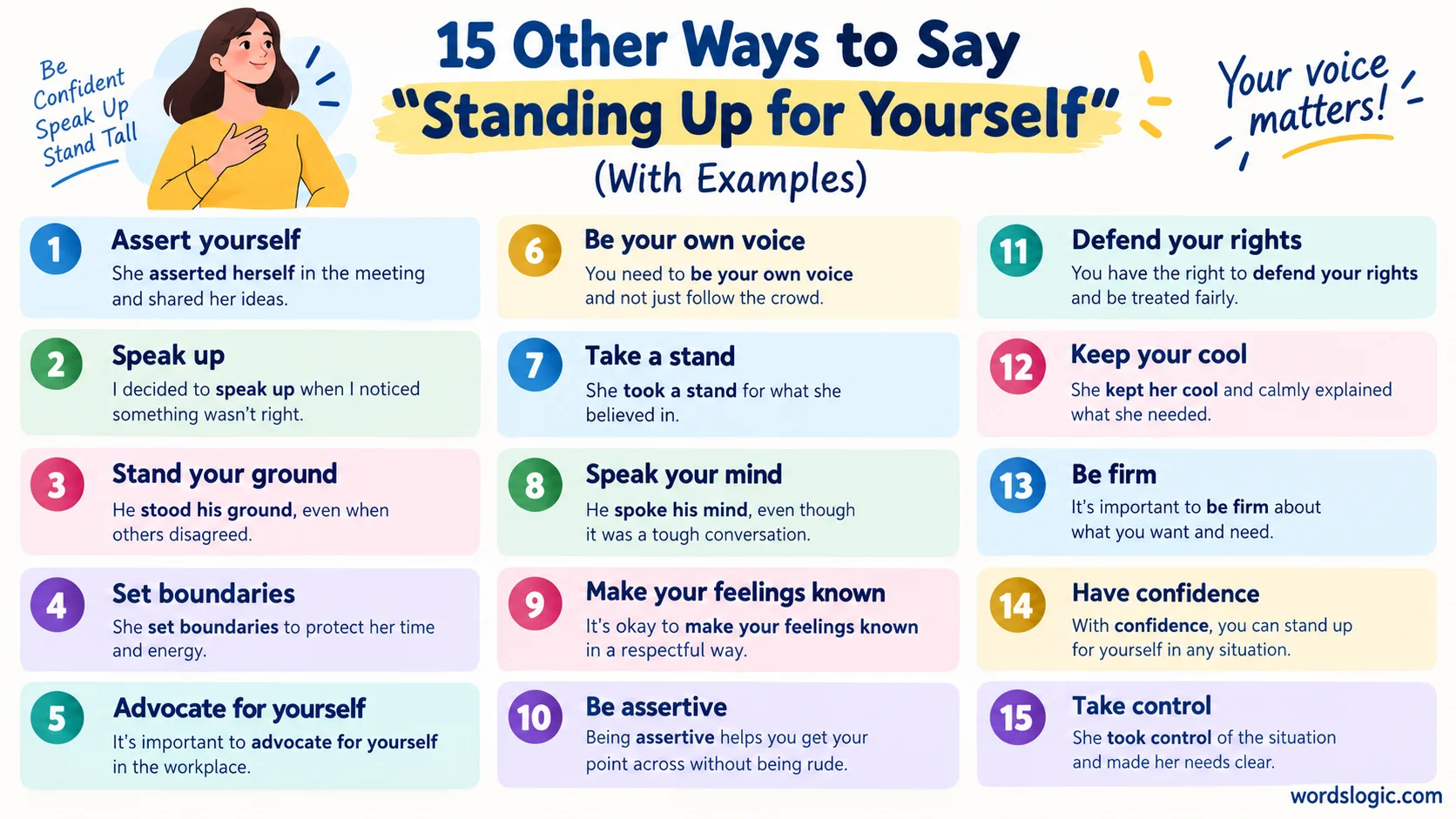
Other Ways to Say “Standing Up for Yourself” can help you express your needs, protect your rights, and communicate with confidence without sounding aggressive. Learning phrases such as assert yourself, speak up, stand your ground, set boundaries, and advocate for yourself makes it easier to share your opinions, beliefs, and desires. In everyday conversations, at work, at school, or at home, the right word choice can make a difficult discussion clearer and more respectful.
These expressions support self-advocacy, self-confidence, self-respect, and personal dignity while helping you explain your position naturally. Exploring natural alternatives, their meaning, usage, and practical examples can also improve your communication skills, vocabulary development, and everyday English.
Standing up for yourself means expressing boundaries, asserting needs, saying no, and resisting unfair treatment while treating others with respect.
What Does “Standing Up for Yourself” Mean?
Standing up for yourself means speaking up for your rights, needs, opinions, or personal boundaries when you feel ignored, mistreated, or unfairly treated. It involves expressing what you believe, asking for fair treatment, and refusing to accept behavior that crosses your limits. The phrase often communicates self-respect, confidence, and courage.
Standing up for yourself does not mean arguing with everyone or trying to control other people’s behavior. It can be as simple as saying no to an unreasonable request, correcting a misunderstanding, asking a colleague to treat you respectfully, or explaining why a decision feels unfair. The goal is to protect your dignity while communicating clearly. Depending on the situation, it may involve assertiveness, setting boundaries, defending your rights, or speaking your mind.
Common Situations Where “Standing Up for Yourself” Is Used
People use this expression in everyday conversations when discussing confidence, difficult interactions, and personal independence.
- Everyday conversations: Describing someone who finally expresses an opinion instead of staying silent.
- Relationships: Explaining personal needs, addressing disrespect, or setting healthy boundaries with a partner or friend.
- Workplace communication: Responding to unfair criticism, asking for appropriate recognition, or challenging an unreasonable request.
- School and education: Encouraging students to speak up about bullying, unfair treatment, or disagreements.
- Family discussions: Communicating personal choices when relatives have different expectations.
- Text messages and social media: Sharing encouragement about self-respect, confidence, and personal boundaries.
- Formal communication: Explaining how someone addressed a concern or advocated for fair treatment.
The wording can change depending on the situation. Asserting yourself may sound appropriate in a professional setting, while defending your boundaries may fit a personal conversation more naturally.
Is It Professional or Polite to Say “Standing Up for Yourself”?
Yes, standing up for yourself is a natural, polite expression when used in the right context. It is common in everyday English and can also appear in workplace discussions, educational writing, and conversations about leadership or communication. The phrase generally sounds supportive and confident rather than rude.
However, the way someone stands up for themselves matters. Calmly explaining a concern is different from insulting someone or raising your voice to win an argument. In professional communication, asserting yourself or advocating for yourself may sound more precise and polished. In personal relationships, setting boundaries can communicate your needs without suggesting confrontation. The best expression depends on whether you want to emphasize confidence, fairness, self-protection, or respectful disagreement.
Advantages and Disadvantages of Saying “Standing Up for Yourself”
Advantages
- Clear meaning: The phrase communicates that someone is protecting their rights, needs, or dignity.
- Positive message: It encourages confidence and self-respect.
- Versatile usage: It works in personal conversations, workplace discussions, motivational writing, and relationship advice.
- Easy to understand: The wording is familiar and accessible to English learners.
- Encourages healthy boundaries: It can remind people that respectful disagreement and saying no are acceptable.
Disadvantages
- Can sound confrontational: In a tense situation, some listeners may interpret the phrase as preparing for an argument.
- Lacks specificity: It does not explain whether someone is expressing an opinion, refusing a request, or addressing unfair treatment.
- May sound informal: More precise expressions can be better suited to professional reports or formal writing.
- Does not explain the approach: Standing up for yourself can involve calm communication or an aggressive response, so additional context may be necessary.
Synonyms for “Standing Up for Yourself”
- Asserting Yourself
- Speaking Up for Yourself
- Defending Your Boundaries
- Advocating for Yourself
- Standing Your Ground
- Speaking Your Mind
- Standing Up for Your Rights
- Being Assertive
- Protecting Your Self-Respect
- Refusing to Be Pushed Around
- Setting Healthy Boundaries
- Defending Your Position
- Finding Your Voice
- Demanding Respect
- Taking a Stand for Yourself
1. Asserting Yourself
Meaning
Asserting yourself means expressing your needs, opinions, or expectations confidently and clearly. It emphasizes communicating what matters to you without unnecessarily attacking or dismissing others.
Definition
Asserting yourself is expressing your views and needs in a confident, direct, and respectful manner.
Detailed Explanation
This is one of the closest alternatives to standing up for yourself, particularly when communication is the main focus. It suggests being clear about what you want while remaining willing to listen to other people. Unlike aggressive behavior, healthy self-assertion does not require intimidation or hostility. It is especially useful when you want to describe confidence in a professional or personal situation.
Scenario Examples
Scenario: A colleague repeatedly interrupts you during meetings.
Example: “I’m learning to assert myself and finish explaining my ideas before responding to questions.”
Scenario: A friend keeps asking for favors when you are busy.
Example: “You can assert yourself by explaining that you don’t have time to help today.”
Scenario: An employee discusses communication skills with a manager.
Example: “I’ve become better at asserting myself when discussing project responsibilities.”
Best Use
Use this expression in workplace communication, personal development, leadership discussions, and situations requiring confident but respectful communication.
Tone
Tone: Confident, professional, respectful.
It emphasizes clear communication rather than confrontation.
2. Speaking Up for Yourself
Meaning
Speaking up for yourself means expressing your concerns, opinions, or needs instead of remaining silent when something matters to you.
Definition
Speaking up for yourself is using your voice to communicate your perspective or address a concern.
Detailed Explanation
This expression feels natural in everyday conversation and is particularly useful when someone has previously stayed quiet. It can describe asking a question, correcting misinformation, objecting to unfair treatment, or explaining how a situation affects you. Compared with asserting yourself, it places more emphasis on actually saying something when you might otherwise remain silent. It does not necessarily mean disagreeing; sometimes it simply means making sure your perspective is heard.
Scenario Examples
Scenario: A student is uncomfortable with a classmate’s repeated jokes.
Example: “I finally spoke up for myself and explained that those comments weren’t funny to me.”
Scenario: A friend feels overlooked during group decisions.
Example: “You deserve to speak up for yourself instead of agreeing with everything.”
Scenario: An employee notices an error in a discussion.
Example: “She spoke up for herself when her contribution was mistakenly credited to someone else.”
Best Use
Choose this phrase for casual conversation, encouraging messages, school situations, workplace discussions, and personal relationships.
Tone
Tone: Encouraging, direct, approachable.
It highlights the courage to express yourself when staying silent feels easier.
3. Defending Your Boundaries
Meaning
Defending your boundaries means protecting the personal limits you have established around your time, privacy, comfort, or emotional well-being.
Definition
Defending your boundaries is communicating and maintaining limits on what you are willing to accept.
Detailed Explanation
This expression is particularly useful when someone ignores a clearly communicated limit. For example, you may need to protect your personal time, refuse unwanted questions, or ask someone to stop making inappropriate comments. Unlike the broader phrase standing up for yourself, it focuses specifically on what is acceptable to you. Defending your boundaries does not require the other person to agree with them; it involves communicating your limits and deciding how you will respond if they are ignored.
Scenario Examples
Scenario: A relative repeatedly asks personal questions.
Example: “I’m defending my boundaries by explaining that I’d rather keep that part of my life private.”
Scenario: A colleague regularly contacts you outside agreed working hours.
Example: “I need to defend my boundaries so that my personal time remains protected.”
Scenario: A friend continues teasing you after you ask them to stop.
Example: “You can defend your boundaries without insulting your friend.”
Best Use
Use it in relationship discussions, personal messages, workplace conversations, and writing about privacy or emotional well-being.
Tone
Tone: Firm, self-protective, respectful.
It communicates that your limits matter and should be taken seriously.
4. Advocating for Yourself
Meaning
Advocating for yourself means actively communicating your needs, interests, or rights to obtain fair treatment or appropriate support.
Definition
Self-advocacy is speaking and acting on your own behalf to explain what you need or believe you deserve.
Detailed Explanation
Advocating for yourself is especially suitable when a situation involves decisions, opportunities, services, or resources. You might explain why you deserve consideration for a promotion, request an adjustment at school, or ask a service provider to address a problem. The phrase sounds more formal and purposeful than standing up for yourself because it often involves explaining your needs and seeking a practical outcome. It can also suggest preparation, such as gathering information before making your case.
Scenario Examples
Scenario: An employee discusses a promotion with a supervisor.
Example: “I’m learning to advocate for myself by clearly explaining my contributions to the team.”
Scenario: A student needs additional support with an assignment.
Example: “He advocated for himself by explaining what support would help him succeed.”
Scenario: A customer receives an incorrect bill.
Example: “She advocated for herself and requested a review of the charges.”
Best Use
Choose this phrase for professional communication, education, customer service, negotiations, and situations involving rights or access to support.
Tone
Tone: Purposeful, professional, confident.
It emphasizes explaining your needs and working toward a fair result.
5. Standing Your Ground
Meaning
Standing your ground means maintaining your position, decision, or belief despite pressure from others to change it.
Definition
Standing your ground is refusing to abandon your position simply because someone disagrees with or pressures you.
Detailed Explanation
This expression is useful when someone is challenging your decision or trying to persuade you to accept something you believe is wrong. It communicates determination and firmness more strongly than speaking up for yourself. However, standing your ground does not automatically mean your position is correct; the phrase describes persistence, not proof. It works best when you have considered the situation carefully and can explain your reasoning calmly.
Scenario Examples
Scenario: A friend pressures you to lend money you cannot afford to lose.
Example: “I stood my ground and explained that I couldn’t lend the money.”
Scenario: A team member defends a carefully considered proposal.
Example: “Despite the disagreement, Maya stood her ground and explained why the original plan was more practical.”
Scenario: Someone feels pressured to change a personal decision.
Example: “You can stand your ground without turning the conversation into an argument.”
Best Use
Use it in difficult conversations, negotiations, disagreements, and situations where you need to maintain a decision.
Tone
Tone: Firm, determined, resolute.
It highlights persistence under pressure rather than simply expressing an opinion.
6. Speaking Your Mind
Meaning
Speaking your mind means openly expressing what you think or feel instead of keeping your opinions to yourself.
Definition
Speaking your mind is communicating your honest thoughts or opinions directly.
Detailed Explanation
This expression emphasizes honesty and openness. It is useful when you want to explain a disagreement, share an unpopular opinion, or tell someone how you feel about a situation. Unlike standing up for yourself, it does not always involve defending your rights or responding to unfair treatment. It can also sound blunt if your words are poorly chosen, so it helps to combine honesty with consideration for your audience.
Scenario Examples
Scenario: Friends are discussing plans that do not suit everyone.
Example: “I spoke my mind and suggested a place that worked better for my budget.”
Scenario: A person wants to address a misunderstanding with a partner.
Example: “I’d rather speak my mind than let resentment build up.”
Scenario: A team is reviewing ideas for a project.
Example: “Everyone should feel comfortable speaking their mind during the discussion.”
Best Use
Choose this phrase for everyday conversation, honest discussions, brainstorming, personal relationships, and expressing opinions.
Tone
Tone: Honest, candid, sometimes blunt.
It values openness, although tact is important when the subject is sensitive.
7. Standing Up for Your Rights
Meaning
Standing up for your rights means speaking or acting when you believe your legal, personal, workplace, or other recognized rights are being ignored or violated.
Definition
Standing up for your rights means taking action to protect the freedoms, protections, or fair treatment you are entitled to.
Detailed Explanation
This expression is more specific than standing up for yourself because it focuses on rights rather than personal preferences alone. It may apply when someone experiences discrimination, unfair workplace treatment, or an infringement of privacy. Depending on the situation, standing up for your rights could involve raising a concern, documenting what happened, or seeking appropriate assistance. The phrase carries more weight than simply expressing a disagreement because it suggests that a meaningful entitlement may be at stake.
Scenario Examples
Scenario: An employee believes their agreed working hours are being ignored.
Example: “He’s standing up for his rights by asking management to review the scheduling issue.”
Scenario: A customer believes a service agreement has not been honored.
Example: “She stood up for her rights and requested a clear explanation of the decision.”
Scenario: A student experiences unfair treatment.
Example: “The students decided to stand up for their rights and raise the issue through the proper channels.”
Best Use
Use it in workplace concerns, discussions about fairness, consumer issues, educational settings, and conversations involving recognized rights.
Tone
Tone: Serious, firm, justice-oriented.
It signals that the concern goes beyond a personal preference and may involve fairness or entitlement.
8. Being Assertive
Meaning
Being assertive means communicating your needs, opinions, and limits confidently while respecting the rights and feelings of other people.
Definition
Assertiveness is the ability to express yourself clearly and firmly without being passive or unnecessarily aggressive.
Detailed Explanation
Being assertive describes a communication style rather than one particular action. It can include saying no, asking for clarification, correcting a misunderstanding, or explaining why you disagree. The important distinction is that assertiveness balances self-respect with respect for others. It is more precise than standing up for yourself when you want to describe how someone communicates consistently across different situations.
Scenario Examples
Scenario: A colleague asks you to take on work you cannot complete.
Example: “I was assertive and explained which tasks I could realistically finish by Friday.”
Scenario: A person wants to disagree with a friend respectfully.
Example: “Being assertive means I can disagree with you without dismissing your opinion.”
Scenario: A manager discusses communication skills with a team.
Example: “Assertive communication helps employees raise concerns before they become bigger problems.”
Best Use
Choose this expression for communication training, leadership, professional development, relationship advice, and discussions about confidence.
Tone
Tone: Balanced, confident, respectful.
It emphasizes how you communicate rather than the specific issue you are addressing.
9. Protecting Your Self-Respect
Meaning
Protecting your self-respect means acting in ways that preserve your dignity and personal values, especially when someone treats you poorly or pressures you to accept something uncomfortable.
Definition
Protecting your self-respect is maintaining a sense of personal dignity through your decisions, behavior, and boundaries.
Detailed Explanation
This phrase emphasizes the personal value behind standing up for yourself. It can involve refusing to tolerate repeated disrespect, walking away from an unhealthy argument, or declining to compromise an important principle. Unlike standing your ground, it does not necessarily mean continuing a disagreement; sometimes the best way to protect your self-respect is to disengage. The expression is especially useful when you want to highlight dignity rather than winning or proving a point.
Scenario Examples
Scenario: Someone is being insulted during an argument.
Example: “He chose to leave the conversation to protect his self-respect.”
Scenario: A person feels pressured to ignore their values.
Example: “Protecting your self-respect sometimes means saying no, even when others are disappointed.”
Scenario: A friend reflects on a difficult relationship.
Example: “I realized that protecting my self-respect was more important than constantly seeking approval.”
Best Use
Use it in personal reflections, relationship discussions, motivational writing, and conversations about dignity and values.
Tone
Tone: Reflective, dignified, self-respecting.
It focuses on preserving your sense of worth rather than confronting someone directly.
10. Refusing to Be Pushed Around
Meaning
Refusing to be pushed around means not allowing other people to intimidate, control, or unfairly pressure you.
Definition
It means resisting attempts by others to dominate you or make you comply against your wishes.
Detailed Explanation
This is a more forceful and informal alternative to standing up for yourself. It is especially appropriate when someone repeatedly uses pressure, intimidation, or bullying to get their way. The phrase communicates determination, but it can sound confrontational if used in a tense conversation. For a more diplomatic approach, you may want to describe yourself as asserting your boundaries or communicating your position firmly.
Scenario Examples
Scenario: A student is repeatedly pressured by classmates.
Example: “She decided she wouldn’t be pushed around anymore and asked a teacher for help.”
Scenario: A person is dealing with a controlling acquaintance.
Example: “I’m not going to let anyone push me around when it comes to my personal decisions.”
Scenario: Friends discuss how to handle an unfair demand.
Example: “You can refuse to be pushed around without treating the other person badly.”
Best Use
Use it in casual conversations, discussions about bullying, personal encouragement, and situations involving intimidation or repeated pressure.
Tone
Tone: Forceful, defiant, informal.
It emphasizes resistance to controlling behavior and is stronger than a neutral phrase such as speaking up.
11. Setting Healthy Boundaries
Meaning
Setting healthy boundaries means deciding what behavior, demands, or interactions you are comfortable accepting and communicating those limits to others.
Definition
Setting healthy boundaries is establishing clear limits that support your needs, well-being, and relationships.
Detailed Explanation
This phrase focuses on prevention as much as response. You do not have to wait until someone mistreats you to establish a boundary; you can communicate expectations early and clearly. For example, you might explain when you are available, ask others to respect your privacy, or decide what topics you are comfortable discussing. Unlike defending your boundaries, which often implies protecting an existing limit, setting healthy boundaries emphasizes creating and communicating the limit in the first place.
Scenario Examples
Scenario: A friend expects immediate replies to every message.
Example: “I’m setting healthy boundaries by explaining that I won’t always be available to text.”
Scenario: A manager wants to prevent confusion about responsibilities.
Example: “We set clear boundaries around each person’s responsibilities so the workload stays manageable.”
Scenario: A family member frequently discusses a sensitive subject.
Example: “I’ve set a healthy boundary by asking my family not to bring up that topic at gatherings.”
Best Use
Choose this expression for relationship advice, personal communication, workplace expectations, and discussions about time, privacy, or emotional well-being.
Tone
Tone: Calm, constructive, self-aware.
It presents boundaries as a way to create clearer and healthier interactions rather than as a threat.
12. Defending Your Position
Meaning
Defending your position means explaining and supporting your opinion, decision, or point of view when someone questions or challenges it.
Definition
Defending your position is providing reasons or evidence to support the stance you have taken.
Detailed Explanation
This expression is particularly useful when standing up for yourself involves a disagreement about a decision or idea. It encourages you to explain your reasoning instead of simply insisting that you are right. In professional or academic contexts, defending your position may involve presenting evidence, responding to questions, or clarifying your assumptions. Unlike defending your boundaries, it is primarily about the strength of your argument, not the limits you set for personal behavior.
Scenario Examples
Scenario: A team member’s proposal is questioned during a meeting.
Example: “I defended my position by explaining how the proposed changes would reduce unnecessary work.”
Scenario: A student discusses an interpretation of a book.
Example: “She defended her position with examples from the text.”
Scenario: Someone explains a personal decision to a relative.
Example: “I explained my reasons calmly rather than feeling that I had to apologize for my choice.”
Best Use
Use it in meetings, debates, academic discussions, negotiations, and conversations involving decisions or opinions.
Tone
Tone: Reasoned, firm, analytical.
It emphasizes supporting your point of view with clear explanations rather than simply resisting pressure.
13. Finding Your Voice
Meaning
Finding your voice means becoming more comfortable expressing your thoughts, needs, values, and opinions in a way that feels authentic to you.
Definition
Finding your voice is developing the confidence and ability to express yourself openly and genuinely.
Detailed Explanation
Finding your voice often describes a gradual process rather than one specific confrontation. Someone who has struggled to express opinions may slowly become more comfortable asking questions, sharing ideas, or discussing personal experiences. The phrase is broader and more personal than speaking up for yourself because it can include discovering what you believe and how you want to communicate. It is also common in writing, creative work, and public speaking, where it can refer to developing a distinctive style.
Scenario Examples
Scenario: A quiet student begins participating in class.
Example: “Joining the debate club helped me find my voice and trust my own ideas.”
Scenario: Someone learns to express needs in a relationship.
Example: “I’m finding my voice instead of agreeing just to avoid conflict.”
Scenario: A new writer develops a distinct style.
Example: “After months of practice, she began finding her voice as a writer.”
Best Use
Choose this phrase for personal development, confidence-building, creative writing, public speaking, and conversations about expressing your identity.
Tone
Tone: Empowering, hopeful, personal.
It highlights growing confidence and authenticity over time.
14. Demanding Respect
Meaning
Demanding respect means firmly insisting that others treat you with basic dignity and consideration.
Definition
Demanding respect is making it clear that disrespectful treatment is unacceptable.
Detailed Explanation
This phrase is stronger and more confrontational than standing up for yourself in a general sense. It is useful when someone repeatedly insults you, dismisses your concerns, or behaves in a demeaning way. However, demanding respect does not mean forcing people to admire you or agree with you; it means expecting appropriate treatment. In many situations, stating your expectations calmly may communicate the same message more effectively than making an angry demand.
Scenario Examples
Scenario: A colleague makes disrespectful remarks during a meeting.
Example: “She asked to be treated respectfully and made it clear that personal insults were unacceptable.”
Scenario: Someone addresses repeated interruptions in a conversation.
Example: “I’m asking for the same respect I give others, including the chance to finish speaking.”
Scenario: A person reflects on a difficult friendship.
Example: “I learned that demanding respect sometimes means stepping away from relationships that repeatedly undermine you.”
Best Use
Use it in discussions about repeated disrespect, workplace conduct, personal dignity, and situations requiring a firm response.
Tone
Tone: Strong, firm, uncompromising.
It communicates a clear expectation and is best used when a gentle reminder has not been enough.
15. Taking a Stand for Yourself
Meaning
Taking a stand for yourself means making a clear decision to support your own needs, values, or rights when they are being challenged.
Definition
Taking a stand for yourself is openly committing to a position or decision that protects your interests or principles.
Detailed Explanation
This expression is especially suitable when a situation requires a clear choice rather than a brief response. It can describe refusing to participate in something that conflicts with your values, challenging unfair treatment, or making a difficult personal decision despite criticism. The phrase often carries more weight than speaking your mind because it suggests commitment and action. It can also imply a turning point when someone decides they will no longer remain silent about an important issue.
Scenario Examples
Scenario: A person is pressured to take part in behavior they believe is wrong.
Example: “He took a stand for himself by refusing to compromise his principles.”
Scenario: An employee raises a concern about unfair treatment.
Example: “She took a stand for herself and requested a fair review of the situation.”
Scenario: Someone decides to stop accepting repeated disrespect.
Example: “This time, I’m taking a stand for myself and making my expectations clear.”
Best Use
Choose this phrase for important personal decisions, discussions about values, workplace concerns, and situations involving a clear commitment to fair treatment.
Tone
Tone: Determined, principled, resolute.
It emphasizes taking a meaningful position and following through on it.
FAQs
What is another way to say “standing up for yourself”?
Asserting yourself is one of the closest alternatives because it means expressing your needs and opinions confidently and respectfully. Depending on the situation, speaking up for yourself, advocating for yourself, or defending your boundaries may be more precise.
What does standing up for yourself mean?
Standing up for yourself means communicating your needs, protecting your rights, and responding when you experience unfair treatment or pressure. It involves self-respect and clear communication, not necessarily confrontation.
Is standing up for yourself professional?
Yes. The expression is appropriate in many workplace conversations, especially when discussing confidence or fair treatment. Asserting yourself and advocating for yourself may sound more polished in formal communication.
What is a polite way to say standing up for yourself?
Expressing your needs clearly is a polite alternative when you want to emphasize respectful communication. You could also say setting healthy boundaries when the situation involves personal limits.
Which alternative works best in formal communication?
Advocating for yourself works well when you are explaining your needs, requesting support, or seeking fair treatment. Asserting yourself is another strong option when the focus is confident communication in professional settings.
Conclusion
Standing up for yourself is an important part of communicating your needs, protecting your dignity, and maintaining healthy relationships. The best alternative depends on what you want to emphasize. Asserting yourself highlights confident communication, defending your boundaries focuses on personal limits, and advocating for yourself is especially useful when seeking support or fair treatment. Other expressions, such as finding your voice and taking a stand for yourself, can communicate a deeper journey toward confidence and independence.
Remember that standing up for yourself does not require aggression. You can be firm without being unkind, honest without being disrespectful, and confident without dismissing another person’s perspective. Choose the wording that fits your circumstances, and let clarity, self-respect, and mutual respect guide the conversation.













