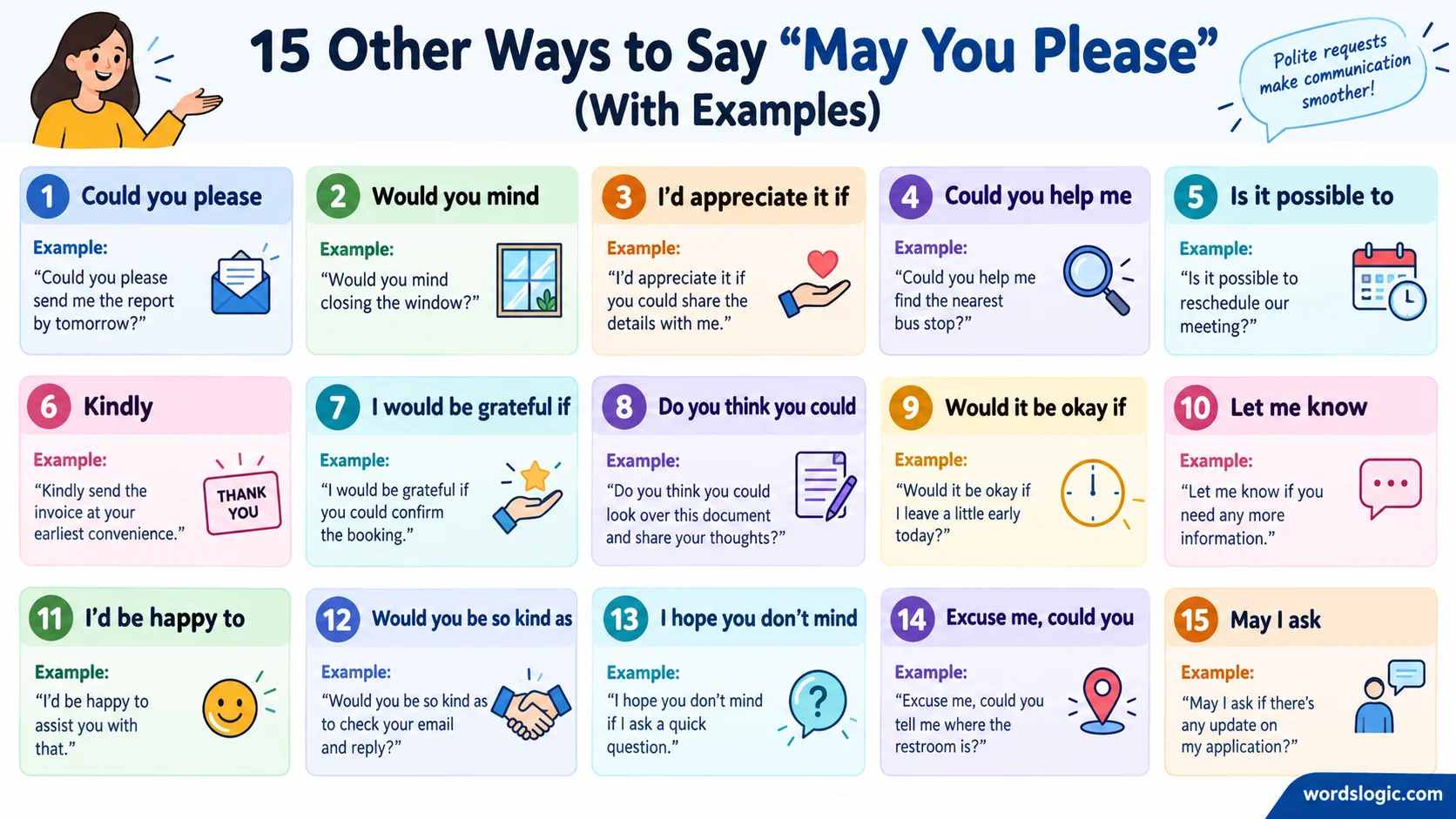
Other Ways to Say “May You Please” help you make polite requests with natural English, correct grammar, and respectful wording in daily use.
Use could you please or would you please for polite requests in natural speech, office communication, and professional situations. These expressions create a friendly, respectful tone and help you choose softer language when speaking with colleagues or team members. The right word choice and request language can make your communication sound more natural, considerate, and engaging.
Choosing the right phrases matters in real communication, whether you are making requests during casual chats, handling requests at work, or practicing casual communication. A small vocabulary shift toward could and would can strengthen communication skills, etiquette, and communication style while showing thoughtfulness, warmth, care, and respect. Using natural phrases helps you communicate effectively without relying on an awkward request form.
What Does “May You Please” Mean?
“May You Please” is intended to introduce a polite request, usually asking another person to do something. The word “may” can express permission or possibility, while “please” signals politeness. However, when directly asking someone to perform an action, native English speakers usually prefer structures such as “Could you please…”, “Would you please…”, or simply “Please…”.
For example, instead of saying “May you please send me the document?”, a more natural request would be “Could you please send me the document?” The intended meaning is clear, but the alternative sounds more idiomatic in modern English.
Common Situations Where “May You Please” Is Used
People may use “May You Please” when making a request, especially in writing, formal communication, workplace messages, or situations where they want to sound respectful. However, the construction is less common in natural conversational English than several other request forms.
If you want your request to sound smooth and natural, alternatives such as “Could you please,” “Would you mind,” or “I’d appreciate it if you could” may be better choices. The right wording depends on how formal, direct, or friendly you want to sound.
Is It Professional or Polite to Say “May You Please”?
“May You Please” is clearly intended to be polite, but it is not the most natural request structure in standard modern English. In professional communication, using a more conventional expression can make your message sound clearer and more fluent.
For example, “Could you please review the report?” sounds natural and professional. “May you please review the report?” may be understood, but many native speakers would find the construction unusual. This distinction matters when writing emails, applications, customer messages, or workplace communication.
Advantages and Disadvantages of Saying “May You Please”
Advantages
“May You Please” communicates a respectful intention and clearly indicates that you are making a request. The inclusion of “please” also prevents the request from sounding unnecessarily commanding.
Disadvantages
The main limitation is that “May You Please” sounds unnatural in many contexts. The modal “may” is normally associated with permission or possibility rather than directly asking another person to perform an action. More natural alternatives can make the same request sound smoother, clearer, and more professional.
Synonyms for “May You Please”
- Could You Please
- Would You Please
- Can You Please
- Will You Please
- Please
- Would You Mind
- Could You Kindly
- Would You Kindly
- I’d Appreciate It If You Could
- If You Could
- I Kindly Ask That You
- May I Ask You to
- Could I Ask You to
- I’d Be Grateful If You Could
- I’d Like to Ask You to
1. Could You Please
Meaning
“Could You Please” is one of the most natural and widely used ways to make a polite request.
Definition
It is a courteous expression used to ask someone to do something for you.
Detailed Explanation
“Could You Please” sounds polite without being overly formal. It is often a better choice than “May You Please” because it follows a common English request pattern. Although “could” technically refers to ability or possibility, in requests it functions as a polite modal. It works in both professional and everyday communication.
Scenario Examples
Scenario: You need a coworker to check a file.
Example: “Could you please review the document before the meeting?”
Scenario: You are asking a friend for assistance.
Example: “Could you please pick up some bread on your way home?”
Best Use
Use it for emails, workplace requests, everyday conversation, customer communication, and polite favors.
Tone
Tone: Polite, professional, friendly. It is one of the most flexible request forms in English.
2. Would You Please
Meaning
“Would You Please” is a polite way to ask someone to complete an action.
Definition
It is a request structure that asks whether someone is willing to do something.
Detailed Explanation
“Would You Please” can sound slightly more formal or deliberate than “Could You Please.” It works well when you want to make a direct request while maintaining courtesy. Depending on the wording and context, it can occasionally sound firm, especially when used without additional softening. It is still a natural choice in many professional situations.
Scenario Examples
Scenario: You are asking someone to close a door.
Example: “Would you please close the door?”
Scenario: A manager asks an employee to complete a task.
Example: “Would you please send me the updated figures by noon?”
Best Use
Use it for polite requests, workplace communication, formal conversations, and direct but respectful instructions.
Tone
Tone: Polite, direct, professional. It can sound firmer than “Could You Please.”
3. Can You Please
Meaning
“Can You Please” is a common and natural way to ask someone to do something.
Definition
It is a polite request that asks whether someone can or is able to perform an action.
Detailed Explanation
“Can You Please” is especially common in everyday spoken English and informal workplace communication. It is slightly more direct than “Could You Please,” but it is not inherently rude. The surrounding wording and relationship affect how it sounds. It is a practical choice when you want a simple, natural request.
Scenario Examples
Scenario: You need help at home.
Example: “Can you please take the trash outside?”
Scenario: You are asking a coworker for a quick action.
Example: “Can you please forward that email to me?”
Best Use
Use it in casual conversation, texting, workplace communication, and everyday requests.
Tone
Tone: Friendly, direct, polite. It sounds natural in ordinary conversation.
4. Will You Please
Meaning
“Will You Please” asks someone to agree to or carry out an action.
Definition
It is a request that focuses on whether someone will perform the requested action.
Detailed Explanation
This expression can be polite, but it often sounds more forceful than “Could You Please.” In certain contexts, it may communicate impatience or emphasis. That does not make it rude automatically; tone and context matter. It is useful when you need to make a clear request rather than a very soft one.
Scenario Examples
Scenario: A parent asks a child to put something away.
Example: “Will you please put your shoes by the door?”
Scenario: Someone has repeatedly interrupted a conversation.
Example: “Will you please let me finish my point?”
Best Use
Use it for direct requests, spoken communication, instructions, and situations where emphasis is appropriate.
Tone
Tone: Direct, firm, polite. It can sound stronger than “Could You Please.”
5. Please
Meaning
“Please” can turn a direct instruction or request into a polite one.
Definition
It is a courtesy word used to ask for an action respectfully.
Detailed Explanation
Sometimes the simplest alternative is the most natural. “Please” works before or after a request and is suitable for a wide range of contexts. In professional communication, it can be especially clear when the requested action is already obvious. The exact tone depends on the sentence around it.
Scenario Examples
Scenario: You are asking someone to wait.
Example: “Please wait here for a moment.”
Scenario: You are giving a polite workplace instruction.
Example: “Please send the completed form by Friday.”
Best Use
Use it for emails, instructions, notices, workplace communication, and everyday requests.
Tone
Tone: Polite, clear, direct. It is simple and highly versatile.
6. Would You Mind
Meaning
“Would You Mind” is a polite way to ask whether someone would be willing to do something.
Definition
It introduces a request by asking about the person’s willingness or objection.
Detailed Explanation
This expression is softer and more indirect than “Could You Please.” It can be useful when you want to show consideration for the other person’s time or preferences. Because the construction asks whether someone minds doing something, the grammar of the response can sometimes be confusing for English learners. It is nevertheless very natural in polite conversation.
Scenario Examples
Scenario: You want someone to move their chair.
Example: “Would you mind moving your chair a little?”
Scenario: You need a colleague to stay a few minutes longer.
Example: “Would you mind staying for another five minutes?”
Best Use
Use it for polite favors, workplace requests, social situations, and considerate conversations.
Tone
Tone: Polite, considerate, indirect. It softens the request by focusing on the other person’s willingness.
7. Could You Kindly
Meaning
“Could You Kindly” is a courteous way to ask someone to do something.
Definition
It is a polite request that combines the modal “could” with the courtesy word “kindly.”
Detailed Explanation
This expression sounds more formal than “Could You Please.” It is common in professional emails and formal written communication, although “kindly” can sometimes sound stiff or overly formal depending on the context. Use it when you want a respectful written request. For everyday conversation, “Could you please” will often sound more natural.
Scenario Examples
Scenario: You are requesting information from a business.
Example: “Could you kindly provide the requested details?”
Scenario: You are asking a colleague to complete a form.
Example: “Could you kindly complete the attached form?”
Best Use
Use it for formal emails, business communication, customer service, and written requests.
Tone
Tone: Formal, courteous, respectful. It has a more polished written feel.
8. Would You Kindly
Meaning
“Would You Kindly” is a formal and courteous way to make a request.
Definition
It asks someone to perform an action while emphasizing politeness and courtesy.
Detailed Explanation
“Would You Kindly” can sound more formal than ordinary conversational requests. It is appropriate when you want to maintain a respectful tone in writing or formal speech. Depending on context and delivery, it can occasionally sound stern or old-fashioned. The rest of the sentence determines whether it feels warm or firm.
Scenario Examples
Scenario: You are making a formal request to an organization.
Example: “Would you kindly provide a copy of the receipt?”
Scenario: You need someone to correct information.
Example: “Would you kindly update the information in your records?”
Best Use
Use it for formal correspondence, business requests, official communication, and respectful written messages.
Tone
Tone: Formal, respectful, courteous. It is more elevated than ordinary everyday requests.
9. I’d Appreciate It If You Could
Meaning
“I’d Appreciate It If You Could” politely expresses gratitude in advance for someone’s help.
Definition
It is a courteous request that combines a request with appreciation.
Detailed Explanation
This phrase is useful when you want your request to sound considerate and professional. Instead of simply asking for an action, you acknowledge that the other person’s assistance would be valuable. It is particularly effective in workplace emails and requests to clients or colleagues. It can sound warmer and less demanding than a direct command.
Scenario Examples
Scenario: You need a colleague to review a proposal.
Example: “I’d appreciate it if you could review the proposal today.”
Scenario: You are asking a client for additional information.
Example: “I’d appreciate it if you could send the missing details.”
Best Use
Use it for professional emails, workplace requests, client communication, and formal favors.
Tone
Tone: Professional, appreciative, courteous. It softens the request by recognizing the recipient’s help.
10. If You Could
Meaning
“If You Could” introduces a request in a soft and indirect way.
Definition
It is a polite phrase used to ask someone to perform a particular action.
Detailed Explanation
“If You Could” can make a request sound less demanding. It is often followed by an action, such as “send,” “check,” or “confirm.” In professional writing, it can be a useful way to make a request without sounding overly forceful. The phrase is especially natural when followed by “please” or a courteous closing.
Scenario Examples
Scenario: You need a coworker to send a file.
Example: “If you could send me the revised file, I’d appreciate it.”
Scenario: You are asking someone to check a detail.
Example: “If you could confirm the meeting time, that would be helpful.”
Best Use
Use it for professional communication, polite requests, emails, and considerate workplace messages.
Tone
Tone: Polite, indirect, considerate. It avoids the forcefulness of a direct command.
11. I Kindly Ask That You
Meaning
“I Kindly Ask That You” introduces a formal request for someone to take a particular action.
Definition
It is a formal expression used to politely request an action.
Detailed Explanation
This phrase is more formal and deliberate than ordinary request structures. It may be appropriate when writing official correspondence or communicating about a matter that requires clear action. However, it can sound stiff in casual conversation. In many everyday emails, a simpler construction such as “Could you please” will feel more natural.
Scenario Examples
Scenario: You are making a formal workplace request.
Example: “I kindly ask that you submit the completed documents by Monday.”
Scenario: You are communicating an official requirement.
Example: “I kindly ask that you follow the instructions provided.”
Best Use
Use it for formal writing, official requests, workplace notices, and serious professional communication.
Tone
Tone: Formal, respectful, firm. It communicates courtesy while clearly identifying the requested action.
12. May I Ask You to
Meaning
“May I Ask You to” politely introduces a request.
Definition
It asks for permission to make a request of another person.
Detailed Explanation
This expression is different from “May You Please” because “may I” correctly focuses on the speaker asking permission to make the request. It can sound formal and courteous, particularly in careful speech or writing. It is useful when you want to soften the act of asking. In ordinary conversation, a shorter expression may be more natural.
Scenario Examples
Scenario: You need someone to provide additional information.
Example: “May I ask you to provide a copy of the original document?”
Scenario: You are speaking formally to a customer.
Example: “May I ask you to confirm your appointment time?”
Best Use
Use it for formal conversations, professional requests, customer service, and respectful communication.
Tone
Tone: Formal, courteous, respectful. It gives the request a careful and deferential feel.
13. Could I Ask You to
Meaning
“Could I Ask You to” is a polite way to introduce a request.
Definition
It asks whether the speaker may request a particular action from the listener.
Detailed Explanation
This phrase is slightly indirect because the speaker first frames the request as a question. It can be useful when you want to sound considerate rather than demanding. It works especially well when the requested action requires some effort from the other person. For very simple requests, “Could you please” is usually more concise.
Scenario Examples
Scenario: You need a colleague to help with a presentation.
Example: “Could I ask you to review these slides before the meeting?”
Scenario: You are speaking politely to a customer.
Example: “Could I ask you to wait while I check your account?”
Best Use
Use it for professional communication, polite requests, customer interactions, and situations requiring extra courtesy.
Tone
Tone: Polite, considerate, professional. It softens the request through indirect wording.
14. I’d Be Grateful If You Could
Meaning
“I’d Be Grateful If You Could” expresses appreciation while making a request.
Definition
It is a courteous request that communicates that the speaker would greatly appreciate the recipient’s assistance.
Detailed Explanation
This phrase is warmer than a simple “Please.” It is particularly useful when you are asking for help or cooperation and want to acknowledge the value of the person’s effort. It can sound formal but remains natural in professional correspondence. Because it explicitly expresses gratitude, it is best used when the requested help genuinely matters.
Scenario Examples
Scenario: You need a document from a colleague.
Example: “I’d be grateful if you could send me the signed document.”
Scenario: You are asking a client to confirm information.
Example: “I’d be grateful if you could confirm these details at your earliest convenience.”
Best Use
Use it for formal emails, professional requests, applications, and situations involving meaningful assistance.
Tone
Tone: Polite, appreciative, formal. It communicates respect and gratitude at the same time.
15. I’d Like to Ask You to
Meaning
“I’d Like to Ask You to” is a polite way to introduce a request.
Definition
It means the speaker would like the recipient to perform a particular action.
Detailed Explanation
This expression is clear and courteous without being excessively formal. It is useful when you want to make a request directly but still soften the wording. It works particularly well in professional communication where a simple command might sound too abrupt. The phrase is less indirect than “Would You Mind” but gentler than an imperative.
Scenario Examples
Scenario: A manager needs an employee to prepare a report.
Example: “I’d like to ask you to prepare the report by Thursday.”
Scenario: You are making a request during a formal discussion.
Example: “I’d like to ask you to consider the proposal carefully.”
Best Use
Use it for workplace communication, formal conversations, professional emails, and respectful requests.
Tone
Tone: Professional, polite, direct. It clearly states the request while maintaining courtesy.
FAQs
What is another way to say “May You Please”?
Natural alternatives include “Could You Please,” “Would You Please,” “Can You Please,” and “Could You Kindly.” In most everyday and professional situations, “Could You Please” sounds more natural than “May You Please.”
What does “May You Please” mean?
“May You Please” is intended to be a polite request asking someone to do something. However, the construction is not commonly used by native speakers for ordinary requests. “May” is more naturally used for permission or possibility.
Is “May You Please” professional?
It is intended to sound polite and respectful, but it may sound unusual in professional English. A phrase such as “Could you please…” is generally more natural and fluent in workplace communication.
What is a more polite way to say “May You Please”?
Depending on the situation, you could say “Could you please,” “Would you mind,” “I’d appreciate it if you could,” or “I’d be grateful if you could.” These expressions offer different levels of directness and formality.
Which alternative works best in formal communication?
For formal communication, “Could you kindly,” “Would you kindly,” “I’d appreciate it if you could,” and “I’d be grateful if you could” can work well. The most natural choice depends on the relationship and the amount of formality required.
Conclusion
“May You Please” communicates the intention to make a polite request, but it is not the most natural construction in modern English. When asking someone to do something, expressions such as “Could You Please” and “Would You Please” usually sound smoother. For a softer request, “Would You Mind” works well, while phrases such as “I’d Appreciate It If You Could” and “I’d Be Grateful If You Could” add warmth and appreciation.
Formal situations may call for “Could You Kindly” or “May I Ask You to.” The key is to choose wording that matches the situation, your relationship with the recipient, and the level of politeness you want to communicate.













