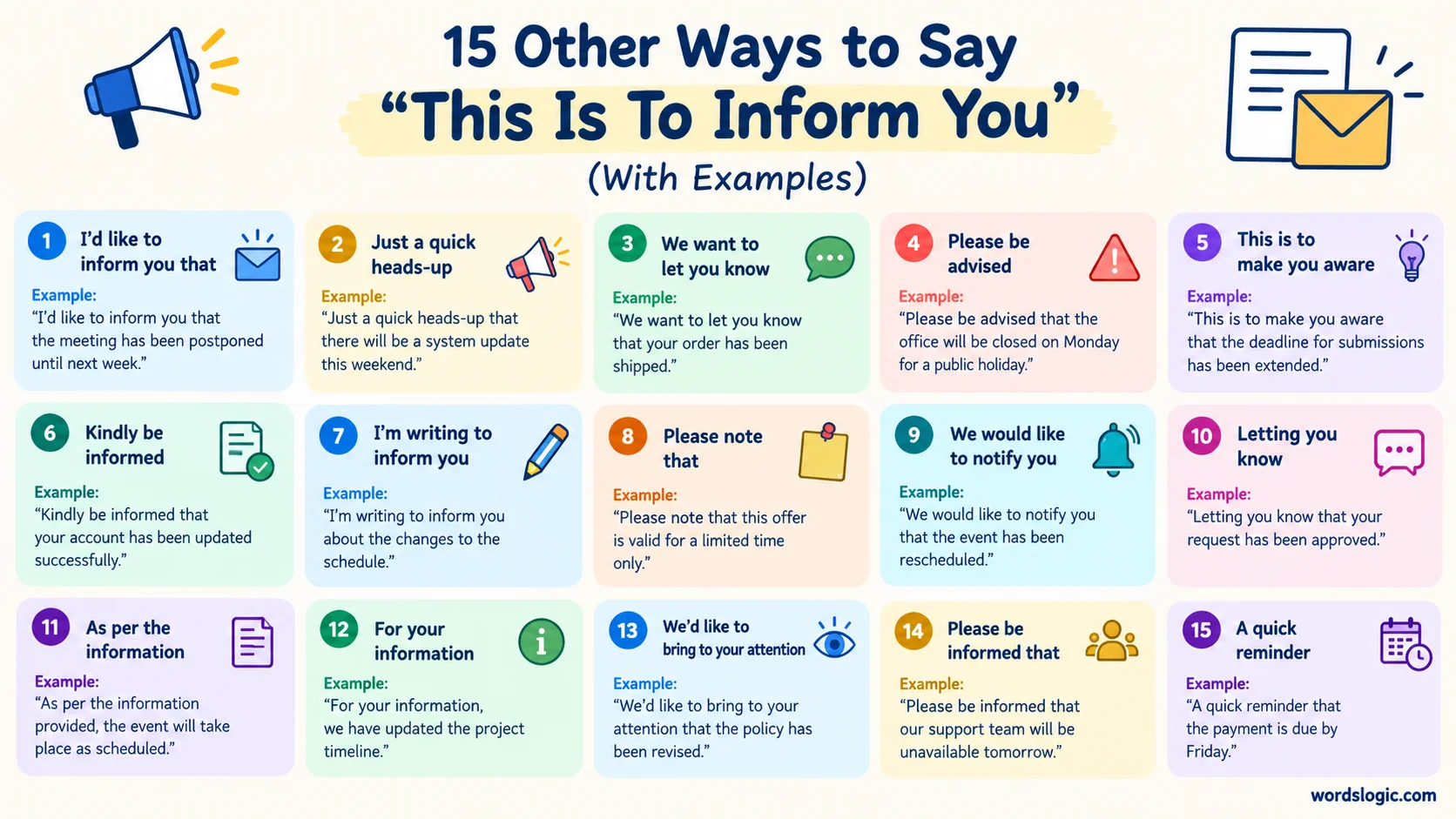
Other Ways to Say “This Is To Inform You” can make your message sound clear, warm, personal, and professional in emails and updates at work. In my experience, choosing the right words helps a simple update feel less distant or impersonal, especially in workplace updates, personal conversations, and professional messages.
The phrase this is to inform you is formal and professional, but it may sound stiff, so simple alternatives such as I wanted to let you know, Just a quick update, and I’m reaching out to share can create a more friendly, natural, and human tone. The meaning remains clear, while empathy, warmth, thoughtfulness, professionalism, and respectful wording can make communication more caring and approachable.
When writing to a coworker, client, friend, or customer, the right phrase depends on the tone, situation, and context. These choices can help you improve your relationship with the reader, communicate confidently, and avoid making your message feel like a template. 30 alternatives, practical examples, and real-life scenarios can give you varied, different, and versatile options for everyday communication. You may need to deliver essential information with clarity and urgency, or simply share something during a relaxed conversation.
What Does “This Is To Inform You” Mean?
“This is to inform you” is a formal expression used to introduce information that the reader needs to know. It often appears at the beginning of an email, letter, notice, or official communication. The phrase essentially means “I am writing to tell you about something” or “I want to make you aware of this information.” It does not usually express emotion by itself; instead, it signals that important information is about to follow. Because it has a formal and somewhat traditional style, many writers replace it with more direct wording in modern business communication.
Common Situations Where “This Is To Inform You” Is Used
The phrase commonly appears in formal letters, workplace emails, administrative notices, school communication, customer correspondence, and official announcements. For example, an organization might use it to announce a schedule change, policy update, deadline, appointment, or decision.
It is less common in casual texts and personal conversations because it can sound unnecessarily formal. Even at work, writers often prefer a direct opening such as “I’m writing to let you know” or “Please be aware that.” Choosing an alternative can make the message easier to read and more conversational while preserving a professional tone.
Is It Professional or Polite to Say “This Is To Inform You”?
“This is to inform you” is formal and professional, but it can sound somewhat stiff or bureaucratic. It is not inherently impolite. In official notices or highly formal correspondence, the phrase may fit naturally because it clearly signals that important information follows.
However, modern workplace writing often favors clear and direct language. “I’m writing to let you know” sounds professional while feeling more personal, whereas “Please be advised” is formal and direct. The best choice depends on whether you are writing a formal notice, a business email, a customer message, or a simple update to a colleague.
Advantages and Disadvantages of Saying “This Is To Inform You”
Advantages
The phrase is clear, formal, and straightforward. It immediately tells the reader that the message contains information they should know. It can also work well in official notices, administrative documents, and situations where a formal tone is appropriate.
Disadvantages
Its main limitation is that it can sound stiff, impersonal, or dated in ordinary workplace emails. It also uses unnecessary introductory wording when the writer could simply state the information. In a friendly business relationship, a more natural phrase may make the communication feel warmer and easier to read.
15 Natural Alternatives to “This Is To Inform You”
- I’m writing to let you know
- I wanted to let you know
- Please be informed that
- Please be advised that
- I’m writing to inform you
- I’d like to inform you
- I’d like to let you know
- I’m reaching out to let you know
- I’m writing to notify you
- Please note that
- Kindly note that
- We would like to inform you
- We’re pleased to let you know
- This message is to let you know
- I’d like to bring to your attention
1. I’m writing to let you know
Meaning
“I’m writing to let you know” is a natural way to introduce information in an email or letter.
Definition
It means “I am contacting you to tell you something.”
Detailed Explanation
This wording keeps the informative purpose of “This is to inform you” but sounds more natural and personal. It is especially useful in professional emails because it clearly explains why you are contacting the reader. Unlike the original phrase, it places the writer directly into the sentence. It works for both routine updates and important announcements.
Scenario Examples
Scenario: You need to tell a client about a schedule change.
Example: “I’m writing to let you know that tomorrow’s meeting has been moved to 2 p.m.”
Scenario: You are informing a colleague about an upcoming deadline.
Example: “I’m writing to let you know that the report is due Friday.”
Best Use
Best for professional emails, workplace communication, customer messages, and formal correspondence.
Tone
Tone: Professional, natural, and friendly. It sounds polished without being overly formal.
2. I wanted to let you know
Meaning
“I wanted to let you know” introduces information in a softer, more conversational way.
Definition
It means “I wanted to tell you or make you aware of something.”
Detailed Explanation
This expression feels more personal than “This is to inform you.” The word “wanted” softens the message and makes it sound less like an official announcement. It works particularly well when you already have some relationship with the reader. Although common in professional communication, it also fits personal messages.
Scenario Examples
Scenario: A manager wants to give an employee a positive update.
Example: “I wanted to let you know that your request has been approved.”
Scenario: You need to update a customer about an order.
Example: “I wanted to let you know that your package has shipped.”
Best Use
Best for friendly workplace emails, customer communication, personal updates, and everyday professional messages.
Tone
Tone: Warm, polite, and conversational. It reduces the formality of the original phrase.
3. Please be informed that
Meaning
“Please be informed that” formally tells the reader that they should take note of specific information.
Definition
It means “Please be aware of or take notice of the following information.”
Detailed Explanation
This is a close formal alternative to “This is to inform you.” It is appropriate when the information has some official or administrative importance. The wording is more formal than “I’m writing to let you know,” so it can feel less personal. It is best used selectively rather than as the opening of every ordinary email.
Scenario Examples
Scenario: A school sends an official notice.
Example: “Please be informed that the campus will be closed on Monday.”
Scenario: An organization announces a change in operating hours.
Example: “Please be informed that our office hours will change beginning October 1.”
Best Use
Best for formal notices, administrative communication, schools, organizations, and official correspondence.
Tone
Tone: Formal, official, and direct. It emphasizes the importance of the information.
4. Please be advised that
Meaning
“Please be advised that” formally alerts someone to information, a condition, or a decision.
Definition
It means “Please take notice of the following information.”
Detailed Explanation
This phrase has a distinctly formal and official character. It is often appropriate when the reader needs to be aware of a rule, change, requirement, or consequence. Compared with “I wanted to let you know,” it creates more distance between the writer and reader. It should not be confused with giving personal advice; here, “advised” means informed or notified.
Scenario Examples
Scenario: A business communicates a policy change.
Example: “Please be advised that all visitors must sign in at reception.”
Scenario: A service provider announces an interruption.
Example: “Please be advised that maintenance may temporarily affect your service.”
Best Use
Best for formal notices, policies, customer notifications, and official business communication.
Tone
Tone: Formal, authoritative, and direct. It is useful when the information requires clear attention.
5. I’m writing to inform you
Meaning
“I’m writing to inform you” directly states that the purpose of the message is to provide information.
Definition
It means “I am contacting you to give you information about something.”
Detailed Explanation
This expression is very close in meaning to the original phrase while sounding slightly more personal and active. It works well in professional correspondence when you want to maintain a formal tone. It can introduce an announcement, decision, update, or notification. Because it remains formal, it may sound less conversational than “I wanted to let you know.”
Scenario Examples
Scenario: An employee needs to formally notify a manager about an absence.
Example: “I’m writing to inform you that I’ll be unavailable next Tuesday.”
Scenario: A company contacts a customer about a policy.
Example: “I’m writing to inform you of an update to our return policy.”
Best Use
Best for formal emails, business letters, official notifications, and professional correspondence.
Tone
Tone: Professional, formal, and straightforward. It preserves much of the formality of the original phrase.
6. I’d like to inform you
Meaning
“I’d like to inform you” politely introduces information the writer wants the reader to know.
Definition
It means “I would like to tell you or make you aware of something.”
Detailed Explanation
The contraction “I’d” makes this slightly less stiff than “I would like to inform you,” while keeping a professional tone. It can be used when sharing an important update or formal piece of information. The phrase is respectful but somewhat formal, so it may be more suitable for significant communications than quick internal messages.
Scenario Examples
Scenario: You are informing a client about a completed request.
Example: “I’d like to inform you that your application has been received.”
Scenario: A representative provides an update.
Example: “I’d like to inform you that the requested documents are now available.”
Best Use
Best for professional emails, customer service, formal updates, and business communication.
Tone
Tone: Polite, professional, and moderately formal. It sounds respectful without being overly impersonal.
7. I’d like to let you know
Meaning
“I’d like to let you know” is a polite and natural way to introduce information.
Definition
It means “I would like to tell you about something.”
Detailed Explanation
This expression is warmer than “I’d like to inform you” because “let you know” is common in everyday English. It can still sound professional, but it feels less bureaucratic. This makes it useful when you want to maintain professionalism while creating a more approachable tone. It is particularly natural in email communication.
Scenario Examples
Scenario: A recruiter gives an applicant an update.
Example: “I’d like to let you know that we’ve received your application.”
Scenario: A colleague shares a change to a meeting.
Example: “I’d like to let you know that the meeting room has changed.”
Best Use
Best for professional emails, workplace updates, customer communication, and polite personal messages.
Tone
Tone: Polite, warm, and professional. It balances clarity with a friendly feel.
8. I’m reaching out to let you know
Meaning
“I’m reaching out to let you know” explains that you are contacting someone specifically to provide an update or information.
Definition
It means “I am contacting you because I want to share some information with you.”
Detailed Explanation
This expression is common in modern business and customer communication. “Reaching out” emphasizes the act of making contact, which can make the message feel more personal. It is less formal than “This is to inform you,” but it remains appropriate for many workplace situations. It works especially well when the recipient may appreciate a more human and approachable opening.
Scenario Examples
Scenario: A customer support representative follows up on an issue.
Example: “I’m reaching out to let you know that your issue has been resolved.”
Scenario: A professional contacts a client about an appointment.
Example: “I’m reaching out to let you know that we have an opening next Thursday.”
Best Use
Best for customer service, professional emails, networking, client communication, and follow-ups.
Tone
Tone: Professional, approachable, and conversational. It feels more personal than an official notice.
9. I’m writing to notify you
Meaning
“I’m writing to notify you” formally tells someone about an event, decision, change, or requirement.
Definition
It means “I am contacting you to officially tell you about something.”
Detailed Explanation
The verb “notify” carries a stronger sense of formal notice than “let you know.” It is useful when the information has an official or administrative purpose. This wording is not necessarily unfriendly, but it creates a more formal distance. It is especially suitable when documenting that someone has been formally informed.
Scenario Examples
Scenario: A company sends a formal notice about an account.
Example: “I’m writing to notify you that your account will be closed on November 1.”
Scenario: An organization communicates a decision.
Example: “I’m writing to notify you that your request has been approved.”
Best Use
Best for formal notifications, business letters, administrative communication, and official decisions.
Tone
Tone: Formal, serious, and precise. It is stronger and more official than “I wanted to let you know.”
10. Please note that
Meaning
“Please note that” asks the reader to pay attention to specific information.
Definition
It means “Please be aware of or remember the following information.”
Detailed Explanation
This is a concise alternative when the writer wants to highlight something important. It does not necessarily announce a major decision; it can introduce a deadline, instruction, change, or useful detail. Compared with “This is to inform you,” it gets to the point more quickly. It works especially well in emails, instructions, notices, and workplace messages.
Scenario Examples
Scenario: An event organizer reminds attendees about timing.
Example: “Please note that registration closes at 5 p.m.”
Scenario: A business explains a delivery condition.
Example: “Please note that orders placed after Friday will ship the following week.”
Best Use
Best for emails, notices, instructions, policies, and professional communication.
Tone
Tone: Professional, concise, and direct. It focuses the reader’s attention without unnecessary formality.
11. Kindly note that
Meaning
“Kindly note that” politely asks the reader to take notice of specific information.
Definition
It means “Please be aware of the following information.”
Detailed Explanation
This phrase adds a courteous quality to a direct notification. It is particularly common in formal and business correspondence, although its naturalness varies by region and organization. In some varieties of international business English, “kindly” is frequently used to soften requests and notices. In more conversational American English, “please note that” may sound more natural.
Scenario Examples
Scenario: A business informs customers about a holiday closure.
Example: “Kindly note that our office will be closed on Friday.”
Scenario: An administrator reminds students about a deadline.
Example: “Kindly note that all forms must be submitted by noon.”
Best Use
Best for formal emails, administrative notices, business correspondence, and institutional communication.
Tone
Tone: Polite, formal, and courteous. It adds a respectful touch to an otherwise direct statement.
12. We would like to inform you
Meaning
“We would like to inform you” formally introduces information from a company, organization, or group.
Definition
It means “Our organization or group wants to tell you something.”
Detailed Explanation
This wording is useful when the message comes from an organization rather than an individual. It has a formal and institutional quality, making it suitable for announcements and official correspondence. It can sound more distant than “we wanted to let you know,” but that distance may be appropriate for formal notices. The phrase is especially useful when representing a company or department.
Scenario Examples
Scenario: A company announces a service update.
Example: “We would like to inform you that our support hours have changed.”
Scenario: A school sends an official announcement.
Example: “We would like to inform you that the examination schedule has been revised.”
Best Use
Best for company announcements, institutional emails, official notices, and customer communication.
Tone
Tone: Formal, professional, and institutional. It represents a group rather than an individual speaker.
13. We’re pleased to let you know
Meaning
“We’re pleased to let you know” introduces information that is generally positive or welcome.
Definition
It means “We are happy to tell you about something.”
Detailed Explanation
This phrase is not a general replacement for every use of “This is to inform you.” It works best when the information is positive or favorable. The word “pleased” adds warmth and communicates the sender’s positive attitude toward the news. Using it for bad news would normally sound inappropriate or confusing.
Scenario Examples
Scenario: A company accepts a customer’s application.
Example: “We’re pleased to let you know that your application has been approved.”
Scenario: An event organizer confirms someone’s participation.
Example: “We’re pleased to let you know that your registration has been confirmed.”
Best Use
Best for positive announcements, acceptance messages, customer communication, business updates, and formal good news.
Tone
Tone: Warm, positive, and professional. It adds a clear sense of goodwill.
14. This message is to let you know
Meaning
“This message is to let you know” explains that the purpose of the message is to provide specific information.
Definition
It means “The purpose of this message is to tell you something.”
Detailed Explanation
This expression keeps the structure of the original phrase but replaces the more formal “inform” with the everyday expression “let you know.” It can work well when the writer wants a clear announcement without sounding overly official. However, in a short email, it may still be unnecessary if the information can simply be stated directly. It is most useful when the writer wants to emphasize the purpose of the message.
Scenario Examples
Scenario: A business sends an update about operating hours.
Example: “This message is to let you know that our office will close early today.”
Scenario: A school sends a reminder to parents.
Example: “This message is to let you know that the field trip will leave at 8 a.m.”
Best Use
Best for announcements, reminders, organizational communication, and clear informational messages.
Tone
Tone: Clear, neutral, and professional. It is less stiff than the original expression but still somewhat formal.
15. I’d like to bring to your attention
Meaning
“I’d like to bring to your attention” tells someone that you want them to notice or consider something important.
Definition
It means “I would like you to notice or be aware of something.”
Detailed Explanation
This phrase is more specific than simply informing someone. It suggests that the information deserves particular attention. It can be useful when pointing out an issue, concern, detail, discrepancy, or important matter. Because it is formal, it is better suited to professional or official communication than casual conversation.
Scenario Examples
Scenario: An employee identifies an issue in a report.
Example: “I’d like to bring to your attention a discrepancy in the figures.”
Scenario: A tenant contacts a property manager about a maintenance issue.
Example: “I’d like to bring to your attention a problem with the heating system.”
Best Use
Best for professional emails, formal complaints, reports, workplace issues, and situations requiring careful attention.
Tone
Tone: Formal, respectful, and purposeful. It signals that the information deserves consideration.
FAQs
What is another way to say “This Is To Inform You”?
Natural alternatives include “I’m writing to let you know,” “I wanted to let you know,” “Please note that,” and “I’m writing to inform you.” The best choice depends on the formality and purpose of your message.
What does “This Is To Inform You” mean?
“This is to inform you” means “I am writing to tell you or make you aware of something.” It is commonly used to introduce information in formal emails, letters, notices, and official communication.
Is “This Is To Inform You” professional?
Yes. The phrase is formal and professional, although it can sound stiff or bureaucratic in modern workplace emails. A more conversational alternative may be better when writing to colleagues, clients, or customers with whom you have an established relationship.
What is a more polite way to say “This Is To Inform You”?
“I’d like to let you know” is a polite and natural choice. “I’m writing to let you know” is another strong option for professional emails because it sounds courteous while remaining clear.
Which alternative works best in formal communication?
For highly formal communication, “Please be informed that,” “Please be advised that,” “I’m writing to notify you,” or “We would like to inform you” can work well. The right choice depends on whether you are issuing a notice, giving an update, or communicating an official decision.
Conclusion
Choosing the right alternative to “This Is To Inform You” can make formal communication clearer and more natural. While the original phrase is grammatically understandable and appropriate for official notices, it may feel unnecessarily stiff in an everyday business email.
Expressions such as “I’m writing to let you know” and “I’d like to let you know” create a warmer professional tone, while “Please be advised that” and “I’m writing to notify you” retain a more formal character. When the news is positive, “We’re pleased to let you know” adds warmth that the original phrase does not provide. Consider your audience, purpose, relationship, and desired tone before choosing your wording. A small change in phrasing can make an important message feel much more natural and reader-friendly.













