The idiom “Barking Up the Wrong Tree” describes misguided efforts, mistaken assumptions, or following a false lead instead of focusing on the real problem.
This common expression comes from old hunting stories in which dogs bark at the wrong tree, believing their prey is hiding there. In everyday English, including American and British English, it describes poor judgment, incorrect accusations, and misguided decisions. Understanding its figurative meaning helps students, writers, and professionals choose suitable phrase alternatives for different situations.
A personal experience taught me that even a logical idea can lead to a futile course of action when it does not match reality. During my college days, I applied to top schools despite having average grades. My mom wisely warned me that my plans might be off-track, but my ambition encouraged me to keep trying. When I was not accepted, I realized the importance of matching career goals with experience and academic performance.
This lesson applies to many areas of life and work. Whether you are pursuing an unachievable goal, following a mistaken path, or trying to solve a problem for the wrong reason, take a moment to check the facts. Evaluating opportunities, identifying problems, and recognizing mistakes can prevent wasted resources and ineffective actions. Better problem-solving, decision-making, and logical reasoning support personal growth and professional development.
What Does “Barking Up the Wrong Tree” Mean?
“Barking up the wrong tree” is an English idiom that means pursuing the wrong idea, blaming the wrong person, or looking for an answer in the wrong place. It suggests that someone has misunderstood a situation or is following an approach that will not solve the problem. For example, if a manager suspects the wrong employee of making a mistake, you might say, “You’re barking up the wrong tree.” The expression is usually informal and can sound slightly critical, depending on your tone. It doesn’t necessarily mean someone is foolish; they may simply lack important information or have reached the wrong conclusion.
Common Situations Where “Barking Up the Wrong Tree” Is Used
People commonly use this idiom during everyday conversations, disagreements, investigations, and problem-solving discussions. For instance, a friend might use it when someone blames the wrong person for a misunderstanding. In school, it can describe researching an irrelevant topic or using an incorrect approach to solve a question. At work, it may refer to investigating the wrong cause of a technical issue or asking the wrong department for help.
The expression also appears in text messages and social media discussions, particularly when someone wants to correct another person’s assumption. However, it can sound confrontational if the other person feels accused of being wrong. In professional communication, a softer alternative such as “I think we’re looking in the wrong direction” may help correct the misunderstanding without embarrassing anyone.
Is It Professional or Polite to Say “Barking Up the Wrong Tree”?
The phrase is casual, direct, and conversational. It is generally acceptable in friendly discussions and informal workplaces, especially when people are comfortable correcting one another. However, it may sound dismissive during a serious disagreement or when speaking to a customer, supervisor, or unfamiliar colleague. The phrase can suggest that someone has made an obvious mistake, even when that isn’t your intention.
For more formal situations, consider expressions such as “That may not be the right approach,” “I think we’re investigating the wrong issue,” or “There may be another explanation.” These alternatives communicate the same general idea while leaving room for discussion. The best choice depends on your relationship with the listener and how directly you need to correct their assumption.
Advantages and Disadvantages of Saying “Barking Up the Wrong Tree”
Advantages
The idiom is short, memorable, and easy to understand for people familiar with English expressions. It quickly communicates that someone’s suspicion, search, or approach may be mistaken. It also works well in casual conversations because it expresses disagreement without requiring a lengthy explanation. When used with a friendly tone, it can correct a misunderstanding in a lighthearted way.
Disadvantages
The expression can sound blunt or dismissive, particularly when someone has invested considerable effort in an idea. It may also be too informal for a business report, customer email, or official discussion. Because the phrase covers several situations, it doesn’t always explain exactly what is wrong. A more specific alternative can identify the incorrect assumption, mistaken direction, or overlooked evidence more clearly.
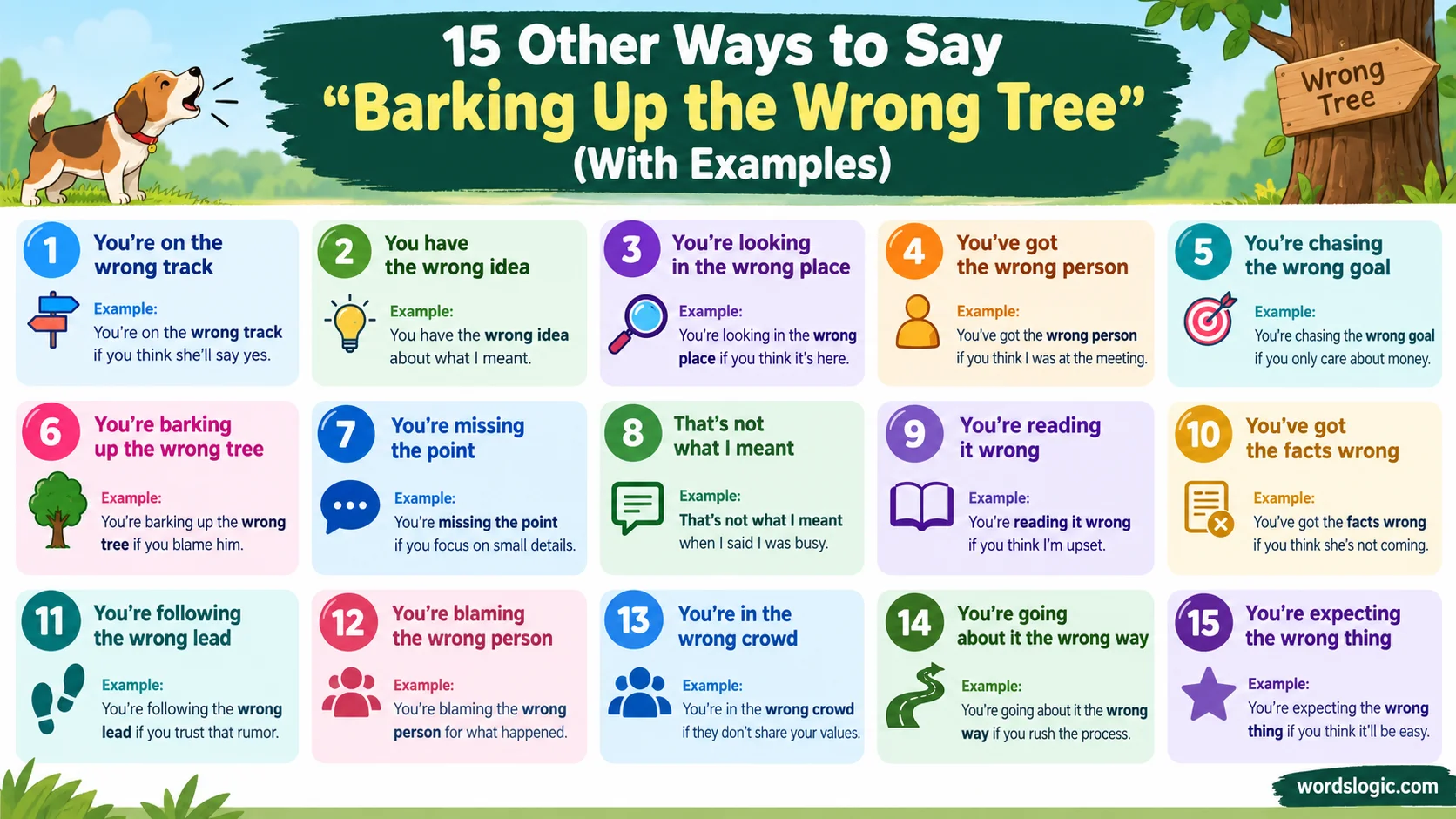
15 Alternatives to “Barking Up the Wrong Tree”
- You’re looking in the wrong direction
- You’re on the wrong track
- You’re mistaken
- You’re jumping to conclusions
- That’s not the right approach
- You’re chasing the wrong lead
- You’re focusing on the wrong issue
- You’re barking at the wrong target
- You’re missing the point
- You’ve got the wrong idea
- You’re blaming the wrong person
- That’s a false assumption
- You’re going down the wrong path
- The answer lies elsewhere
- You’re looking in the wrong place
1. You’re Looking in the Wrong Direction
Meaning
“You’re looking in the wrong direction” means someone is searching for an answer or explanation in an unhelpful area. Like “barking up the wrong tree,” it suggests that the person’s current focus may not lead to the truth.
Definition
A statement indicating that someone’s attention or investigation is focused on the wrong area.
Detailed Explanation
This expression is useful when someone is investigating a problem but concentrating on the wrong cause. It focuses on the direction of the search rather than criticizing the person’s intelligence. Compared with the original idiom, it sounds more neutral and can fit professional discussions. It also leaves room for the possibility that the person simply needs a different perspective.
Scenario Examples
Scenario: A team is trying to identify why sales have dropped.
Example: “I think we’re looking in the wrong direction. We should review the pricing changes first.”
Scenario: A friend suspects the wrong reason for a disagreement.
Example: “You’re looking in the wrong direction if you think she was upset about the invitation.”
Best Use
Use this phrase during problem-solving, workplace discussions, research, and personal conversations when you want to redirect someone’s attention.
Tone
Tone: Neutral, constructive, and direct. It identifies a possible mistake without making the correction sound overly personal.
2. You’re on the Wrong Track
Meaning
“You’re on the wrong track” means someone is following an incorrect line of thought or taking an approach unlikely to produce the right result.
Definition
Following a mistaken idea, method, or course of action.
Detailed Explanation
This expression works when a person has started reasoning from an incorrect assumption or following an ineffective process. It is close to “barking up the wrong tree,” but it emphasizes the path someone is following rather than the target they are pursuing. It can sound firm, especially when delivered without explanation. Adding a reason or suggesting a better direction makes it more helpful.
Scenario Examples
Scenario: A student is solving a math problem using an incorrect formula.
Example: “You’re on the wrong track with that equation. Try isolating the variable first.”
Scenario: A colleague misunderstands customer feedback.
Example: “I think we’re on the wrong track if we assume everyone wants a more complicated design.”
Best Use
This phrase suits learning, troubleshooting, planning, and workplace discussions where someone’s reasoning or method needs adjustment.
Tone
Tone: Direct, practical, and corrective. It works best when paired with a useful explanation.
3. You’re Mistaken
Meaning
“You’re mistaken” means someone has an incorrect belief, understanding, or conclusion. It can communicate the same basic correction as the original idiom, but it focuses directly on whether a belief is accurate.
Definition
Having an incorrect understanding or belief about something.
Detailed Explanation
This expression is more straightforward than “barking up the wrong tree.” It doesn’t necessarily suggest that someone is investigating the wrong lead; it simply says their understanding is incorrect. The phrase can sound polite when spoken calmly, but it may feel confrontational when used abruptly. If you want to maintain a friendly relationship, explain what information changes the conclusion.
Scenario Examples
Scenario: A friend believes a meeting has been canceled.
Example: “You’re mistaken—the meeting is still scheduled for Friday.”
Scenario: A colleague misunderstands a project requirement.
Example: “I believe you’re mistaken about the deadline. The client requested the final draft tomorrow.”
Best Use
Use this expression when you need to correct a factual error or misunderstanding in conversation, email, or professional communication.
Tone
Tone: Firm, clear, and potentially formal. A calm delivery helps keep the correction respectful.
4. You’re Jumping to Conclusions
Meaning
“You’re jumping to conclusions” means someone has decided what happened before gathering enough evidence. It relates to the original idiom when a person wrongly accuses someone or assumes an explanation without checking the facts.
Definition
Making a judgment too quickly without sufficient evidence.
Detailed Explanation
This phrase is especially useful when the problem isn’t necessarily the subject of someone’s investigation but the speed of their judgment. Unlike “barking up the wrong tree,” it emphasizes the process of reaching a conclusion too early. It can be a gentle reminder to consider other explanations, although it may sound defensive during an argument. Use it when more evidence or context could change someone’s opinion.
Scenario Examples
Scenario: A friend assumes someone ignored their message intentionally.
Example: “You’re jumping to conclusions. Maybe she hasn’t checked her phone yet.”
Scenario: A manager assumes a project failed because of one employee.
Example: “Let’s review the timeline before assigning blame. We may be jumping to conclusions.”
Best Use
This expression fits relationships, workplace disagreements, personal messages, and situations involving incomplete information.
Tone
Tone: Cautionary, conversational, and sometimes defensive. It encourages patience before judgment.
5. That’s Not the Right Approach
Meaning
“That’s not the right approach” means a particular method or strategy is unlikely to solve the problem effectively. It is a useful alternative when someone is pursuing an unhelpful solution rather than simply misunderstanding a fact.
Definition
A statement that a method or plan is unsuitable for the situation.
Detailed Explanation
This expression shifts attention from the person to the method they are using. That makes it especially helpful in professional settings where you want to disagree without criticizing someone’s character. It is more formal and constructive than “barking up the wrong tree,” although it can still sound firm. Explaining which approach would work better makes your feedback more actionable.
Scenario Examples
Scenario: A team wants to solve customer complaints by removing the feedback form.
Example: “That’s not the right approach. We should understand why customers are dissatisfied first.”
Scenario: A student plans to memorize answers without understanding the material.
Example: “That may not be the right approach if the exam focuses on applying the concepts.”
Best Use
Choose this phrase for professional communication, planning meetings, academic guidance, and constructive feedback.
Tone
Tone: Professional, respectful, and solution-focused. It challenges the method rather than attacking the person.
6. You’re Chasing the Wrong Lead
Meaning
“You’re chasing the wrong lead” means someone is following a clue or piece of information that is unlikely to help them find the answer.
Definition
Pursuing an unhelpful or misleading clue during an investigation or search.
Detailed Explanation
This expression is particularly suitable when there are clues, leads, or pieces of evidence to examine. It is often associated with detective work, investigations, journalism, and business research. Unlike the broader original idiom, it specifically suggests that the information being followed is unreliable or irrelevant. It can sound more natural than “barking up the wrong tree” when discussing an actual investigation.
Scenario Examples
Scenario: A reporter investigates an outdated rumor.
Example: “You may be chasing the wrong lead. The original source has already corrected that claim.”
Scenario: A support team investigates a minor software warning.
Example: “We’re chasing the wrong lead if we keep investigating that warning instead of the server logs.”
Best Use
Use it in investigations, research, troubleshooting, journalism, and fact-checking.
Tone
Tone: Analytical, direct, and practical. It highlights the quality of the evidence rather than the person’s character.
7. You’re Focusing on the Wrong Issue
Meaning
“You’re focusing on the wrong issue” means someone is concentrating on a less relevant concern while overlooking the problem that actually matters.
Definition
Giving attention to a problem that is not central to the situation.
Detailed Explanation
This expression is helpful when the person has noticed something real but misunderstood its importance. The issue they are discussing may exist, yet it may not explain the larger problem. Compared with the original idiom, this phrase emphasizes misplaced attention rather than an incorrect accusation. It can be effective in meetings where time is limited and the discussion needs to return to the main objective.
Scenario Examples
Scenario: A team debates the color of a website button while users struggle to complete checkout.
Example: “We’re focusing on the wrong issue. The checkout process is what needs our attention.”
Scenario: Two friends argue about the wording of a message instead of its underlying meaning.
Example: “I think you’re focusing on the wrong issue. What matters is why the conversation upset you.”
Best Use
This phrase works well in meetings, project planning, conflict resolution, and discussions about priorities.
Tone
Tone: Focused, assertive, and constructive. It redirects attention toward what matters most.
8. You’re Barking at the Wrong Target
Meaning
“You’re barking at the wrong target” suggests that someone is directing criticism, anger, or suspicion toward the wrong person or thing. It resembles the original idiom but emphasizes the target of the reaction.
Definition
Directing blame or criticism toward an incorrect target.
Detailed Explanation
This wording is understandable, but it is less established than the standard idiom “barking up the wrong tree.” It works best as a creative variation when you want to emphasize misplaced blame. In everyday English, “you’re blaming the wrong person” is usually clearer and more natural. If you choose this version, make sure the surrounding conversation makes your meaning obvious.
Scenario Examples
Scenario: A customer blames a delivery driver for a warehouse packing error.
Example: “You may be barking at the wrong target. The package was already damaged when it left the warehouse.”
Scenario: Friends argue over who caused a misunderstanding.
Example: “Before you get angry with him, consider whether you’re barking at the wrong target.”
Best Use
Use this variation sparingly in casual conversation or expressive writing. For formal communication, choose a more established expression.
Tone
Tone: Informal, pointed, and slightly confrontational. It can sound playful among friends but may feel accusatory in a serious disagreement.
9. You’re Missing the Point
Meaning
“You’re missing the point” means someone has failed to understand the main idea or the most important part of a discussion.
Definition
Failing to recognize the central meaning or purpose of something.
Detailed Explanation
This phrase differs from “barking up the wrong tree” because it focuses on understanding rather than investigation. Someone might be discussing the correct topic but still misunderstand what matters most. It is a useful expression when a conversation keeps getting distracted by minor details. However, it can sound impatient if the listener feels they have already explained their position.
Scenario Examples
Scenario: A friend focuses on the cost of a gift rather than the thought behind it.
Example: “You’re missing the point. I gave it to you because I wanted you to feel appreciated.”
Scenario: A team debates a report’s design instead of its findings.
Example: “I think we’re missing the point. The data shows a problem we still need to address.”
Best Use
Use it during discussions, debates, explanations, and problem-solving conversations when someone overlooks the central message.
Tone
Tone: Direct, emphatic, and sometimes frustrated. A brief explanation can make it more constructive.
10. You’ve Got the Wrong Idea
Meaning
“You’ve got the wrong idea” means someone has misunderstood a situation, intention, or statement. It is useful when you want to correct a false impression rather than an investigative mistake.
Definition
Having an incorrect impression or interpretation of something.
Detailed Explanation
This phrase is especially relevant to personal communication because misunderstandings often arise from tone, incomplete messages, or assumptions about intentions. Unlike the original idiom, it doesn’t necessarily involve searching for evidence or blaming the wrong person. It can sound reassuring when followed by a clear explanation. In a tense conversation, though, it may seem defensive if you don’t address the other person’s concern.
Scenario Examples
Scenario: A friend thinks an invitation was sent out of obligation.
Example: “You’ve got the wrong idea. I invited you because I genuinely want you there.”
Scenario: A colleague thinks a suggestion was meant as criticism.
Example: “I think you’ve got the wrong idea about my feedback. I was trying to help clarify the proposal.”
Best Use
This expression suits personal conversations, text messages, relationship discussions, and informal workplace communication.
Tone
Tone: Reassuring, conversational, and corrective. It works best when followed by an honest clarification.
11. You’re Blaming the Wrong Person
Meaning
“You’re blaming the wrong person” means someone is holding an individual responsible for something they did not cause or do.
Definition
Accusing someone who is not responsible for the problem or mistake.
Detailed Explanation
This is one of the clearest alternatives when the original idiom refers specifically to misplaced blame. Unlike the broader expression, it directly identifies the problem as an incorrect accusation. It can be useful when fairness matters and someone needs to correct the record. Because it challenges an accusation openly, it may sound confrontational unless you can support the correction with facts.
Scenario Examples
Scenario: A teacher blames one student for a classroom mess that another group made.
Example: “I think you’re blaming the wrong person. We were already outside when it happened.”
Scenario: A manager accuses an employee of missing a deadline despite a delayed approval.
Example: “We should check the approval history before deciding that we’re blaming the wrong person.”
Best Use
Use it when addressing unfair accusations, workplace accountability, personal disagreements, and situations where responsibility needs to be established.
Tone
Tone: Firm, protective, and direct. It is strongest when the facts support your position.
12. That’s a False Assumption
Meaning
“That’s a false assumption” means a belief or starting point is incorrect. It is a suitable alternative when someone’s mistaken conclusion comes from believing something that has not been established as true.
Definition
A belief accepted as true that is incorrect or unsupported by the facts.
Detailed Explanation
This expression is more analytical and formal than “barking up the wrong tree.” It works well in discussions involving plans, reports, arguments, or decisions based on inaccurate information. However, an assumption is not automatically false simply because it lacks proof, so use this phrase only when you have good reason to believe it is incorrect. When the evidence is incomplete, “That assumption may not be accurate” is more cautious.
Scenario Examples
Scenario: A business plan assumes every customer prefers the cheapest option.
Example: “That’s a false assumption. Some customers are willing to pay more for reliable service.”
Scenario: A colleague believes a delayed reply means a client has rejected the proposal.
Example: “We shouldn’t make decisions based on that false assumption. The client hasn’t given us an answer yet.”
Best Use
This phrase fits formal discussions, business planning, academic writing, analysis, and evidence-based decision-making.
Tone
Tone: Analytical, professional, and firm. It focuses on the accuracy of an idea rather than the person who holds it.
13. You’re Going Down the Wrong Path
Meaning
“You’re going down the wrong path” means someone is following a course of action or making choices that may lead to an undesirable result.
Definition
Following a direction or course of action that is unlikely to lead to the desired outcome.
Detailed Explanation
This expression can describe more than a single mistake. It often suggests that a person’s decisions or approach are gradually moving them away from their goal. Compared with “barking up the wrong tree,” it may imply a longer process or a series of choices. It can also sound more serious, especially when discussing personal decisions or ethical concerns. Use it when the concern involves the overall direction rather than one incorrect clue.
Scenario Examples
Scenario: A student keeps skipping practice and expects strong results.
Example: “You’re going down the wrong path if you want to improve without practicing regularly.”
Scenario: A business keeps ignoring customer complaints.
Example: “We’re going down the wrong path by treating repeated complaints as isolated incidents.”
Best Use
Use this phrase for long-term planning, personal guidance, business strategy, and discussions about repeated decisions.
Tone
Tone: Concerned, cautionary, and sometimes serious. It suggests that a change in direction may be necessary.
14. The Answer Lies Elsewhere
Meaning
“The answer lies elsewhere” means the solution or explanation is likely to be found in a different place, factor, or line of investigation.
Definition
The correct explanation is likely to be found outside the area currently being examined.
Detailed Explanation
This expression offers a more polished and indirect way to redirect an investigation. Instead of telling someone they are wrong, it suggests that the current explanation is incomplete or unlikely to solve the problem. It is especially useful in professional reports, analytical discussions, and formal writing. Unlike the original idiom, it places more emphasis on finding a solution than correcting someone’s mistake.
Scenario Examples
Scenario: A researcher cannot explain a result using the current theory.
Example: “The answer may lie elsewhere, so we should examine the other variables.”
Scenario: A business struggles to understand falling customer retention.
Example: “The answer may lie elsewhere; the exit surveys point to a problem with onboarding.”
Best Use
Choose this expression for formal writing, research, reports, strategic discussions, and analytical problem-solving.
Tone
Tone: Thoughtful, measured, and professional. It redirects attention without directly criticizing anyone.
15. You’re Looking in the Wrong Place
Meaning
“You’re looking in the wrong place” means someone is searching for information, evidence, or a solution in an unsuitable location or source.
Definition
Searching an irrelevant location or source for the information or answer needed.
Detailed Explanation
This phrase is most appropriate when the problem involves where someone is searching rather than how they are reasoning. For example, a person may be checking the wrong folder, website, department, or source of information. It is more literal than “barking up the wrong tree,” although it can also be used figuratively. If the issue concerns a mistaken belief rather than a search, “you’ve got the wrong idea” may be a better choice.
Scenario Examples
Scenario: An employee searches an old shared folder for the latest contract.
Example: “You’re looking in the wrong place. The updated contract is in the current client folder.”
Scenario: A student searches an unrelated chapter for an answer.
Example: “You may be looking in the wrong place. The explanation is covered in the section on energy transfer.”
Best Use
Use this expression in research, technical support, office communication, schoolwork, and everyday searches for information.
Tone
Tone: Helpful, practical, and neutral. It is especially effective when you can point the person toward the correct source.
FAQs
What does “Barking Up the Wrong Tree” mean?
“Barking Up the Wrong Tree” means following the wrong idea, blaming the wrong person, or trying to solve a problem using an incorrect approach. It describes a situation where someone’s effort and attention focus on the wrong issue.
What are the best alternatives to “Barking Up the Wrong Tree”?
Some useful alternatives include “following a false lead,” “looking in the wrong place,” “making a wrong assumption,” “going in the wrong direction,” and “chasing the wrong idea.” Choose an expression based on the context, audience, and tone.
Is “Barking Up the Wrong Tree” a formal expression?
No, it is generally an informal idiom used in everyday conversations. Although people understand it in professional settings, formal alternatives such as “pursuing an incorrect approach” or “reaching a mistaken conclusion” may work better in business writing.
Can I use “Barking Up the Wrong Tree” at work?
Yes, you can use it at work when the situation allows a casual or conversational tone. For example, you might tell a coworker, “I think we’re barking up the wrong tree by blaming the marketing team.” For sensitive discussions, use polite language to avoid sounding critical or disrespectful.
What is an example of “Barking Up the Wrong Tree” in a sentence?
Here is an example: “If you think I deleted the report, you’re barking up the wrong tree because I never accessed that file.” The sentence shows how the idiom can explain incorrect accusations or mistaken assumptions.
Conclusion
Understanding “Barking Up the Wrong Tree” helps you recognize when someone is following a false lead, focusing on the wrong problem, or making a mistaken assumption. This idiom is useful in everyday conversations, personal situations, and workplace discussions. However, its informal tone may not suit every audience, so it is important to consider the meaning, context, and purpose before using it.
Learning other ways to say “Barking Up the Wrong Tree” gives you more options for expressing your ideas clearly and respectfully. Phrases such as “following a false lead,” “going in the wrong direction,” and “pursuing the wrong approach” can help you communicate more effectively. By choosing the right expression, you can offer constructive feedback, avoid misunderstandings, and support better problem-solving and decision-making in both personal and professional life.