In digital communication, BTW means by the way and helps introduce additional information in everyday conversations. Other Ways to Say “BTW” can make your emails, texts, and social media posts sound natural, friendly, and clear.
BTW is a useful abbreviation for sharing a side note, adding a new thought, or mentioning a useful tip without losing the main point. In my experience, it works well in emails, text messages, and social media posts because it keeps the conversation flowing. For example, someone planning a holiday in Florida might ask a friend to recommend a good hotel and then add, “BTW, my friend had a great experience there.” This small detail adds relevant information without making the discussion feel disconnected. Whether you’re chatting online, writing notes, or using other digital platforms, BTW helps create a friendly tone and a smooth conversational flow.
The phrase by the way is a common idiomatic expression used in everyday language and written communication. Its meaning is simple: it introduces related details, an additional thought, or sometimes information outside the current topic. Depending on the communication context, you can use alternatives such as “Incidentally,” “On another note,” or “Just so you know.” These English expressions can make your communication style more natural and help you choose the right words for different situations. Learning their meanings and reviewing sentence examples can improve your daily conversations, email writing, and spoken English.
What Does “BTW” Mean?
BTW stands for “by the way.” It is an informal abbreviation used to introduce additional information, mention something related to the conversation, or bring up a new point. People commonly use it in text messages, online chats, social media comments, and casual emails. For example, “BTW, the meeting starts at 10 a.m.” adds a useful detail without making the message sound too formal.
The expression can also introduce a reminder or a change of topic. Its meaning depends on the surrounding conversation, but it generally signals that the speaker wants to add something beyond the main point. Although BTW is widely understood in casual digital communication, spelling out “by the way” or choosing a more formal transition may be better in professional documents.
Common Situations Where “BTW” Is Used
People use BTW in everyday conversations when they remember an extra detail, want to share an update, or need to introduce another topic. In text messages, it keeps communication short and relaxed. On social media, it can introduce an observation, recommendation, or additional comment.
In personal relationships, BTW can make reminders and small announcements feel conversational. At work, it may be acceptable in informal team chats, depending on workplace culture. In formal emails, reports, school assignments, and customer communications, expressions such as “I would also like to mention” or “On a related note” may sound clearer and more appropriate.
Is It Professional or Polite to Say “BTW”?
BTW is generally casual, friendly, and informal. It works well when messaging friends, familiar colleagues, or people who already communicate casually with you. It is not inherently rude, but it can look too abbreviated in a formal email, business proposal, academic paper, or message to an unfamiliar client.
For professional communication, consider the audience and purpose. “On a related note” works when introducing connected information, while “I should also mention” is useful for an additional point. If you simply need to add a reminder, “Just so you know” may work in a friendly conversation, although it can sound direct depending on the wording.
Advantages and Disadvantages of Saying “BTW”
Advantages
BTW is short, convenient, and easy to recognize in casual digital conversations. It lets you add a detail without interrupting the flow of a message. It can also make a reminder or side comment sound relaxed rather than overly formal.
Disadvantages
Because BTW is informal, it may not suit every professional or academic setting. Repeating it too often can make messages feel monotonous, and it does not always explain how the new information relates to the main topic. A more specific transition can help readers understand whether you’re adding a detail, changing subjects, giving a reminder, or returning to an earlier point.
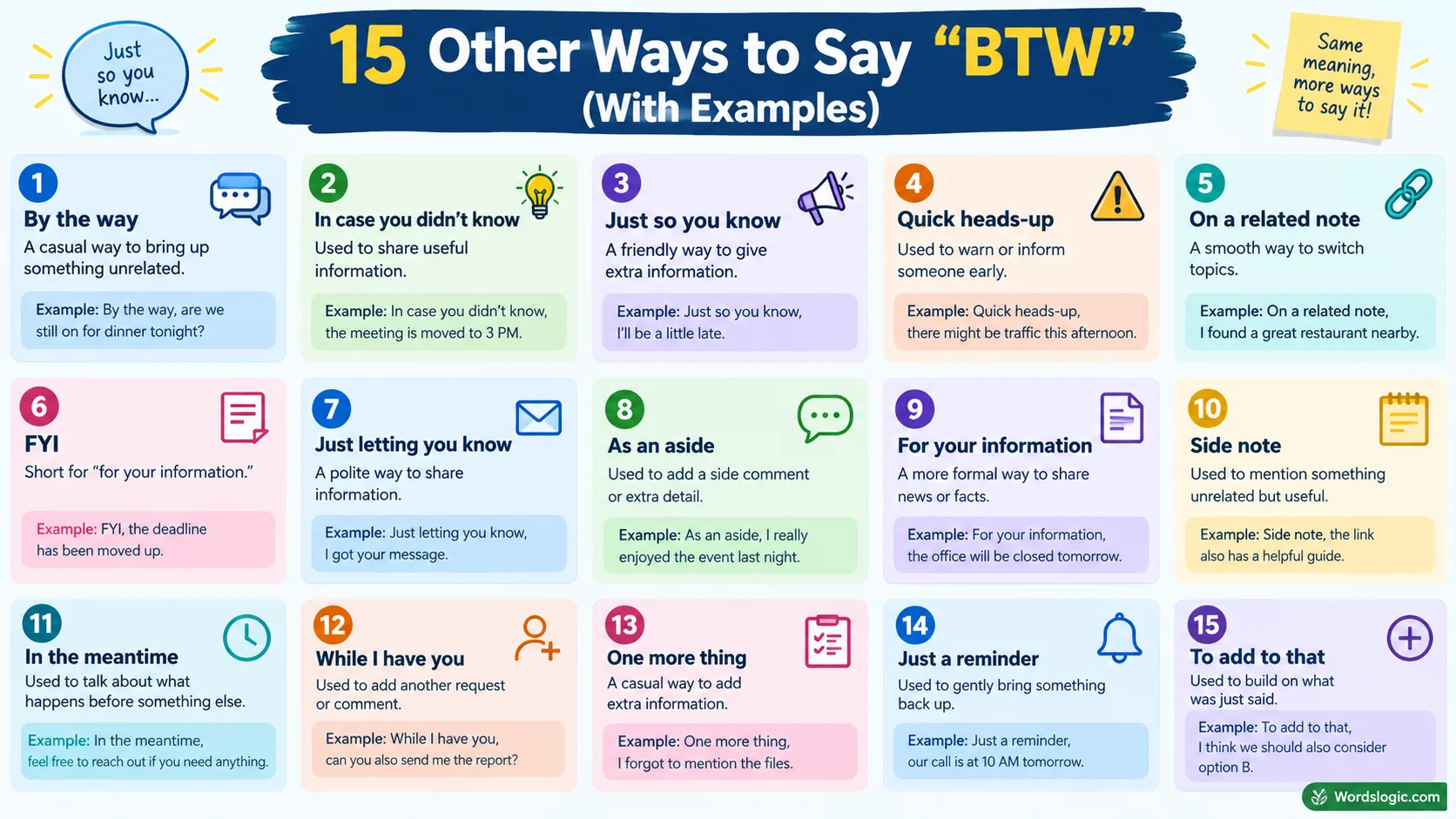
15 Alternatives to “BTW”
- By the way
- Incidentally
- On a related note
- On another note
- That reminds me
- Speaking of which
- Before I forget
- As an aside
- Also
- One more thing
- While we’re on the subject
- In other news
- Changing the subject
- Just so you know
- I should mention
1. By the way
Meaning
By the way is the full version of BTW. It introduces additional information, a reminder, or a side comment without making the conversation feel stiff.
Definition
A conversational expression used to add information or bring up a secondary point.
Detailed Explanation
Unlike the abbreviation BTW, the full phrase works in both speech and writing. It sounds natural in everyday conversations and many informal emails. The expression can introduce a related detail or a completely different subject, depending on the context. It is usually the easiest choice when you want to replace BTW without changing the meaning.
Scenario Examples
Scenario: You’re texting a friend about weekend plans.
Example: “By the way, should we invite Sarah too?”
Scenario: You’re messaging a coworker about a completed task.
Example: “By the way, I’ve uploaded the updated file.”
Best Use
Use this expression in everyday conversations, text messages, friendly emails, and informal workplace chats. In more formal writing, choose a transition that describes the relationship between your points.
Tone
Tone: Casual, friendly, conversational.
The complete phrase sounds natural and approachable while remaining clear to a wide range of readers.
2. Incidentally
Meaning
Incidentally introduces a secondary point or an additional detail that is not the main focus of the conversation. It can also introduce information that happens to be relevant.
Definition
An adverb used to introduce a side comment or an additional piece of information.
Detailed Explanation
Incidentally sounds more polished and slightly more formal than BTW. It works particularly well when the extra information is related to the discussion but not central to it. In casual conversation, it may sound a little deliberate or bookish compared with “by the way.” Choose it when you want a smooth transition in thoughtful writing or professional conversation.
Scenario Examples
Scenario: You’re discussing a project and remember a scheduling detail.
Example: “Incidentally, the client has moved the review to Thursday.”
Scenario: You’re talking about a local restaurant.
Example: “Incidentally, the café next door has started serving breakfast.”
Best Use
Use incidentally in polished emails, presentations, articles, and thoughtful conversations. Avoid it if you want a very relaxed text-message style.
Tone
Tone: Polished, neutral, slightly formal.
The word creates a more measured transition than the abbreviation BTW.
3. On a related note
Meaning
On a related note introduces information connected to the subject you’re already discussing.
Definition
A transition used to introduce another point that shares a clear connection with the current topic.
Detailed Explanation
This expression is more specific than BTW because it signals a relationship between the two ideas. It helps readers understand that you’re adding relevant information rather than suddenly changing subjects. It sounds natural in professional communication and organized writing. However, it is less suitable when the next point has little or no connection to the original discussion.
Scenario Examples
Scenario: You’re discussing a marketing campaign with your team.
Example: “On a related note, we should update the landing page before launch.”
Scenario: You’re helping a classmate prepare for an exam.
Example: “On a related note, the teacher posted another practice worksheet.”
Best Use
Use it in work emails, team discussions, school projects, and topic-focused conversations where the next point builds on the current subject.
Tone
Tone: Professional, clear, organized.
It helps your message feel structured without sounding overly formal.
4. On another note
Meaning
On another note introduces a different point or shifts the conversation toward another subject.
Definition
A transition phrase used to move from one topic to a different one.
Detailed Explanation
On another note differs from “on a related note” because it often signals a change rather than a direct connection. It is useful when you’ve finished discussing one matter and want to introduce something else. The phrase sounds smoother and more deliberate than suddenly switching topics. Still, it may feel unnecessary when the conversation is already moving naturally.
Scenario Examples
Scenario: You’ve finished discussing a work deadline and want to mention an office event.
Example: “On another note, don’t forget about Friday’s team lunch.”
Scenario: You’re chatting with a friend about a difficult week.
Example: “On another note, I found a great movie we could watch tonight.”
Best Use
Use it in casual conversations, emails, meetings, and longer messages when you want to signal a clear change of subject.
Tone
Tone: Friendly, neutral, transitional.
It makes a topic change feel intentional rather than abrupt.
5. That reminds me
Meaning
That reminds me introduces something that a previous comment, event, or idea has brought to your mind.
Definition
A conversational expression used when one thought triggers the memory of another.
Detailed Explanation
This phrase feels more personal than BTW because it explains why the new point came to mind. It works best when there is a genuine connection between what someone just said and the information you want to share. It can introduce a reminder, a question, or a related story. Unlike a general transition, it sounds less natural when the new subject has no clear connection to the previous discussion.
Scenario Examples
Scenario: Your friend mentions an upcoming birthday.
Example: “That reminds me, I still need to buy a gift for Maya.”
Scenario: A colleague talks about a client meeting.
Example: “That reminds me, we haven’t sent them the updated proposal.”
Best Use
Use it in spoken conversations, personal messages, informal meetings, and friendly reminders.
Tone
Tone: Natural, personal, conversational.
It gives the impression that the next thought came up naturally during the discussion.
6. Speaking of which
Meaning
Speaking of which introduces a point directly connected to something that was just mentioned.
Definition
A transition phrase used to continue a topic by referring to a related person, subject, or situation.
Detailed Explanation
This expression creates a stronger connection to the previous statement than BTW usually does. It is especially useful when a particular word or subject triggers another question or comment. The phrase can make conversations feel lively because it shows how one idea leads to another. It should generally refer to something already mentioned or clearly implied.
Scenario Examples
Scenario: Your friend mentions a concert.
Example: “Speaking of which, have you bought your tickets yet?”
Scenario: A teammate talks about a presentation.
Example: “Speaking of which, who is preparing the final slides?”
Best Use
Use it in conversations, team chats, interviews, and informal emails when you want to build directly on a previous point.
Tone
Tone: Engaged, conversational, connected.
It helps the next thought feel like a natural continuation of the discussion.
7. Before I forget
Meaning
Before I forget introduces information that the speaker wants to remember to share, often a reminder or an important detail.
Definition
A phrase used to bring up something that should be mentioned before it slips from memory.
Detailed Explanation
This expression places more emphasis on remembering than BTW does. It works well when you have a practical detail, request, or reminder to share. The wording can make a message feel spontaneous and personal, especially in conversation. However, it is not the best choice when the information is unrelated to remembering or when a highly formal tone is required.
Scenario Examples
Scenario: You’re texting your roommate about household plans.
Example: “Before I forget, the plumber is coming tomorrow morning.”
Scenario: You’re wrapping up a conversation with a coworker.
Example: “Before I forget, could you send me the final figures today?”
Best Use
Use it for reminders, personal messages, informal work conversations, and quick follow-up emails.
Tone
Tone: Practical, friendly, direct.
It signals that the information matters enough to mention now.
8. As an aside
Meaning
As an aside introduces a comment that sits outside the main point but may still be useful or interesting.
Definition
A phrase used to introduce secondary information without making it the central subject.
Detailed Explanation
As an aside sounds more formal and deliberate than BTW. It is helpful when you’re discussing one main subject but want to briefly add a separate observation. In writing, it can make a secondary comment feel intentional and controlled. Because it sounds somewhat formal, it may feel unnatural in a quick text to a close friend.
Scenario Examples
Scenario: You’re presenting a business report.
Example: “As an aside, the design team has already completed the next draft.”
Scenario: You’re explaining a book to a study group.
Example: “As an aside, the author also wrote a collection of short stories.”
Best Use
Use it in presentations, professional discussions, essays, and structured explanations where a secondary comment needs a clear introduction.
Tone
Tone: Measured, thoughtful, somewhat formal.
It separates a side comment from the main discussion without requiring a full topic change.
9. Also
Meaning
Also adds another fact, idea, action, or item to information already provided.
Definition
An adverb used to show that something additional is included.
Detailed Explanation
Also is shorter and more direct than BTW. It works best when the new information adds to the same general point rather than introducing an unrelated subject. The word is suitable for both casual and professional communication, making it more versatile than many conversational alternatives. However, it does not automatically signal a topic change or a personal reminder.
Scenario Examples
Scenario: You’re emailing a customer about an order.
Example: “Your package has shipped. We also included the updated invoice.”
Scenario: You’re making plans with a friend.
Example: “I can meet at six. I can also pick you up if you need a ride.”
Best Use
Use also in emails, reports, messages, instructions, and everyday conversation whenever you need to add another point clearly.
Tone
Tone: Neutral, direct, versatile.
Its straightforward wording makes it suitable for both informal and professional situations.
10. One more thing
Meaning
One more thing introduces an additional point, request, question, or reminder before the speaker moves on or ends the conversation.
Definition
A conversational phrase used to add one final or extra item of information.
Detailed Explanation
This expression often signals that the speaker has one more detail to share. It can sound friendly when used to add a small reminder, but it may also suggest that the message or conversation is nearly finished. Unlike BTW, it emphasizes the extra item rather than simply marking it as a side comment. If you have several new points, repeatedly using this phrase can become confusing.
Scenario Examples
Scenario: You’re finishing a message to a friend about a trip.
Example: “One more thing: bring a light jacket because it may get cold.”
Scenario: You’re ending a project discussion.
Example: “One more thing, please save the presentation as a PDF before sending it.”
Best Use
Use it in checklists, personal messages, meetings, and follow-up emails when you have one additional detail to mention.
Tone
Tone: Friendly, practical, direct.
It gives the extra point a little emphasis without making the message sound formal.
11. While we’re on the subject
Meaning
While we’re on the subject introduces another point that belongs to the topic currently being discussed.
Definition
A transition used to add a connected question, comment, or detail while a subject is already being discussed.
Detailed Explanation
This phrase is more topic-specific than BTW. It tells the listener that the new point fits into the current discussion, even if it hasn’t been mentioned yet. It works particularly well when you want to raise an additional issue before moving to another subject. It can sound slightly long in short messages, so a simpler transition may be more natural in casual texting.
Scenario Examples
Scenario: Your team is discussing office schedules.
Example: “While we’re on the subject, can we confirm next week’s coverage?”
Scenario: You’re talking with a friend about cooking.
Example: “While we’re on the subject, do you have that pasta recipe you mentioned?”
Best Use
Use it in meetings, planning conversations, group discussions, and detailed personal chats where the additional point is relevant to the current topic.
Tone
Tone: Engaged, purposeful, conversational.
It helps you introduce a related point without making the conversation feel scattered.
12. In other news
Meaning
In other news introduces another update or piece of information, often one that is separate from the current subject.
Definition
A phrase used to introduce a different development, announcement, or topic.
Detailed Explanation
In other news often signals a shift toward a separate update rather than a small detail connected to the original topic. It is common in news-style presentations, social media posts, and playful everyday conversation. The phrase can sound lighthearted when you’re sharing personal updates. It may be too casual or dramatic for a routine professional email unless the context supports that style.
Scenario Examples
Scenario: You’re sharing updates with friends in a group chat.
Example: “In other news, I finally passed my driving test!”
Scenario: You’re writing a casual team update.
Example: “In other news, the office kitchen will be closed for repairs on Monday.”
Best Use
Use it in social media posts, informal announcements, newsletters, and casual conversations when introducing a separate update.
Tone
Tone: Light, upbeat, announcement-like.
It makes a new development stand out from the information that came before it.
13. Changing the subject
Meaning
Changing the subject signals that the conversation is moving away from its current topic and toward something different.
Definition
An expression used to introduce or acknowledge a shift to a different subject.
Detailed Explanation
This wording is more explicit than BTW because it openly signals a change in direction. It can be useful when the current conversation has reached a natural stopping point or when you want to discuss something unrelated. Depending on the situation, it can also suggest that you prefer not to continue discussing the original topic. Because it is direct, it may sound abrupt if the other person is sharing something important or emotional.
Scenario Examples
Scenario: Friends have finished discussing a television show.
Example: “Changing the subject, has anyone decided where we’re going for dinner?”
Scenario: A meeting has become focused on an issue outside its purpose.
Example: “Changing the subject for a moment, we still need to confirm the launch date.”
Best Use
Use it in group discussions, meetings, and conversations where a clear topic shift is helpful. In sensitive situations, a gentler transition may be more considerate.
Tone
Tone: Direct, clear, sometimes abrupt.
Its suitability depends on whether a firm change of direction feels natural in the conversation.
14. Just so you know
Meaning
Just so you know introduces information that the listener may need or find useful, often as a heads-up, clarification, or reminder.
Definition
A conversational expression used to share information so another person is aware of it.
Detailed Explanation
This phrase differs from BTW because it emphasizes the listener’s awareness rather than the fact that the information is an extra point. It works well when sharing a practical update or letting someone know about a situation that may affect them. The wording can sound considerate, but it may also seem defensive or slightly sharp if the information is delivered critically. The surrounding sentence determines whether it feels helpful or confrontational.
Scenario Examples
Scenario: You’re letting a friend know about a delay.
Example: “Just so you know, the train is running about 15 minutes late.”
Scenario: You’re updating a coworker about a document.
Example: “Just so you know, the client asked for one more revision.”
Best Use
Use it in friendly messages, practical reminders, informal workplace communication, and helpful updates. For formal client communication, “Please note that” may be more appropriate.
Tone
Tone: Informative, helpful, direct.
It is useful when the main goal is to make sure the other person has relevant information.
15. I should mention
Meaning
I should mention introduces information that the speaker believes is worth including in the conversation.
Definition
A phrase used to bring up an additional fact, qualification, or important detail.
Detailed Explanation
I should mention sounds more deliberate than BTW and can work in both personal and professional settings. It is useful when the extra detail may affect a decision or help someone understand the full situation. The phrase can also introduce a qualification that might otherwise be overlooked. Because it gives the information some importance, it may sound unnecessarily serious when introducing a trivial detail.
Scenario Examples
Scenario: You’re emailing a colleague about an upcoming presentation.
Example: “I should mention that the client requested a shorter version.”
Scenario: You’re telling a friend about your travel plans.
Example: “I should mention that I’ll be arriving a day earlier than planned.”
Best Use
Use it in professional emails, project updates, thoughtful conversations, and explanations where the additional information deserves attention.
Tone
Tone: Thoughtful, clear, moderately formal.
It gives a detail more weight than a casual side comment without sounding overly stiff.
FAQs
What does BTW mean in texting?
BTW stands for “by the way.” People use this common abbreviation in texts, emails, and online chats to introduce additional information or share a side note.
Is BTW formal or informal?
BTW is mainly an informal expression used in casual conversations, text messages, and social media posts. In formal emails or professional writing, phrases such as “Additionally” or “On another note” may be more suitable.
What are some other ways to say BTW?
Common alternatives include “Incidentally,” “On another note,” “Just so you know,” “Additionally,” and “Speaking of which.” Choose an expression that matches your tone and the communication context.
Can I use BTW in professional emails?
Yes, you can use BTW in friendly workplace emails when the conversation is casual. However, in formal business communication, writing “Additionally” or “I would also like to mention” can sound more professional and clear.
How do I use BTW in a sentence?
You can use BTW to introduce a related detail or a new thought. For example: “BTW, the meeting starts at 10 a.m.” This sentence adds useful information without changing the main message.
Conclusion
BTW, short for “by the way,” is a handy abbreviation that makes everyday communication feel natural and conversational. Whether you’re writing text messages, sending emails, or chatting on social media, it helps you introduce additional information, share a side note, and keep the conversation flowing. The right usage depends on your audience, purpose, and communication style.
Learning other ways to say BTW, such as “Incidentally,” “On another note,” and “Just so you know,” gives you more choices for different situations. Use casual alternatives with friends and familiar contacts, and choose more professional expressions for formal emails or workplace discussions. By selecting the right phrase, you can make your writing clearer, improve your communication skills, and share information without distracting readers from the main point.