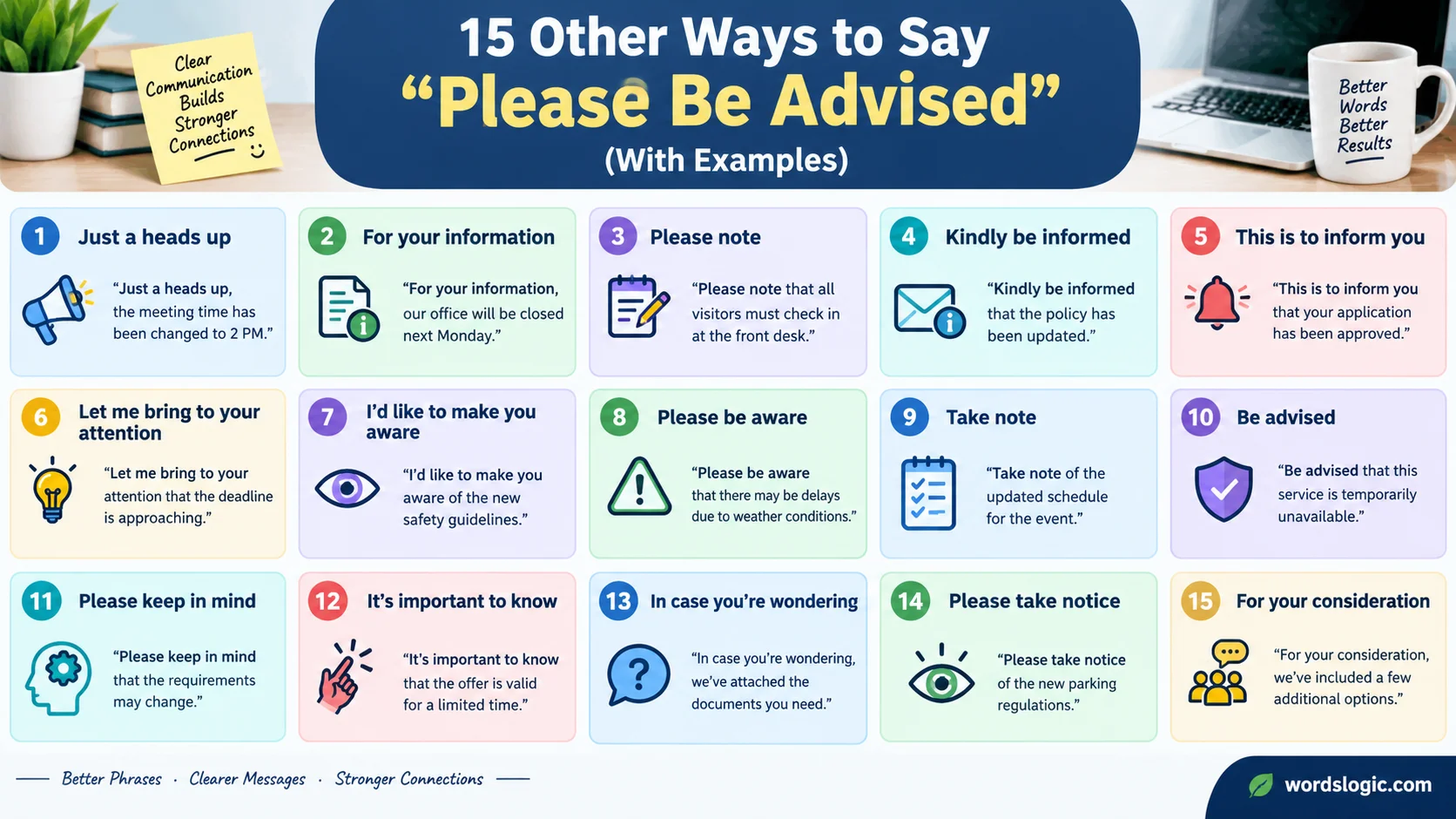
In professional writing, Other Ways to Say “Please Be Advised” can help you share important updates in a clear, polite, and natural way.
The phrase “Please Be Advised” is common in formal emails, business writing, and everyday workplace communication. However, using the same wording repeatedly can make a message feel stiff, distant, or impersonal. Choosing thoughtful alternatives helps your communication sound more human, warm, respectful, and approachable while maintaining professionalism.
For example, phrases like “Kindly note,” “For your awareness,” and “Just so you know” suit different situations and audiences. These alternatives can make important information easier to understand, improve message clarity, and build trust with clients, colleagues, and team members. The best choice depends on your message purpose, tone, and the level of formality your reader expects.
What Does “Please Be Advised” Mean?
“Please be advised” is a formal expression used to draw someone’s attention to important information. It tells the reader to take notice of an announcement, update, instruction, warning, or change. For example, a manager might write, “Please be advised that the meeting has been moved to Thursday.” The phrase doesn’t necessarily ask the reader to take action. It simply signals that the information should be understood or considered.
The expression is especially common in business correspondence, official notices, customer service messages, and administrative communication. Depending on the context, it can sound professional, serious, or slightly distant. In everyday conversation, simpler alternatives such as “Just so you know” or “Please note” often sound more natural.
Common Situations Where “Please Be Advised” Is Used
People use this phrase when they need to communicate information clearly and formally. In the workplace, it may introduce a schedule change, updated policy, deadline, or procedural requirement. In customer service, it can explain a delay, service interruption, price change, or account update. Schools and organizations may also use it in announcements about closures, events, or new rules.
The phrase can be useful in formal emails, notices, and official documents, but it isn’t always the best choice for personal messages. If you’re writing to a coworker you know well, “A quick reminder” might feel friendlier. If you’re communicating with a customer, “We would like to inform you” may sound more considerate. The best alternative depends on the message, the reader, and whether you need to share information, give a warning, or request action.
Is It Professional or Polite to Say “Please Be Advised”?
Yes, “Please be advised” is generally professional and grammatically correct. It works well in formal correspondence, policy notices, and messages that require a clear, official tone. However, it can sound impersonal or overly formal in a friendly conversation. The word “please” adds politeness, but the overall expression may still feel authoritative because it directs the reader’s attention to information.
For routine workplace updates, “Please note” is often shorter and more natural. For a sensitive customer message, “We would like to inform you” can sound more considerate. When speaking to a friend, “Just so you know” is usually more appropriate. Remember that politeness also depends on the surrounding message: a respectful explanation and a clear next step often matter more than the opening phrase alone.
Advantages and Disadvantages of Saying “Please Be Advised”
Advantages
- Professional tone: It fits formal emails, official announcements, and administrative notices.
- Clear emphasis: It signals that the following information deserves attention.
- Useful for important updates: It introduces changes, warnings, deadlines, and policy information.
- Broad application: It works in many business and institutional settings without sounding overly emotional.
Disadvantages
- Can sound stiff: Everyday updates may feel unnecessarily formal when introduced this way.
- May seem impersonal: The phrase doesn’t communicate much warmth or personal consideration.
- Can become repetitive: Reusing it in every email makes business writing feel mechanical.
- Doesn’t explain the required action: Readers may still need clarification about whether they should respond, prepare, or simply take note.
15 Alternatives to “Please Be Advised”
- Please note
- Kindly note
- Please be aware
- For your information
- We would like to inform you
- Please take note
- Just so you know
- A quick reminder
- I wanted to let you know
- Please keep in mind
- Be advised that
- This is to inform you
- We wish to inform you
- Please remember
- For your awareness
1. Please Note
Meaning
“Please note” asks the reader to pay attention to a particular detail, announcement, or change. It is one of the most versatile alternatives to “Please be advised” because it sounds professional without being overly formal.
Definition
A polite expression used to highlight information that deserves attention.
Detailed Explanation
“Please note” works well when you want readers to notice a fact without making the message sound like a warning. It is shorter and more direct than “Please be advised.” You can use it in business emails, instructions, meeting updates, and customer announcements. However, if you need to communicate a serious risk, you may need stronger wording that clearly explains the concern.
Scenario Examples
- Scenario: A manager announces a change in meeting time.
Example: “Please note that tomorrow’s meeting will begin at 10:30 a.m.” - Scenario: A business explains its holiday schedule.
Example: “Please note that our office will close at noon on Friday.”
Best Use
Use this phrase in professional emails, announcements, instructions, and routine updates. It is especially helpful when the reader needs to notice a specific detail.
Tone
Tone: Professional, polite, direct.
It communicates importance without sounding unnecessarily strict.
2. Kindly Note
Meaning
“Kindly note” asks someone to pay attention to information in a courteous manner. It is often used in formal business correspondence and administrative communication.
Definition
A polite request for someone to notice or remember specific information.
Detailed Explanation
This expression places a little more emphasis on courtesy than “Please note.” It is common in some varieties of international business English, although it can sound stiff in casual American English. Use it when you want to maintain a formal, respectful tone. If you’re writing to a close colleague or friend, a simpler expression may sound more natural.
Scenario Examples
- Scenario: An administrator shares a submission deadline.
Example: “Kindly note that all applications must be submitted by October 25.” - Scenario: A supplier explains a change to delivery arrangements.
Example: “Kindly note that deliveries may take an additional business day this week.”
Best Use
Choose this expression for formal emails, administrative notices, and professional messages where courteous wording is important.
Tone
Tone: Courteous, formal, respectful.
The word “kindly” adds politeness, though its naturalness depends on the audience and regional writing conventions.
3. Please Be Aware
Meaning
“Please be aware” tells the reader that certain information, circumstances, or possible consequences deserve attention.
Definition
A polite expression used to draw attention to a relevant fact or situation.
Detailed Explanation
This phrase is particularly useful when the information may affect someone’s plans or decisions. Compared with “Please note,” it can suggest that the reader should understand a condition or potential issue, not merely notice a detail. It doesn’t automatically indicate danger, but it can introduce a caution. If the message concerns a serious risk, explain the risk clearly rather than relying on this phrase alone.
Scenario Examples
- Scenario: A company explains possible shipping delays.
Example: “Please be aware that severe weather may affect delivery times.” - Scenario: A school informs parents about construction near its entrance.
Example: “Please be aware that the main entrance will be temporarily closed.”
Best Use
Use it for important updates, practical cautions, policy changes, and information that could affect someone’s choices.
Tone
Tone: Professional, informative, mildly cautionary.
It prepares readers for relevant information without necessarily sounding alarming.
4. For Your Information
Meaning
“For your information” introduces details that the reader may find useful or need to know. It is commonly shortened to FYI in workplace messages and informal digital communication.
Definition
An expression that shares information with someone, often without requesting an immediate response.
Detailed Explanation
This phrase is useful when you want to pass along a fact, document, or update rather than issue an instruction. It can sound neutral in a well-written email, but depending on context, it may come across as defensive or sarcastic. “Please be advised” often sounds more official, while “For your information” focuses on sharing knowledge. Make the purpose clear if you expect the reader to do something with the information.
Scenario Examples
- Scenario: A colleague forwards a document for reference.
Example: “For your information, I’ve attached the revised project schedule.” - Scenario: A team member shares an update about a deadline.
Example: “FYI, the client has approved the new design.”
Best Use
Choose this phrase for informational emails, internal updates, forwarded documents, and messages where no direct action is required.
Tone
Tone: Informative, neutral, sometimes casual.
The wording is straightforward, but the surrounding message determines whether it feels helpful or pointed.
5. We Would Like to Inform You
Meaning
“We would like to inform you” introduces an announcement or update in a considerate, professional way. It emphasizes the act of communicating information to the reader.
Definition
A formal expression used to announce information on behalf of a person or organization.
Detailed Explanation
This phrase works particularly well when communicating with customers, applicants, employees, or members of an organization. It sounds more customer-focused than “Please be advised” because it frames the message as an announcement rather than a directive. The wording is longer, so it may feel unnecessary for simple updates between coworkers. Use it when the information deserves a more complete and polished introduction.
Scenario Examples
- Scenario: A company announces a service update.
Example: “We would like to inform you that our online payment system will be unavailable on Sunday.” - Scenario: An admissions office shares an application decision.
Example: “We would like to inform you that your application has moved to the next review stage.”
Best Use
Use it in customer service emails, formal announcements, institutional correspondence, and official company communication.
Tone
Tone: Formal, respectful, considerate.
It gives an announcement a polished feel without directly telling the reader what to do.
6. Please Take Note
Meaning
“Please take note” asks the reader to pay attention to information and, often, remember it for future reference.
Definition
A polite instruction to notice and retain an important detail.
Detailed Explanation
This phrase is useful when a detail could affect a later decision, task, or procedure. It can sound slightly more directive than “Please note,” particularly when used in rules or instructions. Although the two expressions overlap, “Please take note” puts a little more emphasis on actively registering the information. Avoid using it for trivial details if you want your message to feel relaxed.
Scenario Examples
- Scenario: A trainer explains a new procedure.
Example: “Please take note of the revised steps before starting the exercise.” - Scenario: An event organizer provides an arrival instruction.
Example: “Please take note that registration closes at 8:45 a.m.”
Best Use
Choose it for training materials, procedural instructions, event notices, and messages where readers should remember a specific detail.
Tone
Tone: Direct, instructional, professional.
It communicates that the information deserves attention and may need to be remembered.
7. Just So You Know
Meaning
“Just so you know” shares information in a relaxed, conversational way. It often introduces an update that could be useful to another person.
Definition
An informal expression meaning “I’m telling you this so you’re aware of it.”
Detailed Explanation
This phrase is much more casual than “Please be advised.” It works well between friends, familiar coworkers, and people who communicate comfortably with one another. Depending on your wording, it can sound helpful, reassuring, or slightly defensive. Because it is informal, it usually isn’t the strongest choice for legal notices or highly formal business announcements.
Scenario Examples
- Scenario: A friend shares a change in weekend plans.
Example: “Just so you know, we’re meeting at Maya’s place instead.” - Scenario: A coworker gives a quick update in chat.
Example: “Just so you know, the client sent the missing files this morning.”
Best Use
Use it in text messages, casual conversations, friendly emails, and informal workplace chats.
Tone
Tone: Casual, friendly, conversational.
It makes information feel like a helpful heads-up rather than an official announcement.
8. A Quick Reminder
Meaning
“A quick reminder” introduces information that someone may already know but could have forgotten. It usually reinforces a deadline, appointment, responsibility, or upcoming event.
Definition
A brief message intended to help someone remember an important detail or task.
Detailed Explanation
Unlike “Please be advised,” this phrase usually refers to information that has already been shared or an action that is approaching. It can sound warmer and less formal, especially when the reminder is short. However, it isn’t a true substitute when you’re announcing something completely new or issuing a warning. If the reader needs to take action, clearly state what they need to do and when.
Scenario Examples
- Scenario: A teacher reminds students about an assignment.
Example: “A quick reminder: your research papers are due on Monday.” - Scenario: A team lead follows up on a scheduled call.
Example: “A quick reminder that our project check-in starts at 2 p.m.”
Best Use
Choose it for deadline reminders, appointment notifications, follow-up emails, and routine workplace communication.
Tone
Tone: Friendly, practical, gently direct.
It helps readers remember something without making the message sound like a formal warning.
9. I Wanted to Let You Know
Meaning
“I wanted to let you know” introduces information in a personal, considerate way. It is especially useful when communicating an update directly to someone.
Definition
A conversational expression used to share information with a particular person.
Detailed Explanation
This wording makes a message feel more personal than “Please be advised.” It works well when the information affects the recipient or when you want to show consideration. Although it uses the past-tense phrase “wanted to,” it is a natural way to introduce a present message in English. For an official announcement sent to a large audience, a more neutral expression may be more suitable.
Scenario Examples
- Scenario: A coworker explains a change that affects a shared task.
Example: “I wanted to let you know that I’ll send you the updated figures this afternoon.” - Scenario: Someone informs a friend about a schedule change.
Example: “I wanted to let you know that I’ll be about 15 minutes late.”
Best Use
Use it in personal emails, one-to-one workplace messages, friendly updates, and considerate communication.
Tone
Tone: Warm, personal, thoughtful.
It focuses on keeping the recipient informed rather than making the message sound official.
10. Please Keep in Mind
Meaning
“Please keep in mind” asks someone to consider a fact, condition, or limitation when making a decision or interpreting information.
Definition
A polite expression that encourages someone to remember or consider relevant information.
Detailed Explanation
This phrase is especially useful when a reader needs context to make a good decision. Unlike “Please be advised,” which can introduce almost any announcement, “Please keep in mind” highlights a factor that should influence someone’s expectations or choices. It is not usually the best way to announce a simple fact that requires no further thought. Add a clear explanation of what the reader should consider.
Scenario Examples
- Scenario: A project manager explains a realistic timeline.
Example: “Please keep in mind that the final review may take two additional days.” - Scenario: A friend discusses travel plans with a group.
Example: “Please keep in mind that the last train leaves before midnight.”
Best Use
Choose it for planning discussions, instructions, advice, project updates, and messages that require readers to consider a condition or limitation.
Tone
Tone: Considerate, explanatory, gently cautionary.
It encourages thoughtful consideration rather than simply directing attention to an announcement.
11. Be Advised That
Meaning
“Be advised that” introduces information in a formal, authoritative manner. It is closely related to “Please be advised,” but removing “please” makes the wording more direct.
Definition
A formal expression used to announce information, a condition, or a requirement.
Detailed Explanation
This phrase is appropriate when the message needs an official or firm tone. It often appears in administrative notices, formal warnings, and policy-related communication. Because it lacks the softening effect of “please,” it can sound more commanding. Use it carefully in routine correspondence, especially when a less forceful expression would communicate the same information more naturally.
Scenario Examples
- Scenario: An organization announces a rule change.
Example: “Be advised that all visitors must register at the front desk.” - Scenario: A formal notice explains an access restriction.
Example: “Be advised that the east entrance will remain locked during maintenance.”
Best Use
Use it for official notices, policy announcements, formal instructions, and circumstances that require an authoritative tone.
Tone
Tone: Formal, firm, authoritative.
It places emphasis on the information and can sound more forceful than the original phrase.
12. This Is to Inform You
Meaning
“This is to inform you” introduces an official announcement or communicates a significant update. It is commonly used in formal letters and institutional messages.
Definition
A formal expression signaling that the message contains information intended for the recipient.
Detailed Explanation
This phrase sounds structured and official, making it useful for administrative correspondence. It can introduce a decision, schedule change, notice, or procedural update. Compared with “Please be advised,” it focuses more directly on the purpose of the message. However, it may sound impersonal in a friendly email, so use a conversational alternative when personal warmth matters more than formality.
Scenario Examples
- Scenario: A training center announces a closure.
Example: “This is to inform you that the center will be closed next Monday.” - Scenario: An organization confirms a change in procedure.
Example: “This is to inform you that the registration process has been updated.”
Best Use
Choose it for formal letters, institutional announcements, administrative notices, and official correspondence.
Tone
Tone: Formal, neutral, official.
It presents information in a structured way without adding unnecessary emotion.
13. We Wish to Inform You
Meaning
“We wish to inform you” introduces information on behalf of a group, business, or institution. It has a formal and somewhat traditional style.
Definition
A courteous, formal expression used to communicate an announcement from an organization or group.
Detailed Explanation
This phrase is similar to “We would like to inform you,” but it can sound more traditional and ceremonious. It suits formal announcements when the sender represents an organization rather than speaking only for themselves. In many modern business emails, “We would like to inform you” or a direct statement sounds more natural. Choose this wording when the more formal style matches the audience and purpose.
Scenario Examples
- Scenario: A professional association announces an event.
Example: “We wish to inform you that the annual meeting will take place on November 12.” - Scenario: A service provider announces a policy update.
Example: “We wish to inform you that our membership terms will change next quarter.”
Best Use
Use it in formal organizational letters, institutional notices, and traditional business correspondence.
Tone
Tone: Formal, courteous, traditional.
It creates a respectful announcement, although it may sound overly ceremonial in everyday communication.
14. Please Remember
Meaning
“Please remember” asks the reader to keep a particular fact, instruction, or responsibility in mind. It is especially useful when someone needs to recall something important.
Definition
A polite request to retain information in memory or act in accordance with an instruction.
Detailed Explanation
This expression is more action-oriented than “Please be advised” when it reminds readers of a responsibility. It works well for instructions, deadlines, safety guidance, and recurring expectations. Depending on the context, it can sound caring or slightly parental, particularly when addressing adults about something they already know. Make sure the reminder feels appropriate to the relationship and doesn’t imply unnecessary criticism.
Scenario Examples
- Scenario: A teacher explains an exam requirement.
Example: “Please remember to bring your student ID to the examination.” - Scenario: A team leader reminds staff about confidentiality.
Example: “Please remember that customer records must be handled securely.”
Best Use
Choose it for instructions, reminders, educational settings, workplace responsibilities, and messages where remembering or following a rule matters.
Tone
Tone: Polite, instructive, sometimes caring.
It emphasizes memory and responsibility rather than merely announcing information.
15. For Your Awareness
Meaning
“For your awareness” introduces information shared so that someone understands a situation or stays informed. It is most often found in professional or organizational communication.
Definition
A workplace-oriented expression used to share information that someone should know about.
Detailed Explanation
This phrase is useful when you want to keep a colleague or stakeholder informed without necessarily asking them to act. It can sound more corporate than “For your information,” particularly in project updates and internal reports. It isn’t always the most natural choice in everyday English, and it may feel vague if the importance of the update isn’t clear. Explain why the information matters when the reader needs to make a decision or take action.
Scenario Examples
- Scenario: A project coordinator shares an update with stakeholders.
Example: “For your awareness, the supplier has revised the estimated delivery date.” - Scenario: A department head shares an operational change.
Example: “For your awareness, the support team will use a new ticketing system starting Monday.”
Best Use
Use it in internal workplace updates, project communication, stakeholder emails, and informational reports where keeping people informed is the main goal.
Tone
Tone: Professional, neutral, corporate.
It emphasizes awareness rather than urgency, making it suitable for informational updates that don’t require an immediate response.
FAQs
What does “Please Be Advised” mean?
“Please Be Advised” is a formal phrase used to share important information, updates, or instructions. People often use it in professional emails, business letters, and workplace communication to make sure the reader knows about something important.
What are the best alternatives to “Please Be Advised”?
Some useful alternatives include “Kindly note,” “For your awareness,” “Just so you know,” “Please note,” and “For your information.” Each phrase has a slightly different tone, so choose one that fits your message, audience, and level of formality.
Is “Please Be Advised” considered rude?
No, “Please Be Advised” is not usually rude. However, it can sound stiff, distant, or overly formal in some situations. Using polite, clear, and conversational wording can help your message feel warmer and more approachable.
Can I use alternatives to “Please Be Advised” in professional emails?
Yes, you can use these alternatives in professional emails. Phrases such as “Please note” and “Kindly note” work well for formal updates, while “For your awareness” can introduce useful information. Choose wording that maintains clarity, respect, and professionalism.
When should I avoid using “Please Be Advised”?
Avoid repeating “Please Be Advised” in every message, especially when a simpler phrase communicates the same idea. In friendly workplace conversations, natural language such as “Just so you know” may sound more personal. For serious notices or official instructions, a more formal expression may be appropriate.
Conclusion
Choosing the right alternatives to “Please Be Advised” can make your writing sound more natural, clear, and respectful. Although the phrase remains useful in formal communication, repeating it too often may make your messages feel distant. Expressions such as “Kindly note,” “Please note,” “For your awareness,” and “For your information” help you share updates while keeping your tone appropriate for the situation.
Before sending a professional email, consider your audience, the purpose of your message, and the impression you want to create. Use formal wording when sharing official information, and choose conversational phrases when a warmer tone fits better. By using clear language and thoughtful expressions, you can improve communication quality, build professional relationships, and make your messages easier to understand.













