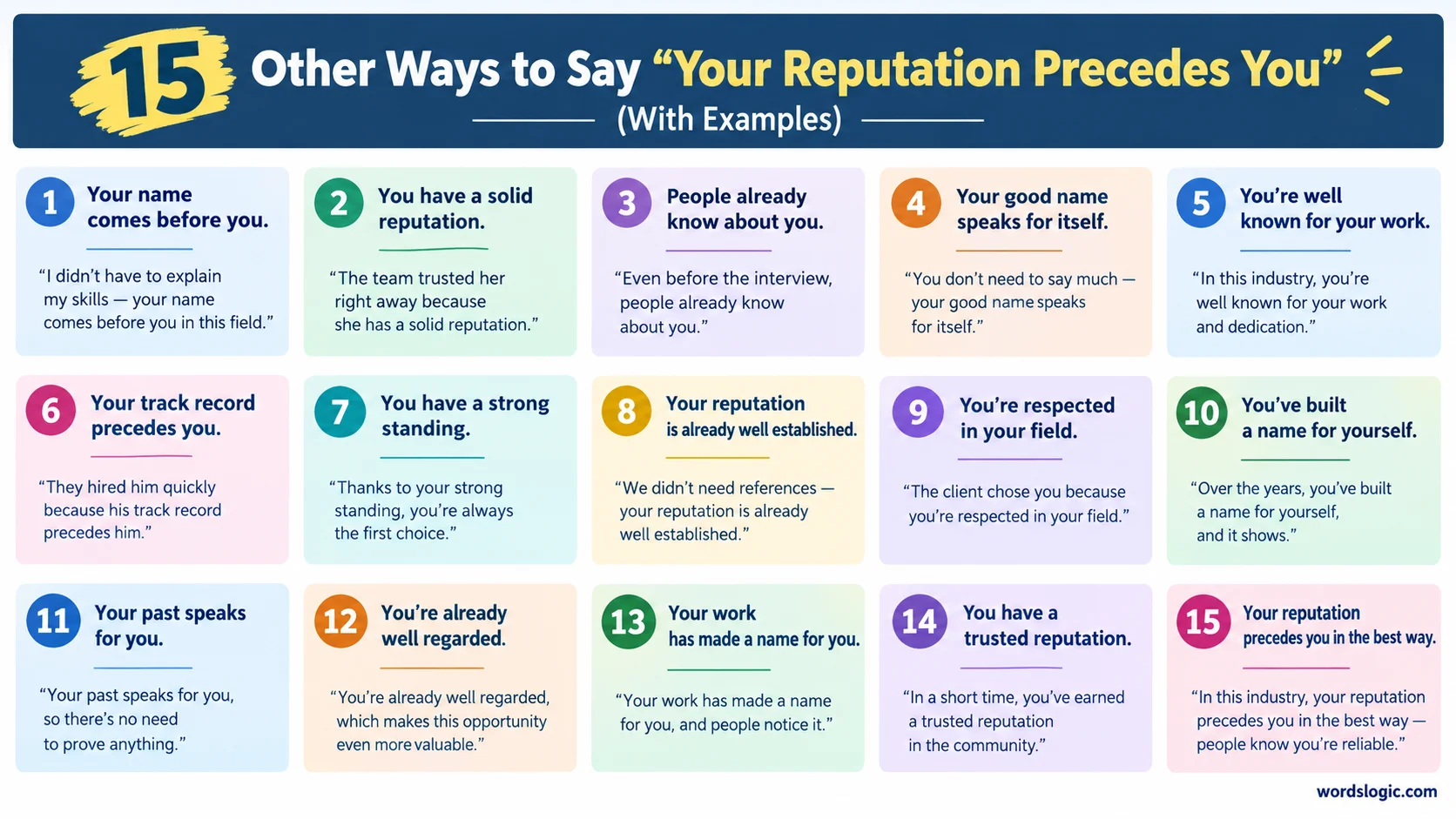
Other Ways to Say “Your Reputation Precedes You” explains how a known image can shape impressions before people meet you in person at work today. The saying Your Reputation Precedes You suggests that your reputation can arrive long before you physically arrive. People may know something about you through past actions, experiences, or stories heard from someone else.
Even small things can affect the impressions others hold, which are shaped by what they have noticed, heard, and formed in their minds. A single word spoken, behavior, or subtle gesture can influence perception in social and professional circles. A good image may naturally gain respect, while a bad reputation can make a person struggle to rebuild trust.
here are other ways to say Your Reputation Precedes You, depending on the tone, formality, and meaning you want. You might say that people have heard of you, your past speaks for you, your name carries weight, or people know your work. Sometimes, you introduce yourself through your work, personality, achievements, or the stories others have shared. These details may create an impression in advance. That is the idea behind the phrase. While this wording is natural and expressive, you may want different wording when speaking to a friend, welcoming a colleague, introducing someone, or writing professionally. The practical difference is often the level of formality and the exact meaning you want to show.
What Does “Your Reputation Precedes You” Mean?
“Your reputation precedes you” means that people have already heard about you or formed an impression of you before meeting or speaking with you directly. Your reputation may come from your achievements, professional work, personality, relationships, or things other people have said about you. For example, if a new employee joins a company and several coworkers already know about their excellent work, someone might say, “Your reputation precedes you.” The phrase can be positive, neutral, or occasionally negative depending on the reputation being discussed.
The expression often carries a sense of recognition and anticipation. It suggests that your name or past actions have created expectations before you arrive. In most friendly or professional situations, it is meant as a compliment, especially when the speaker has heard good things about you.
Common Situations Where “Your Reputation Precedes You” Is Used
The phrase is most common when meeting someone for the first time after hearing about them from other people. A manager might use it when welcoming a highly regarded new employee, or a professional might say it when meeting someone whose work they already know.
It also works in introductions, networking, conferences, business meetings, social events, and personal conversations. Someone might tell a talented photographer, “Your reputation precedes you,” after seeing their work before meeting them. In a casual setting, however, the expression can sound slightly formal or polished, so a simpler alternative may feel more natural.
The phrase can also be used playfully. If a friend has a reputation for always arriving late, another friend might jokingly say, “Your reputation precedes you,” when they finally show up late to an event. In that case, the meaning depends heavily on context and tone.
Is It Professional or Polite to Say “Your Reputation Precedes You”?
Yes, “Your reputation precedes you” can be professional, polite, and complimentary. It is especially suitable when welcoming someone whose work, accomplishments, or professional standing is already known. It can sound thoughtful and sophisticated without being overly formal.
However, the phrase is somewhat idiomatic and polished, so it may feel less natural in very casual conversations. Saying “I’ve heard great things about you” or “I’ve heard a lot about your work” may sound warmer and more conversational.
The phrase also needs some care because “reputation” is not automatically positive. Depending on the situation, it can refer to either a favorable or unfavorable public impression. If you want to make your positive intention unmistakable, choose wording such as “I’ve heard wonderful things about you” or “Your work speaks for itself.”
Advantages and Disadvantages of Saying “Your Reputation Precedes You”
Advantages
The expression is concise and memorable. Instead of explaining that several people have already mentioned someone, it communicates the idea in a short, established phrase. It can also sound respectful when addressing someone who has achieved recognition in a particular field.
Another advantage is its flexibility. The phrase can refer to professional accomplishments, personal qualities, creative work, or even a humorous reputation. It also creates an opportunity for conversation because the person may naturally ask what the speaker has heard.
Disadvantages
The phrase can sound more formal or dramatic than necessary in casual conversation. Some people may also interpret “reputation” broadly and wonder whether the speaker means something positive or negative.
It can also create ambiguity when you want to praise someone directly. If your intention is clearly complimentary, a more specific expression such as “I’ve heard great things about you” can make the meaning warmer and easier to understand.
Synonyms for “Your Reputation Precedes You”
- I’ve Heard Great Things About You
- I’ve Heard a Lot About You
- I’ve Heard Wonderful Things About Your Work
- Your Work Speaks for Itself
- You Come Highly Recommended
- I’ve Heard You’re Very Good at What You Do
- I’ve Heard You Have Quite a Reputation
- People Speak Highly of You
- Your Name Came Up Before We Met
- I’ve Heard You’re Well Regarded
- I Already Know of Your Work
- I’ve Heard Good Things About Your Contributions
- Your Achievements Are Well Known
- You’re Already Known for Your Work
- I Was Looking Forward to Meeting You
1. I’ve Heard Great Things About You
Meaning
“I’ve heard great things about you” means other people have spoken positively about you before the current conversation or meeting. It is one of the most natural alternatives when you want to make the positive meaning of “Your Reputation Precedes You” completely clear.
Definition
A friendly expression used to tell someone that others have given you a favorable impression of them before you met.
Detailed Explanation
This phrase is warmer and more conversational than “Your reputation precedes you.” It focuses directly on positive comments from other people rather than on reputation in general. It works particularly well when meeting someone for the first time. Because it is straightforward, the listener does not have to wonder whether “reputation” is meant positively or negatively.
Scenario Examples
Scenario: You meet a friend’s colleague at a dinner.
Example: “It’s great to finally meet you. I’ve heard great things about you.”
Scenario: A new employee joins your department after being recommended by another manager.
Example: “Welcome to the team. I’ve heard great things about you from Sarah.”
Scenario: You meet a local artist whose work your friends have praised.
Example: “I’m glad we finally met. I’ve heard great things about you and your artwork.”
Best Use
Best for friendly introductions, networking, workplace conversations, and personal meetings where you want to sound genuinely positive.
Tone
Tone: Warm, friendly, complimentary
It sounds natural and sincere without being overly formal.
2. I’ve Heard a Lot About You
Meaning
“I’ve heard a lot about you” means your name or story has come up in conversations before you met. It is broader and less strongly complimentary than “I’ve heard great things about you.”
Definition
A conversational expression meaning that other people have previously talked about or mentioned someone.
Detailed Explanation
This phrase is useful when you know someone has been discussed but do not want to make a specific judgment about what was said. It can be positive, neutral, or slightly playful depending on your delivery. In a friendly setting, it often implies that the person has made an impression on others. The expression is also more casual than the original phrase.
Scenario Examples
Scenario: Your friend introduces you to their longtime coworker.
Example: “Oh, so you’re Mike! I’ve heard a lot about you.”
Scenario: You meet your partner’s close friend for the first time.
Example: “It’s nice to finally meet you. I’ve heard a lot about you.”
Scenario: A colleague introduces a specialist joining a project.
Example: “I’ve heard a lot about you and the work you’ve been doing.”
Best Use
Best for casual conversation, introductions, social gatherings, and friendly workplace interactions.
Tone
Tone: Casual, friendly, open
Because it does not specify whether the comments were positive, your tone and surrounding words help communicate the intended meaning.
3. I’ve Heard Wonderful Things About Your Work
Meaning
This expression tells someone that other people have praised their professional or creative work. It narrows the focus from the person’s overall reputation to something specific they have accomplished.
Definition
A complimentary statement indicating that the speaker has received positive comments about someone’s work.
Detailed Explanation
This is a particularly useful alternative when meeting a professional, artist, writer, designer, teacher, consultant, or specialist. It makes the source of the reputation clear: their work. Compared with “Your reputation precedes you,” it sounds warmer and more specific. It also avoids suggesting that you know anything about the person’s private life or personality.
Scenario Examples
Scenario: You meet a graphic designer whose projects have been recommended by colleagues.
Example: “I’ve heard wonderful things about your work. I’m excited to collaborate with you.”
Scenario: A speaker arrives at a professional event.
Example: “Welcome. I’ve heard wonderful things about your work in this field.”
Scenario: You meet a photographer whose portfolio impressed your friends.
Example: “I’ve heard wonderful things about your work, especially your event photography.”
Best Use
Best for professional introductions, networking, conferences, creative industries, and business communication.
Tone
Tone: Warm, professional, appreciative
It combines personal warmth with a clear professional compliment.
4. Your Work Speaks for Itself
Meaning
“Your work speaks for itself” means that the quality or impact of someone’s work is strong enough to demonstrate their abilities without additional explanation.
Definition
An expression used to say that someone’s results, achievements, or creations clearly demonstrate their value or skill.
Detailed Explanation
This expression is slightly different from “Your reputation precedes you.” It does not focus on what other people have said. Instead, it emphasizes visible results and accomplishments. It can be a powerful compliment because it suggests that the person’s work provides its own evidence of ability. In some situations, it can also sound more confident and professional.
Scenario Examples
Scenario: A designer presents an impressive portfolio.
Example: “You don’t need to explain every project. Your work speaks for itself.”
Scenario: A colleague has consistently delivered successful projects.
Example: “After everything you’ve accomplished, your work speaks for itself.”
Scenario: You praise an artist after seeing their latest exhibition.
Example: “The quality is obvious. Your work really speaks for itself.”
Best Use
Best for professional settings, portfolios, creative work, achievements, presentations, and performance-based compliments.
Tone
Tone: Confident, respectful, professional
It sounds more focused on accomplishments than personal reputation.
5. You Come Highly Recommended
Meaning
“You come highly recommended” means that people whose opinions are trusted have spoken very positively about you.
Definition
A professional expression indicating that others have strongly recommended someone because of their qualities, skills, or work.
Detailed Explanation
This phrase is common when someone has been referred for a job, service, project, or professional opportunity. It emphasizes recommendations from others, rather than general public recognition. It can therefore sound more specific and credible in professional contexts. It is especially useful when you want to welcome someone while acknowledging that another person has already endorsed them.
Scenario Examples
Scenario: A client meets a consultant recommended by a trusted colleague.
Example: “Thanks for meeting with us. You come highly recommended by our director.”
Scenario: A homeowner meets a contractor referred by a neighbor.
Example: “I’ve heard you come highly recommended in the area.”
Scenario: A manager interviews a candidate recommended internally.
Example: “You come highly recommended by several people on our team.”
Best Use
Best for business introductions, referrals, hiring, professional services, and networking.
Tone
Tone: Professional, respectful, complimentary
It sounds polished and gives clear credit to the people who recommended the individual.
6. I’ve Heard You’re Very Good at What You Do
Meaning
This means that people have told the speaker that the person is highly capable or skilled in their area of work or expertise.
Definition
A direct compliment expressing that someone has a strong reputation for being skilled at their work.
Detailed Explanation
This alternative sounds more conversational than “Your reputation precedes you.” It is especially useful when you want to compliment someone’s ability rather than their general reputation. The wording is clear and easy to understand, making it suitable for everyday conversations. It can also feel more personal because it directly acknowledges the person’s competence.
Scenario Examples
Scenario: You meet a mechanic recommended by a friend.
Example: “Nice to meet you. I’ve heard you’re very good at what you do.”
Scenario: A new chef joins a restaurant.
Example: “I’ve heard you’re very good at what you do. I’m looking forward to trying your cooking.”
Scenario: You meet a software developer known for solving difficult problems.
Example: “I’ve heard you’re very good at what you do, so I’m glad you’re on the project.”
Best Use
Best for friendly professional conversations, introductions, skilled trades, creative work, and informal networking.
Tone
Tone: Friendly, direct, complimentary
It feels personal and sincere without sounding overly polished.
7. I’ve Heard You Have Quite a Reputation
Meaning
“I’ve heard you have quite a reputation” means that the person is already known for something, although the phrase does not automatically say whether that reputation is positive or negative.
Definition
A conversational expression suggesting that a person’s name or behavior has become widely known among others.
Detailed Explanation
This phrase can be complimentary, teasing, or ambiguous. Unlike “I’ve heard great things about you,” it does not clearly identify the reputation as positive. That makes it useful for playful situations but potentially risky in formal introductions. Your tone matters greatly because the expression can sound like a joke or hint at a memorable history.
Scenario Examples
Scenario: Your friend is famous among your group for telling hilarious stories.
Example: “So, you’re the storyteller I’ve heard about. I hear you have quite a reputation.”
Scenario: A chef is known locally for unusual dishes.
Example: “I’ve heard you have quite a reputation for creative menus.”
Scenario: A colleague jokingly meets someone famous for solving office problems.
Example: “I’ve heard you have quite a reputation around here for fixing impossible problems.”
Best Use
Best for informal conversations, playful introductions, social situations, and light professional banter.
Tone
Tone: Playful, conversational, slightly teasing
Because “reputation” can be interpreted in different ways, use it carefully with people you do not know well.
8. People Speak Highly of You
Meaning
“People speak highly of you” means that others regularly say positive things about you. It directly communicates a favorable reputation.
Definition
A polite expression meaning that other people have expressed strong positive opinions about someone’s character, work, or abilities.
Detailed Explanation
This phrase is more explicit than “Your reputation precedes you” because it clearly identifies the reputation as positive. It can refer to both professional skills and personal qualities. The wording has a respectful quality and works particularly well when giving someone a sincere compliment. It can also sound slightly more formal than “I’ve heard great things about you.”
Scenario Examples
Scenario: A manager welcomes a new employee.
Example: “We’re happy to have you here. People speak highly of you.”
Scenario: You meet a teacher recommended by several parents.
Example: “I’ve heard that people speak very highly of you as a teacher.”
Scenario: A friend introduces you to someone who has helped many people.
Example: “You’ve clearly made a difference. People speak highly of you.”
Best Use
Best for professional introductions, recommendations, respectful compliments, and conversations about someone’s character or abilities.
Tone
Tone: Respectful, warm, professional
It clearly signals admiration without becoming overly enthusiastic.
9. Your Name Came Up Before We Met
Meaning
This expression means that someone mentioned the person’s name in conversation before the speaker met them.
Definition
A natural statement explaining that the person was already known by name because others had talked about them.
Detailed Explanation
This is a more specific and conversational alternative to the original phrase. It does not necessarily suggest a strong reputation; it simply explains that the person’s name had already appeared in previous conversations. It can therefore be used when you want to avoid making assumptions about the person’s achievements or character. The phrase feels especially natural in networking and workplace settings.
Scenario Examples
Scenario: You meet someone who was mentioned during a project meeting.
Example: “Your name came up before we met when we were discussing the project.”
Scenario: A friend introduces you to someone from their community.
Example: “Your name came up a few times before tonight, so it’s nice to finally meet you.”
Scenario: You meet a new colleague after hearing about their role.
Example: “Your name came up during our planning meetings. I’m glad we finally connected.”
Best Use
Best for workplace communication, networking, introductions, meetings, and casual social situations.
Tone
Tone: Neutral, friendly, conversational
It is less complimentary than some alternatives, which makes it useful when you want to stay factual.
10. I’ve Heard You’re Well Regarded
Meaning
“I’ve heard you’re well regarded” means that other people have a positive opinion of you and respect you.
Definition
A moderately formal expression meaning that someone is respected or positively viewed by others.
Detailed Explanation
This wording is closely related to the idea of reputation but makes the positive meaning clearer. It works particularly well when discussing someone’s professional standing, character, or contributions. Compared with “I’ve heard great things about you,” it sounds more measured and formal. It is a good choice when you want to compliment someone without sounding overly enthusiastic.
Scenario Examples
Scenario: You meet a professional at a conference.
Example: “I’ve heard you’re well regarded in this field. It’s a pleasure to meet you.”
Scenario: A new department head joins the organization.
Example: “I’ve heard you’re well regarded by your previous team.”
Scenario: You meet a community volunteer.
Example: “I’ve heard you’re well regarded for the work you’ve done locally.”
Best Use
Best for formal introductions, professional communication, conferences, business meetings, and respectful conversations.
Tone
Tone: Professional, respectful, measured
It sounds polished without being excessively formal.
11. I Already Know of Your Work
Meaning
“I already know of your work” means that the speaker has previously encountered or heard about the person’s professional, creative, or academic work.
Definition
A straightforward expression indicating that someone’s work is already familiar to the speaker.
Detailed Explanation
This phrase focuses on recognition rather than hearsay. You might use it when you have personally seen someone’s projects, publications, performances, or other contributions. It does not necessarily imply that other people have praised the person, so it is more neutral than “I’ve heard great things about you.” That makes it useful when you want to acknowledge familiarity without making a broad judgment.
Scenario Examples
Scenario: You meet an author whose books you have read.
Example: “It’s a pleasure to meet you. I already know of your work.”
Scenario: A researcher joins a professional conference.
Example: “I already know of your work in this area, so I’m pleased to have the chance to speak with you.”
Scenario: You meet a designer whose projects you have seen online.
Example: “I already know of your work. Your recent campaign caught my attention.”
Best Use
Best for professional networking, academic settings, creative industries, conferences, and formal introductions.
Tone
Tone: Professional, respectful, composed
It communicates recognition without making an exaggerated compliment.
12. I’ve Heard Good Things About Your Contributions
Meaning
This expression means that people have spoken positively about what someone has contributed to a project, organization, community, or field.
Definition
A professional compliment indicating that someone’s contributions have been positively discussed or recognized.
Detailed Explanation
This wording is especially useful when you want to praise someone’s specific contributions rather than their overall reputation. It works well in workplace and organizational settings where people contribute through projects, leadership, ideas, research, or teamwork. The expression is more precise than the original phrase because it identifies the source of recognition. It also avoids sounding overly personal.
Scenario Examples
Scenario: A colleague joins a new project team.
Example: “I’ve heard good things about your contributions to the previous project.”
Scenario: A volunteer joins a community organization.
Example: “I’ve heard good things about your contributions to the neighborhood.”
Scenario: A researcher joins a collaborative team.
Example: “Several colleagues have mentioned your contributions, and I’m glad we’ll be working together.”
Best Use
Best for workplaces, organizations, academic projects, volunteer groups, and team introductions.
Tone
Tone: Professional, appreciative, respectful
It focuses on meaningful work and participation rather than general popularity.
13. Your Achievements Are Well Known
Meaning
“Your achievements are well known” means that other people are already aware of what you have accomplished.
Definition
A formal expression indicating that someone’s accomplishments have gained recognition among others.
Detailed Explanation
This phrase is stronger and more specific than the original when the person’s reputation comes primarily from measurable accomplishments or notable results. It works well for awards, professional achievements, academic accomplishments, creative success, or leadership. Because it emphasizes achievements rather than personality, it can sound formal and respectful. It is less suitable when the reputation is based mainly on personal qualities.
Scenario Examples
Scenario: You introduce an award-winning researcher.
Example: “Your achievements are well known in this field, so it’s an honor to meet you.”
Scenario: A successful business leader joins a panel.
Example: “Your achievements are well known, and we’re pleased to have you here.”
Scenario: You meet a student who has won several academic competitions.
Example: “Your achievements are already well known around the school.”
Best Use
Best for formal introductions, ceremonies, professional events, academic settings, awards, and public recognition.
Tone
Tone: Formal, respectful, complimentary
It highlights accomplishments and carries a more ceremonial feel than casual alternatives.
14. You’re Already Known for Your Work
Meaning
“You’re already known for your work” means that people recognize someone because of the quality, impact, or nature of their work.
Definition
A clear statement that someone has gained recognition through their professional or creative activities.
Detailed Explanation
This expression is useful when a person’s reputation comes specifically from what they do. It is less focused on hearsay than “I’ve heard great things about you” and less formal than “Your achievements are well known.” The phrase can be complimentary without sounding exaggerated. It is especially natural when introducing someone who has built recognition in a particular profession or creative field.
Scenario Examples
Scenario: A filmmaker attends a local industry event.
Example: “You’re already known for your work, so I’m sure many people here are familiar with you.”
Scenario: A new designer joins a creative agency.
Example: “You’re already known for your work in branding, and we’re excited to see your ideas.”
Scenario: An author visits a school.
Example: “You’re already known for your work, especially among our older students.”
Best Use
Best for professional introductions, creative fields, networking, conferences, and public-facing work.
Tone
Tone: Respectful, professional, confident
It acknowledges recognition without making the statement overly personal.
15. I Was Looking Forward to Meeting You
Meaning
“I was looking forward to meeting you” communicates that the speaker had already heard enough about the person or knew enough about them to feel anticipation about meeting them.
Definition
A warm expression used to say that you were genuinely interested or pleased at the prospect of meeting someone.
Detailed Explanation
This is not a direct synonym for “Your reputation precedes you,” because it focuses on the speaker’s anticipation rather than the person’s reputation. Still, it can serve a similar purpose when welcoming someone you have already heard about. It sounds more personal and warm than the original expression. It is particularly useful when you want to make the person feel welcome rather than simply acknowledge their reputation.
Scenario Examples
Scenario: You finally meet a professional contact after exchanging emails.
Example: “It’s great to meet you in person. I was looking forward to meeting you.”
Scenario: Your friend’s sibling visits from another city.
Example: “I’ve heard so much about you. I was looking forward to meeting you.”
Scenario: You meet a guest speaker before an event.
Example: “Welcome! I was looking forward to meeting you and hearing your presentation.”
Best Use
Best for personal introductions, networking, workplace meetings, events, and warm first encounters.
Tone
Tone: Warm, friendly, welcoming
It shifts attention from reputation to the personal connection between the two people.
FAQs
What is another way to say “Your Reputation Precedes You”?
Natural alternatives include “I’ve heard great things about you,” “People speak highly of you,” “You come highly recommended,” and “I’ve heard you’re well regarded.” The best choice depends on whether you want to sound casual, professional, warm, or formal.
What does “Your Reputation Precedes You” mean?
“Your reputation precedes you” means that people have already heard about you or know about your qualities, achievements, behavior, or work before meeting you. The phrase usually suggests that your previous reputation has created an impression in advance.
Is “Your Reputation Precedes You” professional?
Yes. “Your reputation precedes you” is professional and polite when used appropriately. It can sound sophisticated when welcoming someone whose work or achievements are already known, although a simpler phrase may feel more natural in casual conversation.
What is a more polite way to say “Your Reputation Precedes You”?
If you want a clearly positive and warm expression, try “I’ve heard wonderful things about you” or “I’ve heard great things about you.” For professional situations, “You come highly recommended” is another polished option.
Which alternative works best in formal communication?
For formal communication, expressions such as “You come highly recommended,” “I’ve heard you’re well regarded,” and “Your achievements are well known” can work well. Choose the wording based on whether you are referring to someone’s recommendations, professional standing, or accomplishments.
Conclusion
Choosing an alternative to “Your reputation precedes you” can help you make your message more precise and natural. Some expressions, such as “I’ve heard great things about you,” clearly communicate warmth and praise, while others, such as “Your achievements are well known,” place more emphasis on recognition and accomplishment.
Professional settings may call for measured wording like “You come highly recommended,” while casual introductions may sound better with “I’ve heard a lot about you.” The important thing is to consider context, tone, relationship, and intention before choosing your words. A similar phrase can carry a noticeably different feeling, so the best expression is the one that communicates exactly what you mean.