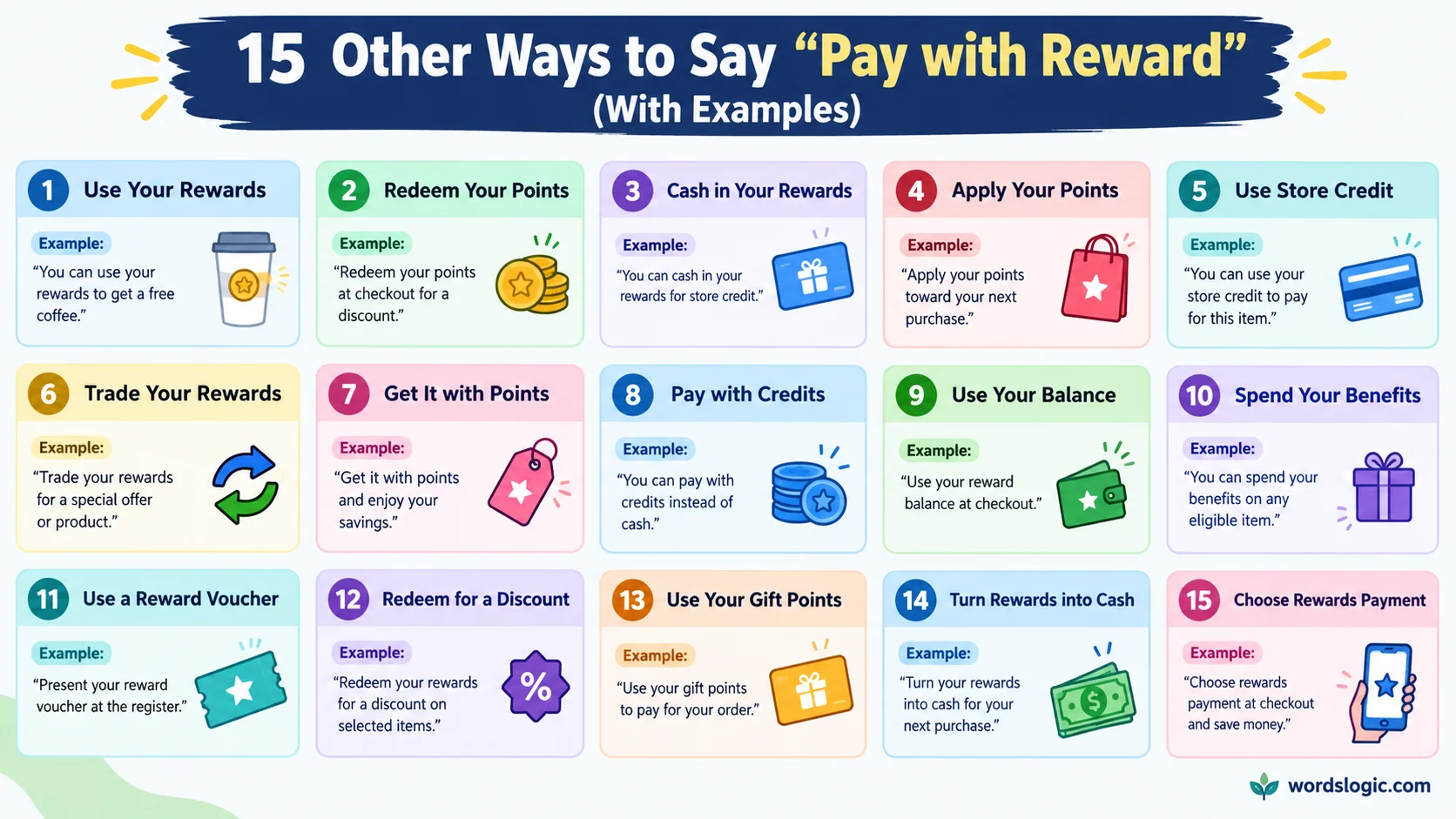
When shopping online, you may see a reward option on the checkout page that lets you use cashback, loyalty points, credit card miles, or a promotional bonus to pay. Other Ways to Say “Pay with Reward” can help you explain how earned rewards and loyalty credits cover purchases instead of cash. This approach supports clear wording, user trust, and a better shopping experience.
The right wording alternatives make payment options easier to understand. Phrases such as pay with rewards and pay with points sound natural in everyday English. They describe reward redemption, payment with points, cashback rewards, and credit card rewards. For website copy, UI copywriting, marketing campaigns, and email writing, use clear instructions that explain how customers can view, select, and use rewards at checkout. A well-designed reward system, supported by an app, credit card, or unified apps, can make payment flexibility easier to manage and help customers understand their reward balance, purchase cost, and potential savings.
A useful reward system can motivate customers, employees, and participating members through meaningful incentives and financial benefits. By allowing shoppers to redeem points, cover the cost, or reduce everyday spending, businesses can improve customer satisfaction and customer loyalty. Clear explanations also help improve their business English and understand payment terminology. Whether a program offers accumulated points, travel miles, merchant rewards, or earned credits, the goal is to provide practical benefits, encourage positive behaviour, and make reward-based payments convenient for customers.
What Does “Pay with Reward” Mean?
“Pay with reward” generally refers to using rewards earned through a loyalty program, credit card, shopping account, or promotional offer to cover some or all of a purchase. These rewards might include points, cashback, vouchers, or other eligible benefits. However, the exact phrase is uncommon and may sound unnatural without an article or plural noun. For example, “pay with rewards” and “pay with reward points” are clearer alternatives. The precise meaning depends on the payment system because some rewards cover an entire purchase while others only reduce the amount you owe.
Common Situations Where “Pay with Reward” Is Used
People may use this idea when shopping online, buying products in stores, booking travel, or paying for services through a loyalty program. For example, a customer might use accumulated points to purchase a product or apply cashback toward an eligible transaction. Businesses may also explain reward redemption options in checkout instructions, promotional emails, and customer support messages.
In these situations, clearer wording helps customers understand how rewards work, whether they can cover the full cost, and whether additional payment is required. The best expression depends on the reward type and the payment method offered.
Is It Professional or Polite to Say “Pay with Reward”?
The phrase “pay with reward” is understandable in some contexts, but it is not the most natural wording for professional communication. In customer service messages, product descriptions, and checkout instructions, “redeem your rewards” or “apply your rewards at checkout” sounds clearer and more polished. In casual conversation, someone might simply say, “Can I pay with points?” The phrase is not impolite; it mainly needs more natural wording. For formal business writing, use language that accurately describes the available payment option.
Advantages and Disadvantages of Saying “Pay with Reward”
Advantages
The phrase communicates a basic idea: using earned benefits instead of relying entirely on ordinary payment methods. It can be useful as a starting point when discussing loyalty programs, reward balances, and purchase discounts. Its short structure may also suit brief conversations where the meaning is already understood.
Disadvantages
The wording can sound incomplete because “reward” usually needs an article, a plural form, or a more specific noun in this context. It also fails to explain whether the customer is using points, cashback, vouchers, or another benefit. In professional communication, that lack of detail can confuse customers. A more specific expression helps clarify whether rewards reduce the total, cover the full price, or exchange for a product.
15 Other Ways to Say “Pay with Reward”
- Pay with Rewards
- Redeem Your Rewards
- Use Reward Points to Pay
- Pay with Points
- Apply Rewards Toward Your Purchase
- Use Points at Checkout
- Cover the Cost with Rewards
- Redeem Points for Payment
- Use Loyalty Rewards
- Pay Using Loyalty Points
- Apply Your Points Balance
- Use Cashback Rewards
- Offset the Purchase with Rewards
- Spend Your Accumulated Points
- Use Rewards as Payment
1. Pay with Rewards
Meaning
“Pay with rewards” means using benefits earned through a rewards program to pay for a purchase. It is a more natural version of “pay with reward” because the plural noun fits the general idea of accumulated benefits.
Definition
To pay with rewards is to use eligible loyalty benefits toward the cost of goods or services.
Detailed Explanation
This expression works when a payment system accepts different types of rewards. Depending on the program, those benefits may include points, credits, or eligible vouchers. It is broad enough for general customer communication without naming a particular reward type. However, it does not explain exactly how the rewards are converted into payment.
Scenario Examples
– Scenario: Shopping online. Example: “Choose the rewards option at checkout if you want to pay with rewards.”
– Scenario: Asking a store employee about payment options. Example: “Can I pay with rewards from my membership account?”
Best Use
Use this phrase in checkout instructions, shopping conversations, loyalty program descriptions, and general customer support messages.
Tone
Tone: Clear, neutral, practical.
It describes a payment option directly without sounding overly formal or promotional.
2. Redeem Your Rewards
Meaning
“Redeem your rewards” means exchanging benefits you’ve earned for an eligible product, discount, credit, or other benefit. It is related to paying with rewards, although redemption does not always involve paying for a purchase directly.
Definition
To redeem rewards is to exchange earned benefits according to a program’s rules.
Detailed Explanation
This phrase emphasizes the process of using benefits rather than the payment itself. It is especially suitable for loyalty programs that let members exchange rewards for merchandise, vouchers, or discounts. Unlike “pay with rewards,” it can describe transactions where no conventional checkout payment occurs. Always check the program’s rules because redemption options vary.
Scenario Examples
– Scenario: A member receives a loyalty email. Example: “Redeem your rewards before your eligible points expire.”
– Scenario: A customer visits a rewards portal. Example: “You can redeem your rewards for selected gift cards.”
Best Use
Use it in loyalty program emails, reward dashboards, promotional messages, and instructions explaining how customers exchange benefits.
Tone
Tone: Professional, informative, action-oriented.
The wording encourages the reader to take a specific action while remaining suitable for business communication.
3. Use Reward Points to Pay
Meaning
“Use reward points to pay” means applying points earned through a program toward an eligible purchase. It is more specific than the original phrase because it identifies points as the payment resource.
Definition
To use reward points to pay is to spend eligible points on a purchase instead of paying the entire amount through another method.
Detailed Explanation
This expression works when a loyalty program assigns a points balance to each member. It helps customers understand that their points may have a monetary value within the program. However, points do not always equal cash, and some programs restrict which products qualify. This phrase is best when the payment option genuinely accepts points.
Scenario Examples
– Scenario: Buying a product through a loyalty website. Example: “You can use reward points to pay for eligible items.”
– Scenario: Explaining a purchase to a friend. Example: “I used my reward points to pay for the headphones.”
Best Use
Choose this wording for loyalty program guides, shopping websites, customer instructions, and conversations about point-based payment systems.
Tone
Tone: Practical, specific, straightforward.
It explains the method clearly and avoids the ambiguity of the word “reward” alone.
4. Pay with Points
Meaning
“Pay with points” means using a points balance to cover some or all of a purchase. It is a concise, familiar expression in programs that allow members to spend points.
Definition
To pay with points is to apply eligible points toward a transaction.
Detailed Explanation
This alternative is shorter and more conversational than “use reward points to pay.” It works particularly well when customers already understand the loyalty program. The phrase does not necessarily mean that points will cover the full price; some transactions require an additional payment. For clarity, explain any limits or extra charges when presenting the option.
Scenario Examples
– Scenario: Booking a hotel through a loyalty program. Example: “I decided to pay with points for one night of my stay.”
– Scenario: Asking about checkout options. Example: “Can I pay with points, or do I need a credit card?”
Best Use
Use it in casual conversations, booking platforms, checkout menus, and short payment instructions.
Tone
Tone: Casual, simple, convenient.
Its brevity makes it easy to understand, particularly when the audience already knows how the points system works.
5. Apply Rewards Toward Your Purchase
Meaning
“Apply rewards toward your purchase” means using eligible benefits to reduce the amount payable for a product or service.
Definition
To apply rewards toward a purchase is to use available benefits as a contribution toward the transaction’s cost.
Detailed Explanation
This phrase is helpful when rewards cover only part of the total price. It clearly suggests that the benefits contribute to the purchase rather than necessarily paying for everything. The wording is slightly more formal than “pay with points” and fits customer-facing business language. It is particularly useful when customers may need to pay the remaining balance separately.
Scenario Examples
– Scenario: A checkout page offers a partial discount. Example: “Apply rewards toward your purchase to reduce the amount due.”
– Scenario: A customer contacts support. Example: “I’d like to apply my available rewards toward this purchase.”
Best Use
Use this phrase in checkout instructions, online shopping platforms, customer service emails, and explanations of partial reward payments.
Tone
Tone: Professional, helpful, precise.
It explains how rewards affect the transaction without promising that they will cover the entire cost.
6. Use Points at Checkout
Meaning
“Use points at checkout” means selecting an eligible points balance during the final stage of a purchase.
Definition
To use points at checkout is to apply available loyalty points while completing a transaction.
Detailed Explanation
This expression focuses on when the customer uses the points rather than simply describing the payment method. It is particularly useful for online stores and mobile applications that display rewards during checkout. Unlike “redeem your rewards,” it directs attention to a specific step in the buying process. It should only be used when customers can actually apply their points at checkout.
Scenario Examples
– Scenario: An online store displays a points option. Example: “Sign in to your account and use points at checkout.”
– Scenario: A customer asks when to enter a loyalty balance. Example: “You can use your points at checkout before confirming your order.”
Best Use
Choose this wording for checkout buttons, website instructions, app notifications, and step-by-step shopping guidance.
Tone
Tone: Direct, instructional, user-friendly.
It tells customers what to do and when to do it, making it useful for practical instructions.
7. Cover the Cost with Rewards
Meaning
“Cover the cost with rewards” means using eligible benefits to pay for some or all of the price of a purchase.
Definition
To cover a cost with rewards is to use earned benefits to meet a purchase’s financial cost.
Detailed Explanation
This phrase emphasizes the amount of the purchase that rewards can pay for. It is useful when a program allows enough benefits to cover the full price, but it can also describe partial coverage if the sentence makes that clear. Unlike “pay with points,” it does not specify the type of reward. Avoid suggesting that rewards cover the whole cost unless the program confirms that they do.
Scenario Examples
– Scenario: A member has enough eligible credits for an item. Example: “I had enough rewards to cover the cost of the kitchen appliance.”
– Scenario: A business explains its loyalty benefits. Example: “Eligible members can use their rewards to cover part of the cost.”
Best Use
Use it in budget-related discussions, loyalty program explanations, and situations where the amount covered by rewards matters.
Tone
Tone: Practical, reassuring, financially focused.
It highlights the benefit of reducing out-of-pocket spending without implying that every reward has the same value.
8. Redeem Points for Payment
Meaning
“Redeem points for payment” means exchanging eligible points for a payment benefit within a program that supports this option.
Definition
To redeem points for payment is to exchange a points balance for an approved payment credit or purchase benefit.
Detailed Explanation
This wording is more transactional than “pay with points.” It may fit program rules or instructions explaining how points become usable payment value. However, it is not always interchangeable with ordinary point spending because some programs redeem points for discounts, products, or vouchers rather than direct payment. Use it when the program specifically supports payment-related redemption.
Scenario Examples
– Scenario: Reading a loyalty program’s payment instructions. Example: “Eligible members can redeem points for payment on selected orders.”
– Scenario: A customer asks how to use a points balance. Example: “Check whether you can redeem points for payment on your next booking.”
Best Use
Use this phrase in program documentation, account instructions, and formal explanations of eligible point-redemption options.
Tone
Tone: Formal, transactional, precise.
Its wording suits explanatory material more than casual conversation.
9. Use Loyalty Rewards
Meaning
“Use loyalty rewards” means applying benefits earned through a customer loyalty program. Those benefits might include discounts, points, vouchers, or eligible account credits.
Definition
To use loyalty rewards is to take advantage of benefits offered through a customer loyalty scheme.
Detailed Explanation
This expression is broader than a direct payment phrase because loyalty rewards can offer benefits beyond paying for an order. It works when the exact redemption method is not important or when several reward types are available. If the goal is to explain a payment option, add details about how the rewards affect the total. That extra information helps customers understand the actual benefit.
Scenario Examples
– Scenario: A store promotes its membership program. Example: “Sign in to use loyalty rewards on eligible purchases.”
– Scenario: A customer discusses a membership account. Example: “I saved my loyalty rewards for a larger purchase.”
Best Use
Choose this expression for membership programs, promotional materials, customer service, and general discussions about loyalty benefits.
Tone
Tone: Friendly, promotional, approachable.
It emphasizes the value of membership without limiting the benefits to a specific payment method.
10. Pay Using Loyalty Points
Meaning
“Pay using loyalty points” means paying for an eligible transaction with points earned through a loyalty program.
Definition
To pay using loyalty points is to apply a member’s earned points toward the cost of a purchase.
Detailed Explanation
This expression is similar to “pay with points,” but it identifies the points as part of a loyalty scheme. It works well when a business wants to distinguish loyalty points from other kinds of account credits. The wording is slightly more explanatory and may suit customer instructions. As with other point-based options, the actual payment depends on the program’s conditions and available balance.
Scenario Examples
– Scenario: A customer books a flight through a loyalty scheme. Example: “I plan to pay using loyalty points for part of my ticket.”
– Scenario: A support agent explains an account feature. Example: “You can pay using loyalty points if your booking meets the program requirements.”
Best Use
Use it in travel bookings, membership platforms, formal customer communication, and explanations of loyalty-based payment methods.
Tone
Tone: Professional, informative, clear.
It specifies the source of the points while maintaining a natural, business-appropriate style.
11. Apply Your Points Balance
Meaning
“Apply your points balance” means using the points available in your account toward an eligible transaction or benefit.
Definition
To apply a points balance is to use available points for an approved purpose within a program.
Detailed Explanation
This expression emphasizes the customer’s existing account balance rather than the act of earning or redeeming rewards generally. It works well in digital services where users can see their available points. The phrase may sound slightly technical, so a short explanation can help first-time customers. It should be used only when the program actually lets customers apply their balance to the transaction.
Scenario Examples
– Scenario: A shopping app shows a member’s available points. Example: “Apply your points balance before submitting the order.”
– Scenario: A customer asks about using saved points. Example: “Can I apply my points balance to this purchase?”
Best Use
Choose this phrase for account dashboards, application instructions, customer support, and point-balance features.
Tone
Tone: Instructional, neutral, slightly technical.
It suits digital interfaces and account-related guidance where precision matters.
12. Use Cashback Rewards
Meaning
“Use cashback rewards” means applying cashback benefits according to the rules of a card, shopping service, or rewards program.
Definition
To use cashback rewards is to use money-back benefits that a program has made available to the customer.
Detailed Explanation
Cashback differs from ordinary points because it represents a money-back benefit, although its value and availability depend on the program. Some services let customers apply cashback to purchases, while others require them to redeem it as a statement credit or transfer. This expression is appropriate only when the benefit is genuinely cashback. It should not be used as a substitute for points when a program offers points instead.
Scenario Examples
– Scenario: A customer uses an eligible shopping credit. Example: “I used my cashback rewards to reduce the cost of my order.”
– Scenario: A cardholder reviews their account. Example: “Check your account to see whether your cashback rewards can be applied to this purchase.”
Best Use
Use it in cashback program explanations, card benefit guides, and customer conversations about money-back rewards.
Tone
Tone: Practical, financially focused, informative.
It highlights the monetary nature of the benefit while avoiding confusion with point-based programs.
13. Offset the Purchase with Rewards
Meaning
“Offset the purchase with rewards” means using eligible benefits to reduce the net amount spent on a transaction.
Definition
To offset a purchase with rewards is to use benefits to reduce the financial impact of buying something.
Detailed Explanation
The word “offset” emphasizes a reduction rather than a direct payment. This makes it useful when rewards cover only part of a purchase or help balance some of its cost. It sounds more formal than “pay with points” and may suit business or financial explanations. Because it is less conversational, simpler wording may work better in casual messages.
Scenario Examples
– Scenario: A company explains a member benefit. Example: “Members can offset eligible purchases with rewards earned throughout the year.”
– Scenario: A shopper compares available discounts. Example: “I’ll offset the purchase with rewards and pay the remaining balance by card.”
Best Use
Use this expression in business communication, program descriptions, and explanations of partial cost reductions.
Tone
Tone: Formal, analytical, financially focused.
It presents rewards as a way to reduce costs rather than necessarily replace the full payment.
14. Spend Your Accumulated Points
Meaning
“Spend your accumulated points” means using points collected over time through purchases, activities, or participation in a rewards program.
Definition
To spend accumulated points is to use points that have built up in an account for an eligible reward or purchase.
Detailed Explanation
This expression highlights the fact that the points have been collected over time. It can encourage members to make use of an existing balance rather than leave it unused. However, spending points does not always mean paying directly for an item; the program may exchange them for vouchers, discounts, or other benefits. The surrounding instructions should clarify the available redemption options.
Scenario Examples
– Scenario: A member checks an old loyalty account. Example: “I decided to spend my accumulated points on a gift for my sister.”
– Scenario: A retailer sends a membership reminder. Example: “Spend your accumulated points on eligible products in our rewards catalog.”
Best Use
Choose this wording for loyalty reminders, rewards newsletters, and conversations about using a points balance that has grown over time.
Tone
Tone: Encouraging, practical, slightly promotional.
It encourages action without implying that the points must be used immediately.
15. Use Rewards as Payment
Meaning
“Use rewards as payment” means using eligible rewards in place of money or another payment method for a permitted transaction.
Definition
To use rewards as payment is to apply approved reward benefits directly toward a transaction’s payable amount.
Detailed Explanation
This expression clearly presents rewards as a payment method. It works when a program explicitly allows customers to use rewards at the point of purchase. However, some rewards are only discounts or vouchers, so describing them as payment may be inaccurate in those cases. Check the program’s terms before using this wording in official instructions.
Scenario Examples
– Scenario: A customer asks about checkout methods. Example: “Does this store let members use rewards as payment?”
– Scenario: A business explains a supported payment option. Example: “You may use eligible rewards as payment for selected purchases.”
Best Use
Use this expression in payment policy explanations, customer service messages, and checkout guidance when rewards function as an accepted payment method.
Tone
Tone: Clear, professional, direct.
It makes the payment purpose explicit, which helps readers understand the option quickly.
FAQs
What does “Pay with Reward” mean?
Pay with Reward means using earned rewards, such as loyalty points, cashback, travel miles, or reward credits, to pay for a purchase instead of using cash or a regular payment method.
What is a more natural way to say “Pay with Reward”?
Pay with rewards and pay with points are more natural expressions in everyday English. You can also use redeem your rewards, use your loyalty points, or pay using reward credits, depending on the payment method.
Can I use loyalty points to pay for purchases?
Yes, many loyalty programs allow customers to redeem points for products, services, discounts, or part of a purchase. The available options depend on the merchant, reward program, and its terms.
What is the difference between cashback and reward points?
Cashback usually returns a percentage or fixed amount of money from a purchase. Reward points accumulate through eligible transactions and can be redeemed for specific benefits, discounts, or purchases, depending on the program.
How can businesses explain reward payments clearly?
Businesses should use simple wording, clear instructions, and familiar expressions such as pay with points or redeem your rewards. Clear website copy, checkout instructions, and payment options help customers understand how to use their rewards.
Conclusion
Choosing the right alternative to “Pay with Reward” makes payment instructions easier to understand. Expressions such as pay with rewards, pay with points, redeem your rewards, and use your loyalty credits work well in different situations. The best choice depends on the audience, the payment method, and the type of reward program being described.
For businesses, marketers, and English learners, using clear wording improves communication, supports customer trust, and creates a smoother checkout experience. Whether you’re writing website content, designing a mobile app, or explaining loyalty points, choose natural expressions that tell customers exactly how they can use their rewards.