The phrase Other Ways to Say “Past Few Days” helps you describe recent events in simple, natural English. Over the past few days.
I’ve noticed that even a short duration can feel meaningful when we reflect on daily events. This period is usually unspecified, often covering two to four days before the present moment. It describes a somewhat indefinite timeframe that includes days before today, although the exact meaning depends on the context.
When you want to rephrase this expression, you can use alternatives such as recently, lately, of late, not long ago, the last few days, or within the last few days. Other useful phrases include within a short span and the last stretch of time. These expressions help you communicate timing naturally without sounding too rigid. From my experience, flexible wording improves clarity when you discuss recent events, reflect on small changes, share ideas, or explain something that happened before today.
What Does “Past Few Days” Mean?
The phrase “past few days” refers to a small number of days that have already occurred, usually the days immediately before today. For example, “I’ve been feeling tired over the past few days” means the speaker has felt tired recently and that the situation may still be continuing. The word “past” places the time before the present, while “few” suggests a small number without specifying an exact count.
People commonly use this expression to discuss recent activities, changes, experiences, problems, or feelings. Its exact time span depends on the context, although it often refers to approximately two to five days. It is a flexible, conversational expression, not a precise measurement, so a specific date range may be better when accuracy matters.
Common Situations Where “Past Few Days” Is Used
People use “past few days” in everyday conversations when explaining what they’ve been doing, how they’ve been feeling, or why they haven’t responded to a message. For example, someone might say, “I’ve been busy over the past few days,” to explain a delayed reply without giving every detail.
In professional communication, the phrase can describe recent progress, customer concerns, project updates, or changes in a team’s workload. Students may use it to discuss recent studying or assignments, while friends and family might use it when catching up. In emails and reports, alternatives such as “over the last several days” can sound more polished, while “recently” works when the exact length of time is not important.
Choosing an alternative can also help you avoid repetition. If you’ve already used “past few days” several times in a message, changing the wording can improve its flow. The best choice depends on whether you want to emphasize a time period, describe a recent event, or highlight something that has continued until now.
Is It Professional or Polite to Say “Past Few Days”?
Yes. “Past few days” is professional and polite enough for most everyday workplace conversations, emails, and informal reports. For example, “We’ve noticed an increase in customer inquiries over the past few days” sounds clear and appropriate. The phrase is neutral rather than emotional, so it usually works well when discussing recent developments.
However, more formal documents may benefit from precise wording, such as “during the preceding three days” or “over the last five business days,” when the actual period is known. In casual messages, “these last few days” can sound more personal, while “recently” is useful when the duration does not matter. The expression itself is not impolite; clarity and context determine whether it is the best choice.
Advantages and Disadvantages of Saying “Past Few Days”
Advantages
The phrase is simple, natural, and easy to understand. It communicates that something happened recently without requiring exact dates. It also works in spoken English, text messages, emails, and many workplace discussions. Because it is neutral, you can use it to discuss positive experiences, ongoing tasks, or problems without adding an unintended emotional tone.
Disadvantages
The main limitation is its lack of precision. Different people may interpret “a few days” differently, which can create confusion when deadlines or records require exact dates. The phrase may also become repetitive in longer writing. In some situations, a more specific expression, such as “since Monday,” communicates the time frame more clearly. When you want to emphasize a recent trend rather than a specific period, “recently” may also be more suitable.
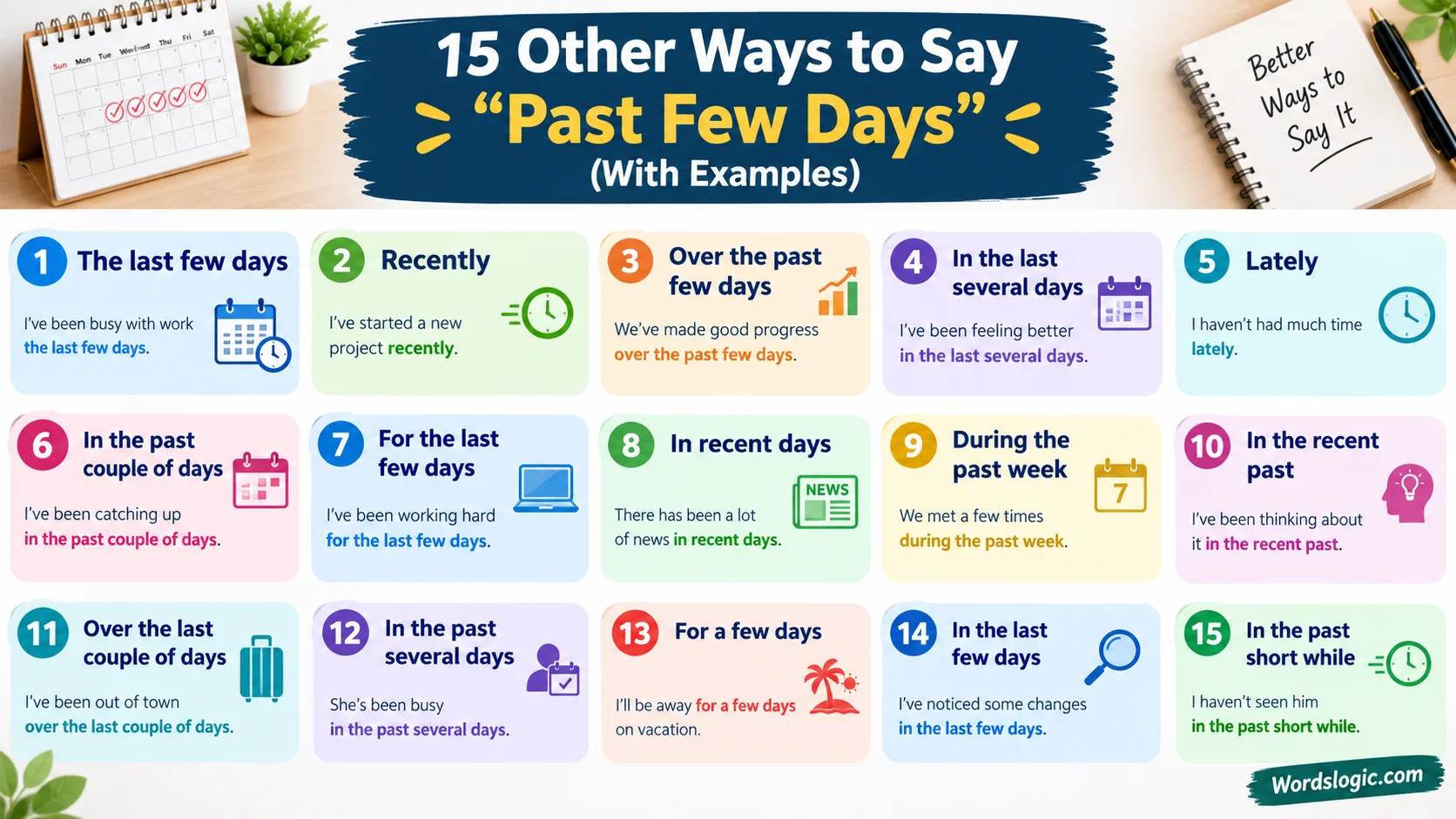
15 Alternatives to “Past Few Days”
- The Last Few Days
- Over the Last Few Days
- In Recent Days
- The Last Several Days
- Over the Past Several Days
- Recently
- Lately
- These Past Few Days
- Over the Last Couple of Days
- In the Last Few Days
- During the Past Few Days
- In the Days Leading Up to Now
- Over the Recent Days
- Since Earlier This Week
- In the Days Just Gone By
1. The Last Few Days
Meaning
“The last few days” refers to the days immediately before the present. It is very similar to “past few days” and works naturally when describing recent activities, experiences, or changes.
Definition
A short period of time covering several recent days up to now.
Detailed Explanation
This expression is one of the most natural alternatives in everyday English. It often emphasizes the period leading up to the present rather than a completed event. You can use it when talking about work, personal experiences, or recent changes. Although it is slightly different in wording, its meaning is almost identical to the original phrase.
Scenario Examples
– Scenario: Catching up with a friend.
Example: “I’ve had a lot on my mind over the last few days.”
– Scenario: Giving a workplace update.
Example: “The team has made good progress in the last few days.”
– Scenario: Discussing your health or energy.
Example: “I’ve been sleeping much better during the last few days.”
Best Use
Use this expression in casual conversations, emails, personal messages, and workplace updates. It is a reliable choice when you want familiar, straightforward wording.
Tone
Tone: Natural, neutral, conversational.
It sounds relaxed and clear without being overly casual or formal.
2. Over the Last Few Days
Meaning
“Over the last few days” describes something that happened, developed, or continued throughout a recent period.
Definition
During the days immediately preceding the present, often with an emphasis on change or ongoing activity.
Detailed Explanation
The word “over” highlights a period during which something occurred. This makes the expression particularly useful for describing gradual progress, repeated events, or continuing situations. Unlike wording that simply identifies a time, it often draws attention to what happened throughout that time. It works well in both professional and personal communication.
Scenario Examples
– Scenario: Explaining project progress.
Example: “We’ve resolved several technical issues over the last few days.”
– Scenario: Talking to a friend about a busy schedule.
Example: “I’ve barely had time to relax over the last few days.”
– Scenario: Discussing customer feedback.
Example: “We’ve received several helpful suggestions over the last few days.”
Best Use
Choose this expression for progress reports, work emails, ongoing situations, and everyday conversations when you want to emphasize developments across a period.
Tone
Tone: Professional, neutral, informative.
It gives your message a smooth, organized feel without sounding stiff.
3. In Recent Days
Meaning
“In recent days” refers to a period shortly before the present. It can describe events, developments, or changes that have happened lately.
Definition
During a short, recent period before now.
Detailed Explanation
This expression sounds somewhat more formal than “past few days.” It is especially useful when discussing news, public developments, business activities, or general observations. It does not necessarily specify exactly how many days are involved. Unlike a strongly conversational expression, it creates a more report-like tone that suits informative writing.
Scenario Examples
– Scenario: Writing a business update.
Example: “The company has introduced several improvements in recent days.”
– Scenario: Reporting a developing situation.
Example: “Temperatures have dropped considerably in recent days.”
– Scenario: Describing a change in school attendance.
Example: “More students have attended the study sessions in recent days.”
Best Use
Use it in formal emails, reports, news-style writing, and professional updates. It is particularly useful when exact dates are not essential.
Tone
Tone: Formal, informative, objective.
It sounds measured and professional, making it a good option for factual communication.
4. The Last Several Days
Meaning
“The last several days” refers to a number of recent days, often suggesting a somewhat longer period than “the last couple of days.”
Definition
Several days immediately preceding the present.
Detailed Explanation
This phrase is useful when you want to emphasize that something has continued for multiple days. “Several” can suggest a larger number than “a couple,” although the distinction is not mathematically fixed in everyday English. It is appropriate when describing a busy period, a continuing issue, or repeated activity. The wording can sound slightly more deliberate than “the last few days.”
Scenario Examples
– Scenario: Explaining a delay to a colleague.
Example: “I’ve been handling urgent requests for the last several days.”
– Scenario: Discussing a household problem.
Example: “We’ve had trouble with the internet for the last several days.”
– Scenario: Sharing a personal update.
Example: “I’ve spent the last several days preparing for my exams.”
Best Use
Use this expression in workplace communication, personal updates, and discussions about ongoing situations where you want to emphasize duration.
Tone
Tone: Neutral, slightly emphatic, informative.
It places more emphasis on the length of the period than a general reference to something recent.
5. Over the Past Several Days
Meaning
“Over the past several days” describes events or changes that have taken place throughout a period of multiple recent days.
Definition
Across several days leading up to the present.
Detailed Explanation
This phrase combines the duration suggested by “several” with the time-span emphasis of “over.” It is particularly effective when reporting trends, ongoing work, or repeated observations. Compared with “over the past few days,” it may suggest a slightly longer period, depending on the speaker. It also fits formal writing without requiring complicated vocabulary.
Scenario Examples
– Scenario: Providing a project update.
Example: “Our team has completed three major tasks over the past several days.”
– Scenario: Describing a continuing problem.
Example: “The road has been unusually busy over the past several days.”
– Scenario: Discussing a study routine.
Example: “I’ve reviewed all my notes over the past several days.”
Best Use
Choose this phrase for progress reports, professional emails, research summaries, and explanations of continuing activities.
Tone
Tone: Professional, precise, measured.
It sounds appropriate when you want to communicate duration in a more structured way.
6. Recently
Meaning
“Recently” means at a time not long ago. It is useful when the exact number of days does not matter.
Definition
At some point in the near past.
Detailed Explanation
Unlike “past few days,” this word does not specify a particular length of time. Depending on context, it can refer to something that happened hours, days, or even weeks ago. That flexibility makes it useful when you want to keep a message concise. However, it is not an exact synonym when the duration itself is important.
Scenario Examples
– Scenario: Telling a friend about a purchase.
Example: “I recently bought a new laptop for my studies.”
– Scenario: Introducing a workplace change.
Example: “We recently updated our customer support process.”
– Scenario: Answering a question about a hobby.
Example: “I’ve recently started learning how to cook.”
Best Use
Use “recently” in conversations, emails, reports, and social media posts when you want to mention a recent event without specifying how long ago it occurred.
Tone
Tone: Neutral, concise, versatile.
It sounds natural in nearly every setting, although it provides less information about the time frame.
7. Lately
Meaning
“Lately” refers to a recent period, especially when discussing repeated activities, changing feelings, or situations that have continued up to now.
Definition
During the recent period, particularly up to the present.
Detailed Explanation
“Lately” often sounds more conversational and personal than “in recent days.” It works particularly well with present perfect and present perfect continuous constructions, such as “I’ve been feeling tired lately.” It can describe a pattern rather than one isolated event. However, it does not always mean only the last few days because its time frame depends on context.
Scenario Examples
– Scenario: Checking in with a friend.
Example: “I haven’t heard from you much lately. Is everything okay?”
– Scenario: Talking about a personal habit.
Example: “I’ve been going to bed earlier lately.”
– Scenario: Describing a work pattern.
Example: “We’ve been receiving more inquiries lately.”
Best Use
Use it in casual conversation, personal messages, relationship discussions, and informal workplace communication when describing recent patterns.
Tone
Tone: Casual, personal, reflective.
It often feels warmer and less report-like than a precise time expression.
8. These Past Few Days
Meaning
“These past few days” refers to the recent days leading up to the present, often with an emphasis on a personal experience or a situation that is still relevant.
Definition
The days immediately before now, considered as a connected period.
Detailed Explanation
The word “these” can make the period feel more immediate or personally significant. This expression is especially natural when discussing emotions, relationships, challenges, or memorable experiences. It often suggests that the speaker is reflecting on a period that matters to them. Although it is similar to “the past few days,” the wording can sound a little more personal.
Scenario Examples
– Scenario: Talking with a partner.
Example: “These past few days have reminded me how much I appreciate you.”
– Scenario: Sharing a personal challenge.
Example: “These past few days have been exhausting, but I’m feeling better now.”
– Scenario: Thanking a helpful colleague.
Example: “Your support has meant a lot to me these past few days.”
Best Use
Choose this expression for personal messages, conversations about emotions, relationship communication, and reflective writing.
Tone
Tone: Warm, reflective, personal.
It emphasizes the speaker’s connection to the recent period rather than presenting it as a detached fact.
9. Over the Last Couple of Days
Meaning
“Over the last couple of days” refers to a short period immediately before the present, usually around two days.
Definition
During approximately the two days leading up to now.
Detailed Explanation
This expression is more specific than “past few days” because “couple” usually means two. In casual speech, some people use it loosely, but it generally suggests a shorter time frame. It works well when describing something that has happened recently without needing exact dates. If the period has lasted four or five days, “the last several days” may be more accurate.
Scenario Examples
– Scenario: Explaining a delayed response.
Example: “Sorry I haven’t replied; I’ve been traveling over the last couple of days.”
– Scenario: Discussing a home repair.
Example: “The heating has been working properly over the last couple of days.”
– Scenario: Giving a quick work update.
Example: “I’ve finished most of the revisions over the last couple of days.”
Best Use
Use it in text messages, informal work updates, everyday conversation, and situations where approximately two days is the intended period.
Tone
Tone: Casual, direct, conversational.
It sounds relaxed while giving the reader a slightly clearer sense of duration.
10. In the Last Few Days
Meaning
“In the last few days” refers to events or changes that occurred during a recent period before the present.
Definition
At some point within the days immediately preceding now.
Detailed Explanation
This expression is very close in meaning to “in the past few days.” It often emphasizes that something happened at least once within the period, rather than focusing on the whole period as a continuous stretch. For example, it works well when mentioning a recent conversation, discovery, or change. It is a natural choice for both spoken and written English.
Scenario Examples
– Scenario: Sharing a personal discovery.
Example: “I’ve learned a lot about time management in the last few days.”
– Scenario: Talking about a new friendship.
Example: “We’ve had some interesting conversations in the last few days.”
– Scenario: Reporting an improvement at work.
Example: “We’ve seen a noticeable improvement in response times in the last few days.”
Best Use
Choose it for everyday conversation, work updates, emails, and descriptions of recent events.
Tone
Tone: Neutral, clear, practical.
It communicates recent timing without adding emotional meaning or unnecessary formality.
11. During the Past Few Days
Meaning
“During the past few days” describes something that happened at some point or at several points within a recent period.
Definition
At one or more times throughout the days preceding the present.
Detailed Explanation
The word “during” draws attention to the period in which an event took place. This expression is particularly helpful when discussing meetings, observations, activities, or incidents. It can sound a little more formal than “over the past few days,” making it suitable for structured communication. However, it does not necessarily imply that an activity continued without interruption.
Scenario Examples
– Scenario: Describing a series of meetings.
Example: “During the past few days, we’ve discussed several ways to improve the service.”
– Scenario: Explaining a school project.
Example: “I’ve gathered information from several sources during the past few days.”
– Scenario: Updating a customer.
Example: “During the past few days, our team has been reviewing your request.”
Best Use
Use it in formal emails, business updates, academic writing, and explanations of events within a defined period.
Tone
Tone: Professional, organized, informative.
It gives your writing a structured feel without sounding excessively formal.
12. In the Days Leading Up to Now
Meaning
“In the days leading up to now” describes events that occurred during the period immediately before the present moment.
Definition
During the recent days before the current time.
Detailed Explanation
This expression makes the movement toward the present especially clear. It can be useful when describing a developing situation, a sequence of events, or a gradual change. However, it is longer and less conversational than “past few days.” It may also sound unnecessarily wordy in a quick text message, so a shorter alternative is usually better for everyday communication.
Scenario Examples
– Scenario: Explaining preparation for an event.
Example: “In the days leading up to now, we’ve made several final changes to the schedule.”
– Scenario: Reflecting on a developing situation.
Example: “In the days leading up to now, the situation has become easier to understand.”
Best Use
Use this expression when the sequence of events leading to the present matters, especially in explanatory or reflective writing. In most everyday messages, “over the past few days” sounds smoother.
Tone
Tone: Explanatory, deliberate, reflective.
It emphasizes the progression toward the present rather than simply identifying a recent time period.
13. Over the Recent Days
Meaning
“Over the recent days” attempts to describe developments across a period of recent days. However, it is less idiomatic in everyday English than “over the past few days” or “in recent days.”
Definition
Across a period of days that occurred shortly before the present.
Detailed Explanation
Readers can generally understand this expression, but many English speakers would choose a more natural alternative. The combination of “over” and “the recent days” can sound awkward because English more commonly uses “over the past few days” or simply “in recent days.” It is therefore better to treat it as an understandable but less preferred construction rather than a first-choice synonym. Choosing a more established expression makes your wording sound smoother.
Scenario Examples
– Scenario: Writing a business update. A more natural version would be:
Example: “We’ve improved our response times over the past few days.”
– Scenario: Describing a recent change. A more natural version would be:
Example: “In recent days, the weather has become much cooler.”
Best Use
For most purposes, replace this wording with “over the past few days” or “in recent days.” These alternatives are more idiomatic and work well in professional and casual writing.
Tone
Tone: Intended to be neutral and informative, but somewhat unnatural.
The meaning is understandable, yet a more conventional expression will usually communicate the same idea more effectively.
14. Since Earlier This Week
Meaning
“Since earlier this week” refers to a period that began at some point earlier in the current week and continues to the present, or to something that has happened repeatedly since then.
Definition
From a point earlier in the current week until now.
Detailed Explanation
This expression is more useful when you can identify the relevant period by reference to the current week. Unlike “past few days,” it can imply a starting point earlier in the week rather than a rolling period of several days. It is particularly suitable for workplace updates and scheduling discussions. However, it is not interchangeable with the original phrase if the event began last week or if the exact starting point is important.
Scenario Examples
– Scenario: Updating a manager.
Example: “I’ve been working on the revised proposal since earlier this week.”
– Scenario: Discussing a continuing problem.
Example: “We’ve been experiencing delays since earlier this week.”
– Scenario: Explaining a change in routine.
Example: “I’ve been taking the bus since earlier this week.”
Best Use
Use it in work emails, weekly progress reports, scheduling conversations, and descriptions of ongoing activities when the current week provides a useful time reference.
Tone
Tone: Practical, neutral, work-friendly.
It helps clarify when an ongoing situation began, although a specific day is better when precision matters.
15. In the Days Just Gone By
Meaning
“In the days just gone by” refers to days that have recently passed. It can emphasize reflection on events or experiences that are now in the past.
Definition
During the days that have just passed.
Detailed Explanation
This expression is understandable, but it sounds more literary or reflective than ordinary conversation. It can suit personal essays, storytelling, speeches, or writing that looks back on recent experiences. In a casual text or routine business email, it may sound unnecessarily elaborate. If your goal is simple, direct communication, “in the last few days” is generally the more natural choice.
Scenario Examples
– Scenario: Writing a reflective personal passage.
Example: “In the days just gone by, I’ve realized how important it is to make time for family.”
– Scenario: Looking back on a community event.
Example: “In the days just gone by, our neighborhood has come together to help those in need.”
Best Use
Choose it for reflective writing, storytelling, speeches, and personal essays. Prefer a simpler alternative for everyday conversation or professional updates.
Tone
Tone: Reflective, literary, slightly formal.
It gives recent events a sense of looking back, rather than presenting them as an ordinary daily update.
FAQs
What does “past few days” mean?
Past few days refers to a recent period leading up to the present moment. It often means the last two to four days, but the exact timeframe depends on the context.
What are other ways to say “past few days”?
You can use recently, lately, of late, not long ago, the last few days, or within the last few days. These alternatives help you express time in a more natural way.
Is “last few days” the same as “past few days”?
Yes, both expressions usually describe a similar recent timeframe. For example, “I’ve been busy over the past few days” and “I’ve been busy over the last few days” have nearly the same meaning.
Can I use “past few days” in professional writing?
Yes, past few days works in professional emails, reports, and workplace conversations. For a more formal tone, you can use in recent days or over the past several days, depending on the situation.
How can I use “past few days” in a sentence?
You can say, “I’ve noticed several small changes over the past few days.” Another example is, “We’ve made good progress within the last few days.” Both sentences describe recent events clearly.
Conclusion
The phrase past few days is a simple way to talk about recent events, changes, and experiences. Alternatives such as recently, lately, of late, and within the last few days help you express the same idea with different wording. Choosing the right phrase depends on your audience, context, and the tone you want to create.
When writing emails, sharing updates, or having everyday conversations, use expressions that make your message clear, natural, and easy to understand. With these alternatives, you can avoid repeating the same phrase and communicate about recent events with greater confidence.