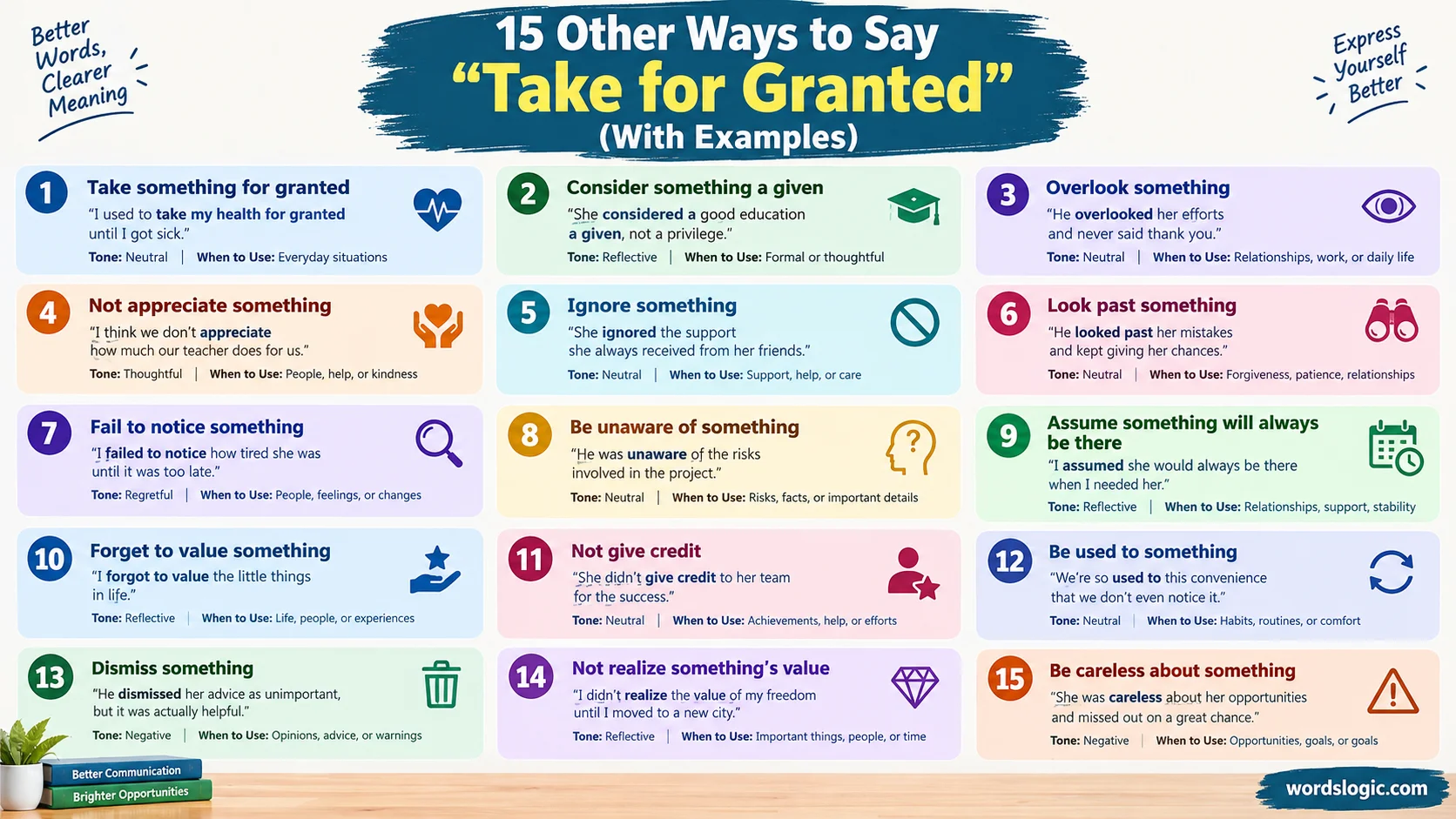
Other Ways to Say “Take for Granted” helps you express how people overlook daily comforts, familiar routines, and the things they often fail to appreciate.
People often take things for granted without realizing how much they rely on small routines in everyday life. For example, I once took my car for granted, assuming it would start every morning. I also expected the grocery store and butcher shop to be ready with dinner essentials. When something breaks a familiar pattern, we feel forced to consider the comforts we quietly assume will always exist.
We may suppose or presuppose that these things are permanent, but there is no proof that life will remain the same. Our routines are built around what we believe to be true. We think, reckon, and imagine stability as an axiom of daily life, expecting consistency, dependability, comfort, convenience, and normality. This routine behavior creates an unconscious reliance on familiar things, making their overlooked value and unrecognized importance easy to miss.
Our human nature encourages us to form habitual expectations and trust the presumed availability of everyday necessities. This can lead to a lack of appreciation, undervaluing, underestimating, neglecting, and overlooking what we already have. By accepting things as normal and failing to appreciate them, we may start assuming permanence and taking something lightly. This lack of gratitude can develop into complacency, even when our dependence on reliable routines is clear. However, unexpected changes, a sudden disruption, or a difficult realization can encourage reflection and consideration.
What Does “Take for Granted” Mean?
To take something or someone for granted means to assume that they will always be available, reliable, or present without recognizing their value. When you take a person for granted, you may overlook their kindness, efforts, support, or sacrifices. When you take something for granted, you may fail to appreciate a benefit or opportunity because it seems normal or permanent.
For example, someone might take a supportive friend for granted by expecting help without expressing gratitude. Similarly, a person might take good health for granted until an illness makes them appreciate it. The phrase can describe a lack of appreciation, an unquestioned assumption, or both. Its meaning depends on the situation, but it often encourages people to recognize what they have before they lose it.
Common Situations Where “Take for Granted” Is Used
The phrase commonly appears in personal relationships, family conversations, friendships, workplace discussions, and everyday communication. It can describe a partner who stops appreciating thoughtful gestures, a friend who expects constant support, or an employee whose contributions go unnoticed.
People also use it when discussing everyday privileges and opportunities. For instance, someone might say that people sometimes take clean water, good health, or access to education for granted because these benefits are part of their normal routine.
In professional communication, the phrase may describe situations where employees feel their work is undervalued. In personal messages, it can express disappointment when someone repeatedly receives kindness without showing appreciation. Depending on the situation, an alternative may sound gentler, more specific, or less accusatory.
Is It Professional or Polite to Say “Take for Granted”?
The phrase “take for granted” is appropriate in both casual and professional English, but its tone depends on how it is used. In personal conversations, it can communicate hurt or disappointment when someone feels unappreciated. For example, telling a friend, “I feel like you take my help for granted,” expresses a concern directly without necessarily attacking their character.
In the workplace, the expression can be useful when discussing recognition, teamwork, or employee contributions. However, it may sound confrontational if directed at a colleague without explanation. A more constructive approach might be to say that someone’s contributions are being overlooked or that their efforts are not receiving enough recognition. These alternatives focus on the situation rather than blaming a person. Choosing wording that fits the relationship and context helps keep the conversation respectful.
Advantages and Disadvantages of Saying “Take for Granted”
Advantages
The phrase “take for granted” communicates a recognizable problem clearly. It helps people describe situations in which gratitude is missing, effort goes unnoticed, or someone assumes that another person will always be available.
It is also versatile. You can use it when discussing relationships, everyday privileges, professional contributions, or personal habits. Because the expression is familiar, readers and listeners can usually understand its emotional meaning without needing a lengthy explanation.
Disadvantages
The phrase can sometimes sound critical or emotionally charged, especially when directed at someone during an argument. A person who hears that they take others for granted may feel accused rather than encouraged to change.
It can also be too broad when the real issue is more specific. Someone may fail to say thank you, overlook another person’s efforts, or assume that a responsibility will always be handled by someone else. In these situations, a more precise expression can explain the problem more clearly. Choosing a suitable alternative helps communicate disappointment without creating unnecessary tension.
Synonyms for Say “Take for Granted”
- Fail to Appreciate
- Overlook Someone’s Efforts
- Underappreciate
- Assume Something Will Always Be There
- Treat Someone as a Given
- Neglect to Value
- Take Advantage of
- Overlook the Importance Of
- Show Little Appreciation For
- Expect Without Acknowledgment
- Fail to Recognize
- Become Complacent About
- Disregard Someone’s Contributions
- Assume Something Is Guaranteed
- Lose Sight of the Value Of
1. Fail to Appreciate
Meaning
Fail to appreciate means not fully recognizing the value, kindness, or importance of someone or something. It is a close alternative to taking someone for granted because it emphasizes a lack of gratitude or recognition.
Definition
To fail to appreciate something means to overlook its value or not show the gratitude it deserves.
Detailed Explanation
This expression focuses on what someone does not recognize or acknowledge. It can describe a person who receives regular help but rarely expresses thanks. Compared with “take for granted,” it can sound slightly more neutral because it describes a failure to appreciate rather than an assumption that something will always be available. It works well when you want to discuss gratitude without making the situation sound overly dramatic.
Scenario Examples
Scenario: A friend regularly helps someone move or complete difficult tasks.
Example: “I hope I never fail to appreciate everything you’ve done for me.”
Scenario: An employee discusses a lack of recognition with a manager.
Example: “Sometimes, team members feel that their extra efforts are not fully appreciated.”
Best Use
Use this phrase in personal conversations, workplace discussions, reflective writing, and messages expressing gratitude or disappointment.
Tone
Tone: Thoughtful, respectful, and sometimes disappointed. It highlights the importance of recognizing another person’s value.
2. Overlook Someone’s Efforts
Meaning
Overlook someone’s efforts means failing to notice or recognize the work, time, or energy that person contributes. It is particularly useful when the problem involves unrecognized effort rather than a general lack of appreciation.
Definition
To overlook someone’s efforts means to fail to notice or acknowledge the work they have done.
Detailed Explanation
This expression is more specific than “take for granted” because it focuses on someone’s contributions. It is useful when a person consistently works hard but receives little acknowledgment. The phrase does not necessarily mean that anyone intentionally ignores those efforts; the oversight may be accidental. In professional settings, it can help describe a problem without directly accusing someone of being ungrateful.
Scenario Examples
Scenario: A colleague organizes a successful team event but receives no acknowledgment.
Example: “We shouldn’t overlook Maya’s efforts in making the event successful.”
Scenario: A family member handles household responsibilities every day.
Example: “It’s easy to overlook someone’s efforts when they quietly keep everything running.”
Best Use
Choose this expression for workplace communication, teamwork, family discussions, and situations where someone’s contributions deserve recognition.
Tone
Tone: Professional, considerate, and constructive. It draws attention to work that may have gone unnoticed.
3. Underappreciate
Meaning
Underappreciate means not valuing someone or something as much as it deserves. It is a concise alternative when you want to communicate that a person’s efforts, qualities, or importance receive insufficient recognition.
Definition
To underappreciate something means to recognize less value or importance in it than it deserves.
Detailed Explanation
This word is particularly useful when someone receives some appreciation but not enough. For example, a hardworking employee might be praised occasionally while their overall contribution remains undervalued. Unlike “take for granted,” underappreciate does not necessarily suggest that someone expects continued availability or support. It focuses more directly on the gap between actual value and perceived value.
Scenario Examples
Scenario: A student reflects on a parent’s support.
Example: “I think I underappreciated how much my parents did to help me succeed.”
Scenario: A manager reviews the responsibilities of an experienced employee.
Example: “We may have underappreciated the experience she brings to the department.”
Best Use
Use this word in professional evaluations, personal reflections, discussions about relationships, and writing about recognition.
Tone
Tone: Reflective, measured, and honest. It often suggests a realization that someone or something deserves greater appreciation.
4. Assume Something Will Always Be There
Meaning
This expression describes the belief that a person, resource, opportunity, or benefit will remain available indefinitely. It captures an important part of taking something for granted: assuming its continued presence without considering its value.
Definition
To assume something will always be there means to expect its continued availability without questioning whether it could change or disappear.
Detailed Explanation
This phrase is particularly useful when the issue involves security or permanence rather than a simple lack of gratitude. Someone may assume a friend will always be available to help or believe that good health will never change. The wording is conversational and explains the assumption behind the behavior. It does not automatically mean the person is selfish or intentionally ungrateful.
Scenario Examples
Scenario: Someone repeatedly cancels plans because they expect a close friend to remain available.
Example: “You shouldn’t assume I’ll always be there whenever you need me.”
Scenario: A person reflects on everyday comforts.
Example: “We sometimes assume clean drinking water will always be there until a shortage affects our community.”
Best Use
This expression works well in personal conversations, reflective writing, discussions about everyday privileges, and situations involving expectations of permanent availability.
Tone
Tone: Conversational, explanatory, and occasionally cautionary. It highlights an assumption that may need reconsideration.
5. Treat Someone as a Given
Meaning
Treat someone as a given means assuming that person’s presence, support, or contribution is guaranteed. It is a close alternative to taking someone for granted, especially in relationships where one person’s efforts have become an expected part of everyday life.
Definition
To treat someone as a given means to regard their presence or support as something that can automatically be relied upon.
Detailed Explanation
This expression emphasizes the assumption that someone will remain available without needing acknowledgment or consideration. It can describe a relationship in which one person stops making an effort because they believe the other person will never leave. The phrase is understandable, although “take someone for granted” is more idiomatic in everyday English. For a natural alternative, you can also say that someone treats another person’s support as a certainty.
Scenario Examples
Scenario: A partner feels that their efforts are no longer noticed.
Example: “I want us to appreciate each other instead of treating each other as a given.”
Scenario: A friend expects help without asking politely.
Example: “It’s unfair to treat her support as a given when she has her own responsibilities.”
Best Use
Use this expression in relationship discussions, reflective writing, and conversations about emotional support or dependable people.
Tone
Tone: Personal, reflective, and gently critical. It emphasizes the risk of assuming that another person’s support is guaranteed.
6. Neglect to Value
Meaning
Neglect to value means failing to recognize or give proper importance to someone or something. It emphasizes an absence of appreciation and can be useful when describing a repeated habit of overlooking what matters.
Definition
To neglect to value something means to fail to recognize its worth or importance.
Detailed Explanation
This phrase focuses on the failure to assign appropriate value to something. It can describe a person who overlooks the importance of supportive relationships or an organization that fails to recognize the contribution of its employees. Compared with “take for granted,” it sounds more formal and less conversational. It is also less common as a fixed expression, so wording such as “fail to value” may sound more natural in many sentences.
Scenario Examples
Scenario: A company discusses the importance of experienced employees.
Example: “Organizations should not neglect to value the knowledge their experienced staff bring.”
Scenario: Someone reflects on an old friendship.
Example: “I neglected to value our friendship when I was too busy to make time for you.”
Best Use
This phrase is most suitable for formal writing, reflective essays, organizational discussions, and contexts that emphasize the importance of recognition.
Tone
Tone: Formal, thoughtful, and mildly critical. It suggests that something important has not received proper consideration.
7. Take Advantage of
Meaning
Take advantage of can mean using a situation, resource, or opportunity for your benefit. When referring to people, it can mean exploiting their kindness or willingness to help. This makes it a possible alternative to “take for granted” in situations where someone repeatedly benefits from another person’s generosity without respecting their needs.
Definition
To take advantage of someone means to use their kindness, trust, or willingness to help for your own benefit, often unfairly.
Detailed Explanation
This expression is stronger than “take for granted” when it describes unfair treatment. A person who takes someone for granted may simply fail to show appreciation, while someone who takes advantage of them may knowingly exploit their generosity. However, the phrase is not always negative: taking advantage of an opportunity can be entirely positive. Use it carefully when describing relationships because it implies a more serious problem than mere forgetfulness or lack of gratitude.
Scenario Examples
Scenario: A friend repeatedly asks for money but never tries to repay it.
Example: “I feel that he’s taking advantage of my willingness to help.”
Scenario: A student is offered a chance to attend a free workshop.
Example: “She decided to take advantage of the opportunity to learn a new skill.”
Best Use
Use the negative meaning in discussions about unfair relationships, personal boundaries, workplace exploitation, or repeated misuse of someone’s kindness. Use the positive meaning when discussing opportunities.
Tone
Tone: Direct and potentially serious when describing exploitation; positive and practical when referring to opportunities.
8. Overlook the Importance Of
Meaning
Overlook the importance of means failing to recognize how significant something is. It is useful when someone takes a valuable part of life, a relationship, or a responsibility for granted without fully understanding its impact.
Definition
To overlook the importance of something means to fail to recognize its significance or value.
Detailed Explanation
This expression focuses on importance rather than gratitude alone. For example, someone may overlook the importance of regular communication in a relationship or underestimate how much teamwork contributes to a project’s success. It can sound more analytical than “take for granted,” making it suitable for explanatory and professional writing. Unlike the original phrase, it does not necessarily imply that the person expects something to remain available forever.
Scenario Examples
Scenario: A student ignores the value of consistent revision.
Example: “Many students overlook the importance of regular practice until exam season begins.”
Scenario: A couple reflects on their relationship.
Example: “We shouldn’t overlook the importance of making time for each other.”
Best Use
This phrase works well in educational writing, professional communication, relationship advice, presentations, and discussions about priorities.
Tone
Tone: Analytical, thoughtful, and instructive. It draws attention to something whose significance may be underestimated.
9. Show Little Appreciation For
Meaning
Show little appreciation for means expressing limited gratitude or recognition for something valuable. It is especially useful when the issue involves a person’s behavior rather than an assumption that something will always be available.
Definition
To show little appreciation for something means to give it very little acknowledgment, gratitude, or recognition.
Detailed Explanation
This expression describes how someone responds to kindness, effort, or a benefit. It can refer to a person who rarely thanks others or an employee who does not acknowledge the help they receive. Compared with “take for granted,” it focuses more on the visible lack of appreciation. It is often softer than directly accusing someone of exploiting others, although it can still sound critical.
Scenario Examples
Scenario: A teenager rarely acknowledges the work their parents do at home.
Example: “He sometimes shows little appreciation for everything his family does for him.”
Scenario: A team member receives help from coworkers but never thanks them.
Example: “The team feels discouraged when their colleague shows little appreciation for their support.”
Best Use
Use this phrase in personal conversations, workplace feedback, family discussions, and situations where gratitude is noticeably missing.
Tone
Tone: Observational, mildly critical, and measured. It describes a behavior without necessarily judging the person’s intentions.
10. Expect Without Acknowledgment
Meaning
Expect without acknowledgment describes a situation where someone assumes they will receive help, effort, or support but does not recognize or thank the person providing it. It captures a common way people take others for granted.
Definition
To expect without acknowledgment means to receive or anticipate someone’s effort without recognizing their contribution.
Detailed Explanation
This expression is more descriptive than idiomatic, so it works best when you want to explain a particular behavior clearly. It highlights two connected actions: expecting something and failing to acknowledge the person responsible for it. Unlike “take for granted,” it specifically draws attention to the absence of recognition. In polished writing, a sentence such as “He expects help without acknowledging the effort involved” will often sound more natural than using the phrase as a fixed label.
Scenario Examples
Scenario: One roommate regularly cleans the shared apartment.
Example: “It’s frustrating when someone expects a clean home without acknowledging the effort it takes.”
Scenario: An employee repeatedly asks a colleague for assistance.
Example: “She expects help with every deadline but rarely acknowledges her coworker’s contribution.”
Best Use
Choose this wording for workplace feedback, discussions about shared responsibilities, and explanations of behavior that lacks gratitude or recognition.
Tone
Tone: Direct, explanatory, and constructive. It describes the specific behavior that causes frustration.
11. Fail to Recognize
Meaning
Fail to recognize means not noticing or properly understanding the value, effort, or significance of someone or something. It is a useful alternative when a person overlooks contributions or benefits without necessarily intending to do so.
Definition
To fail to recognize something means to not notice, acknowledge, or understand its value or importance.
Detailed Explanation
This phrase has a broad meaning and can refer to anything from overlooked effort to an unrecognized achievement. It is suitable for professional and academic contexts because it focuses on recognition rather than emotional blame. Unlike “take for granted,” it does not necessarily suggest that someone expects continued support or availability. The surrounding sentence should make clear whether the issue is a lack of awareness, acknowledgment, or appreciation.
Scenario Examples
Scenario: A manager discusses an employee’s contribution to a successful project.
Example: “We must not fail to recognize the effort that made this project possible.”
Scenario: Someone reflects on the support of an old friend.
Example: “I failed to recognize how much your encouragement helped me during that difficult time.”
Best Use
Use this expression in performance reviews, professional writing, personal reflections, and discussions about overlooked contributions or achievements.
Tone
Tone: Professional, thoughtful, and neutral to mildly regretful. It allows you to discuss overlooked value without automatically assigning blame.
12. Become Complacent About
Meaning
Become complacent about means growing too comfortable or satisfied with a situation and no longer making enough effort to maintain or improve it. It can relate to taking something for granted when familiarity leads to neglect.
Definition
To become complacent about something means to feel so comfortable with the current situation that you stop paying enough attention or making necessary efforts.
Detailed Explanation
Complacency is not exactly the same as a lack of appreciation. It often involves reduced attention, effort, or concern because a person assumes that things will continue going well. In relationships, someone may stop making thoughtful gestures because they feel secure. At work, a team may stop checking procedures because they assume nothing will go wrong. This expression is useful when the problem involves becoming careless or overconfident, rather than simply forgetting to say thank you.
Scenario Examples
Scenario: A couple stops making time for meaningful conversations.
Example: “We shouldn’t become complacent about our relationship just because we’ve been together for years.”
Scenario: A business team has enjoyed consistent success.
Example: “The company must not become complacent about customer satisfaction.”
Best Use
This phrase is particularly suitable for professional development, leadership discussions, relationship advice, safety, and situations where continued effort is important.
Tone
Tone: Cautionary, serious, and reflective. It warns against allowing comfort or success to reduce attention and effort.
13. Disregard Someone’s Contributions
Meaning
Disregard someone’s contributions means failing to give proper attention or consideration to what that person has done. It is stronger than simply overlooking an effort because it can suggest that someone’s work is being ignored or dismissed.
Definition
To disregard someone’s contributions means to ignore or give insufficient consideration to their work, effort, or input.
Detailed Explanation
This expression is especially useful when discussing teamwork, professional recognition, and shared responsibilities. It emphasizes the treatment of someone’s contribution rather than the broader emotional idea of taking a person for granted. Depending on context, “disregard” may suggest deliberate neglect, so it can sound stronger than “overlook.” Use it when a person’s work or input is not being given appropriate attention, particularly if the pattern is repeated.
Scenario Examples
Scenario: A project leader presents a team idea without acknowledging its original contributor.
Example: “We should not disregard the contributions of the colleagues who developed the proposal.”
Scenario: A family member feels ignored during decisions about household responsibilities.
Example: “It’s unfair to disregard his contributions when making decisions that affect the whole family.”
Best Use
Use this expression in workplace discussions, collaborative projects, formal complaints, and conversations about fairness or recognition.
Tone
Tone: Firm, professional, and critical. It emphasizes that someone’s work or input deserves proper consideration.
14. Assume Something Is Guaranteed
Meaning
Assume something is guaranteed means believing that a benefit, outcome, or opportunity is certain without considering that circumstances could change. It is especially relevant when taking something for granted involves unrealistic expectations of permanence or certainty.
Definition
To assume something is guaranteed means to believe it is certain to remain available or happen without sufficient reason.
Detailed Explanation
This expression focuses on certainty rather than gratitude. A person may assume that a job, opportunity, relationship, or regular source of support will always remain secure. Unlike “fail to appreciate,” it does not directly describe a lack of thankfulness; instead, it highlights an expectation that something is assured. The phrase is useful when encouraging people to recognize uncertainty and avoid treating current circumstances as permanent.
Scenario Examples
Scenario: An employee assumes their position can never change.
Example: “It’s unwise to assume that a job is guaranteed without continuing to meet expectations.”
Scenario: A student receives a scholarship and stops meeting the required standards.
Example: “She learned not to assume that her scholarship was guaranteed regardless of her academic performance.”
Best Use
This phrase works well in career discussions, financial planning, education, and conversations about opportunities or uncertain outcomes.
Tone
Tone: Cautionary, practical, and direct. It encourages realistic expectations instead of unwarranted certainty.
15. Lose Sight of the Value Of
Meaning
Lose sight of the value of means gradually forgetting how important or beneficial something is. It is a natural alternative when familiarity, routine, or distraction causes someone to stop appreciating what they have.
Definition
To lose sight of the value of something means to stop recognizing its importance or worth clearly.
Detailed Explanation
This expression often suggests that appreciation has faded over time rather than being absent from the beginning. A person may become so accustomed to a supportive relationship that they no longer notice its benefits. Similarly, someone may focus so much on daily frustrations that they forget the positive aspects of their life. Compared with “take for granted,” this phrase sounds more reflective and less accusatory, making it useful when discussing personal growth or changing perspectives.
Scenario Examples
Scenario: Someone becomes busy and stops noticing a friend’s support.
Example: “I got caught up in my own problems and lost sight of the value of our friendship.”
Scenario: A team focuses on minor disagreements rather than its achievements.
Example: “We shouldn’t lose sight of the value of the progress we’ve made together.”
Best Use
Choose this expression for personal reflection, relationship discussions, motivational writing, and situations where people need to reconsider what matters to them.
Tone
Tone: Reflective, warm, and gently corrective. It encourages renewed appreciation without necessarily blaming anyone.
FAQs
1. What does “take for granted” mean?
Take for granted means assuming that someone or something will always be available or reliable without showing enough appreciation. For example, you might take your family’s support for granted because they help you every day.
2. What are some other ways to say “take for granted”?
You can say overlook the value of, fail to appreciate, assume something is always available, underestimate the importance of, or take something for granted. The best phrase depends on the situation and the message you want to express.
3. Why do people take things for granted?
People often take things for granted because of familiarity, daily routines, and habitual expectations. When something happens regularly, we may stop noticing its value. Unexpected changes can remind us how much we depend on these everyday comforts.
4. Is “take for granted” always negative?
No, the phrase is not always negative. It can mean accepting something as true without questioning it, such as taking a fact for granted. However, when discussing relationships, support, or everyday comforts, it often suggests a lack of gratitude or appreciation.
5. How can I stop taking things for granted?
Practice mindfulness, express gratitude, and pay attention to the people and resources that support your daily life. Make time to appreciate small comforts, acknowledge others’ efforts, and remember that routines and circumstances can change unexpectedly.
Conclusion
Learning other ways to say “take for granted” helps you express appreciation, awareness, and gratitude more clearly. Phrases such as overlook the value of, fail to appreciate, and underestimate the importance of can make your writing more precise and help you explain how people sometimes ignore the value of familiar routines, relationships, and everyday comforts. Choosing the right expression depends on your context, tone, and intended meaning.
In everyday life, it is easy to assume that reliable people, familiar routines, and simple comforts will always be there. However, practicing mindfulness, showing gratitude, and recognizing the importance of everyday things can help us appreciate what we have. Whether you are writing a message, having a conversation, or creating an article, choosing thoughtful words can help you communicate your feelings and remind others not to overlook what truly matters.