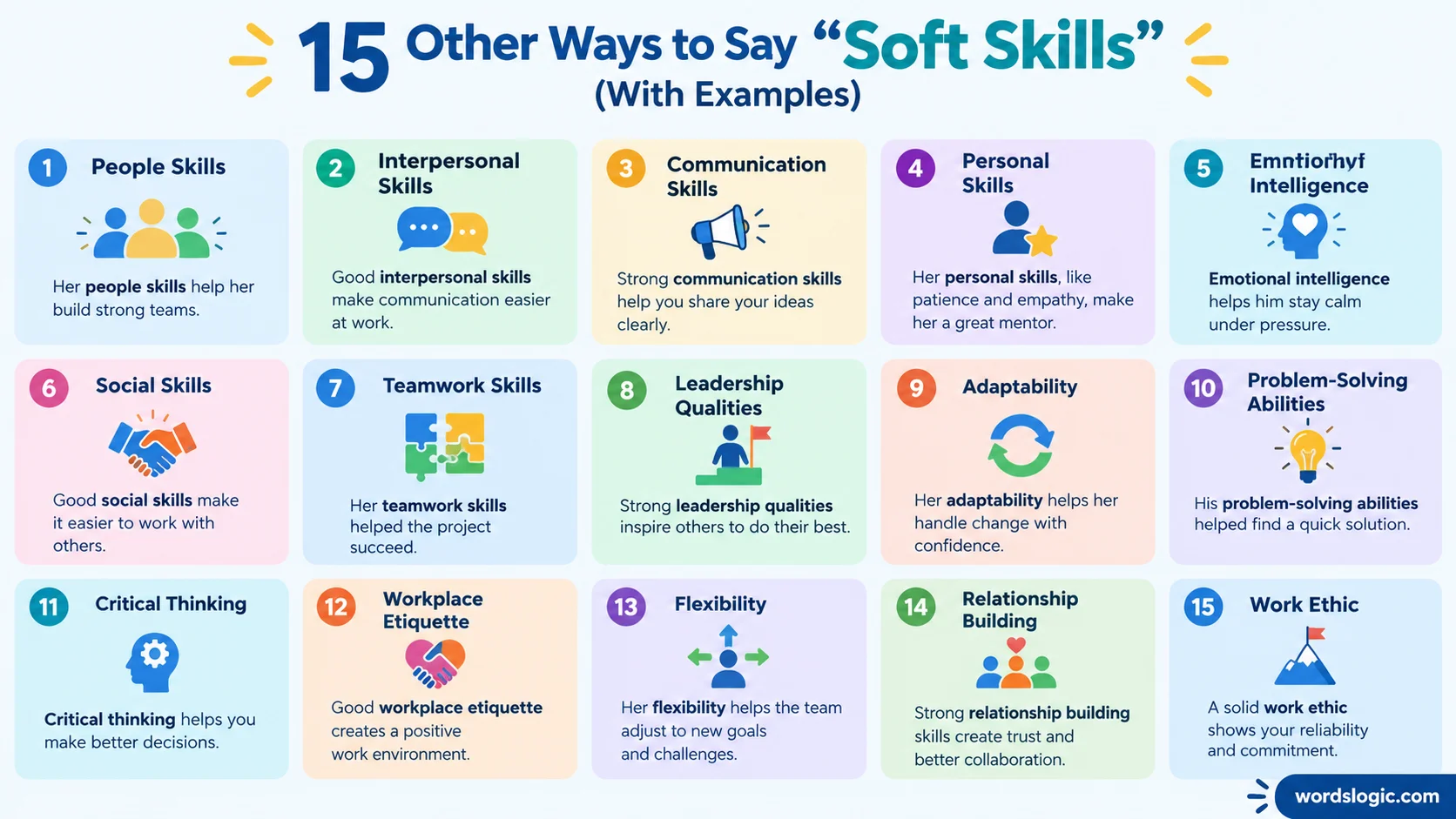
Other Ways to Say “Soft Skills” helps professionals describe interpersonal abilities, communication strengths, and workplace competencies more clearly. Instead of using the vague or overused phrase “soft skills,” you can choose expressions such as people skills, power skills, transferable skills, essential skills, human skills, and professional abilities.
These alternatives appear in job descriptions, resumes, CVs, LinkedIn profiles, university brochures, and corporate training programs. In 2026, workplace expectations emphasize emotional intelligence, leadership, adaptability, teamwork, and problem-solving. Choosing precise language makes professional writing more impactful and helps describe a person’s personality, character, work ethic, talents, and ability to work effectively with others.
When writing a resume, preparing for job interviews, or creating professional profiles, select words that match the role and employer’s expectations.
What Does “Soft Skills” Mean?
Soft skills are personal qualities and abilities that influence how someone communicates, interacts with others, manages responsibilities, and responds to different situations. They include communication, teamwork, adaptability, empathy, problem-solving, leadership, and conflict resolution. Unlike technical skills, which involve specific knowledge or tasks, soft skills generally focus on behavior, interpersonal relationships, and how people work with others.
For example, knowing how to operate a spreadsheet is a technical skill, while explaining its results clearly to a team involves communication skills. Soft skills are useful in almost every workplace, but they also matter in education, friendships, family relationships, and everyday life. Although the term covers a broad range of abilities, a more specific expression can help you communicate exactly which strength you mean.
Common Situations Where “Soft Skills” Is Used
People use the phrase in professional, educational, and personal contexts. The best alternative depends on the ability being discussed and the audience.
- Resumes and cover letters: Job applicants describe communication, teamwork, adaptability, and other workplace strengths.
- Job interviews: Candidates explain how they handle pressure, resolve disagreements, or cooperate with colleagues.
- Workplace communication: Managers discuss collaboration, leadership, relationship-building, and employee development.
- Education: Teachers help students develop teamwork, listening, organization, and problem-solving abilities.
- Personal relationships: People discuss empathy, patience, communication, and understanding others.
- Training and development: Organizations identify areas employees can strengthen to work more effectively.
- Professional writing: Reports and development plans may use specific terms such as interpersonal abilities or emotional intelligence.
An alternative often makes the message more precise. For instance, people skills emphasizes interacting with others, while self-management skills focuses on organizing your behavior, time, and responsibilities.
Is It Professional or Polite to Say “Soft Skills”?
Yes, soft skills is a professional, widely understood term used in hiring, employee training, education, and career development. It is neutral rather than rude or overly casual, so it generally works well in resumes, interviews, and workplace discussions.
However, the expression can sometimes sound broad because it includes many different abilities. In a formal application, describing your specific strengths may be more persuasive than simply stating that you have good soft skills. For example, interpersonal skills, communication abilities, or emotional intelligence can be more precise when they accurately describe your strengths. The phrase itself is appropriate; the key is choosing wording that clearly connects your abilities to the situation.
Advantages and Disadvantages of Saying “Soft Skills”
Advantages
- Broad and inclusive: The phrase covers many interpersonal and personal abilities under one familiar term.
- Professionally recognized: Employers, educators, and training professionals commonly understand its general meaning.
- Easy to use: It provides a convenient way to discuss abilities that are not tied to a particular technical task.
- Useful for career development: It helps people identify areas such as teamwork, communication, adaptability, and leadership.
- Suitable for different contexts: The expression works in interviews, training materials, educational discussions, and workplace documents.
Disadvantages
- Can be vague: Readers may not know which particular abilities you possess unless you provide examples.
- May sound generic on a resume: Saying you have soft skills is less informative than describing a specific strength and how you use it.
- Covers different abilities: Communication, emotional awareness, organization, and leadership are not identical, so one broad label may hide important distinctions.
- May understate expertise: Some abilities, such as negotiation, conflict resolution, and leadership, can require substantial training and practice. Calling them simply “soft” may not fully reflect their complexity.
Synonyms for “Soft Skills”
- Interpersonal Skills
- People Skills
- Communication Skills
- Emotional Intelligence
- Social Skills
- Relationship-Building Skills
- Human Skills
- Teamwork Skills
- Leadership Skills
- Self-Management Skills
- Adaptability Skills
- Conflict Resolution Skills
- Problem-Solving Skills
- Professional Competencies
- Personal Effectiveness Skills
1. Interpersonal Skills
Meaning
Interpersonal skills are the abilities people use to communicate, cooperate, and build positive relationships with others. They form an important part of soft skills, especially in situations involving teamwork and collaboration.
Definition
Interpersonal skills are abilities that help people interact effectively and appropriately with other people.
Detailed Explanation
This is one of the closest alternatives to soft skills, particularly when discussing relationships and workplace interactions. It includes listening, empathy, cooperation, and the ability to communicate respectfully. Unlike the broader term soft skills, interpersonal skills focus mainly on how people deal with one another rather than how they manage their own time or behavior. The phrase is professional and precise enough for resumes, interviews, and employee development plans.
Scenario Examples
Scenario: A job applicant describes their strengths.
Example: “My interpersonal skills help me build positive relationships with clients and colleagues.”
Scenario: A manager provides feedback to an employee.
Example: “Strengthening your interpersonal skills could help you manage team discussions more effectively.”
Scenario: A student works on a group assignment.
Example: “Good interpersonal skills helped us share responsibilities and resolve disagreements.”
Best Use
Use this expression in resumes, interviews, workplace evaluations, academic discussions, and professional development documents when you want to emphasize interaction with others.
Tone
Tone: Professional, respectful, clear.
It sounds suitable for formal settings while describing practical abilities rather than abstract personality traits.
2. People Skills
Meaning
People skills describe the ability to get along with others, understand their needs, and communicate in a way that supports positive interactions.
Definition
People skills are the practical abilities used to communicate with, understand, and work well with other people.
Detailed Explanation
People skills is a natural, accessible alternative that sounds slightly more conversational than interpersonal skills. It often refers to friendliness, listening, empathy, tact, and the ability to make others feel comfortable. The phrase is especially useful when describing someone who works well with customers, colleagues, or the public. However, it does not cover every soft skill, since independent problem-solving and time management may not involve other people directly.
Scenario Examples
Scenario: A friend is applying for a customer service position.
Example: “Your people skills would be a real strength in a customer-facing role.”
Scenario: A supervisor praises a team member.
Example: “She’s great at calming frustrated customers because she has excellent people skills.”
Scenario: Someone describes a successful community volunteer.
Example: “His people skills make it easy for him to connect with people from different backgrounds.”
Best Use
Choose this phrase for everyday conversation, customer service, sales, networking, hospitality, and friendly professional communication.
Tone
Tone: Warm, approachable, conversational.
It emphasizes ease of interaction and the ability to connect with people naturally.
3. Communication Skills
Meaning
Communication skills refer to the ability to share information, express ideas clearly, listen carefully, and understand other people’s messages.
Definition
Communication skills are the abilities needed to exchange information clearly and effectively through speaking, writing, listening, or nonverbal signals.
Detailed Explanation
Communication skills are a specific category of soft skills rather than a complete replacement for the entire term. They include explaining ideas, asking useful questions, listening actively, and adjusting your message to suit the audience. This phrase is particularly effective when communication is the main strength you want to highlight. It is also more concrete than soft skills when supported by an example, such as presenting complex information clearly or resolving a misunderstanding.
Scenario Examples
Scenario: A candidate prepares a resume.
Example: “Strong communication skills help me explain technical information to nontechnical audiences.”
Scenario: A team member writes an update.
Example: “Clear communication skills helped everyone understand the new project deadlines.”
Scenario: A student prepares for a presentation.
Example: “I’m working on my communication skills so I can speak more confidently in front of a class.”
Best Use
Use it in resumes, cover letters, presentations, interviews, team meetings, and academic settings when speaking, writing, or listening is central to the task.
Tone
Tone: Professional, direct, practical.
It identifies a recognizable ability and works especially well when you can demonstrate it with an example.
4. Emotional Intelligence
Meaning
Emotional intelligence is the ability to recognize, understand, and manage emotions while responding thoughtfully to other people’s feelings.
Definition
Emotional intelligence is the ability to understand emotions and use that understanding to guide behavior and relationships.
Detailed Explanation
Emotional intelligence is a more specific concept than soft skills. It focuses on emotional awareness, self-regulation, empathy, and responding appropriately in emotionally challenging situations. Someone with strong emotional intelligence may remain composed during a disagreement or notice when a colleague needs support. It is useful when discussing leadership and relationship management, but it should not be used as a synonym for every interpersonal ability because skills such as technical organization and time management fall outside its main focus.
Scenario Examples
Scenario: A manager handles a tense team meeting.
Example: “Her emotional intelligence helped her acknowledge everyone’s concerns without escalating the disagreement.”
Scenario: A colleague receives critical feedback.
Example: “Emotional intelligence allows him to consider feedback without immediately becoming defensive.”
Scenario: Someone reflects on a friendship.
Example: “I’ve become more aware of my reactions, which has improved my emotional intelligence.”
Best Use
Use this phrase in leadership discussions, coaching, workplace training, relationship communication, and personal development writing.
Tone
Tone: Thoughtful, professional, emotionally aware.
It emphasizes understanding and managing emotions rather than general friendliness or communication alone.
5. Social Skills
Meaning
Social skills are the abilities that help people interact appropriately in social situations, understand social cues, and participate comfortably in conversations or group activities.
Definition
Social skills are behaviors and abilities that support effective interaction with other people in social settings.
Detailed Explanation
Social skills overlap with soft skills, but their emphasis is often on everyday social interaction. They can include taking turns in conversation, recognizing nonverbal signals, showing consideration, and adapting to different social settings. The phrase is useful in education, community activities, and discussions about social confidence. In a business context, however, interpersonal skills may sound more precise when the focus is on professional relationships and collaboration.
Scenario Examples
Scenario: A teacher helps students participate in group activities.
Example: “The project gives students a chance to practice social skills such as listening and taking turns.”
Scenario: Someone attends a professional networking event.
Example: “Developing my social skills has made it easier to start conversations with new people.”
Scenario: A parent discusses a child’s friendships.
Example: “Playing team games can help children practice cooperation and other social skills.”
Best Use
Choose this expression for education, social development, everyday interactions, community activities, and discussions about confidence in social settings.
Tone
Tone: Friendly, accessible, developmental.
It focuses on how people interact in social environments rather than the full range of workplace abilities.
6. Relationship-Building Skills
Meaning
Relationship-building skills are the abilities used to establish, maintain, and strengthen positive connections with others.
Definition
Relationship-building skills are the behaviors and communication abilities that help create trust and maintain productive relationships.
Detailed Explanation
This expression is particularly useful when the goal is to develop lasting connections rather than simply exchange information. It can involve showing reliability, remembering others’ concerns, communicating openly, and following through on commitments. Compared with soft skills, the phrase highlights the ongoing process of building trust over time. It is especially relevant in management, networking, client relations, and teamwork, although it is narrower than the broader category of soft skills.
Scenario Examples
Scenario: A salesperson maintains a long-term client relationship.
Example: “Her relationship-building skills have helped her earn clients’ trust.”
Scenario: A new employee joins a department.
Example: “I want to strengthen my relationship-building skills so I can collaborate more effectively across teams.”
Scenario: A community organizer welcomes new volunteers.
Example: “Good relationship-building skills help people feel included and valued.”
Best Use
Use it in networking, customer relations, account management, leadership, teamwork, and community engagement.
Tone
Tone: Collaborative, professional, people-focused.
It highlights trust and long-term connections rather than general communication alone.
7. Human Skills
Meaning
Human skills refers to abilities that help people understand one another, communicate effectively, cooperate, and respond thoughtfully to human needs.
Definition
Human skills are abilities that support effective interaction, empathy, collaboration, and judgment in situations involving people.
Detailed Explanation
Human skills is a broader, people-centered expression that can serve as an alternative to soft skills in discussions about modern workplaces and collaboration. It draws attention to the value of empathy, judgment, creativity, and communication when working with other people. Unlike soft skills, it may sound less like a category of secondary abilities and more like a recognition of essential human capabilities. Its meaning can vary by organization, however, so formal documents should explain which specific abilities the term includes.
Scenario Examples
Scenario: A manager discusses teamwork in a changing workplace.
Example: “Human skills remain important when a team needs to build trust and make decisions together.”
Scenario: A trainer designs a workplace course.
Example: “The program develops human skills such as empathy, listening, and constructive feedback.”
Scenario: A colleague reflects on client service.
Example: “Technical knowledge matters, but human skills help us understand what clients actually need.”
Best Use
Choose this expression for workplace discussions, leadership writing, team training, and conversations about empathy and collaboration. Define it clearly if using it in a formal report.
Tone
Tone: Modern, inclusive, people-centered.
It emphasizes the human side of working and communicating rather than presenting these abilities as secondary to technical expertise.
8. Teamwork Skills
Meaning
Teamwork skills are the abilities that help people contribute to a shared goal, coordinate responsibilities, and cooperate effectively with others.
Definition
Teamwork skills are the abilities needed to collaborate, share responsibilities, and help a group achieve common objectives.
Detailed Explanation
Teamwork skills are a focused alternative when cooperation is the main ability being discussed. They include listening to colleagues, respecting different viewpoints, sharing information, and completing assigned responsibilities. Unlike soft skills, this phrase does not cover every personal or interpersonal ability; it specifically relates to working as part of a group. It is particularly effective in job applications when the position requires cross-functional collaboration or group problem-solving.
Scenario Examples
Scenario: A job applicant describes a group project.
Example: “My teamwork skills helped our group finish the assignment ahead of schedule.”
Scenario: A project manager welcomes a new employee.
Example: “Strong teamwork skills will help you coordinate with designers and developers.”
Scenario: A student reflects on a sports team.
Example: “Playing basketball taught me the importance of trust and teamwork.”
Best Use
Use it in resumes, interviews, school projects, team evaluations, sports, and collaborative workplace settings.
Tone
Tone: Cooperative, practical, professional.
It communicates a willingness and ability to contribute to shared work.
9. Leadership Skills
Meaning
Leadership skills are the abilities used to guide people, set direction, make decisions, and help a group work toward a common goal.
Definition
Leadership skills are the capabilities that help someone influence, support, and coordinate people toward shared objectives.
Detailed Explanation
Leadership skills are one specific group of soft skills, especially relevant to roles involving responsibility for people or projects. They may include delegation, decision-making, motivation, accountability, and constructive feedback. Unlike general soft skills, leadership skills imply some ability to guide others or take responsibility for outcomes. You do not need to hold a management title to demonstrate them; leading a project, mentoring a colleague, or organizing a community activity can also show leadership.
Scenario Examples
Scenario: An employee applies for a supervisory position.
Example: “I have developed leadership skills by coordinating projects and supporting new team members.”
Scenario: A student organizes a school event.
Example: “The experience strengthened my leadership skills and taught me how to delegate tasks.”
Scenario: A manager discusses team performance.
Example: “Effective leadership skills help me set clear expectations and give useful feedback.”
Best Use
Choose this expression for management resumes, promotion applications, leadership training, project coordination, and mentoring discussions.
Tone
Tone: Confident, responsible, professional.
It highlights initiative and the ability to guide or support others toward a goal.
10. Self-Management Skills
Meaning
Self-management skills are the abilities that help people organize their time, control their behavior, maintain focus, and meet responsibilities.
Definition
Self-management skills are the abilities used to manage your own tasks, habits, time, and responses effectively.
Detailed Explanation
Self-management skills are useful when soft skills refers to personal discipline rather than interaction with others. They can include time management, organization, self-control, prioritization, and accountability. These abilities help people work independently and remain dependable even when supervision is limited. The expression is narrower than soft skills overall, but it is more informative when describing someone who manages competing deadlines or stays focused on long-term goals.
Scenario Examples
Scenario: A remote worker explains how they organize their day.
Example: “My self-management skills help me prioritize tasks and meet deadlines while working remotely.”
Scenario: A university student balances classes and a part-time job.
Example: “Improving my self-management skills has helped me keep track of assignments and work shifts.”
Scenario: A manager discusses professional expectations.
Example: “This role requires strong self-management skills because employees handle much of their work independently.”
Best Use
Use this phrase in remote-work applications, performance reviews, education, independent projects, and discussions about organization and accountability.
Tone
Tone: Practical, responsible, disciplined.
It emphasizes reliability and the ability to manage your own work and behavior.
11. Adaptability Skills
Meaning
Adaptability skills describe the ability to adjust to changing circumstances, learn new approaches, and respond constructively to unexpected challenges.
Definition
Adaptability skills are the abilities that help someone adjust their behavior, methods, or expectations when situations change.
Detailed Explanation
Adaptability skills are especially valuable when a person needs to respond to changing priorities, unfamiliar tasks, or new working conditions. They can involve flexibility, openness to feedback, willingness to learn, and the ability to remain productive during uncertainty. The phrase is more specific than soft skills because it concentrates on responding to change rather than every aspect of communication or behavior. It is useful in workplaces where responsibilities evolve or where employees need to learn new processes quickly.
Scenario Examples
Scenario: A team adopts a new project management system.
Example: “My adaptability skills helped me learn the new system without disrupting my work.”
Scenario: An employee describes a challenging assignment.
Example: “I adjusted to changing deadlines by reorganizing priorities and communicating with the team.”
Scenario: A student starts studying in a new environment.
Example: “Developing adaptability skills made the transition to university easier.”
Best Use
Choose this expression for job interviews, career development, change management, project work, and discussions about flexibility under pressure.
Tone
Tone: Positive, flexible, forward-looking.
It highlights a willingness to adjust and keep working effectively when circumstances change.
12. Conflict Resolution Skills
Meaning
Conflict resolution skills are the abilities used to address disagreements, understand different viewpoints, and work toward a constructive solution.
Definition
Conflict resolution skills are the communication and problem-solving abilities that help people manage disputes and reach workable agreements.
Detailed Explanation
Conflict resolution skills are a specific type of soft skill that becomes important when opinions, goals, or expectations differ. They can involve listening carefully, identifying the real issue, staying calm, negotiating, and finding common ground. Unlike general interpersonal skills, this expression directly addresses how someone handles disagreement. It is especially useful in management, customer service, healthcare, education, and other environments where tensions can arise.
Scenario Examples
Scenario: Two colleagues disagree about project responsibilities.
Example: “My conflict resolution skills helped us clarify expectations and agree on a fair division of work.”
Scenario: A customer complains about a delayed order.
Example: “The representative used strong conflict resolution skills to understand the problem and explain the available options.”
Scenario: A team leader addresses a disagreement.
Example: “We resolved the issue by listening to both sides before deciding on the next step.”
Best Use
Use it in management resumes, customer service, mediation, team leadership, education, and roles that require handling complaints or disagreements.
Tone
Tone: Diplomatic, calm, solution-focused.
It emphasizes resolving problems respectfully instead of avoiding disagreements or winning arguments.
13. Problem-Solving Skills
Meaning
Problem-solving skills refer to the ability to identify challenges, evaluate possible solutions, and choose practical ways forward.
Definition
Problem-solving skills are the abilities used to understand a problem and develop effective solutions.
Detailed Explanation
Problem-solving skills are relevant to soft skills when the emphasis is on reasoning, judgment, and handling challenges with other people or in changing situations. They may involve asking questions, analyzing information, considering alternatives, and making sound decisions. The phrase is not a complete synonym for soft skills because problem-solving can also involve technical expertise. Still, it is a useful alternative when you want to highlight how you respond to obstacles rather than simply describing yourself as adaptable or capable.
Scenario Examples
Scenario: An employee explains a workplace achievement.
Example: “My problem-solving skills helped identify why our delivery process was falling behind.”
Scenario: A student works on a difficult group assignment.
Example: “We used our problem-solving skills to divide the challenge into smaller tasks.”
Scenario: A customer service worker handles an unusual request.
Example: “Good problem-solving skills helped me find a practical solution within company policy.”
Best Use
Choose this phrase for resumes, interviews, project reports, analytical roles, customer service, and examples of overcoming workplace challenges.
Tone
Tone: Analytical, capable, solution-oriented.
It highlights the ability to move from identifying a challenge to finding a workable response.
14. Professional Competencies
Meaning
Professional competencies are the combined abilities, knowledge, behaviors, and judgment needed to perform effectively in a particular role or profession.
Definition
Professional competencies are the capabilities required to meet the expectations and responsibilities of a job or professional field.
Detailed Explanation
Professional competencies can include soft skills, but they also cover technical knowledge and role-specific expertise. This makes the phrase broader in one sense and more job-focused in another. It is useful in formal workplace documents because it connects a person’s abilities to actual professional responsibilities. However, it should not replace soft skills when you specifically mean interpersonal abilities, since professional competencies may also include qualifications, technical skills, and industry knowledge.
Scenario Examples
Scenario: A company develops an employee evaluation framework.
Example: “The review assesses professional competencies such as communication, decision-making, and role-specific knowledge.”
Scenario: A job applicant discusses their qualifications.
Example: “My professional competencies include client communication, project coordination, and analytical thinking.”
Scenario: A training manager plans an employee development program.
Example: “We identified the professional competencies employees need before moving into supervisory roles.”
Best Use
Use it in formal reports, performance evaluations, competency frameworks, job descriptions, and career development plans.
Tone
Tone: Formal, structured, workplace-focused.
It connects abilities to the standards and responsibilities of a professional role.
15. Personal Effectiveness Skills
Meaning
Personal effectiveness skills are the abilities that help people manage themselves, use their strengths, make sound decisions, and work toward goals.
Definition
Personal effectiveness skills are the habits and abilities that help someone manage responsibilities and achieve meaningful results.
Detailed Explanation
Personal effectiveness skills are useful when you want to emphasize how well someone manages their work and personal responsibilities. They can include organization, prioritization, self-awareness, decision-making, and goal-setting. Unlike interpersonal skills, they do not necessarily depend on interacting with other people, although effective communication may support them. The expression is broader than time management alone and can be especially useful in training programs or discussions about working independently and consistently.
Scenario Examples
Scenario: A professional discusses a development goal.
Example: “I’m improving my personal effectiveness skills by planning priorities and reviewing my progress each week.”
Scenario: A student learns to manage several assignments.
Example: “Better organization and decision-making have strengthened my personal effectiveness skills.”
Scenario: A team leader discusses productivity.
Example: “Personal effectiveness skills help employees focus on important tasks without losing sight of deadlines.”
Best Use
Choose this expression for personal development programs, workplace training, productivity discussions, educational planning, and independent work.
Tone
Tone: Practical, developmental, goal-oriented.
It emphasizes using your abilities effectively and managing responsibilities with purpose.
FAQs
What is another way to say “soft skills”?
Common alternatives include interpersonal skills, people skills, communication skills, and human skills. The best choice depends on the ability you want to describe. For example, use communication skills when discussing clear expression and active listening, or teamwork skills when focusing on collaboration.
What do soft skills mean?
Soft skills are personal and interpersonal abilities that influence how people communicate, cooperate, manage themselves, and respond to challenges. Examples include empathy, adaptability, teamwork, and conflict resolution.
Is “soft skills” a professional term?
Yes. Soft skills is widely used in resumes, job interviews, training programs, and workplace discussions. In formal writing, naming the specific abilities you possess often provides more useful information than using the broad term alone.
What is a more professional way to say “soft skills”?
Interpersonal skills is a strong choice when discussing communication and working relationships. Professional competencies may be appropriate in formal evaluation documents, but it includes technical knowledge and job-specific abilities as well as interpersonal strengths.
Which alternative works best on a resume?
The best alternative is usually the specific skill relevant to the job. Communication skills, leadership skills, adaptability skills, and conflict resolution skills are useful choices when they accurately describe your abilities. Support each claim with an achievement or example whenever possible.
Conclusion
Choosing the right alternative to soft skills helps you communicate your strengths with greater clarity and confidence. Expressions such as interpersonal skills and people skills emphasize working well with others, while emotional intelligence highlights understanding and managing emotions. Other terms, including self-management skills and adaptability skills, focus on personal responsibility and responding to change. For formal workplace documents, professional competencies may be appropriate when you mean a broader combination of knowledge, behavior, and abilities.
Remember that these expressions are related, but they are not exact synonyms. Consider your audience, the context, and the ability you want to emphasize before selecting your wording. When describing your strengths, specific examples are often more meaningful than broad labels. Clear language helps others understand not just what skills you have, but how those skills make a difference.